
Conversational lead capture is defined as an interactive method of collecting prospect information through guided, progressive dialogue rather than static web forms. Where a traditional form asks for everything upfront, this approach provides immediate value before requesting contact details, which measurably improves both completion rates and lead quality. Platforms like Neuwark and tools built on conversational AI have demonstrated that the "help first, ask later" principle is not a design preference. It is a conversion strategy. For businesses and marketers tired of watching visitors abandon forms, understanding what is conversational lead capture is the first step toward fixing a broken process.
What is conversational lead capture and how does it differ from static forms?
Conversational lead capture turns a website visit into a two-way exchange. Instead of presenting a visitor with five blank fields and a submit button, it opens with a question, responds to the answer, and progressively builds a picture of who that person is and what they need. According to Neuwark, this method adds context, timing, and behavioural engagement to every interaction, which static forms are structurally incapable of doing.
The mechanics rely on sequential question flow and adaptive branching logic. If a visitor indicates they are looking for a service in a specific location, the next question adapts accordingly. This is not a scripted FAQ. It is a qualification engine that responds to intent in real time. The result is a visitor who feels guided rather than interrogated, and a business that receives data that is actually useful.

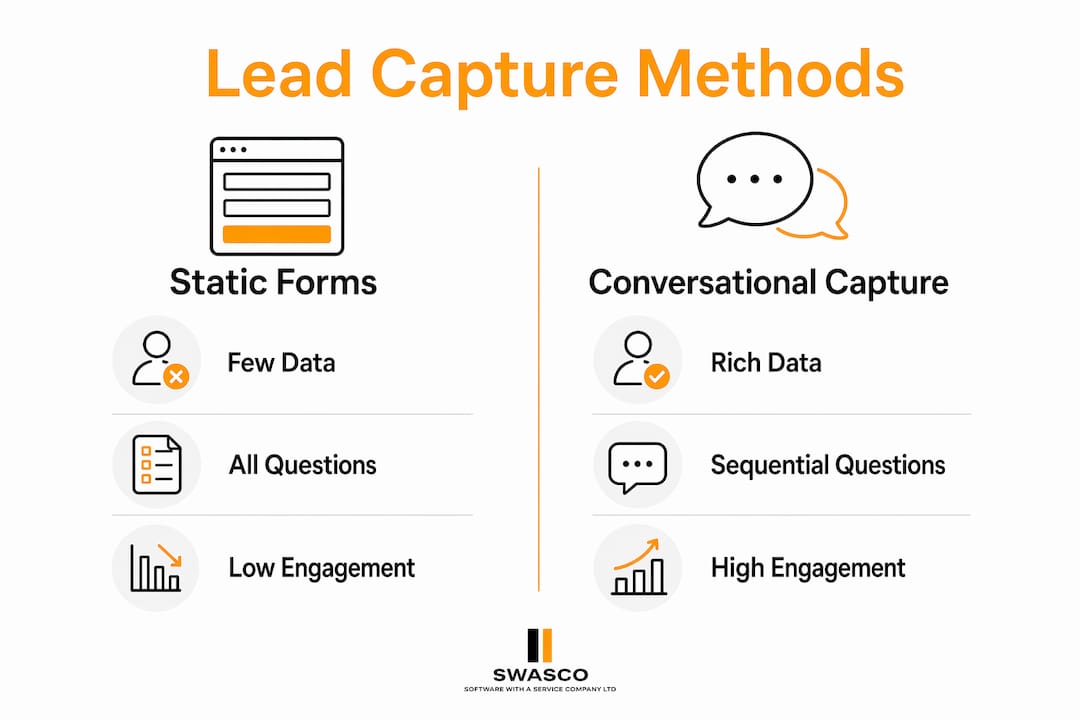
The contrast with traditional forms is stark. Here is a direct comparison:
| Feature | Static lead form | Conversational lead capture |
|---|---|---|
| Questions asked | All at once | One at a time, sequentially |
| Data collected | 4 to 6 fields | 15 to 40 data points per interaction |
| Cognitive load on visitor | High | Low |
| Lead qualification | None at point of capture | Real-time, during conversation |
| Abandonment rate | High | Significantly reduced |
| Personalisation | None | Adaptive based on responses |
The data depth difference alone justifies the switch. Collecting 15 to 40 data points per interaction compared to 4 to 6 from a static form means your sales team receives leads that are already partially qualified, not raw names and email addresses with no context.
The benefits of conversational lead capture also extend to user experience. Asking one question at a time with a chat-like interface reduces cognitive load and increases completion rates. Visitors are not overwhelmed. They are guided.
How does conversational lead capture fit into a conversational marketing strategy?
Conversational lead capture does not operate in isolation. It is a core component of a broader conversational marketing technique that replaces broadcast messaging with real-time, tailored dialogue across multiple channels. The goal of conversational marketing is to accelerate the buyer journey by meeting prospects with relevant, personalised exchanges at the moment they are most engaged.
The channels involved go well beyond a website chat widget. A complete conversational marketing approach typically includes:
- AI-powered website chat that engages visitors based on the page they are viewing
- SMS and messaging apps that follow up after an initial enquiry
- Voice assistants that handle inbound calls with natural language responses
- Social media messaging that captures leads from platforms like Facebook and Instagram
What ties these channels together is the principle that conversations happen on the customer's terms, not on a schedule that suits the business. A prospect who enquires at 11pm via Instagram should receive an intelligent, qualifying response immediately, not a holding message and a callback the next morning.
"Effectiveness improves when conversations occur across channels and at customer-preferred timings, not just real-time chat." — HubSpot Blog
This multichannel reality is why businesses that deploy conversational lead capture only on their website are leaving significant opportunity on the table. The role of social media in lead generation for service businesses has grown considerably, and conversational capture methods are what make those channels productive rather than passive.
How to implement conversational lead capture effectively
Getting conversational lead capture right requires more than installing a chatbot. The design decisions you make at the outset determine whether visitors engage or ignore it entirely. These are the steps that produce results:
-
Start with the help-before-ask principle. The first interaction should deliver value before asking for contact details. Answer a question, offer a resource, or provide a recommendation. Visitors who receive something useful are far more willing to share their information in return.
-
Use a hybrid intake model. Separating basic contact fields from deeper qualification is a proven approach. Collect name and email quickly, then use the conversation to gather intent, budget, timeline, and specific requirements. This balances low-friction entry with high-value data collection.
-
Build dynamic branching logic. Your conversation flow should adapt based on what visitors tell you. A visitor who says they need a service urgently should be routed differently from one who is still researching. Branching logic is what separates a qualifying conversation from a generic script.
-
Align the conversation with your sales process. Every question you ask should map to a qualification criterion your sales team actually uses. If your team needs to know budget range, service type, and location before calling a lead, those three data points should be captured during the conversation, not discovered on the first sales call.
-
Define your handoff trigger. Decide at what point a qualified lead gets passed to a human. The most effective systems use chatbots as initial filters, with human agents following up using the full conversation context. This removes the cold-call dynamic entirely.
Pro Tip: Avoid asking more than three to four questions before offering a clear next step. Visitors who feel the conversation is going nowhere will drop off, even if the questions are individually simple.
A common pitfall is treating the conversation as a form in disguise. If your chatbot asks for name, email, phone, company, and budget in five consecutive questions with no acknowledgement of the visitor's responses, you have not built a conversation. You have built a form with extra steps. The lead response time after capture matters too. Qualification during the conversation reduces the delay between generating a lead and moving it into a pipeline-ready state.
What technology powers conversational lead capture?
The technology behind effective chatbot lead capture has moved well beyond simple rule-based bots. Rule-based chatbots follow fixed decision trees. They work for narrow, predictable queries, but they break the moment a visitor phrases something unexpectedly or asks a follow-up question the script did not anticipate.
Conversational AI is fundamentally different. It uses natural language understanding, intent detection, and large language models to personalise conversations dynamically in real time. This means the system can interpret what a visitor means, not just what they typed, and respond in a way that feels natural rather than mechanical.
The practical capabilities of a well-built conversational AI system include:
- Natural language understanding that interprets varied phrasing and colloquial language
- Intent detection that identifies whether a visitor is ready to buy, still researching, or looking for support
- Progressive profiling that builds a richer picture of each lead across multiple visits, not just a single session
- Real-time qualification scoring that flags high-intent leads for immediate follow-up
- Contextual handoff that passes the full conversation history to a human agent when escalation is needed
The data depth this creates is significant. Where a static form captures a name and an email, a conversational AI system can capture service preferences, urgency, budget signals, location, and objections, all within a single exchange. This leads directly to improved lead scoring and pipeline readiness, which means your sales team spends time on leads that are genuinely worth pursuing.
Platforms like Neuwark's Revenue Care AI represent this category of tool. They are built specifically to qualify leads during the capture process, not after it. The distinction matters because qualification during lead capture reduces the gap between interest and action, which is where most leads are lost.
Key takeaways
Conversational lead capture outperforms static forms because it qualifies leads in real time, collects significantly more data per interaction, and reduces friction by delivering value before asking for contact details.
| Point | Details |
|---|---|
| Definition | Conversational lead capture collects prospect data through guided dialogue, not static forms. |
| Data depth advantage | Conversational AI captures 15 to 40 data points per interaction versus 4 to 6 from static forms. |
| Help-before-ask principle | Delivering value before requesting contact details increases visitor willingness to share information. |
| Multichannel deployment | Effective lead capture operates across website chat, SMS, voice, and social media simultaneously. |
| Sales alignment | Every qualifying question should map directly to criteria your sales team uses to prioritise leads. |
Why conversational lead capture is no longer optional
I have worked with enough service-based businesses to know that the form-fill model is not just underperforming. It is actively costing businesses revenue they do not realise they are losing. A visitor lands on your site, reads your services page, and then faces a contact form with six fields. Half of them leave. The other half submit incomplete information. Your sales team calls back with no context, and the lead has already moved on.
What strikes me most about conversational lead capture is not the technology itself. It is the shift in mindset it requires. Businesses that adopt it well stop thinking about lead capture as data collection and start thinking about it as the first sales conversation. That reframe changes everything, from the questions you ask to the way you train your team to handle the handoff.
The buyers who prefer interactive conversations over forms during solution research are not a niche segment. Buyers increasingly prefer interactive engagement over passive form submission, and that preference is only growing. Businesses that meet that preference with a well-designed conversational system will consistently outperform those that do not, regardless of how much they spend on traffic.
The long-term value is in the data quality. A pipeline full of leads that arrived with context, intent signals, and qualification data is a fundamentally different asset from a spreadsheet of names and phone numbers. The former enables precise follow-up. The latter produces wasted calls and frustrated sales teams.
— James Paul
Stop losing leads with Talk2Aiva
If you recognise the gap between the leads you are generating and the revenue you are actually closing, Talk2Aiva is built to close it.
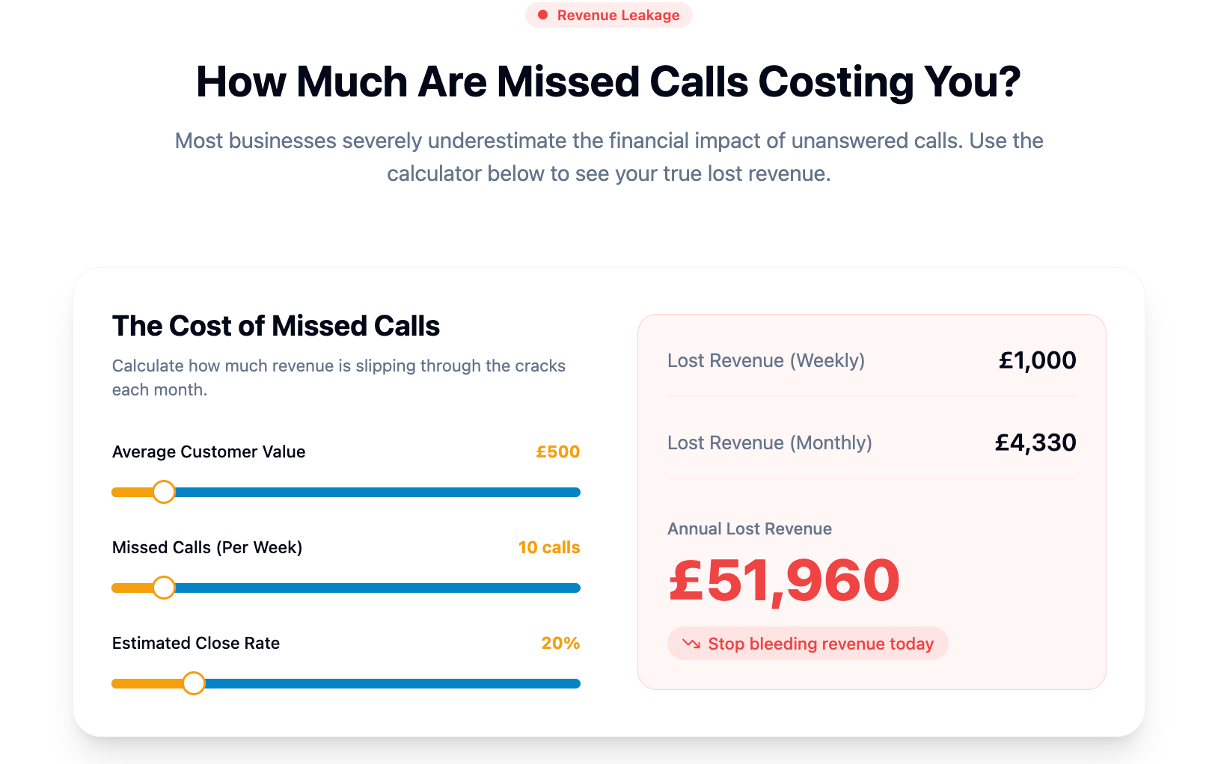
Talk2Aiva by SWASCO is a fully guided AI receptionist and revenue recovery system that engages, qualifies, and follows up with leads 24/7 across calls, text, website chat, and social media. Every enquiry receives an immediate, intelligent response, whether it arrives at 9am or midnight. Setup, AI training, and ongoing technical support are all included, so you are not left to figure it out alone. If you are ready to put a proper conversational lead capture system to work for your business, explore Talk2Aiva and see what a done-for-you solution looks like in practice.
FAQ
What is conversational lead capture in simple terms?
Conversational lead capture is the process of collecting prospect information through a guided, chat-based dialogue rather than a static web form. It asks one question at a time, adapts based on responses, and qualifies leads in real time.
How does conversational lead capture differ from a standard chatbot?
A standard rule-based chatbot follows a fixed script and breaks when questions fall outside its decision tree. Conversational lead capture uses AI to understand intent, adapt dynamically, and collect far richer qualification data during the interaction.
What are the main benefits of conversational lead capture?
The primary benefits include higher completion rates, significantly more data per lead, real-time qualification, and a better experience for the visitor. Conversational AI systems can capture 15 to 40 data points per interaction compared to 4 to 6 from a static form.
Is conversational lead capture only for websites?
No. Effective conversational lead capture operates across multiple channels including SMS, social media messaging, voice calls, and website chat. Leads captured at the customer's preferred time and channel convert at higher rates.
How quickly should a business follow up after a conversational lead capture?
Speed is critical. Qualification during the capture conversation reduces the delay between interest and pipeline entry, but human follow-up should still happen within minutes for high-intent leads. Delayed responses remain one of the most common causes of lost revenue for service businesses.