
AI's role in new client onboarding is to automate administrative workflows, coordinate multi-step processes, and deliver personalised client experiences while freeing your team to focus on relationship-building. Professional services firms using AI-driven onboarding report a 60–80% reduction in total onboarding time, compressing what once took 3–5 days into under 24 hours. That is not a marginal improvement. It is a structural shift in how service businesses operate. Tools like PandaDoc for document automation, Fireflies.ai for call transcription, and agentic AI architectures for multi-step coordination are already making this a reality for firms of every size. This guide explains how it works, what the numbers mean, and how you can implement it without losing the human connection your clients value.
How does AI automate the new client onboarding process?
AI in client onboarding works by replacing manual, sequential handoffs with autonomous workflows that run tasks in parallel. Instead of waiting for one team member to complete a step before another begins, AI agents handle document validation, data extraction, account provisioning, and status tracking simultaneously. The result is a process that moves faster and makes fewer errors.

The mechanics rely on what practitioners call multi-agent systems. Each agent is responsible for a specific task: one verifies identity documents, another routes data into your CRM, a third generates a personalised onboarding plan based on the client's intake responses. These agents coordinate with each other without human intervention at every step. Agentic AI systems that autonomously plan and execute complex multi-step onboarding tasks represent the direction the industry is moving in 2026.
Here is what a typical AI-assisted onboarding workflow looks like in practice:
- Intake and data capture: The client completes a smart intake form. AI extracts key data, flags missing fields, and populates your CRM automatically.
- Document verification: AI cross-checks submitted documents against required criteria and flags discrepancies for human review.
- Personalised plan generation: Based on intake responses, AI produces personalised onboarding plans within minutes, so your first live session focuses on high-value work rather than admin.
- Workflow coordination: AI notifies relevant team members, schedules kickoff calls, and sends welcome sequences without anyone chasing tasks manually.
- Status tracking: Clients and internal teams receive automated updates at each milestone, reducing inbound "where are we?" queries.
This parallel execution model is what separates AI-powered onboarding from simply digitising a paper process. Sequential handoffs are the bottleneck in traditional onboarding. AI removes them entirely.
Pro Tip: Before deploying any AI onboarding tool, map your existing process step by step. Identify which tasks are purely mechanical, such as data entry and document chasing, and which require human judgement. Automate the mechanical tasks first. This gives you quick wins and a clear baseline for measuring improvement.
What are the measurable benefits of ai-powered onboarding?
The business case for automating client onboarding is well supported by data. High-ticket consulting firms that switched to multi-agent onboarding systems saw activation periods drop from 45 to 12 days and onboarding costs fall from £5,700 to under £380 per client. That cost reduction alone changes the economics of taking on new clients at scale.
Retention improves too. Firms using AI onboarding report a 30% increase in client retention within six months. Faster activation means clients reach value sooner, which directly reduces early-stage churn.
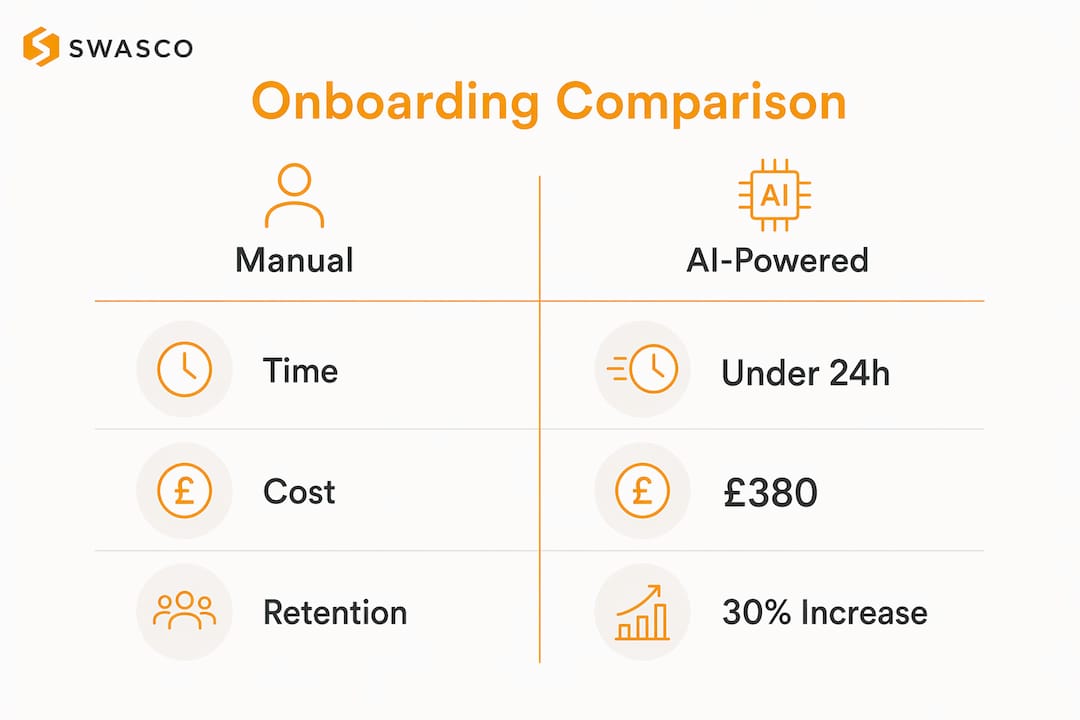
The table below compares manual and AI-powered onboarding across the metrics that matter most to service businesses.
| Metric | Manual Onboarding | AI-Powered Onboarding |
|---|---|---|
| Total onboarding time | 3–5 days | Under 24 hours |
| Cost per client | ~£5,700 | ~£380 |
| Activation period | 45 days | 12 days |
| Client retention (6 months) | Baseline | +30% improvement |
| Team hours per onboarding | High (manual coordination) | Reduced by 60–80% |
The financial logic is straightforward. Faster onboarding means faster revenue recognition. When a client moves from signed contract to active engagement in under 24 hours rather than five days, your cash flow improves and your team spends less time on admin. The best AI onboarding strategies decouple capacity from headcount, meaning you can take on more clients without hiring more staff to manage the process.
For service businesses with recurring revenue models, the retention improvement is the most significant number. A 30% lift in six-month retention compounds over time. It means fewer clients leaving before they have experienced your full value, and more clients renewing, referring, and expanding their engagement with you.
How do you balance AI automation with human interaction?
Automating the wrong parts of onboarding causes more damage than not automating at all. Replacing human touchpoints like early check-in calls with automated sequences leads to faster client attrition. Clients notice when warmth disappears from the process, even if they cannot articulate exactly why.
The principle that produces the best outcomes is straightforward: automate the administrative half of onboarding, not the relational half. AI handles drafting, verification, and data routing. Humans retain final decision-making on high-stakes actions like contract approvals and strategic conversations. This is the human-in-the-loop model, and it is the standard best practice for service businesses in 2026.
The following onboarding elements should remain human-led:
- Discovery calls: These conversations surface client goals, concerns, and communication preferences. AI cannot replicate the trust built in a well-run discovery call.
- Role-clarity conversations: Agreeing on responsibilities, timelines, and expectations requires human judgement and negotiation.
- Contract approval: A human must review and sign off before any agreement is finalised.
- Early relationship touchpoints: A personal check-in at day three or day seven signals that a real person is invested in the client's success.
AI can support these moments without replacing them. Voice memo transcripts from discovery calls give AI the relational context it needs to generate more relevant follow-up content and personalised plans. The human captures the nuance; the AI uses it to do better work downstream.
Pro Tip: Create a simple two-column list before you build any AI workflow. Label one column "Mechanical" and the other "Relational." Every onboarding task goes in one column. Automate the mechanical column entirely. Keep the relational column human-led. Review this list every quarter as your process evolves.
What steps should you take to implement AI in your onboarding workflows?
Implementation works best as a phased process. Rushing to automate everything at once creates confusion for your team and inconsistency for your clients. The following steps give you a structured path from where you are now to a fully functioning AI-assisted onboarding system.
-
Document your current process in full. Write out every step from signed contract to first active session. Include who does what, how long each step takes, and where delays typically occur. You cannot automate a process you have not defined.
-
Identify automation candidates. Look for tasks that are repetitive, rule-based, and do not require human judgement. Data entry, document requests, welcome email sequences, and CRM updates are strong starting points.
-
Build templates and repeatable processes first. Rigid, repeatable processes must be established manually before AI can scale them reliably. If your onboarding varies significantly from client to client, standardise it before you automate it.
-
Select your tools. PandaDoc handles document creation and e-signatures. Fireflies.ai transcribes and summarises discovery calls. A CRM like HubSpot or GoHighLevel manages contact data and workflow triggers. For AI-driven coordination and personalised plan generation, purpose-built onboarding platforms or AI agency tools handle the orchestration layer.
-
Set policy guardrails. Lack of guardrails in AI onboarding risks errors and breaches of client trust. Define what AI is permitted to send without human review, what requires approval, and how client data is stored and protected.
-
Run a pilot with two or three clients. Measure time to activation, client satisfaction, and team hours saved. Use this data to refine your workflow before rolling it out across your full client base.
-
Monitor AI confidence scores and set intervention triggers. Most AI workflow tools surface a confidence rating for automated outputs. Set a threshold below which a human reviews the output before it reaches the client.
The 2026 guide to new client onboarding automation covers tool selection and workflow design in greater depth if you want to go further on any of these steps.
Key takeaways
AI-powered onboarding cuts costs, accelerates activation, and improves retention, but only when automation is applied to administrative tasks and human involvement is preserved for relationship-critical moments.
| Point | Details |
|---|---|
| Time and cost savings are significant | AI reduces onboarding time by 60–80% and can cut cost per client from thousands to hundreds of pounds. |
| Retention improves with faster activation | Clients who reach value quickly are 30% more likely to stay beyond six months. |
| Automate admin, not relationships | Replacing human touchpoints with automation accelerates client attrition rather than preventing it. |
| Standardise before you automate | Repeatable manual processes must exist before AI can scale them reliably and consistently. |
| Human-in-the-loop is non-negotiable | Contract approvals, discovery calls, and early check-ins must remain human-led regardless of automation level. |
Why most service businesses get AI onboarding wrong
I have watched service businesses fall into two opposite traps with AI onboarding. The first is doing nothing because the technology feels overwhelming. The second is automating everything because the efficiency gains look compelling on paper. Both approaches cost money.
The businesses that get it right treat AI as a capable coordinator, not a replacement for human judgement. They use it to handle the tasks that drain their team's time without adding any relational value: chasing documents, populating CRMs, sending status updates, generating first-draft plans. They keep humans in the room for the conversations that actually build trust.
What surprises most business owners is how much clients appreciate the speed that AI enables. A client who receives a personalised onboarding plan within minutes of signing feels valued, not processed. The AI is invisible to them. What they experience is a business that has its act together.
The uncomfortable truth is that most service businesses have chaotic onboarding processes that they have simply scaled manually. Adding AI to a chaotic process does not fix the chaos. It amplifies it. The work of standardising your process first is unglamorous, but it is what separates a successful AI implementation from an expensive experiment.
Agentic AI, where systems plan and execute multi-step tasks without step-by-step human instruction, is maturing quickly. The service businesses building clean, documented onboarding processes now will be the ones who benefit most when these tools become standard. The window to get ahead of this is open, but it will not stay open indefinitely.
— James Paul
How Talk2Aiva helps you onboard new clients without the admin chaos
If your onboarding process still relies on manual follow-ups, chased documents, and delayed responses, you are losing revenue before the client relationship has properly begun. Talk2Aiva by SWASCO is built to fix exactly that.
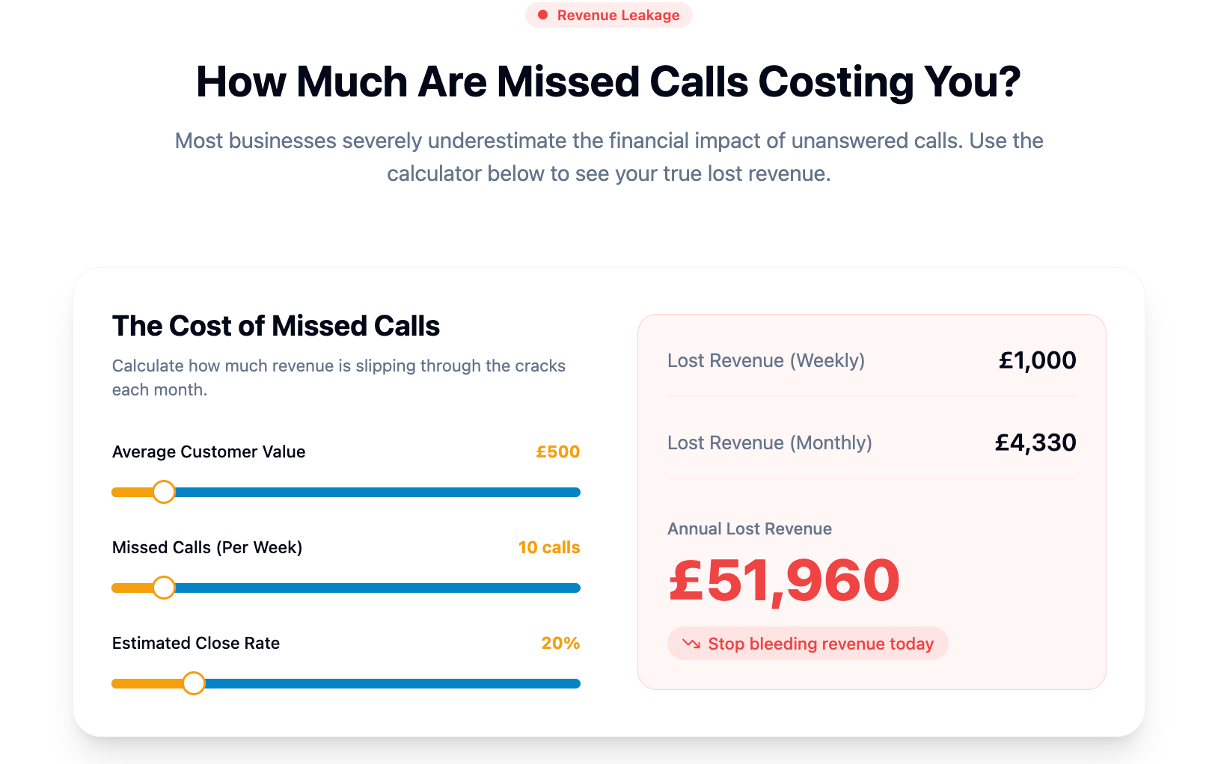
Talk2Aiva handles lead qualification, booking, and follow-up automatically, across calls, text, website chat, and social media, so new clients move from enquiry to onboarded without your team managing every step. The entire setup, from AI training to workflow building and live launch, is done for you with ongoing support included. If you are ready to stop losing clients to slow onboarding, explore Talk2Aiva and see how it fits your business.
FAQ
What is the role of AI in new client onboarding?
AI automates administrative tasks such as data collection, document verification, and workflow coordination, compressing onboarding from days to under 24 hours while freeing your team for relationship-building.
How much can AI reduce onboarding costs?
Professional services firms report onboarding costs falling from approximately £5,700 to under £380 per client after switching to AI-powered multi-agent systems.
Does AI onboarding replace human interaction?
No. AI handles mechanical coordination tasks. Human involvement in discovery calls, contract approvals, and early check-ins remains essential to prevent client attrition.
What tools are commonly used for AI onboarding automation?
PandaDoc manages documents and e-signatures, Fireflies.ai transcribes discovery calls, and CRM platforms like HubSpot or GoHighLevel handle workflow triggers and contact management.
How do i start implementing AI in my onboarding process?
Document your current process fully, identify repetitive tasks suitable for automation, standardise your workflows, then pilot AI tools with two or three clients before rolling out across your full client base.