
Call deflection to SMS moves suitable inbound calls into text messaging so routine enquiries get resolved without tying up a live agent. The three common methods are IVR handoff, in-call SMS, and shift-to-text follow-up, each suited to different call types. Done well, this approach can improve containment and speed up resolution, but it depends on getting consent right under PECR and ICO guidance and on choosing the right platform, something providers like Talk2Aiva build entire workflows around.
TL;DR:
- Call deflection to SMS is most effective when selecting the appropriate pattern—IVR handoff for quick links, in-call SMS for evidence exchange, and shift-to-text for ongoing updates—based on call complexity.
- Ensuring consent is properly recorded and maintaining separate workflows for operational versus marketing messages is crucial to comply with ICO and PECR standards.
- Using the correct numbering option, such as long codes for moderate volume or short codes for large-scale alerts, significantly impacts message throughput and deployment speed.
- Monitoring key metrics like deflection rates, escalation back to voice, and customer satisfaction is essential to evaluate pilot success and refine campaigns.
- Guided platforms like Talk2Aiva can simplify deployment by handling setup, workflow, and compliance, reducing the risk of operational pitfalls and speeding time to launch.
Table of Contents
- How call deflection to SMS works
- Benefits and use cases for contact centres
- Technical components and numbering options
- Compliance and consent: PECR, ICO guidance and practical rules
- Step-by-step implementation checklist for routing calls to SMS
- Measurement: KPIs, dashboards and expected outcomes
- How Talk2Aiva implements call deflection to SMS
- Common pitfalls and when not to deflect
- Talk2Aiva as an option: guided deployment and support
- Sources
- FAQ
How call deflection to SMS works
Three patterns cover most deflection scenarios, and picking the right one depends on what the caller actually needs.
IVR handoff happens at the menu stage. A caller selects an option such as "text me a link instead" and the system sends an SMS with a booking link, payment page, or tracking number, then ends the call. This suits quick, self-service tasks where the caller doesn't need a conversation.
In-call SMS, sometimes called SMS blending, lets an agent send a text while the caller is still on the line. According to Google Cloud's documentation, agents can send preset or custom messages during a call, including MMS for photos and videos. This works well when a customer needs to send a photo of a damaged item or confirm details in writing while the agent talks them through it.

Shift-to-text moves the conversation to SMS after the initial call ends, continuing the exchange asynchronously. A customer who called about a delivery issue might get a follow-up text with tracking updates rather than another phone call.
A few operational details matter across all three:
- Some platforms end the SMS session automatically when the call ends, so you need an auto-response configured to avoid leaving the customer without a reply.
- In-call SMS in many CCaaS platforms is enabled queue by queue, not organisation-wide, which lets you pilot on a low-risk queue first.
- Cross-border number compatibility varies, so test with numbers from your customers' actual mobile operators before a wider rollout.
Choosing between patterns is mostly about complexity. Quick confirmations and link delivery suit IVR handoff. Anything requiring evidence, like a photo or a signed acknowledgement, suits in-call SMS. Ongoing updates that don't need real-time back and forth suit shift-to-text.
Benefits and use cases for contact centres
The case for call deflection to SMS rests on a straightforward trade: routine, low-complexity enquiries move to a channel that doesn't require an agent to stay on the line, freeing capacity for calls that genuinely need a voice conversation.
Practical use cases include:
- Appointment changes and confirmations sent as a text link rather than talked through
- Payment links for outstanding balances or deposits
- Delivery and order status updates
- Basic FAQ answers delivered as a scripted text response
- MMS exchanges for damage claims, ID verification, or proof-of-delivery photos
Ofcom's recipient research found that many respondents agreed SMS is very useful for application-to-person messages, and a significant portion said A2P SMS seemed more legitimate than other message services, according to the Ofcom A2P recipient research. The same research found SMS is seen as appropriate for security and passcode messages and is less likely to be missed than app notifications, which matters when the deflected message carries something time-sensitive like a one-time link.
For contact centres already using SMS for appointment reminders, extending the same channel to inbound deflection is a natural next step rather than a new system to learn.
Technical components and numbering options
Routing calls to SMS requires a handful of pieces working together, and getting the numbering choice wrong is one of the most common early mistakes.
An SMS API or gateway connects your contact centre software to carrier networks so messages can be sent and received programmatically. Twilio's documentation on SMS APIs for business messaging describes this as the layer that routes messages and handles delivery receipts, and without it, your IVR or CRM has no way to trigger a text.
Number choice affects throughput and how quickly you can go live:
- Long codes are standard mobile-format numbers, familiar to customers but limited in message volume per second.
- Short codes support high throughput and are used for large-scale alerts, though they typically require a longer approval process.
- Toll-free numbers can send SMS in some markets and suit lower-volume, conversational use.
Integration points matter as much as the numbers themselves. Your IVR or CCaaS platform needs a hook that can trigger an outbound SMS at the right menu point, and your CRM needs to log the resulting conversation against the same case as the original call. Cross-border deployments carry extra caveats: not every carrier treats A2P messages the same way, and some overseas numbers may block MMS outright, so any pilot should include a device and carrier test matrix before scaling. Businesses using two-way SMS without heavy development work often find this integration layer is the part worth getting right first, since everything else depends on it.
Compliance and consent: PECR, ICO guidance and practical rules
This is the section that determines whether your deflection programme is safe to scale or a liability waiting to surface.
Under ICO guidance on electronic and telephone marketing, the legal treatment of a text depends on its purpose and the recipient's relationship with you. Marketing messages to individuals usually need specific consent. Transactional or operational messages, such as appointment confirmations or delivery updates, are treated differently, but the distinction depends on what the message actually says, not just its label.
Practical steps to stay on the right side of this:
- Keep the first deflection message strictly transactional: confirm the caller's request, send the link or payment page, nothing else.
- Capture any marketing permission as a separate, clearly labelled step, never bundled into the transactional text.
- Record consent at the point of collection, including how and when it was given.
- Use a recognisable sender ID so the message doesn't read as unsolicited.
- Review message templates periodically against current ICO guidance, since interpretations can shift.
Industry guidance on UK commercial SMS regulations reinforces the same principle: separate transactional service texts from marketing, and treat the two as distinct workflows with distinct consent records.
Pro Tip: Write your deflection templates so a compliance reviewer could read them cold and immediately tell they're transactional, not promotional.
Step-by-step implementation checklist for routing calls to SMS
A pilot runs faster when you sequence the work rather than trying to build everything at once.
- Define eligible call types. List the enquiries that genuinely don't need a voice conversation, such as appointment changes, payment reminders, or status checks, and set the success metrics before you build anything.
- Choose your numbers and API. Decide between long code, short code or toll-free based on expected volume, and connect your SMS gateway to your IVR or CCaaS platform.
- Write message templates. Draft transactional-only templates for each eligible call type, keeping language plain and the next step obvious.
- Configure IVR menu options. Add a clear deflection option at the right point in the call flow, with wording the caller will immediately understand.
- Map to your CRM. Ensure the SMS thread and the original call log merge under the same customer record, so agents see the full history.
- Pilot on one queue. Enable in-call SMS or IVR handoff for a single, low-risk queue first, and test with real devices across the mobile operators your customers actually use.
- Train agents on fallback. Make sure agents know when to override deflection and keep a caller on the line, particularly for anything that sounds complicated or distressing.
- Launch and monitor. Track delivery rates, opt-outs and complaint rates in the first two weeks, adjusting templates where confusion shows up.
- Handle opt-outs properly. Build a clear STOP process and make sure it's respected immediately, not just logged for later.
- Set an escalation path. Define exactly when a deflected conversation should be routed back to a live agent, and make that path visible to the customer.
Pro Tip: Run your pilot on the queue with the most repetitive, low-stakes calls first, appointment confirmations are a good place to start since mistakes there cost the least.
Post-launch, treat this as an ongoing operation rather than a one-off project. Review templates monthly, re-test device compatibility when you add new customer segments, and keep the CRM mapping current as your call flows change.
Measurement: KPIs, dashboards and expected outcomes
The metrics that matter fall into two tiers, and conflating them is a common reason pilots get judged too harshly or too generously.
Primary KPIs:
- Deflection rate: the share of eligible calls successfully moved to SMS
- Average handle time (AHT) for calls that remain with agents
- First contact resolution (FCR) for deflected conversations
- Customer satisfaction (CSAT) specifically for the SMS thread
- Cost per contact, comparing deflected versus agent-handled
Secondary metrics worth watching include SMS delivery rates, opt-out and complaint rates, and how often a deflected conversation escalates back to voice, since a high escalation rate usually signals the eligibility criteria are too broad.
Google's platform documentation notes that session behaviour and queue-level settings directly affect delivery consistency, which is worth checking before you set targets. A sensible reporting cadence for an 8 to 12 week pilot is weekly for the first month, then fortnightly once the numbers stabilise. Businesses running similar text-based deflection for chat channels often find containment improves steadily over the first six weeks as templates get refined, then plateaus, which is a useful benchmark for setting realistic pilot expectations.
How Talk2Aiva implements call deflection to SMS
Talk2Aiva is built around the idea that businesses shouldn't have to assemble this stack themselves. Onboarding, AI training, workflow building, live launch and ongoing optimisation are included as part of the guided setup, rather than left to the customer to configure.
In practice, that means:
- A unified inbox that merges calls, SMS, website chat and social messages into one thread per customer
- Calendar sync so a deflected call can end with a booked appointment, not just a link
- Two-way SMS that works without requiring the customer to install an app
- Automated follow-ups after the initial text, reducing the need for a second call
The platform is designed for service businesses such as salons, dental practices, gyms and home services, where missed calls and unmanaged enquiries translate directly into lost bookings. James Paul, who writes on conversational AI implementation for contact centres, notes that the gap between having SMS capability and having a working deflection programme is almost always in the setup, not the technology itself.
Common pitfalls and when not to deflect
Not every call belongs in a text thread. Complex disputes, anything involving a vulnerable customer, and calls with legal or safeguarding implications need a human voice, not a link. Deflecting these erodes trust fast.
The most common operational mistake is setting eligibility criteria too broadly, which pushes confused or frustrated callers into a channel that can't handle nuance. The fix is conservative criteria from day one: start narrow, measure escalation rates, and widen only once the data supports it. Audit templates and outcomes regularly, since a script that worked at launch can age badly as call patterns shift.
— James Paul
Talk2Aiva as an option: guided deployment and support
Everything covered above, the IVR logic, the SMS gateway, the compliance templates, the CRM mapping, is work Talk2Aiva builds for you rather than handing over as a specification document. If your team wants call deflection to SMS without assembling the stack piece by piece, this is where a guided platform earns its keep.
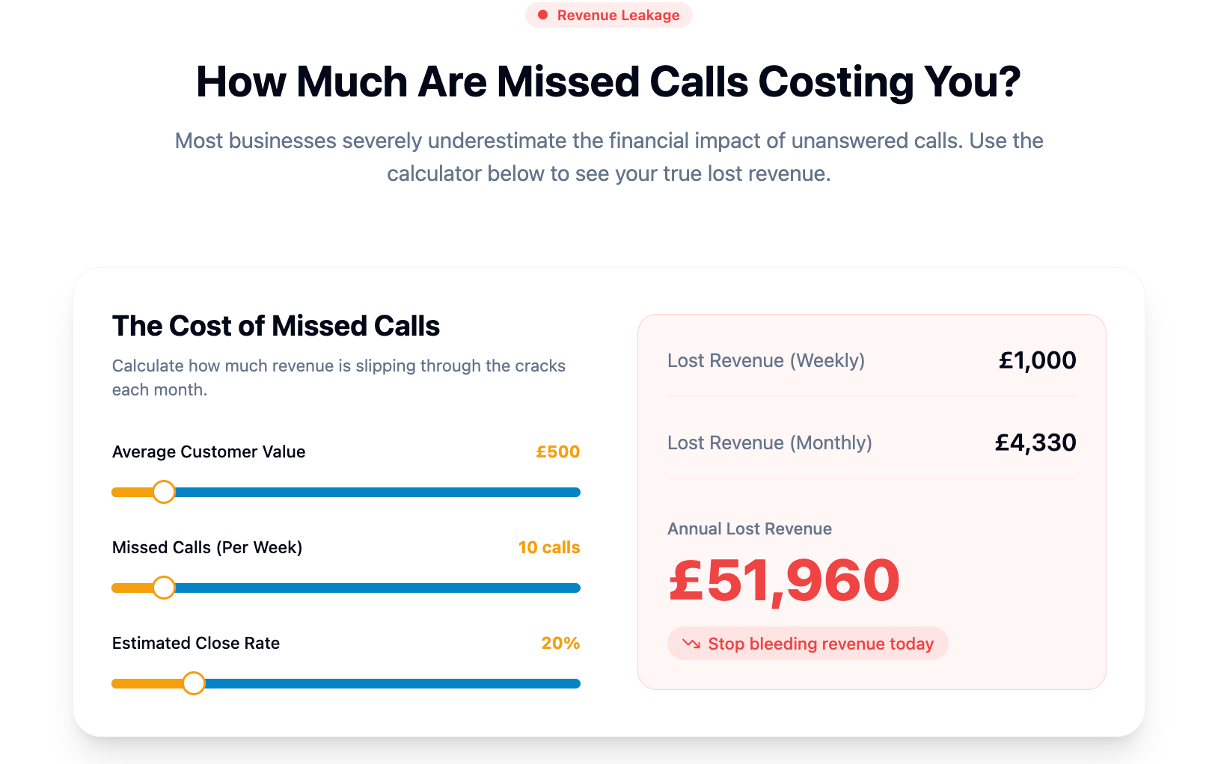
It suits service businesses that already juggle missed calls, bookings and follow-ups across several disconnected tools, and want one system that answers, texts, books and follows up automatically.
- Software Suite covers the core automation; current prices are on the pricing page
- Ultimate AI Suite adds broader workflow coverage; current prices are on the pricing page
- Elite AI Suite is built for higher-volume operations; current prices are on the pricing page
You can review plan details and see how the setup works at Swasco. If bookings are also part of your deflection flow, this guide to stress-free booking websites is worth a look alongside it, and this sales follow-up workflow guide covers the post-text follow-up sequence in more depth.
Sources
- Electronic and telephone marketing | ICO
- In call SMS | Google Cloud Contact Center as a Service | Google Cloud Documentation
- Application to Person (A2P) Message Recipient Research – Report
FAQ
What is call deflection to SMS?
Call deflection to SMS moves an inbound phone enquiry into a text conversation, either during the call, right after the IVR menu, or as a follow-up once the call ends. It's used for routine tasks like confirmations, payment links and status updates that don't need a full voice conversation.
Is call deflection to SMS legal without extra consent?
It depends on whether the message is transactional or marketing. ICO guidance treats operational messages like appointment confirmations differently from marketing texts, which usually need specific consent, so keeping deflection messages strictly transactional is the safest approach.
Does the SMS session end when the call ends?
On many platforms, yes, according to Google Cloud's documentation, which is why an auto-response is worth configuring so the customer isn't left without a reply.
What KPIs show whether a deflection pilot is working?
Deflection rate, average handle time, first contact resolution and CSAT for the SMS thread are the core measures, alongside cost per contact. Watching escalation rates back to voice also helps you catch eligibility criteria that are too broad.
Can Talk2Aiva handle call deflection to SMS for a service business?
Talk2Aiva includes guided onboarding, workflow building and ongoing support as part of its setup, covering call answering, two-way SMS, calendar sync and a unified inbox. For current plan details and pricing, please see the client's website.