
The fastest, highest-ROI way to stop callers reaching voicemail is an always-on, booking-capable AI receptionist paired with instant SMS or web acknowledgement and fast routing to a live callback. Vendor-cited data shows this combination can recover 55–95% of otherwise-lost calls, against just 8–15% recovery from voicemail-only handling. Start today by switching on instant acknowledgement and setting after-hours coverage rules.
TL;DR:
- Calls answered by an AI receptionist with 24/7 coverage and instant SMS acknowledgement can recover up to 95% of missed calls.
- Setting up a three-week implementation plan with baseline measurement, instant acknowledgement, and live-callback testing is essential for success.
- Response times should aim for under five minutes during business hours and seconds for acknowledgement, as speed drastically increases lead conversion likelihood.
- Using multi-channel capture, calendar sync, and CRM integration enhances personalization and reduces caller frustration with abandoned voicemails.
- Compliance requires clear disclosure of call recording and automated handling, along with separate messaging for promotional and transactional communications.
Table of Contents
- Quick checklist: voicemail avoidance strategies to implement this week
- How do you set up voicemail avoidance step by step?
- Which technology and channels actually stop calls hitting voicemail?
- How do you measure whether it's actually working?
- Common implementation pitfalls and fixes
- What response time actually stops a caller reaching voicemail?
- Why do callers avoid leaving voicemail in the first place?
- How should your voicemail greeting actually sound?
- How do you train staff to answer live instead of letting calls fall to voicemail?
- How does CRM data make voicemail avoidance more personal?
- What legal and privacy rules apply to automated call handling?
- Our perspective on getting this right
- Ready to stop losing calls to voicemail?
- Sources
Quick checklist: voicemail avoidance strategies to implement this week
You don't need a new phone system to stop losing leads to voicemail. You need a handful of rules working together, and most can go live within days.
- AI receptionist with 24/7 coverage: answer every call, day or night, with the ability to book appointments directly.
- Instant acknowledgement: send an SMS or web-chat reply within seconds of a missed or unanswered call, confirming you've received the enquiry.
- Routing and live-callback rules: send calls to available staff first, then trigger an automatic callback offer the moment nobody picks up.
- First-contact booking and qualification: capture service type, urgency, and preferred time on the first exchange, not the third.
- One inbox, one owner: unify calls, SMS, and web chat into a single notification stream with a named person accountable for follow-up.
- Short follow-up sequences: if a caller doesn't answer a callback, send two or three brief SMS nudges over 24 to 48 hours rather than one and done.
None of this needs to be complicated. A minimal three-part stack: an AI or chat first responder, SMS for capture, and simple routing to a human is enough to outperform competitors who still rely on a voicemail box and a callback "when we get a chance." Salons and dental practices lose weekend and evening enquiries this way constantly. Trades lose them mid-job, when a phone is in a van and nobody's checking it.
The point of this checklist isn't perfection on day one. It's removing the single biggest leak first: the caller who hangs up rather than leaves a message.
How do you set up voicemail avoidance step by step?
Implementation doesn't require a developer or a six-month rollout. It requires a baseline measurement, then three weeks of configuration, then a month of refinement.
Before you touch anything, measure your baseline. For two weeks, log every missed call: time of day, service type requested, and whether a human ever called back and how long it took. Most owners are shocked by the gap between calls received and calls returned same-day.
-
Week 1: Turn on instant acknowledgement. Set up an automatic SMS or web-chat reply the moment a call goes unanswered. Keep the message short: confirm receipt, state a rough response window, and offer a booking link if relevant. Assign one named person as the owner of every inbound lead notification, so nothing sits unclaimed in a shared inbox.
-
Week 2: Onboard your after-hours coverage. Whether that's an AI receptionist or a human answering service, load your actual pricing, service menu, and booking rules before going live. Sync it to your real calendar so it can offer genuine available slots, not guesses.
-
Week 3: Configure routing and test live-callback flows. Decide the order calls should ring, who covers overflow, and how fast an unanswered call triggers an automatic callback offer. Run test calls at different times, including evenings and weekends, and check the calendar sync doesn't double-book a slot two people can see as "free."
-
Month 1: Refine using real transcripts. Pull the actual calls and messages that came through and use them to sharpen your AI's scripts and your team's own phrasing. Turn on a short SMS follow-up sequence for anyone who didn't book after the first live callback attempt.
Pro Tip: Run your live-callback test outside office hours first. Most rollouts get tested at 11 a.m. on a Tuesday, when everyone's watching, and fail silently at 7 p.m. on a Saturday, when nobody is.
An instant auto-response buys you the window to follow up properly, rather than losing the caller to a competitor in the two minutes it takes you to notice a missed call.
Which technology and channels actually stop calls hitting voicemail?
Three broad categories cover most small businesses, and they differ sharply in cost and recovery rate.
AI receptionists run at a flat monthly rate and, when configured properly with pricing, service types, and booking rules loaded in, tend to sit at the high end of recovery. Human answering services charge per call or per minute and generally recover less, mainly because scripts are generic and booking access is limited. In-house-only coverage, whoever's free picks up, caps out fast once you're closed or short-staffed, and it's the category still leaking the most revenue.
Whichever route you choose, the feature list that actually matters is short:
- 24/7 answering, not just extended office hours.
- Booking and calendar sync, so a caller gets a real appointment, not a promise to call back.
- Payment or deposit handling for businesses where no-shows are a genuine cost.
- Multi-channel capture: calls, SMS, and web chat feeding the same system.
- Audit and tracking, so you can see what was said and when.
- Notification routing to the right person, on the right device, in real time.
Integration doesn't need to be technical. Most small-business platforms offer native calendar integrations, a Zapier connection, or a simple CRM hook that takes an afternoon to set up rather than a development sprint. If you're weighing options, this rundown of AI receptionist tools and the right questions to ask a vendor before signing anything are worth reading first.
How do you measure whether it's actually working?
Five numbers tell you almost everything: missed-call rate, time to first human touch, acknowledgement speed, after-hours conversion rate, and estimated monthly recovered revenue.
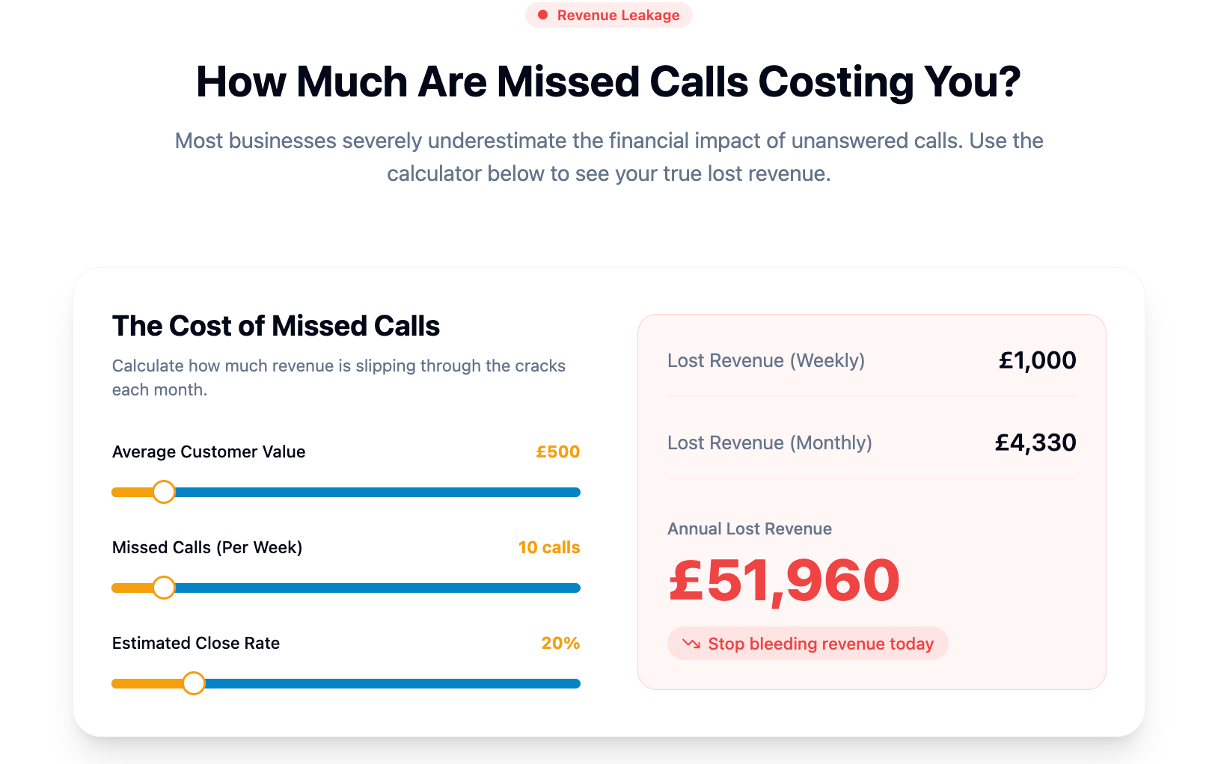
A simple formula gets you to a defensible ROI figure: multiply your monthly after-hours or missed leads by the conversion uplift you're seeing, then by your average job value. For example, recovering extra leads with increased conversion rates and average job values can yield substantial recovered monthly revenue. Contractors responding within five minutes convert at roughly 21 times the rate of those waiting 30, so the uplift from fast acknowledgement alone is rarely marginal.
Compare the same weekdays across 30-day windows rather than week to week, since call volume swings with seasonality and marketing spend. Anything under roughly 20 calls in a comparison window is too small a sample to draw conclusions from.
Common implementation pitfalls and fixes
Most failed rollouts share the same handful of mistakes.
- Scripts too rigid: an AI or agent that can't handle a slightly unusual question sends the caller straight to frustration. Fix with flexible templates and regular review of real transcripts.
- Calendar desync: double-bookings or phantom availability erode trust fast. Fix with a weekly sync check, not a one-off setup.
- Slow human follow-up: a great instant acknowledgement means nothing if the human callback takes three days. Fix by making one person accountable for every open lead.
- Untested after-hours flows: many owners never actually call their own business at 9 p.m. on a Sunday. Fix by scheduling a monthly test call outside office hours.
Pro Tip: Escalate to a human the moment a caller's question exceeds two exchanges with the AI. A staged escalation rule, immediate acknowledgement, then a short AI qualifying window, then live handoff, keeps complex enquiries from stalling in an automated loop.
What response time actually stops a caller reaching voicemail?
Speed is the single biggest lever in this entire strategy. Businesses that respond within five minutes are roughly 21 times more likely to qualify a lead than those that wait half an hour. That gap isn't a rounding error, it's the difference between a booked job and a lead who's already called your competitor.
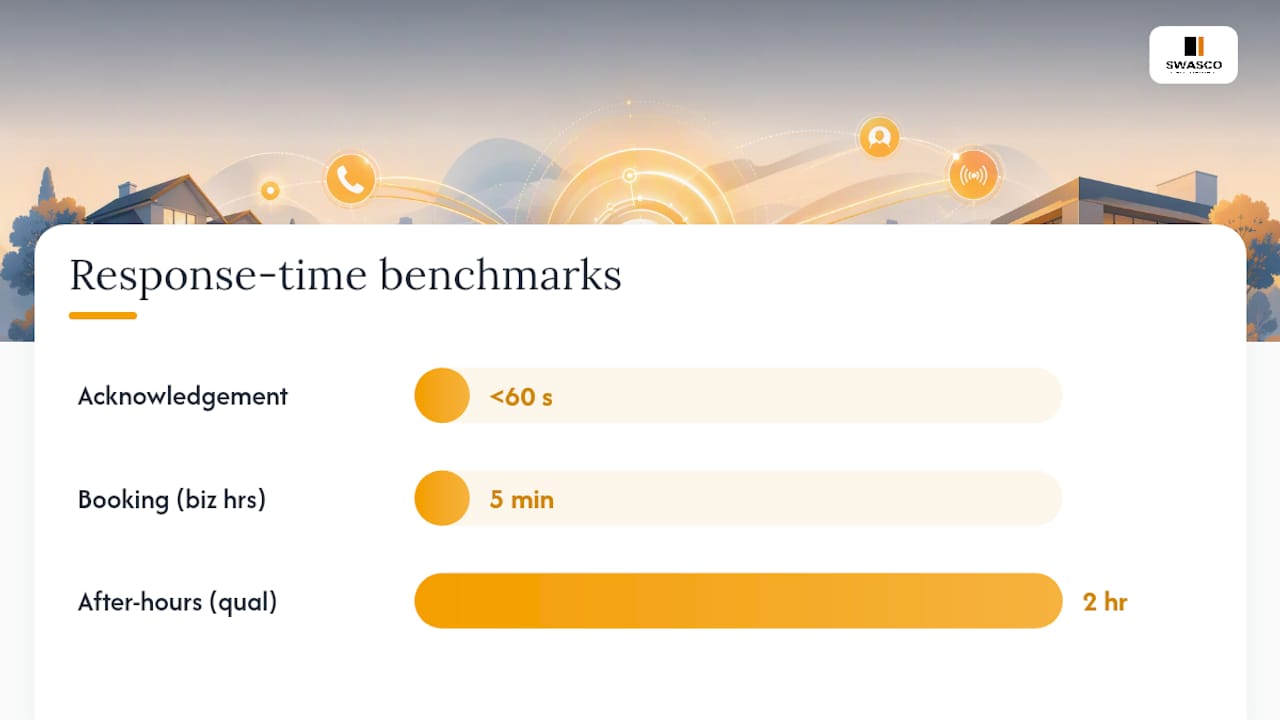
The practical target for most service businesses is under five minutes for any human follow-up, and instant, meaning seconds, for the initial acknowledgement. That first automated reply doesn't need to solve the enquiry. It needs to tell the caller they've been heard, so they don't hang up and try elsewhere.
Set two separate benchmarks. The acknowledgement benchmark (SMS or chat reply) should be measured in seconds, ideally under 60. The human or AI-booking benchmark, actually confirming a time slot or answering a specific question, should sit comfortably under five minutes during business hours and under two hours for qualified after-hours leads.
Salons and trades often assume speed matters less for them than it does for, say, emergency plumbing. It doesn't. A caller booking a haircut or a boiler service is usually comparing two or three providers in the same ten-minute window. Whoever replies first tends to win the booking, regardless of who has the better reviews.
Why do callers avoid leaving voicemail in the first place?
Most callers treat voicemail as a dead end, not a message service. They've learned, often from experience, that voicemails to small businesses get checked hours or days later, if at all.
There's also a friction cost to leaving a message: it takes longer than texting, it requires the caller to articulate their need clearly on the spot, and it offers no confirmation the message was even received. Compare that to texting a friend, where a reply arrives with visible proof it landed. Voicemail gives none of that reassurance.
Younger callers in particular default to text-based channels for anything transactional and treat voice messages as awkward or old-fashioned. Even older callers, comfortable with phone calls, often abandon a voicemail attempt the moment they hear a generic, robotic greeting that suggests nobody's actually listening on the other end.
The behavioural fix isn't complicated: remove the need to leave a message at all. If a caller reaches a system that can book them directly, or that promises and delivers a callback within minutes, the entire avoidance instinct becomes irrelevant. The caller was never avoiding contact, they were avoiding a black hole.
How should your voicemail greeting actually sound?
If voicemail is still part of your setup, even as a fallback, the greeting itself needs work. A generic, flat "please leave a message after the tone" invites exactly the abandonment behaviour you're trying to prevent.
A better greeting does three things quickly: confirms the business name so the caller knows they've reached the right place, states a specific response commitment ("we return calls within one business hour" rather than a vague "we'll get back to you"), and offers an alternative channel immediately, such as a text-back number or booking link, for anyone who doesn't want to leave a spoken message at all.
Keep it under 20 seconds. Every extra second is a chance for the caller to hang up before they even reach the beep. Update it seasonally too. A greeting that mentions holiday hours in July looks careless, and callers notice.
The honest goal here is different from most voicemail advice: not a better voicemail experience, but making voicemail the last resort a caller almost never needs to use.
How do you train staff to answer live instead of letting calls fall to voicemail?
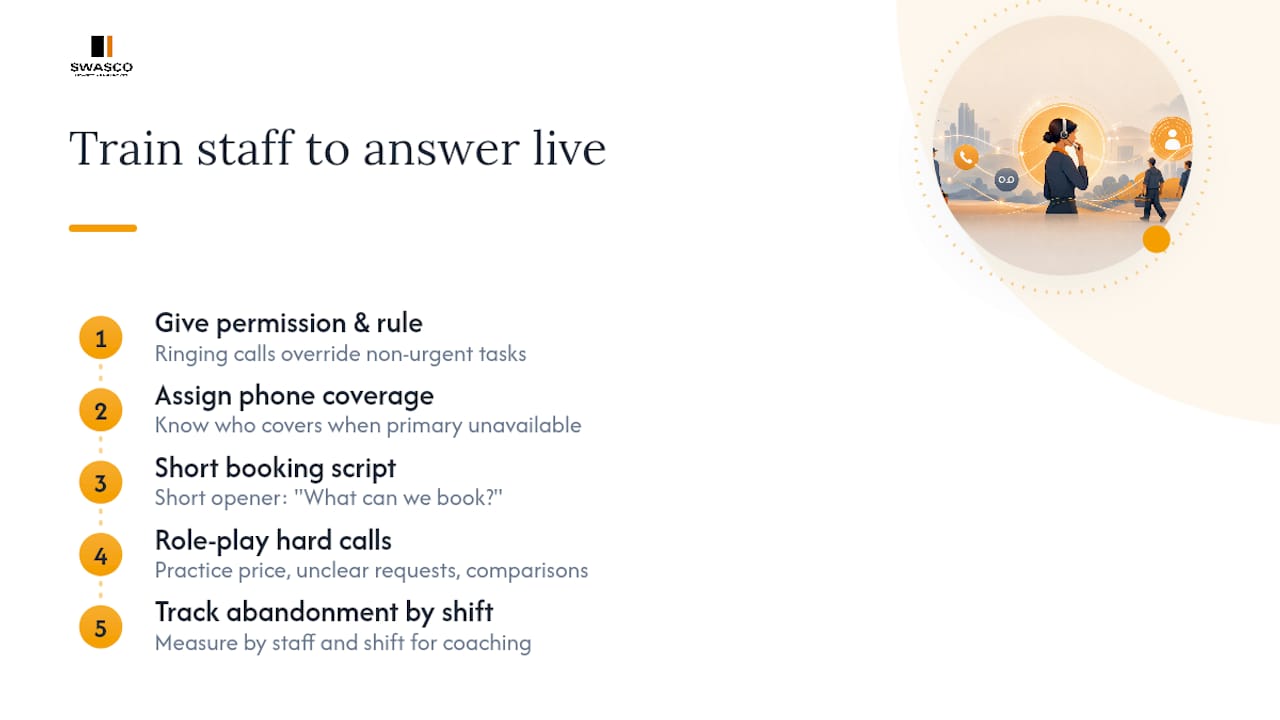
Live agents need permission and structure to prioritise picking up, not just a vague instruction to "answer when you can." Build a simple rule: any ringing call takes priority over non-urgent tasks, full stop, and staff know exactly who covers the phone when the primary person is unavailable.
Scripting matters as much as the rule. Give staff a short, flexible opening line that gets straight to booking, "Thanks for calling, what can we get you booked in for?", rather than a long-winded greeting that delays the caller getting what they need. The same speed principle that applies to automated acknowledgement applies here: every extra second of scripted preamble is a second closer to the caller giving up.
Role-play the awkward calls specifically, the ones staff tend to let ring out because they're unsure how to handle them: price objections, unclear service requests, or a caller who's clearly comparing three providers at once. Confidence on those calls is what keeps a human picking up instead of letting the system take over.
Finally, track abandonment by staff member or shift, not just by business overall. It surfaces coaching opportunities fast, particularly around lunch hours and shift handovers, when calls quietly go unanswered more than owners realise.
How does CRM data make voicemail avoidance more personal?
Generic automation treats every caller the same. CRM-linked automation recognises a returning customer's number, pulls their service history, and can route or greet them differently, "Welcome back, are you calling about your usual appointment?", rather than starting from zero every time.
That personalisation does double duty. It speeds up the call itself, since the system or agent already has context, and it signals to the caller that they're a recognised customer rather than a stranger dialling a call centre. For a dental practice or salon with repeat visits, this alone can cut call handling time meaningfully.
Practically, this means your phone or chat system needs to talk to your booking and customer records, even a basic hook is enough. A caller flagged as having an outstanding invoice or an upcoming appointment can be routed differently from a brand-new enquiry. The technical lift is usually smaller than owners expect: most modern platforms support this through native integrations or a simple connector, not custom development.
What legal and privacy rules apply to automated call handling?
Recording calls, using AI to handle enquiries, and sending automated SMS all carry data protection obligations, particularly around consent and disclosure. UK businesses using call recording or AI-assisted answering should disclose that calls may be recorded or handled by an automated system, and should have a clear basis under data protection law for storing caller information such as phone numbers and service history.
SMS follow-up sequences need explicit thought too. Sending repeated marketing-style messages to someone who only wanted a one-off booking confirmation risks both annoying the customer and straying into rules around unsolicited marketing communications. Keep transactional messages, booking confirmations, appointment reminders, clearly separate from anything promotional, and give recipients an easy way to opt out of the latter.
None of this should discourage automation. It should shape how you configure it: disclose clearly, store only what you need, and separate service messages from marketing ones. A five-minute conversation with whoever handles your data protection compliance, often the same person managing your booking system, is worth having before full rollout rather than after a complaint.
Our perspective on getting this right
We built Talk2Aiva because most "voicemail avoidance" advice stops at technology and skips the part that actually matters: guided setup. An AI receptionist configured badly is just a faster way to frustrate callers. Talk2Aiva's onboarding, workflow-building, and ongoing optimisation process exists because the CX playbook target of 60–80% containment only holds when scripts, routing, and calendar rules are tuned properly and not left on default settings....
— James Paul
Ready to stop losing calls to voicemail?
A guided AI receptionist system can help put everything in this article into practice without hiring a developer or piecing together three separate tools. Such systems may handle instant acknowledgement, booking-capable 24/7 answering, and live-callback routing as one connected system, often including onboarding, workflow setup, and ongoing support rather than leaving it for the user to figure out alone.
Setup starts with training the AI on your actual services, pricing, and calendar, then testing live-callback flows before going live, exactly as outlined in the implementation steps above. If your acknowledgement copy needs sharpening too, this guide to writing an effective call to action is a useful companion piece. To see how the full system fits your business, visit Talk2Aiva's landing page and request a walkthrough of the setup for your specific service type.
Sources
For deeper detail on response-time research and missed-call revenue impact, see the contractor lead response time study and missed-call cost analysis.
- 2026 Contractor Lead Response Time Study: How Speed Determines Revenue | CustomerFlows
- How Much Do Missed Calls Cost? | TheKeyBot
- Speed to Lead: Why the First Five Minutes Decide Whether You Win the Job