
Two-way SMS is text messaging that lets a business and a customer reply to each other on the same number, turning a one-way alert into a real conversation. Its biggest business benefit is speed: customers confirm bookings, ask questions, or opt out with a single reply, which cuts missed appointments and speeds up support. You will need to choose between a short code, long number, or keyword-based routing, and get consent right under GDPR before you switch it on.
TL;DR:
- Using short codes for two-way SMS offers high throughput but incurs higher costs, while long numbers are cheaper but slower and better for international reach.
- Response times depend heavily on the gateway and system setup; carriers do not guarantee in-order message delivery, which can impact complex workflows.
- Ensuring explicit double opt-in and immediate handling of opt-outs is essential for GDPR compliance and maintaining trust in two-way messaging campaigns.
- Response and reply rates, along with delivery and resolution times, are key KPIs to track the ROI of two-way SMS in supporting customer engagement and operational efficiency.
- Proper testing across carriers and staged rollout with ongoing optimization are critical to avoid common mistakes like consent issues and overautomation.
Table of Contents
- How two-way SMS actually works
- Short codes, long numbers, and keywords compared
- Where two-way SMS earns its place in a service business
- Setting up two-way SMS with your CRM and helpdesk
- Consent, GDPR, and message best practice
- Measuring the return: KPIs that actually matter
- How implementation actually rolls out
- What most businesses get wrong first time
- Get two-way SMS running without building it yourself
- Sources
How two-way SMS actually works
Outbound texts follow a simple path: your platform sends a message through an SMS gateway, the carrier network picks it up, and it lands on the customer's handset. The reply reverses that route, but with more moving parts. The carrier passes the incoming text to a gateway, which forwards it to a webhook, an API endpoint, or a unified inbox where a human or a bot can act on it.
That inbound leg is where most businesses get caught out. Cm describes two-way messaging as the ability to send and receive SMS on the same number, which sounds simple until you realise every reply needs somewhere specific to go.
Three things shape how reliably that happens:
- The gateway decides how fast a reply reaches your system and whether it can trigger automation.
- Webhooks and APIs connect that inbound message to your CRM, helpdesk, or booking tool.
- Unified inboxes let staff see and answer texts alongside calls and web chats.
AWS's own documentation notes that two-way SMS is only available in certain countries, and inbound messages aren't guaranteed to arrive in the order they were sent. If your workflow depends on message sequence (a multi-step keyword survey, for instance), build in a check rather than assuming a clean order.
Short codes, long numbers, and keywords compared
Your choice of number type determines cost, reach, and how automation gets triggered. A dedicated short code (five or six digits) handles high volume fast and carries strong deliverability, but leasing one is expensive and usually only justifies itself at serious scale. A shared short code cuts that cost by splitting a number across several businesses, though keyword clashes are a real risk.
Long numbers (standard mobile-format numbers) cost far less and work well for international reach or lower-volume use, but they send more slowly and can face stricter carrier filtering in some regions.
Keywords are the automation layer sitting on top of either number type. A customer texting "BOOK" or "STOP" triggers a specific workflow, whether that's a booking confirmation or an opt-out.
- Dedicated short code: highest cost, highest throughput
- Shared short code: lower cost, shared keyword risk
- Long number: cheapest, slower send rate, better for global reach
Pro Tip: Test your chosen keywords against common misspellings and abbreviations before launch. A customer texting "canceI" instead of "cancel" should still land in the right workflow, not a dead end.
Where two-way SMS earns its place in a service business
Service businesses see the fastest return where a quick reply replaces a phone call or an email chain. The use cases below are the ones that consistently justify the setup effort.
- Support and ticket creation. A customer texts a query, the system logs it as a ticket, and a quick automated acknowledgement buys time for a human agent to follow up.
- Appointment confirmation and no-show prevention. A reminder text with a "Y to confirm, R to reschedule" option catches cancellations early instead of losing the slot on the day.
- Lead capture and qualification. A single keyword reply (say, "INFO") starts a qualifying sequence that filters serious enquiries from casual browsers.
- Surveys, voting, and promotion redemptions. Short numeric replies ("1 for yes, 2 for no") turn a marketing text into a two-way exchange rather than a broadcast.
Dotdigital's analysis makes the point plainly: two-way SMS turns a notification into a conversation, and open-ended replies tend to lift engagement above what a plain alert achieves. Service businesses running appointment-heavy operations, from clinics to salons, get the clearest wins here because every confirmed slot is revenue protected.
Setting up two-way SMS with your CRM and helpdesk
Getting two-way SMS live is less about buying a number and more about wiring replies to the right place. Follow this rough order:
- Pick your address type based on expected volume and budget: a long number for most SMEs, a short code only once volume demands it.
- Enable inbound handling through a webhook or your provider's inbox, then map incoming fields (phone number, message body, keyword) to your CRM.
- Set routing rules and SLAs. Decide which replies go to a bot, which escalate to a human, and how fast a human must respond.
- Test across major carriers before launch, checking delivery speed and confirming message ordering behaves as you expect. The property-lead workflow described in this SWASCO how-to guide is a useful reference for wiring inbound SMS on a provisioned number.
Document what "normal" delivery looks like on each carrier during testing, so a genuine fault is obvious later rather than lost in normal variance.
Consent, GDPR, and message best practice
Two-way SMS lives or dies on consent. Express opt-in, where a customer actively agrees to receive texts, is the safer baseline under GDPR; relying on implied consent from an existing relationship carries more legal risk and should be the exception, not the default.
- Use double opt-in for marketing sends: one message to request consent, a second reply to confirm it.
- Handle opt-outs immediately and automatically. A "STOP" reply must remove the contact from future sends, not just log a request.
- Keep an audit log of consent records, timestamps, and opt-out actions tied back to the CRM contact.
- Set retention limits on message content and personal data rather than storing every text indefinitely.
- Keep messages short, put the action (the CTA) in the first line, and set a target reply time for anything routed to a human.
Mobile Ecosystem Forum's guidance on enterprise messaging stresses that sender reputation and fraud governance now sit alongside consent as core trust factors. Get the practical detail right with this GDPR SMS consent checklist for UK SMEs.
Measuring the return: KPIs that actually matter
A handful of numbers tell you whether two-way SMS is paying off. Track these from day one:
- Delivery rate: the share of sends that actually reach a handset.
- Response time: how long customers take to reply, and how long you take to reply back.
- Reply rate: the percentage of outbound texts that get any response at all.
- Resolution time: how long a support or booking conversation takes end to end.
- Conversion per conversation: bookings, sales, or resolved tickets per text thread started.
Confirmation texts have a direct, measurable effect on no-show rates, and SWASCO's data on follow-up texts shows rebooking rates climbing when a follow-up text lands soon after a missed or completed appointment. A simple ROI framework: multiply bookings recovered per month by your average booking value, then compare that against your monthly platform cost.
How implementation actually rolls out
A guided rollout follows a predictable arc rather than a single big switch. Onboarding starts with a discovery call to map your existing workflows, then moves into number provisioning and template creation so keywords and replies match how your business actually operates.
- AI training and workflow building: mapping common service flows (bookings, enquiries, follow-ups) into automated sequences.
- Small-scale pilot: testing routing and reply handling before a full switch.
- Live launch with fortnightly optimisation: adjusting templates and escalation rules based on real reply data.
Ongoing technical support stays part of the arrangement rather than ending at launch.
What most businesses get wrong first time
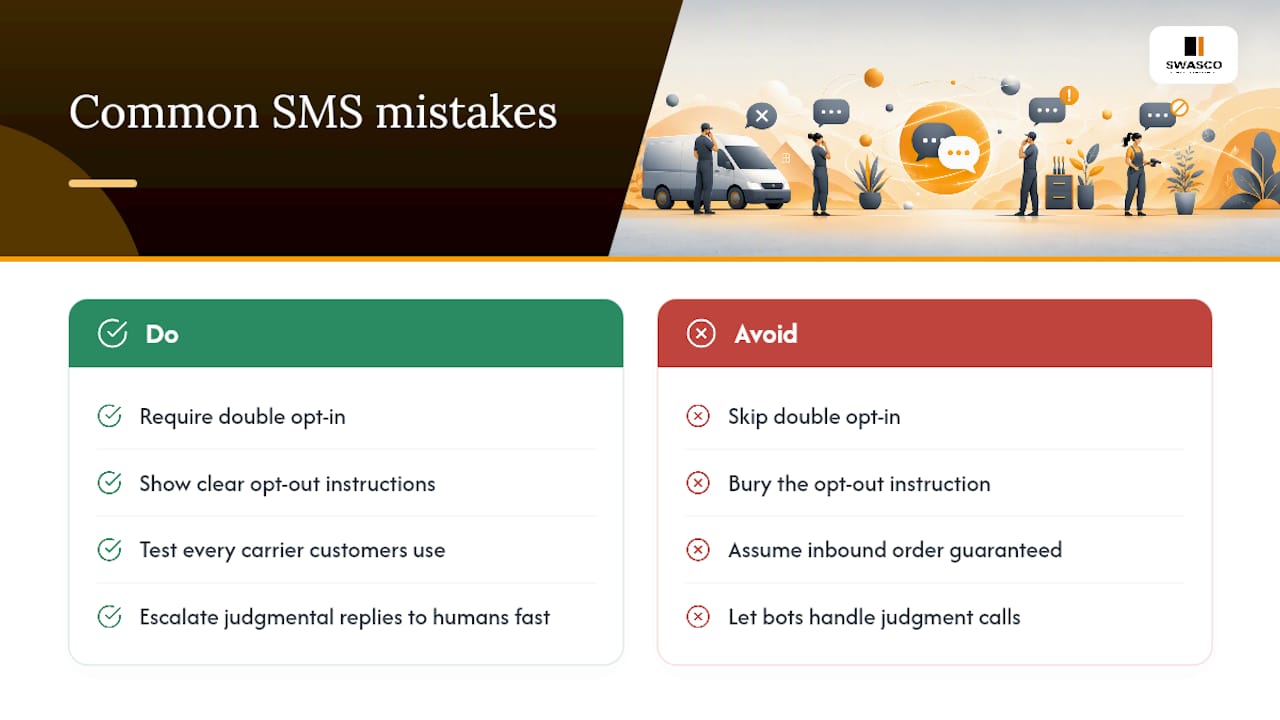
Consent is the mistake that costs money, not the technology. Businesses that skip double opt-in or bury the opt-out instruction end up fielding complaints instead of bookings. Test every carrier your customers actually use. AWS's own note that inbound order isn't guaranteed is a genuine operational quirk, not a footnote.
The third failure is automating too far: replies that need judgement should escalate to a person fast, not loop through another bot message. Balance is the whole job here, not a nice extra.
— James Paul
Get two-way SMS running without building it yourself
A system can be set up for two-way SMS as part of a wider system that also covers calls, website chat, and social messages, so you are not stitching together a separate tool just to handle text replies. Rather than leasing a number and wiring webhooks yourself, you get discovery, number provisioning, template and keyword mapping, and a pilot run before anything goes live to customers.
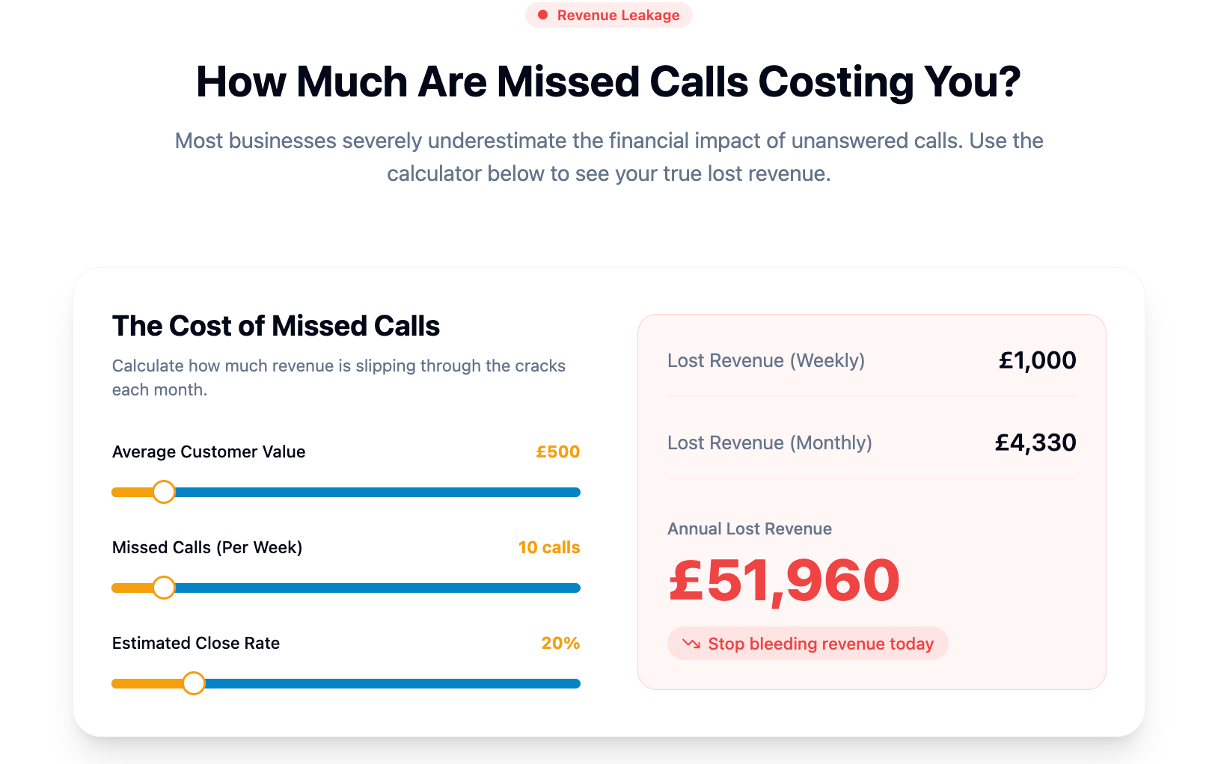
Ongoing support continues after launch too, with regular optimisation sprints that adjust routing and templates as real reply patterns emerge. If your team is currently juggling missed calls, slow email replies, and no consistent way to catch a text reply from a customer, this closes that gap in one system rather than three. For teams handling higher lead volumes, a workflow partner like Northlight's automation tools for account teams can complement the follow-up side once conversations start flowing in. See how the Talk2Aiva AI receptionist fits your setup, or head to the Talk2Aiva homepage to check what a pilot rollout would look like for your business.
Sources
For the technical detail behind the claims in this guide, the AWS two-way SMS documentation and CM.com's glossary entry are worth a direct read. Mobile Ecosystem Forum's trust materials cover fraud governance in more depth, and SWASCO's guide on SMS appointment reminders for salons shows the setup applied to a real service business.
- Cm
- Two-way SMS messaging in AWS End User Messaging SMS — AWS documentation
- How two-way SMS works and why it drives performance — dotdigital
- Trust in enterprise messaging — Mobile Ecosystem Forum