
Every missed call is a potential job walking to your competitor. The fastest way to recover missed-call revenue is to deploy an automated SMS text-back the moment a call goes unanswered, then follow up with a scheduled callback or an AI receptionist that captures and qualifies leads around the clock. You can act on this today.
- Run the calculator in the next section using your own call volume and average job value.
- If you don't have exact figures, use the industry benchmarks provided.
- Once you've quantified the opportunity, follow the implementation checklist to get your first recovery workflow live within 24–72 hours.
Industry data shows service businesses miss 27–47% of inbound calls during business hours — and the majority of those callers won't leave a voicemail.
Key takeaways
Recovering missed-call revenue requires three things: a quantified baseline, a fast first-response layer (SMS text-back), and a 24/7 capture system that qualifies and books leads while your team is unavailable.
| Point | Details |
|---|---|
| Quantify first | Use the formula (calls/day × 365 × missed % × job value × close rate) to calculate your annual loss before choosing a tool. |
| SMS text-back is the fastest win | A text-back deployed in under two days typically recovers 15–25% of missed calls with minimal cost. |
| AI receptionist compounds gains | Real-world deployments recover 27–30% of previously missed calls within 30 days, with payback often under one week. |
| Track six core KPIs | Missed-call rate, recovery rate, time-to-first-response, and booking rate from recovered leads are the metrics that prove improvement. |
| Talk2Aiva handles the full workflow | Talk2Aiva by SWASCO provides done-for-you setup, 24/7 AI answering, SMS follow-up, and CRM sync to recover missed-call revenue from day one. |
Table of Contents
- How much revenue are you losing to missed calls?
- Why missed calls turn into lost revenue so quickly
- Practical methods to recover missed-call revenue, ranked by speed
- Which KPIs should you track before and after deployment?
- How to calculate ROI and payback for your recovery investment
- Step-by-step implementation checklist for UK service businesses
- What actually works for UK service businesses
- Stop losing revenue to missed calls with Talk2Aiva
- Sources
How much revenue are you losing to missed calls?
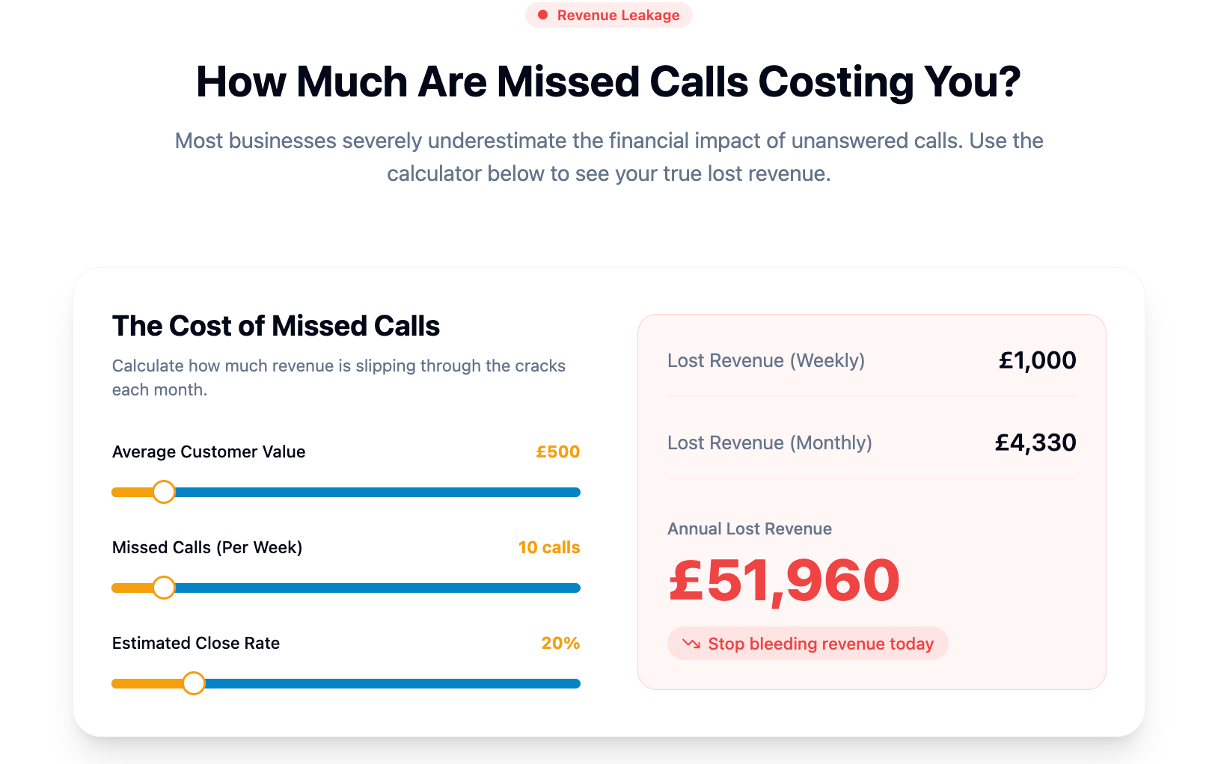
The arithmetic is straightforward. Once you run it, the number tends to be uncomfortable — and motivating.
The formula:
This canonical formula is used by call-analytics vendors and revenue calculators alike. The four inputs you need are:
- Calls per day (or week, divided by 5 for a working-day average)
- Missed-call rate (your phone system or CRM will show this; use a benchmark rate if unknown)
- Average job or deal value in GBP
- Close rate on inbound calls (the percentage of answered inbound calls that convert to a booking or sale)
Worked example: a mid-sized plumbing firm
Assume 10 inbound calls per day, a typical missed-call rate, an average job value of £350, and a moderate close rate on answered calls.
Annual loss = (10 calls daily over the year) multiplied by typical missed-call rate, average job value, and close rate equals a significant sum
That figure assumes zero recovery. The table below shows what happens when you deploy a recovery workflow at three different recovery rates.
How to choose your recovery rate: Use lower recovery rates for SMS text-back only setups, moderate rates with added scheduled callbacks, and higher rates with 24/7 AI receptionist deployment, consistent with reported client experience.
If you don't yet have your own call data, pull 30 days of logs from your phone system or, for Android users, retrieve your call history via Google backup to establish a baseline missed-call count.
Why missed calls turn into lost revenue so quickly
An unanswered call doesn't just sit in a queue. It triggers a behaviour chain that almost always ends with the caller booking someone else.
The five most common causes of missed-call revenue loss:
- After-hours volume: Calls arriving outside 9–5 go unanswered entirely unless you have overnight cover or an AI receptionist.
- Busy teams: A single receptionist or owner-operator handling a job cannot answer simultaneously. The call rings out.
- No voicemail left: Most callers hang up rather than leave a message, particularly for urgent trade work.
- Next-on-list behaviour: High-intent callers searching for a plumber, dentist, or solicitor will ring two or three businesses in sequence. The first to respond wins the job.
- Poor callback prioritisation: Even when a missed call is logged, it sits in a list with no urgency attached. By the time someone calls back, the lead has gone cold or booked elsewhere.
Industry benchmarks place the missed-call rate at 27–47% during business hours, with the rate climbing sharply after hours. For a busy trades business or a clinic with a single front-desk phone, the real figure is often at the upper end of that range.
Consider a scenario: a homeowner's boiler breaks on a Friday afternoon. She rings three local heating engineers. The first two go to voicemail. The third answers immediately. She books on the spot. The first two businesses lost a £600 job each — not because their price was wrong, but because they were unavailable for 90 seconds.
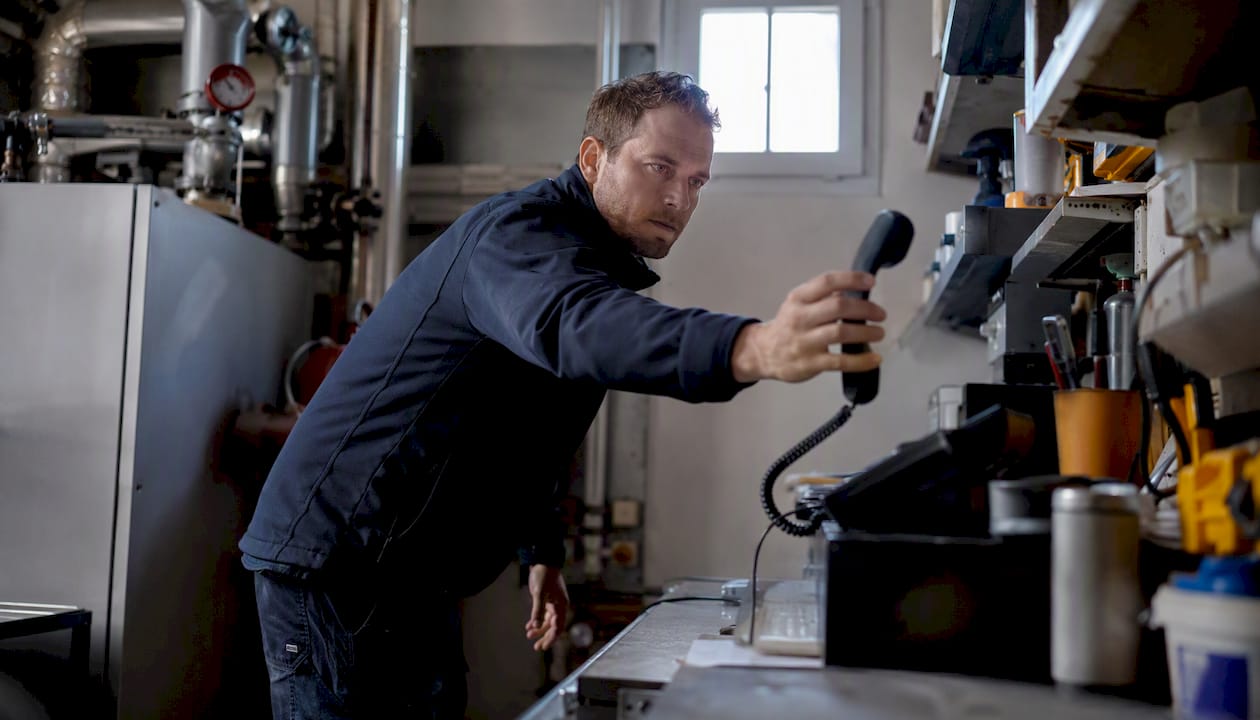
Customer behaviour after a missed call reinforces this. Research into lead nurturing and re-engagement consistently shows that callers prefer a rapid text response over a voicemail request, and that re-engagement probability drops sharply after 10 minutes without contact. Speed is the variable that matters most.
Practical methods to recover missed-call revenue, ranked by speed
Not every business needs the same solution. Here are four methods ranked by how quickly you can deploy them and how much revenue each typically recovers.
1. Missed-call text-back (fastest win)
The moment a call goes unanswered, an automated SMS fires to the caller's number. This is the single quickest recovery lever available. Most SMS platforms can be configured in under a day, and a rapid text-back materially increases the chance a caller re-engages, especially for urgent trade and appointment-based enquiries.
Speed to implement: 1–2 days.
Three SMS templates that convert:
Template A — Short and direct: Template B — Personalised with urgency: Template C — Booking prompt: Pros: Low cost, fast to deploy, no staff training needed. Cons: Doesn't qualify the lead or capture job details. Works best as the first layer of a wider workflow.
2. Scheduled callback cadences and human overflow
A callback cadence is a structured sequence: attempt 1 within 15 minutes, attempt 2 within 2 hours, attempt 3 the following morning. Pair this with a human overflow service for peak periods and you cover the gap between SMS capture and a live conversation.
Speed to implement: 3–5 days (requires CRM setup and staff briefing).
Callback script to qualify intent and book:
Keep it under 60 seconds. The goal is qualification and booking, not a full consultation.
3. Automated callback with CRM integration
Automated callback tools trigger a call to the missed number and, when answered, connect the caller to an available agent or play a qualification prompt. Combined with CRM tagging, every recovered lead is logged with source, time, and outcome.
Speed to implement: 1–2 weeks (requires CRM configuration).
Integration checklist:
- Set up a dedicated call-tracking number for inbound enquiries (separate from your main line) so missed calls are logged separately.
- Create a CRM custom field: "Lead source = missed call" and "Recovery status = pending / contacted / booked."
- Route recovered leads into your existing sales pipeline at the correct stage (enquiry, not closed).
- Use call-tracking numbers and consistent CRM tagging to avoid miscounting and to measure recovery rate accurately.
4. AI receptionist — 24/7 capture and qualification
An AI receptionist answers every call, qualifies the caller, books appointments directly into your calendar, and sends an SMS confirmation. It handles after-hours volume without staffing costs and feeds qualified leads straight into your CRM.
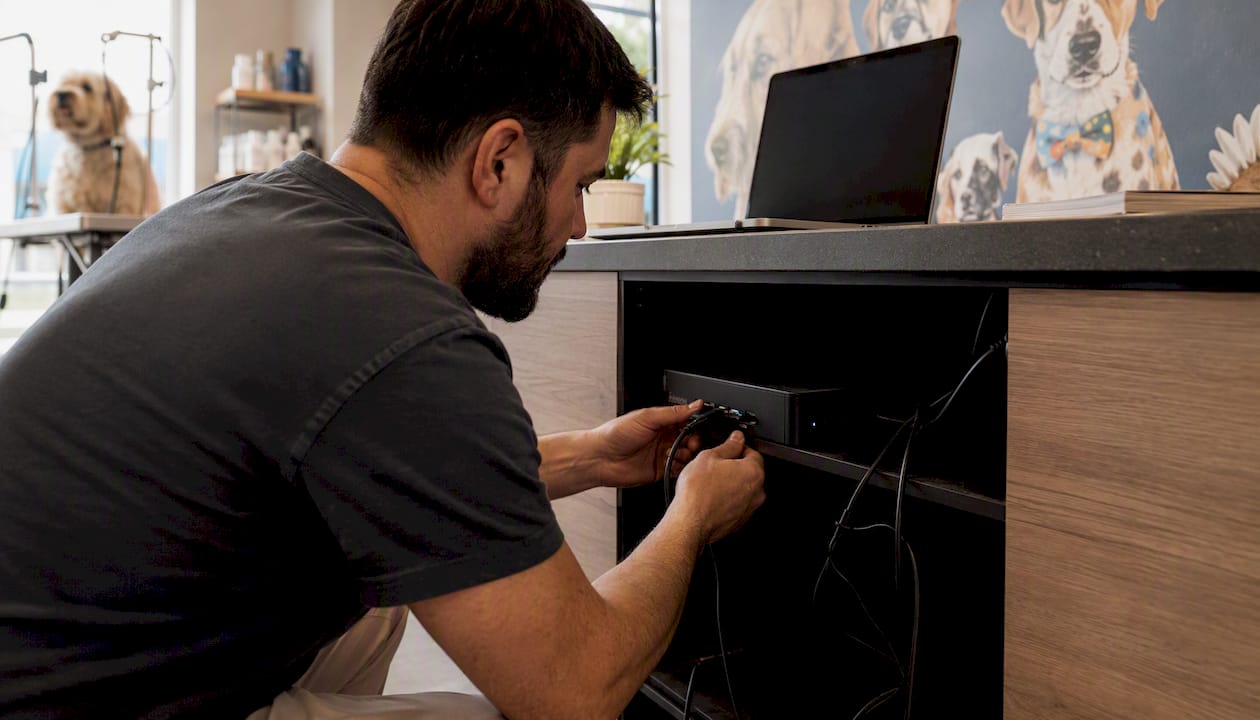
Speed to implement: 1–3 weeks with a managed onboarding.
This is the highest-capacity option and the one that compounds over time. For a guide to how AI call handling works in practice, including typical workflows for trades and clinics, the technical detail is worth reviewing before you configure your first workflow.
Pro Tip: Don't try to automate everything at once. Start with SMS text-back for one week to establish a recovery baseline, then layer in the AI receptionist. You'll have real data to prove the ROI before you commit to the full setup.
A hybrid approach — immediate AI capture combined with scheduled human follow-up — consistently outperforms either method alone. Automation handles speed; a human handles complex or high-value enquiries that need nuance.
Which KPIs should you track before and after deployment?
You can't manage what you don't measure. Before you deploy any recovery workflow, capture a 30-day baseline for each of these metrics.
Essential KPIs:
- Inbound call volume: total calls received per day/week, split by time of day.
- Missed-call rate: missed calls as a percentage of total inbound calls.
- Answered-call conversion rate: percentage of answered calls that result in a booking or sale.
- Average job or deal value (GBP): your average revenue per converted inbound call.
- Recovered-call conversion rate: percentage of recovered (text-back or callback) leads that convert to a booking.
- Time-to-first-response: minutes between a missed call and your first outbound contact attempt.
- Booking rate from missed leads: bookings generated specifically from recovered calls, tracked separately.
Baseline measurement checklist:
- Pull 30 days of call logs from your phone system or VoIP provider.
- Tag all missed calls in your CRM with "missed inbound" as the source.
- Record the outcome of every callback attempt (no answer, spoke to caller, booked, lost to competitor).
- Note the time of day for missed calls to identify peak-loss windows (often 12–2 PM and after 5 PM).
For accurate ongoing measurement, call-analytics platforms recommend dedicated call-tracking numbers and consistent CRM tagging — without these, your recovery rate figures will be unreliable. Set up a weekly dashboard showing missed-call rate, recovery rate, and bookings from recovered leads. Review it every Monday morning. Trends become visible within two to three weeks.
How to calculate ROI and payback for your recovery investment
Once you have your baseline metrics, the ROI calculation is a two-step process.
ROI formula:
Three worked GBP scenarios
Annual missed-call revenue loss = (8 × 365) × 0.35 × £280 × 0.40 = £115,136
Assumptions to check before using these figures:
- Close rate on recovered calls is typically lower than on answered calls — use 25–30% for recovered leads rather than your standard 40%, unless your data shows otherwise.
- Average job value should reflect your actual average, not your highest-value jobs. Use a 12-month median.
- Tool cost varies by provider and tier. The figures above are illustrative cost bands; confirm current pricing with your chosen provider.
- For conservative forecasting, use the lower end of the recovery rate range and the lower close rate. If the ROI is still positive at those inputs, the investment is low-risk.
The payback period in every scenario above is measured in days, not months. That's the nature of high-value inbound calls: recovering even a small number of them covers the cost of the tool within the first week.
Step-by-step implementation checklist for UK service businesses
The rollout plan
- Audit (Days 1–3): Pull 30 days of call logs. Calculate your current missed-call rate and annual revenue loss using the formula above. Identify peak missed-call windows.
- Choose your first recovery layer (Days 3–5): For most businesses, SMS text-back is the right starting point. Select a platform, configure your first template, and test it on your own number.
- Set up call tracking (Days 5–7): Assign a dedicated inbound tracking number. Create CRM custom fields for missed-call source and recovery status.
- Pilot SMS text-back (Week 2): Go live. Monitor daily. Log every recovery attempt and outcome in your CRM.
- Review pilot data (Week 3): Calculate your actual recovery rate. Compare against the baseline. Decide whether to add a callback cadence or AI receptionist.
- Add AI receptionist or callback cadence (Weeks 4–6): Onboard your chosen tool. Configure qualification questions, calendar sync, and CRM handover. Test end-to-end with sample calls.
- Full launch and staff training (Week 7): Brief your team on how recovered leads arrive in the CRM and how to action them. Set up the weekly KPI dashboard.
- 30-day review (Week 8): Compare post-launch metrics against baseline. Calculate actual ROI. Optimise templates and scripts based on conversion data.
Timeline and cost bands
| Stage | Timing | Estimated cost (GBP) |
|---|---|---|
| SMS text-back (DIY setup) | Days 1–7 | £30/month |
| Managed callback cadence | Weeks 2–4 | £100/month |
| AI receptionist (full onboarding) | Weeks 4–8 | £200/month |
UK legal and compliance checklist
SMS outreach and call recordings carry specific legal obligations in the UK. Before you go live, confirm the following:
- GDPR consent: You must have a lawful basis to send SMS messages to callers. For a caller who rang your business number, legitimate interest is a defensible basis — but document your reasoning. For marketing texts to cold contacts, explicit consent is required.
- TCP rules: The Telephone Consumer Protection equivalent in the UK is governed by PECR (Privacy and Electronic Communications Regulations). Marketing texts require prior consent. Service texts (e.g., "we missed your call, here's how to reach us") are generally permissible under legitimate interest.
- Call recording: Inform callers that calls may be recorded for quality and training purposes. This is typically handled via an IVR message at the start of the call.
- Data retention: Set a retention policy for call recordings and lead data. 12 months is a common standard for SME sales records; review against your sector's requirements.
The marketing automation compliance checklist covers SMS consent and GDPR handling in more detail and is worth reviewing before your first text-back goes live.
Pro Tip: Run three test calls through your full workflow before going live — one during business hours, one after hours, and one to a number not in your CRM. Check that every step fires correctly: SMS sends, CRM logs the lead, and the callback queue populates.
What actually works for UK service businesses
The pattern I see repeatedly with UK service SMEs is this: the businesses that recover the most revenue are not the ones with the most sophisticated setup. They're the ones that moved fastest on the simplest fix.
A single SMS text-back, configured in an afternoon, routinely generates the first recovered booking within 48 hours of going live. That quick win matters because it builds internal confidence — the owner sees the ROI with their own eyes and commits to the next layer.
The steady, compounding gains come from the AI receptionist. After-hours capture alone accounts for a disproportionate share of recovered revenue for trades businesses, because that's when high-intent callers ring and find no one available. A heating engineer who starts capturing Friday-evening boiler calls that previously went to voicemail can add several thousand pounds a month without changing anything else about how they operate.
The obstacle I see most often is not technical — it's the assumption that "our customers prefer to speak to a person." They do, when a person is available. When no one answers, they prefer a fast text to silence. The data on re-engagement rates after a rapid text-back versus no response makes this clear.
Stop losing revenue to missed calls with Talk2Aiva
Every day without a recovery workflow is another day of missed calls becoming your competitor's bookings. Talk2Aiva by SWASCO gives you a done-for-you AI receptionist and revenue recovery system that answers calls 24/7, fires instant SMS follow-ups, qualifies leads, syncs with your calendar, and routes every recovered enquiry into your CRM.
The onboarding process covers everything: workflow builds, AI training, calendar integration, live launch, and ongoing optimisation. You don't need a technical team. You need a working day and a willingness to stop bleeding revenue from unanswered calls. Businesses using Talk2Aiva typically see their first recovered bookings within days of going live, with payback measured in weeks rather than months.
Book a free ROI assessment with Talk2Aiva and find out exactly how much your missed calls are costing you — and what it would take to recover them.