
Automated property lead qualification is the process of using AI, scoring frameworks, and CRM workflows to assess, rank, and route inbound leads without manual agent input. To qualify property leads automatically, you need three core pillars in place: a defined scoring rubric, an AI-driven capture layer, and a CRM that acts on scores in real time. Qualified leads must be evaluated on motivation, financial capability, and specific property needs before any agent time is spent. Healthy qualification systems convert 20 to 40% of inbound leads. If your conversion rate sits outside that range, your qualification process is the first place to look.
What tools do you need to qualify property leads automatically?
Automated property lead qualification requires four categories of technology working together. Miss one and the system breaks down at that point.
The core stack looks like this:
- AI chatbots and conversational agents: Tools like Talk2Aiva handle initial enquiries across web chat, SMS, and social media, asking qualification questions and capturing structured responses 24 hours a day.
- CRM system: Platforms such as HubSpot, Salesforce, or a property-specific CRM store lead data, apply scoring rules, and trigger routing workflows.
- Lead scoring engine: Either native CRM scoring or a dedicated tool. You can also build a sales call quality scoring system using frameworks like BANT to assign point values objectively.
- Integration middleware: Tools such as Zapier or n8n connect your chatbot, CRM, and communication channels so data flows without manual copying.
Beyond software, you need clean data inputs. Your system must capture budget range, purchase or rental timeline, financing status, preferred location, and the lead's motivation for moving. Without these five data points, no scoring engine can produce reliable tiers.
Compliance is non-negotiable. Automated workflows must include explicit refusal patterns for protected-class data to remain compliant with the Fair Housing Act. This means your AI must be programmed to decline questions about race, religion, national origin, familial status, and disability. Build these refusal patterns into your chatbot scripts before you go live, not after.

Organisational readiness matters as much as the technology. You need a written qualification criteria document, a scoring matrix with defined point values, and clear routing rules that specify which agent receives which lead tier.
Pro Tip: Before selecting any software, write your qualification criteria on paper first. Agents who define what a "hot" lead looks like before building the system produce far more accurate scoring rubrics than those who configure the tool and then try to reverse-engineer the criteria.
How to set up automated lead qualification: a step-by-step process
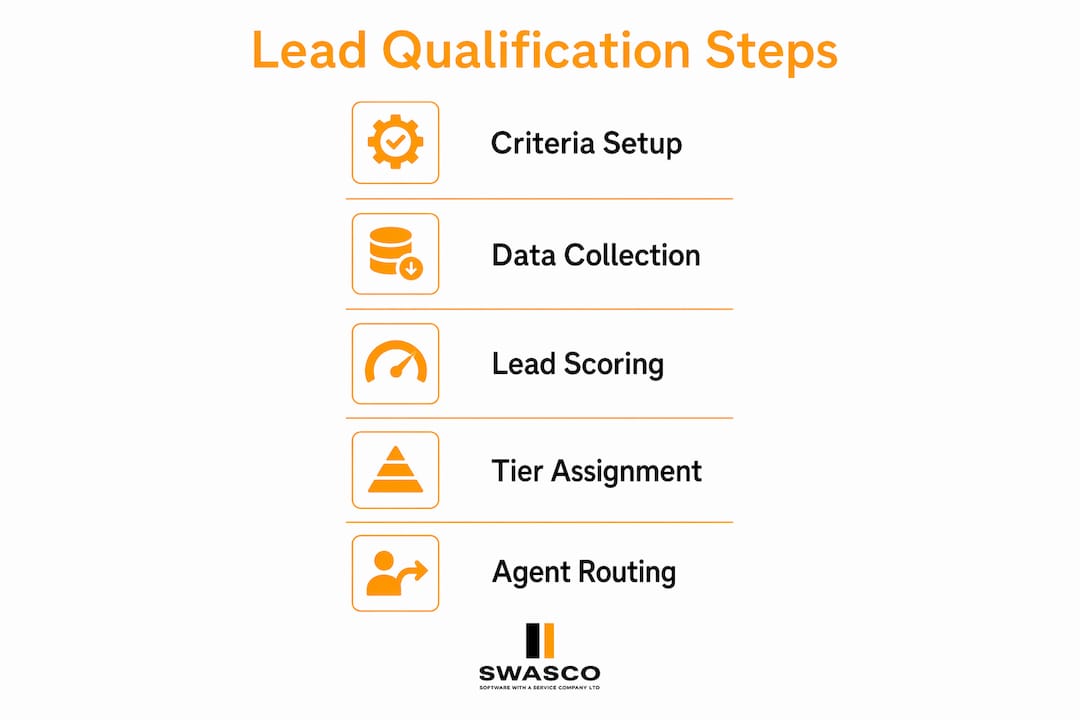
Setting up an efficient lead qualification process takes five deliberate steps. Each one builds on the last, so skipping ahead creates gaps that cost you leads.
-
Define your qualification questions. Focus on the three pillars that determine lead quality: motivation, financial readiness, and specific property needs. Limit your intake form or chatbot script to five questions maximum. Overly long qualification forms reduce completion rates, so every question must earn its place. A strong five-question set covers: reason for moving, target budget, financing status, preferred move-in date, and preferred area.
-
Build AI scoring workflows. Use the BANT framework (Budget, Authority, Need, Timeline) to assign point values to each response. A lead with a confirmed budget, decision-making authority, a clear property need, and a timeline under 90 days scores highest. The BANT framework provides an objective, standardised approach that removes subjective bias from the process entirely.
-
Automate lead routing. Once a lead is scored and tiered, your CRM should route it automatically based on geography, agent speciality, and current workload. A hot lead in North Manchester should reach the agent covering that area within minutes, not hours.
-
Set up tiered nurture sequences. Automated nurture sequences tailored to lead scores maintain engagement and increase conversion over time. Hot leads receive immediate agent contact. Warm leads enter a structured email and SMS sequence. Cold leads go into a long-term drip campaign with monthly check-ins.
-
Monitor and tune monthly. Join your lead scores with actual showing and conversion data every 30 days. Leads that scored "warm" but converted at the same rate as "hot" leads signal that your scoring weights need adjusting.
The table below shows how tiers map to response actions:
| Lead tier | Score range | Response action | SLA target |
|---|---|---|---|
| Hot | 80 to 100 | Immediate agent call | Within 5 minutes |
| Warm | 50 to 79 | Automated email plus SMS sequence | Within 2 hours |
| Cold | Below 50 | Long-term drip nurture campaign | Weekly touchpoint |
Pro Tip: Programme your AI to ask questions before making any property recommendations. Automated qualification avoids pitching before vetting lead motivation, which builds trust and significantly improves conversion rates. Leads that feel heard convert at higher rates than leads that feel sold to.
How does lead scoring work in real estate automation?
A property lead scoring system assigns numeric values to lead attributes and behaviours, then sums those values to produce a tier. The tier determines what happens next without any agent decision required.
Objective criteria are the only safe inputs. Budget confirmation, purchase timeline, decision-making authority, and stated property need are all measurable and compliant. Demographic data is not. Scoring models that incorporate age, family status, or neighbourhood preference by demographic create Fair Housing liability. Your AI must apply refusal patterns consistently to keep the system clean.
Contacting hot leads within 5 minutes significantly increases conversion chances, with response rates dropping sharply after that window closes. This is why the scoring system must trigger routing automatically rather than sending an email to an agent who may not check it for an hour. The 5-minute window is not aspirational. It is a hard operational target.
AI can also extract intent from free-text enquiries. When a lead submits an open-ended message, natural language processing identifies signals such as urgency words ("need to move by March"), budget indicators ("around £350,000"), and motivation cues ("relocating for work"). These signals feed into the scoring engine alongside structured form responses, producing a richer and more accurate tier assignment.
The lettings lead qualification checklist for agents is a practical reference for building your initial scoring criteria, particularly for rental leads where motivation and timeline differ from sales leads.
What are the most common pitfalls in automated lead qualification?
Most automated lead qualification systems fail for one of five reasons. Knowing them in advance saves you weeks of troubleshooting.
- Over-engineering the intake form. Forms with more than five questions see sharp drops in completion. Every additional question is a reason for a lead to abandon the process. Keep it tight and capture the rest through follow-up sequences.
- Pitching before qualifying. Agents and chatbots that lead with property recommendations before understanding the lead's situation destroy trust immediately. Always question first. Effective automation frameworks focus on question-first workflows rather than pitching, increasing lead trust and qualification accuracy.
- Missing Fair Housing compliance. AI systems that ask about or infer protected-class characteristics create legal exposure. Explicit refusal programming for protected-class data is critical to avoid unintentional Fair Housing Act violations. Audit your chatbot scripts quarterly.
- Neglecting scoring performance reviews. A scoring rubric that was accurate in January may misclassify leads by June as market conditions shift. The scoring rubric should be reviewed and tuned regularly by joining lead scores with actual conversion data to reduce misclassification errors.
- Data silos between chatbot and CRM. If your chatbot captures qualification data but it does not flow into your CRM in real time, agents follow up blind. Integration of chatbot outputs into CRM workflows eliminates data silos and ensures timely follow-up on qualified leads. Use Zapier, n8n, or native API connections to close this gap.
For a broader view of how automation applies across the property management function, the property management automation guide covers practical examples beyond lead qualification.
Key takeaways
Automated property lead qualification converts more inbound enquiries into revenue by scoring, tiering, and routing leads instantly using BANT frameworks, AI chatbots, and CRM workflows, with compliance guardrails built in from the start.
| Point | Details |
|---|---|
| Conversion rate benchmark | Healthy systems convert 20 to 40% of inbound leads; outside this range signals a process fault. |
| Five-minute response rule | Hot leads must be contacted within 5 minutes; automated routing makes this operationally achievable. |
| BANT scoring framework | Assign point values to budget, authority, need, and timeline to tier leads objectively and remove agent bias. |
| Fair Housing compliance | Programme explicit refusal patterns for protected-class data before going live to avoid legal exposure. |
| Monthly scoring audits | Join lead scores with conversion data every 30 days and adjust scoring weights to reduce misclassification. |
Why I think most agents automate the wrong thing first
Real estate professionals tend to reach for automation at the marketing end: paid ads, social scheduling, email blasts. The lead qualification step gets left to manual follow-up because it feels personal. That instinct is understandable, but it is costing you money.
In my experience, the highest-value automation in any property business is the moment between a lead arriving and an agent picking up the phone. That gap, which often stretches to hours or even days, is where most revenue is lost. A lead that enquires at 9pm on a Sunday and receives a response on Monday morning has already contacted two other agents. You are not competing on service at that point. You are competing on luck.
What I have found actually works is building the qualification layer first and the nurture layer second. Agents resist this because they worry automation will feel cold to clients. The opposite is true. A lead that receives an immediate, intelligent question about their budget and timeline feels attended to. A lead that waits 18 hours for a generic "thanks for your enquiry" email feels ignored.
The compliance piece is also underestimated. I have reviewed chatbot scripts for property businesses that were inadvertently asking questions that created Fair Housing exposure. The agents had no idea. Tailoring your qualification scripts by lead type, as the research on buyer versus seller qualification confirms, also improves engagement quality in ways that generic scripts simply cannot match.
Automate the qualification step. Get it right. Then build everything else on top of that foundation.
— James Paul
How Talk2Aiva helps you automate property lead qualification
If you are ready to stop losing leads to slow response times and manual processes, Talk2Aiva by SWASCO is built for exactly this.
Talk2Aiva deploys conversational AI across your calls, web chat, SMS, and social media to engage, qualify, and route property leads the moment they arrive, 24 hours a day. The system applies your scoring criteria automatically, tiers leads into hot, warm, and cold, and pushes structured data directly into your CRM. Setup, AI training, workflow building, and ongoing technical support are all included. You focus on the conversations that close. Talk2Aiva handles everything before that point. Explore end-to-end lead automation for property businesses at SWASCO.
FAQ
What does it mean to qualify property leads automatically?
Automated property lead qualification uses AI chatbots, scoring engines, and CRM workflows to assess each inbound lead against defined criteria such as budget, timeline, and motivation, then tier and route them without manual agent input.
How many questions should a property qualification form include?
Limit your qualification form or chatbot script to five questions. Forms with more than five questions see significantly lower completion rates, reducing the volume of leads that enter your scoring system.
What is the BANT framework in real estate lead scoring?
BANT stands for Budget, Authority, Need, and Timeline. It assigns point values to each criterion to produce an objective lead score, tiering leads into hot (showing-ready), warm (nurture), and cold (long-horizon) categories.
How quickly should you contact a hot property lead?
Hot leads should be contacted within 5 minutes of qualification. Response rates drop sharply after this window, making automated routing to an available agent the only reliable way to meet this target consistently.
Is automated lead qualification compliant with Fair Housing rules?
Yes, provided your AI is programmed with explicit refusal patterns that prevent it from collecting or acting on protected-class data such as race, religion, or familial status. Audit your chatbot scripts regularly to maintain compliance.