
Managing rental properties manually is exhausting, and the numbers prove it. The role of automation in rental business operations has shifted from a nice-to-have to a genuine competitive requirement. Yet many landlords and property managers still assume automation is either too expensive or too complex for their portfolio size. That assumption is costing them real money. This article breaks down what rental automation actually involves, the measurable efficiency and revenue gains it delivers, and how you can implement it without disrupting your existing operations.
Table of Contents
- Key takeaways
- What automation in rental business actually means
- Efficiency gains you can actually measure
- Revenue gains from automated workflows
- Implementing automation without the headaches
- Automation and AI: knowing where each fits
- My take on automation after years in this space
- How Talk2Aiva can help your rental business
- FAQ
Key takeaways
| Point | Details |
|---|---|
| Automation cuts manual hours sharply | Total manual time for key tasks drops from 86 hours per month to just 15.5 hours with automation. |
| Revenue recovery is rapid | Renewal rates climb 10 to 15 percentage points within 90 days of implementing automated workflows. |
| Start small for fast wins | Begin with one high-volume, low-complexity task such as rent reminders before expanding to more complex processes. |
| Automation and AI serve different roles | Rule-based automation handles predictable tasks; AI adds adaptability for complex, unstructured decisions. |
| Compliance becomes consistent | Automated screening applies uniform criteria and creates full audit trails, reducing fair housing risk. |
What automation in rental business actually means
Automation, in the context of property management, refers to rule-based, repeatable workflows that trigger actions without human input. When a tenant's rent due date arrives, the system sends a reminder. When a maintenance request is submitted, it is logged, categorised, and routed to the right contractor. No one needs to remember to do it. No one needs to be in the office.
This is different from artificial intelligence. AI makes decisions based on patterns and predictions. Automation follows instructions. Both have a place, but they are not the same thing. Confusing them leads managers to either over-invest in AI tools before their basic processes are even consistent, or dismiss automation as "just software" without recognising its transformational potential.
The most common automated workflows in rental management include:
- Rent collection reminders and late-fee escalation triggered by payment status
- Maintenance request intake and contractor routing based on issue type and urgency
- Lease renewal sequences sent at defined intervals before expiry
- Tenant screening workflows applying uniform criteria across all applicants
- Owner reporting generated and distributed on a fixed schedule
Automated screening logic also reduces fair housing risk by applying the same criteria to every applicant, creating a full audit trail that manual processes simply cannot match.
Pro Tip: If you are unsure where automation ends and AI begins, ask this: does the task always follow the same steps regardless of context? If yes, it is a candidate for automation. If it requires judgement or varies significantly, that is where AI may add value later.
Efficiency gains you can actually measure
The operational case for automated rental management is not theoretical. The data is specific and striking.
Manual time for key tasks drops from 86 hours per month to just 15.5 hours once automation is in place across rent collection, maintenance triage, tenant screening, and reporting. That is not a marginal improvement. That is time you get back to focus on growing your portfolio or improving tenant relationships.
Here is how those savings break down across core activities:
| Task | Manual time (monthly) | Automated time (monthly) | Time saved |
|---|---|---|---|
| Rent collection and follow-up | ~30 hours | ~3 hours | 90% reduction |
| Maintenance triage and routing | ~20 hours | ~4 hours | 80% reduction |
| Tenant screening | ~18 hours | ~5 hours | 72% reduction |
| Owner reporting | ~18 hours | ~3.5 hours | 81% reduction |
Beyond time savings, the compliance benefit is significant. Automated workflows create consistent audit trails that protect you in fair housing disputes and legal challenges around rent collection. When every action is logged automatically, you are not relying on memory or paper records.
Tenant satisfaction also improves. Faster maintenance acknowledgement and consistent communication make tenants feel heard, which directly affects retention. A tenant who receives an automated acknowledgement within minutes of submitting a repair request has a very different experience from one who waits three days for a phone call.
Pro Tip: Track your current monthly hours across rent collection, maintenance, and screening for just two weeks before implementing any automation. That baseline makes your ROI calculation concrete and gives you a clear before-and-after comparison.
Revenue gains from automated workflows
Operational efficiency is one side of the equation. The other is revenue. And this is where the impact of technology on rental industry performance becomes genuinely compelling.

Automated rent increase, lease renewal, and vacancy-to-lease workflows recover 8 to 15% more revenue per unit annually. For a portfolio of 50 units at an average rent of £1,200 per month, that represents between £57,600 and £108,000 in additional annual revenue. Not from raising rents aggressively. From not losing money through process gaps.
Here is how manual and automated approaches compare across key revenue-affecting workflows:
| Workflow | Manual approach | Automated approach |
|---|---|---|
| Lease renewals | Sent when remembered, often late | Triggered 90, 60, and 30 days before expiry |
| Late fee collection | Chased inconsistently, often waived | Escalated automatically, collected 85 to 95% of applicable fees |
| Vacancy-to-lease | Slow response to enquiries, longer voids | Instant follow-up, shorter vacancy periods |
| Rent increases | Applied ad hoc, sometimes missed | Scheduled and applied consistently across portfolio |
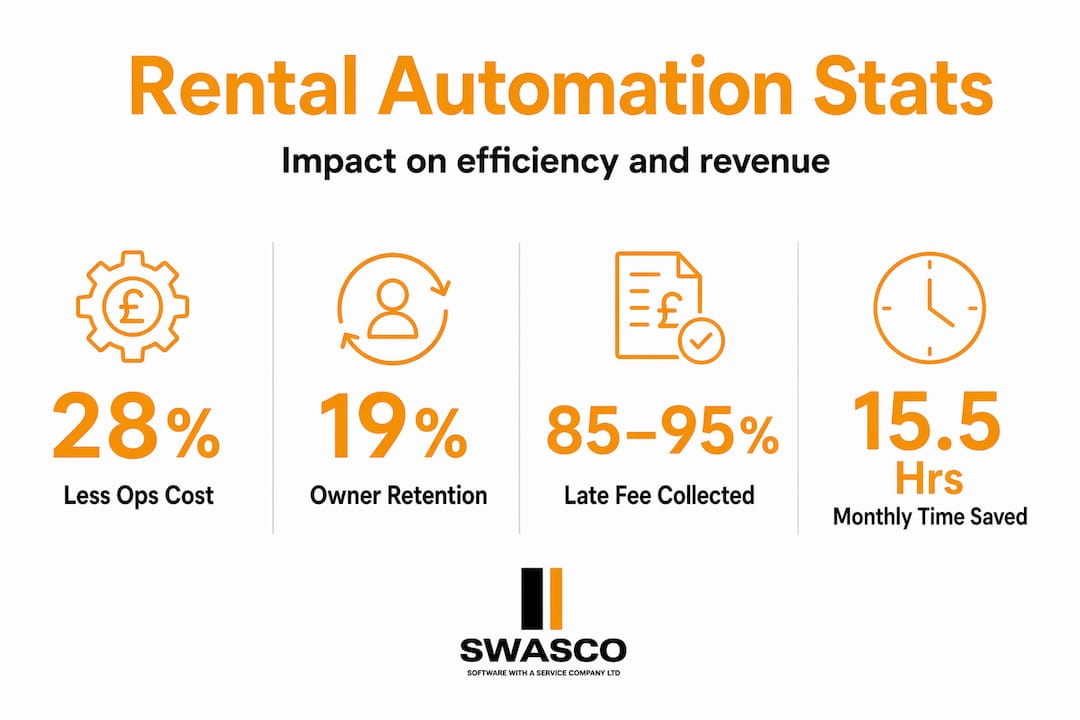
The late fee data is particularly telling. Automated late-fee escalation collects 85 to 95% of applicable fees, compared to 55 to 70% when managed manually. Late rent payments also reduce by up to 34% when automated reminders are in place. Tenants pay on time when the system consistently reminds them. They delay when they know nothing will happen quickly.
You can also learn more about lost rental leads and how slow response times during the vacancy-to-lease phase cost landlords more than they realise.
Full-stack automation reduces operational costs by 28% and increases owner retention by 19% annually. Property management firms that automate at least 40% of back-office tasks report 22% higher profit margins. These are not projections. They are reported outcomes from firms that have already made the shift.
Implementing automation without the headaches
The biggest reason automation projects fail is not the technology. It is the process underneath it. Automation failure most often results from trying to automate chaotic, undocumented workflows. You end up scaling the inefficiency rather than removing it.
Here is a practical sequence that works:
- Map your current workflows. Write down every repeatable task you or your team performs each week. Include who does it, how often, and how long it takes. This is your baseline.
- Identify your highest-volume, lowest-complexity tasks. Rent reminders, maintenance intake, and lease renewal sequences are ideal starting points. They are high-impact and straightforward to automate.
- Choose a unified platform. Integrated systems that connect your property management software, communication tools, accounting, and vendor management handle 80% or more of routine operations automatically, escalating exceptions only. Avoid bolting together disconnected tools that create new data silos.
- Automate one workflow fully before moving to the next. Test it, measure it, and confirm it is working as intended. Then expand.
- Review compliance requirements before automating screening or communications. Automated workflows must still meet legal obligations around fair housing, data protection, and tenancy law.
For guidance on where to start, this resource on picking your first workflow to automate is a practical reference for back-office decisions.
The ROI timeline is faster than most managers expect. Most revenue automation cases close within 30 days for portfolios above 50 units, with renewal rates climbing 10 to 15 percentage points within 90 days of implementation.
Pro Tip: Do not try to automate everything at once. Pick the single task that costs you the most time or causes the most errors. Get that running well. The confidence and clarity that comes from one working automation makes the next one far easier to implement.
You can also explore how to automate application screening as an early high-impact step that delivers both time savings and compliance benefits.
Automation and AI: knowing where each fits
Understanding the difference between rule-based automation and AI is not just academic. It affects how you spend your budget and where you focus your attention.
Automation is foundational for operational stability. It handles the predictable, repeatable tasks that make up the majority of daily property management work. AI adds adaptability for complex, unstructured tasks where the right action depends on context.
In practice, this means:
- Automation handles rent reminders, maintenance routing, lease renewal sequences, and report generation
- AI can analyse maintenance history to predict failures before they happen, or personalise leasing communications based on prospect behaviour
- The right order is to automate first, then layer AI where it genuinely adds decision-making value
- The risk of skipping automation and jumping to AI is that you invest in adaptability before you have stability
Successful operators build what might be called an operational command centre: a unified system where pricing, scheduling, maintenance, and communications all connect. AI sits on top of that foundation, not underneath it.
The cost and complexity of AI tools also remains higher than basic automation software. For most rental businesses managing under 200 units, the returns from well-implemented automation will outpace AI investment for the foreseeable future.
My take on automation after years in this space
I have seen rental managers spend months evaluating AI platforms while their rent collection process still relies on someone remembering to send a text message. That is the wrong order of operations.
What I have learned is that the managers who get the most from automation are not the ones who buy the most sophisticated software. They are the ones who take the time to understand their own workflows before touching any technology. When you know exactly what you do, how often, and where it breaks down, automation becomes obvious rather than overwhelming.
I have also noticed that the fear of automation being "too impersonal" rarely survives first contact with the results. Tenants do not care whether a maintenance acknowledgement came from a person or a system. They care that it arrived quickly and that someone followed through. Automation handles the first part. Your team handles the second.
The managers I worry about are the ones treating automation as optional in 2026. Digital competitiveness in rental markets now depends on operational speed and consistency that manual processes cannot deliver at scale. If your competitors are recovering 15% more revenue per unit through automated workflows and you are not, that gap compounds every month.
Start with one workflow. Measure it. Build from there. That is not a cautious approach. It is the fastest path to results.
— James Paul
How Talk2Aiva can help your rental business
If this article has shown you where your rental operations are leaking time and revenue, Talk2Aiva by SWASCO is built to close those gaps. Talk2Aiva uses conversational AI to instantly engage, qualify, and follow up with leads and enquiries 24/7, across calls, text, website chat, and social media. For rental businesses, that means no missed enquiry during a void period, no delayed response to a prospective tenant, and no revenue lost because someone called after hours.
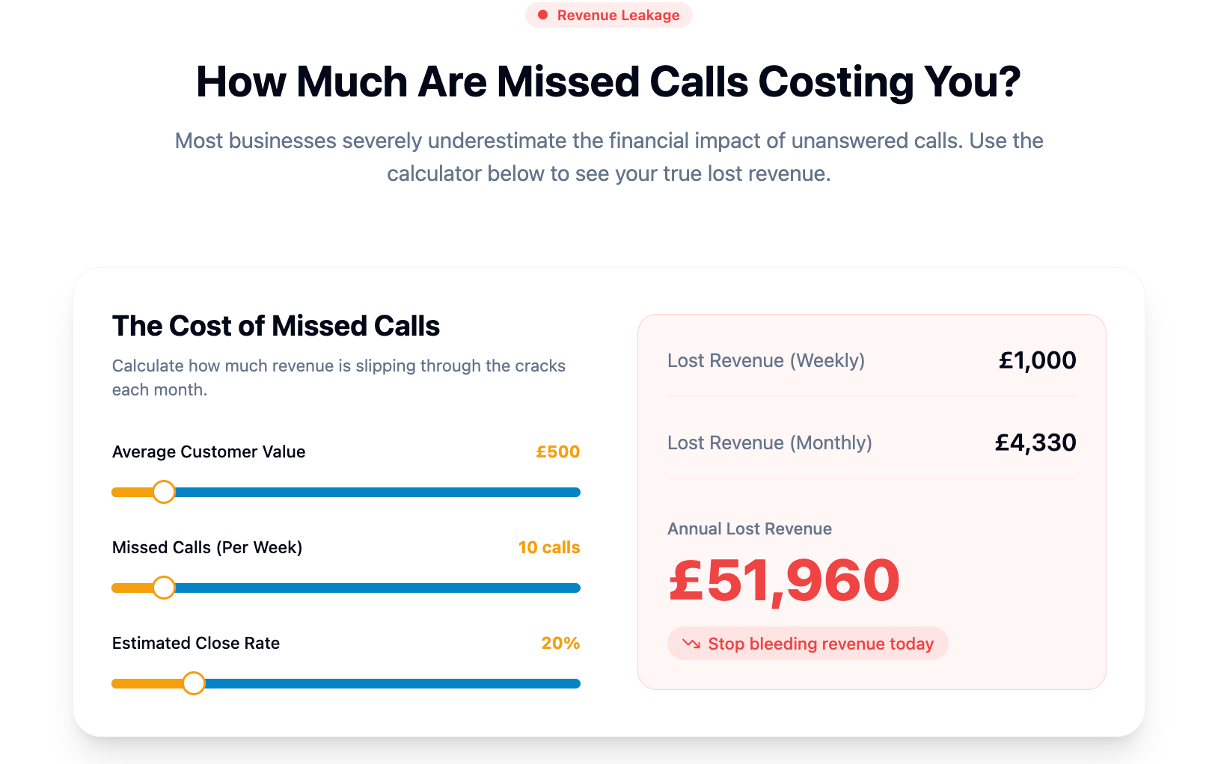
Talk2Aiva handles the front-end communication layer that sits on top of your rental management workflows, so your team focuses on decisions rather than chasing messages. Setup and ongoing technical support are included, meaning you are not left to figure it out alone. Visit Swasco's automation platform to see how it integrates with your rental operations and starts recovering revenue from day one.
FAQ
What does automation mean for a rental business?
Automation in rental management refers to rule-based workflows that trigger actions automatically, such as sending rent reminders, routing maintenance requests, or issuing lease renewal notices, without requiring manual input each time.
How much time can automation save a property manager?
Total manual time for core tasks including rent collection, maintenance triage, and reporting drops from 86 hours per month to around 15.5 hours with automation in place.
Does automation help with late rent payments?
Yes. Automated rent reminders and late-fee escalation reduce late payments by up to 34% and collect 85 to 95% of applicable late fees, compared to 55 to 70% when managed manually.
When does automation pay for itself?
For portfolios above 50 units, most revenue automation cases recover their cost within 30 days, with renewal rates improving by 10 to 15 percentage points within 90 days.
Should I use AI or automation for my rental business?
Start with automation for predictable, repeatable tasks. AI is best layered on top once your core workflows are stable, adding value in areas like predictive maintenance or personalised leasing communications.