

The fastest way to fix tyre shop bookings is a 24/7 AI receptionist that answers instantly and books the job while the caller is still on the line. Every ring that goes unanswered is a customer calling the next shop on the list. There are AI receptionist solutions designed to convert after-hours and overflow calls into confirmed appointments instead of missed opportunities.
TL;DR:
- An AI receptionist that answers calls instantly and handles bookings 24/7 captures more inquiries and prevents missed opportunities during peak or off-hours.
- Integration with your calendar and POS ensures bookings are accurate, respecting bay and fitter availability, and avoids double-booking or stock mismatches.
- Training the AI on your specific services, pricing, and job durations improves booking accuracy and reduces no-shows by providing timely confirmations and reminders.
- Using deposits and automatic rescheduling minimizes cancellations and last-minute gaps, keeping the workflow full and efficient.
- Protecting customer data with proper security and clear retention policies remains essential, especially for sensitive personal and vehicle information.
Table of Contents
- Why automation matters for tyre-fitting businesses
- Core features checklist for an AI receptionist and booking automation
- Step-by-step implementation plan for tyre shops
- Integrations and operational tips: calendars, POS and messaging
- Common pitfalls and how to avoid them
- Handling cancellations and rescheduling efficiently
- Data privacy and security considerations when managing booking information
- Author perspective: real-world lessons from automation projects
- How Talk2Aiva by SWASCO helps tyre shops capture every booking
- Sources
- FAQ
Why automation matters for tyre-fitting businesses
Someone with a slow puncture or a screeching brake doesn't wait around. They call whoever answers first, and if that's not you, it's your competitor two streets over. Speed to respond isn't a nice-to-have in tyre fitting. It's the difference between a booked bay and an empty one.
Most missed calls happen at the worst possible moments: lunchtime rushes, end-of-day pickups, or evenings and weekends when the front desk is unstaffed, but demand hasn't stopped. Internal guidance on after-hours enquiry handling shows that always-on call capture converts enquiries that would otherwise vanish into a voicemail nobody checks until morning.
Beyond the immediate booking, centralising every enquiry into one system builds a cleaner record of who called, why, and what they need next. That matters for follow-up and repeat business.
Automating the front end also frees your team from constant callback chasing:
- Fewer manual callbacks chasing missed enquiries
- Less time spent double-checking diaries against workshop capacity
- More admin hours redirected towards fitting, not phone tag
- A cleaner paper trail for repeat customers and fleet accounts
Core features checklist for an AI receptionist and booking automation
Not every booking tool is built for a workshop with limited bays, mobile fitters on the road, and stock that changes by the hour. Before you commit to any system, check it against this shortlist.
- Immediate voice answering with natural conversation. The system needs to sound like a person who understands tyres, not a menu of button presses.
- Calendar sync with bay and mobile fitter rules. Google or Outlook integration should respect which bays are free and which mobile fitter is already booked out.
- Automatic confirmations and a structured reminder sequence. A confirmation at the point of booking, a reminder roughly 48 hours out, and a same-day nudge by SMS or email meaningfully cuts no-shows, according to Acuity Scheduling's 2025 customer survey.
- Lead qualification on the call itself. Tyre size, vehicle make, and urgency should be captured before the booking is confirmed, not chased afterwards.
- A unified inbox and call log. Every call, text, and web enquiry needs to land in one place for accurate follow-up and reporting.
Pro Tip: Ask any provider to show you a live call transcript, not a demo script. Real conversations expose whether the AI can actually handle a caller who doesn't know their tyre size off the top of their head.
Missing any one of these usually shows up later as a double-booked bay or a customer who never got their reminder.
Step-by-step implementation plan for tyre shops
Rolling out an AI receptionist works best as a staged process, not a switch you flip overnight.
- Map your appointment flows first. Document workshop bay slots, mobile fitter routes, and how long each job type genuinely takes.
- Train the AI on your service list and pricing. Feed it your tyre brands, fitting prices, alignment add-ons, and answers to the questions your front desk gets asked daily.
- Set booking rules before launch. Decide on deposit requirements, minimum lead time, and buffer slots between jobs so bays aren't overrun.
- Run a soft launch. Route calls to a human for a set number of rings before the AI picks up, giving your team a safety net while the system learns your patterns.
- Automate confirmations and reminders. Once live, every booking should trigger a confirmation and a reminder sequence without anyone touching a keyboard.
- Review and refine weekly. Listen back to real calls for the first 30 to 90 days and adjust prompts where the AI stumbles.
Training on specifics matters more than most shops expect. An AI receptionist that knows how long a typical fitting takes and whether alignment is bundled in will book accurate slots instead of guessing.
During onboarding, expect to answer questions like:
- What's your average job duration by tyre type and vehicle class?
- Which days or hours are mobile fitters unavailable?
- What's your policy on same-day emergency callouts?
- Do you require a deposit for special-order tyres?
Integrations and operational tips: calendars, POS and messaging
The booking system is only as reliable as what it talks to. Connect your calendar first, whether that's Google Calendar or Outlook, and double-check the sync runs both directions. A common pitfall is a workshop manually blocking out a bay in one system while the booking tool still shows it as free.
From there, map confirmed bookings into your workshop management or point-of-sale software so a booked appointment automatically becomes a scheduled job with stock allocated against it. This avoids the classic mismatch where a customer turns up for a tyre that was never actually reserved.
Automated confirmation systems paired with a small deposit for higher-value fittings do the heavy lifting on no-shows. A partner guide on centralising customer updates for repair workshops makes a similar point: the businesses that keep customers informed automatically see far fewer no-shows and last-minute cancellations than those relying on memory.
Track these numbers weekly once live:
- Answered call rate versus missed calls
- Bookings made per call answered
- No-show rate against total bookings
- Average time from first enquiry to job completion
Common pitfalls and how to avoid them
Most failed rollouts trace back to a handful of avoidable mistakes.
- Inadequate training produces wrong bookings. Test the AI with real, messy phone calls before launch, not just clean scripted examples.
- Availability mismatches frustrate customers. If the booking system doesn't know a bay is actually full, enforce hard slot rules so it can't overbook.
- No escalation path for complex queries. Fleet accounts, warranty disputes, and unusual fitments need a clear route to a human.
- Over-automation annoys callers. Always keep a simple, obvious way to reach a person.
Pro Tip: Run your soft launch for at least two full weeks before removing the human safety net entirely. Edge cases surface slower than you'd think.
Handling cancellations and rescheduling efficiently
Cancellations are inevitable in tyre fitting. Weather changes, parts arrive late, or a customer's plans shift. What separates a well-run booking system from a chaotic one is how smoothly that change gets absorbed.
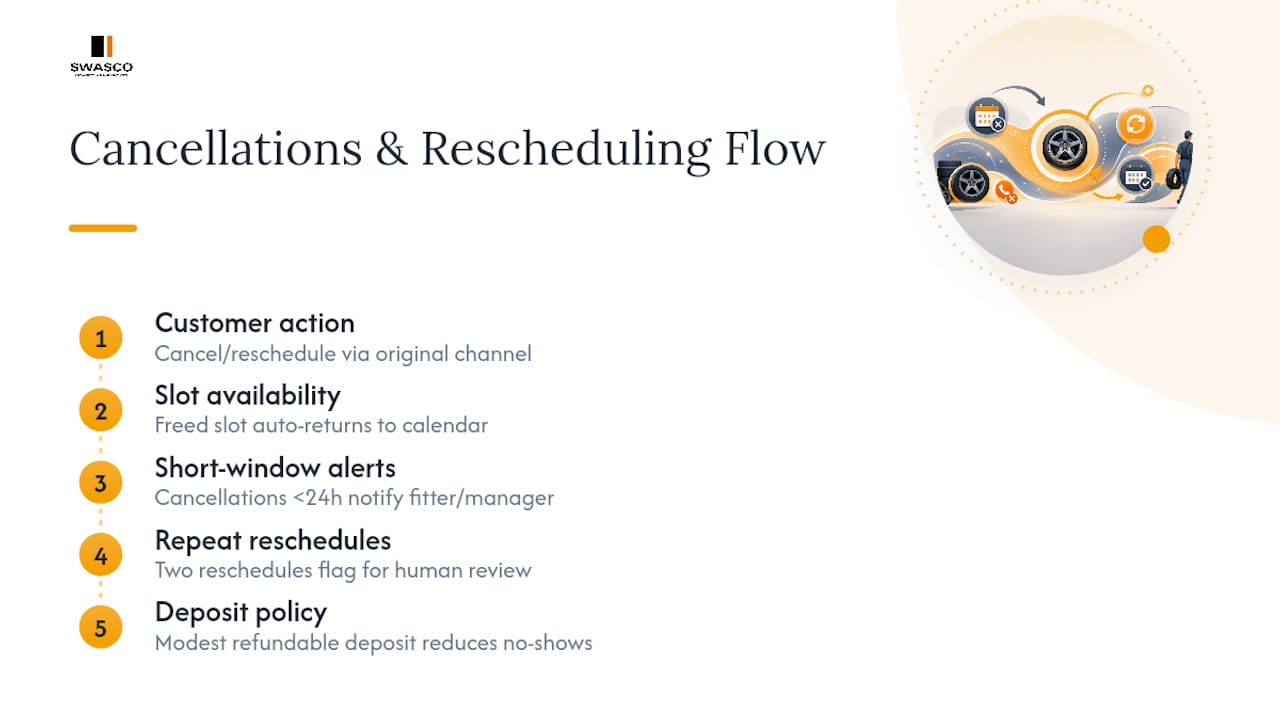
An AI receptionist should let customers cancel or reschedule through the same channel they booked in, whether that's a callback, a text reply, or a quick web chat, without forcing them to phone during business hours and wait on hold. The moment a slot frees up, it needs to reappear in your calendar automatically so it can be offered to the next enquiry, not sit invisible until someone manually checks the diary.
Build a simple internal rule: any cancellation inside a short window, say 24 hours, triggers an automatic alert to a mobile fitter or bay manager so they can fill the gap rather than lose the slot entirely. For rescheduling, the system should recognise repeat patterns. A customer who reschedules twice for the same fitting is a signal worth flagging to a human, since it often means a genuine complication rather than simple forgetfulness.
Deposits play a useful role here too. A modest deposit on higher-value bookings, refundable within a reasonable cancellation window, tends to reduce casual no-shows without discouraging genuine customers, echoing the same pattern seen in scheduling automation outcomes more broadly. The goal isn't to penalise customers. It's to keep your bays full and your diary honest.
Data privacy and security considerations when managing booking information
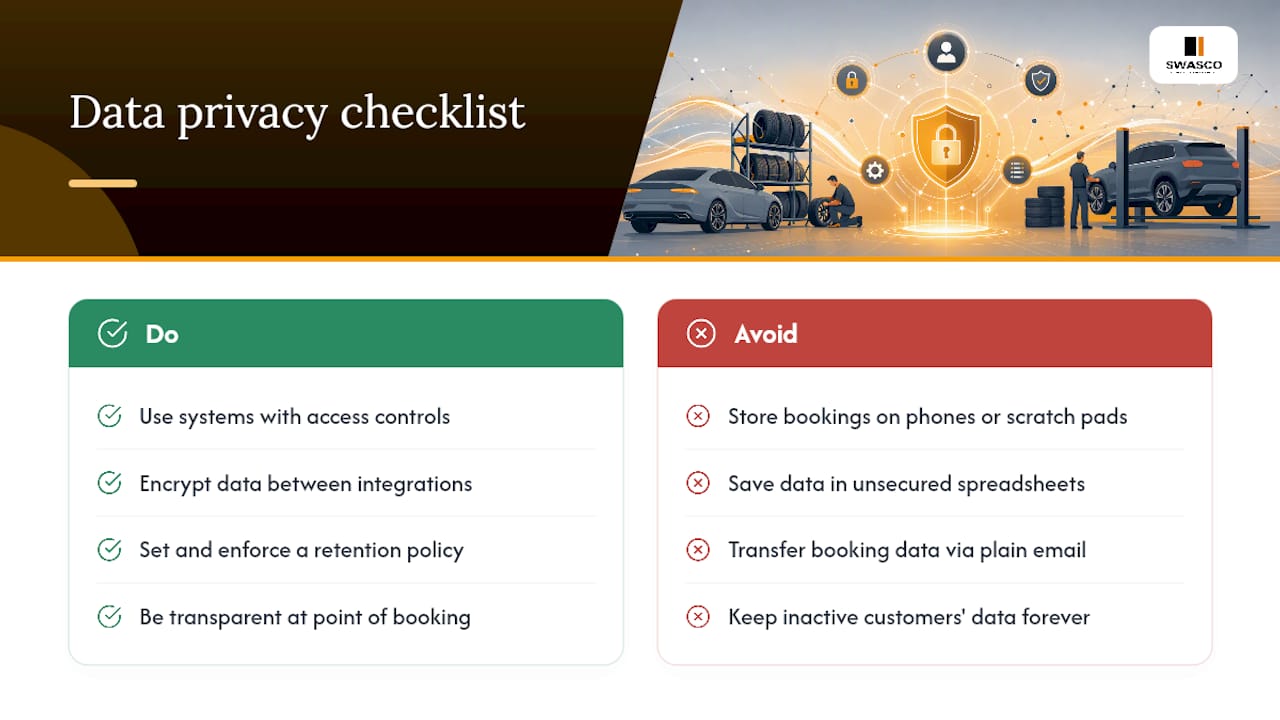
Every booking captures personal data: names, phone numbers, vehicle registrations, and sometimes payment details for deposits. That data needs handling with the same care you'd expect from any customer-facing system, not treated as an afterthought bolted onto a scheduling tool.
Start with storage. Booking information should sit in a system with proper access controls, meaning only staff who need it can see it, and it shouldn't be scattered across scratch pads, personal phones, or unsecured spreadsheets. If your AI receptionist integrates with your calendar and POS, check that data flows between them over encrypted connections, not plain email exports.
Retention matters too. Vehicle registration and contact details tied to a completed job don't need to live in an active system forever. Set a sensible retention policy and stick to it, particularly for customers who haven't returned in years.
Be transparent about what you collect and why, especially if reminder texts or marketing follow-ups use the same contact details gathered at booking. A clear, brief note at the point of booking, something as simple as confirming a number will be used for appointment reminders, avoids the awkward surprise of an unexpected message later. Any provider handling this data on your behalf should be able to explain plainly how it's stored, who can access it, and how long it's kept. If they can't answer that clearly, that's a red flag worth taking seriously before signing anything.
Author perspective: real-world lessons from automation projects
The first 90 days follow a predictable pattern. Answered call rate climbs almost immediately as the AI picks up when nobody else would have. Booked appointment rate and no-show reduction usually build over a few weeks as the AI's training on your specific services and pricing matures.
The biggest single lever isn't the AI itself. It's how well you've trained it on your own FAQs and reminder cadence, covered in the class booking automation playbook. Shops that skip proper onboarding get a receptionist that answers politely but books badly.
Guided onboarding exists because most tyre shops don't have a technical team sitting idle. Lean into it, and treat optimisation as ongoing, not a one-off setup task.
— James Paul
How Talk2Aiva by SWASCO helps tyre shops capture every booking
This kind of AI receptionist system aims to answer calls around the clock, qualify the caller, check calendars in real time, and confirm appointments during the call.
Setup isn't a case of switching on generic software and hoping it works. Such systems typically include guided onboarding to map schedules, AI training on service lists and pricing, a soft launch period, and ongoing optimisation. Calendar sync, SMS and email reminders, and a unified inbox often come built in to avoid manual integration.
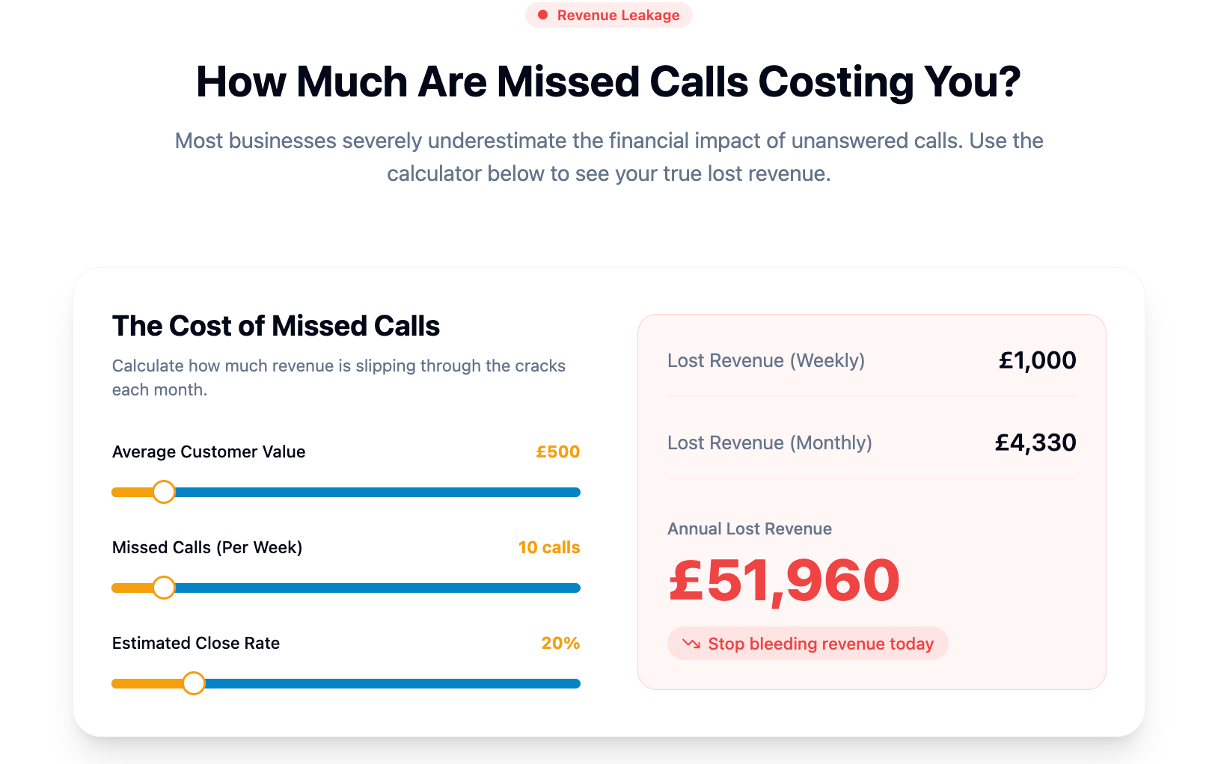
If missed calls are costing you bookings every week, visit the Talk2Aiva landing page to talk through a pilot for your shop.
FAQ
What is the best way to automate tyre shop bookings?
A 24/7 AI receptionist that answers calls, qualifies the caller, and syncs directly with your calendar is the most reliable route, since it captures enquiries the moment they happen rather than after a callback.
How does mobile tyre fitting appointment booking differ from in-shop booking?
Mobile fitting needs the booking system to account for travel time and technician location alongside service duration, so calendar rules must reflect routes and territories, not just a single fixed bay.
How long does it take to see results from booking automation?
Answered call rate typically improves within the first week of launch, while booked appointment rate and no-show reduction usually build over four to six weeks as the AI's training on your services matures.
What metrics should I track after automating bookings?
Watch answered call rate, bookings made per call, no-show rate, and the average time between first enquiry and completed job to judge whether the system is working.
Can Talk2Aiva handle both workshop and mobile tyre fitting bookings?
Yes. Talk2Aiva's calendar sync and onboarding process are built to reflect bay availability and mobile fitter schedules, so bookings route correctly whichever service model you run.