
Implement an AI receptionist that instantly captures, qualifies and books every lead, connected to your CRM and calendar. That single move fixes the biggest leak in most agencies: slow speed-to-lead. Once you're set up, try a guided demo of Talk2Aiva and see it working against your own portal feeds within days.
Key Takeaways
Estate agent lead automation works because it closes the speed-to-lead gap that costs most agencies their best enquiries before a human ever calls back.
| Point | Details |
|---|---|
| Speed decides contact rate | Replying within five minutes lifts contact rates 5 to 10 times versus a 30-minute delay. |
| Integrations come first | Prioritise CRM, calendar and portal syncing before adding advanced analytics or telephony. |
| Pilot before full rollout | Run a two to four week pilot on one branch or lead source to catch mapping errors early. |
| Track five core metrics | Monitor response time, contact rate, booking rate, cost per lead and lead-to-close conversion. |
| Talk2Aiva as a deployable option | Talk2Aiva bundles AI receptionist, qualification, booking and CRM sync with done-for-you setup and support. |
Table of Contents
- Why estate agent lead automation matters right now
- What features does a lead automation tool need?
- How does an automated lead workflow actually run?
- Which integrations should agencies prioritise?
- How do you roll out lead automation, and what does it cost?
- What metrics actually prove automation is working?
- What pitfalls should agencies avoid when automating leads?
- Why is Talk2Aiva a practical choice for estate agents?
- Try Talk2Aiva's guided setup and demo
- Frequently asked questions
- Sources
Why estate agent lead automation matters right now
Speed decides who wins the instruction. Contact an enquiry within five minutes and you're 5 to 10 times more likely to reach that person than if you wait 30 minutes, yet many UK agents still average response times above 45 minutes. That gap is not a training problem. It's a staffing and timing problem, and it's exactly what estate agent lead automation solves.
Automating first response and qualification tends to deliver:
- Higher contact rates, because someone (or something) answers before the lead cools
- More booked viewings and valuations, without extra admin hours
- Cleaner vendor reporting, since every touchpoint is logged automatically
- Freed-up staff time to focus on negotiations, not chasing forms
Because so many competitors still respond slowly, agencies that fix this first grab an advantage that costs surprisingly little to capture.
What features does a lead automation tool need?
Not every tool marketed as "AI for estate agents" does the same job. Before you commit to one, check it covers the basics that actually move conversion.
- Instant first response. SMS, email or chat reply within seconds, referencing the specific property and using the enquirer's name.
- Automatic qualification. Questions on timeline, budget and intent, with smart routing so a hot buyer reaches a negotiator, not a generic inbox.
- Booking with calendar sync. Valuations and viewings get slotted directly into an agent's diary, with confirmation and reminder messages sent automatically.
- Multi-channel, one inbox. Website chat, SMS, WhatsApp and phone calls all land in a single unified thread, so nobody replies twice or misses a message.
- Pre-built workflows and analytics. Follow-up sequences that run themselves, plus dashboards showing where leads stall in the pipeline.
Buyers who treat this as a checklist, rather than judging tools on a features list alone, tend to see the biggest jump in conversion and agent efficiency.
How does an automated lead workflow actually run?
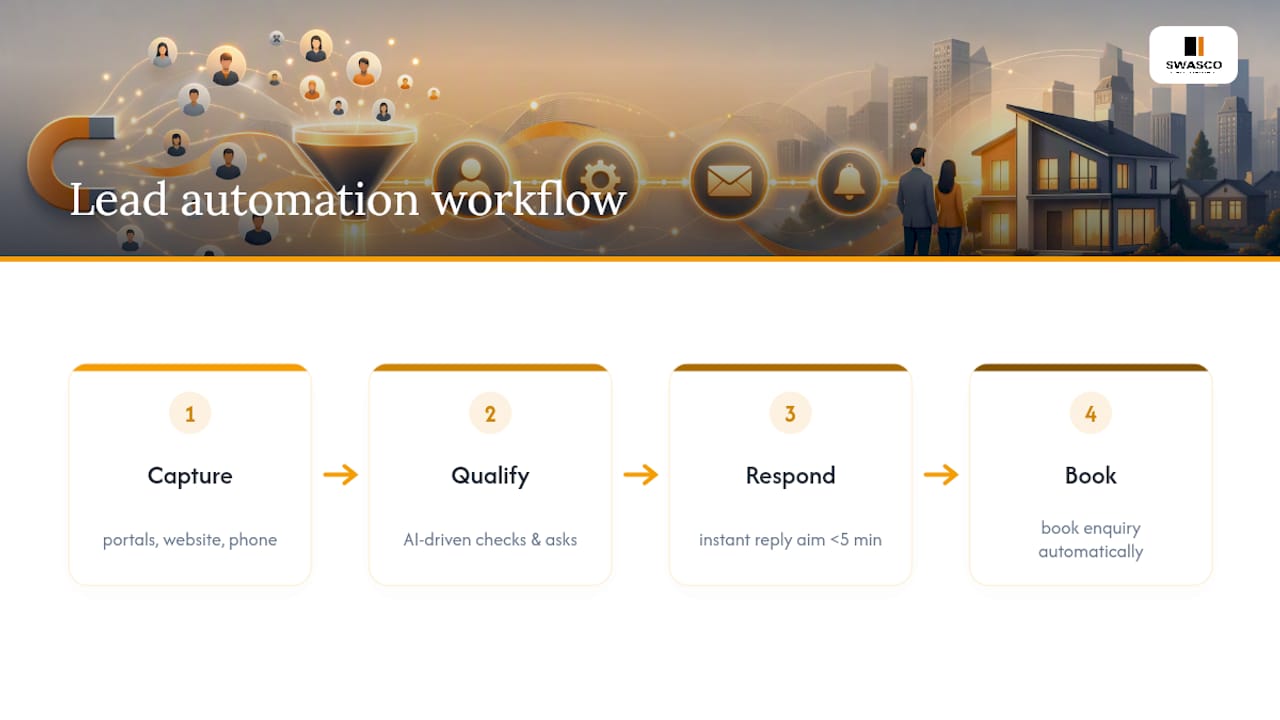
Picture a seller filling in a valuation form on Rightmove at 9pm.
- The enquiry hits your CRM the instant it's submitted, tagged with source and property reference.
- An automated reply goes out within seconds, thanking them and asking two or three qualifying questions.
- Based on the answers, the system scores intent and routes the lead to the right valuer.
- A calendar link is offered, and the seller books a slot without a single phone call.
- The negotiator gets a summary and a confirmed appointment before they've finished their coffee.
Every one of those handoffs used to involve a human checking an inbox, typing a reply, and hoping the seller hadn't already booked with a competitor. Automation removes the manual touchpoints from steps one to four, leaving your team to focus purely on step five: the conversation that actually closes the sale.
Which integrations should agencies prioritise?
Lead automation only works if it talks to the systems you already use. Trying to bolt it onto a fragmented stack is where most rollouts stumble.
- CRM — the single source of truth for every contact and interaction history.
- Calendar (Google or Outlook) — for real-time booking without double-entry.
- Property portal inboxes — Rightmove, Zoopla and OnTheMarket enquiries need automatic capture, not manual copy-paste.
- Telephony or SMS provider — so calls and texts feed the same record as web enquiries.
- Web forms — valuation and viewing request forms should push straight into the workflow, not sit in a separate mailbox.
Watch how data flows between these systems: duplicate contacts and mismatched fields cause more wasted follow-up than any missing feature. For a small agency, treat CRM and portal integration as mandatory on day one; telephony and advanced analytics can follow once the basics are proven.
How do you roll out lead automation, and what does it cost?
A realistic project runs in phases rather than a single big-bang switch.
- Discovery (a few days) — map your current lead sources and response gaps.
- Integrations (one to two weeks) — connect CRM, calendar and portal feeds.
- Workflow and script build (one to two weeks) — write qualification questions and follow-up sequences.
- Staff training (a few days, run alongside the build) — get negotiators comfortable handing off to the system.
- Pilot (two to four weeks) — run on one branch or one lead source before full rollout.
- Full launch — extend across all channels once the pilot proves out.
Costs typically break into three buckets:
- Subscription fees, usually tiered by feature depth and lead volume
- One-off integration or setup costs where custom portal connections are needed
- Internal time, mainly during the pilot, which shrinks fast once workflows are tuned
Payback usually comes from faster contact rates converting into extra viewings and instructions, not from cutting headcount.
What metrics actually prove automation is working?
Track a short list of numbers, not a dashboard full of vanity metrics.
- Response time — the clock from enquiry to first reply, aiming for minutes, not hours.
- Contact rate — the share of leads you actually reach, which climbs sharply once response time drops under five minutes.
- Booking rate — enquiries converted into a confirmed viewing or valuation slot.
- Appointment-to-instruction rate — how many bookings turn into signed business.
- Cost per lead — weighed against source, since paid leads often convert at 0.4% to 1.2% while referral and organic leads convert several times higher.
- Lead-to-close conversion — the number that ultimately justifies the spend.
Review these weekly during the pilot, then monthly once the system is settled, so you catch drift before it costs you instructions.
What pitfalls should agencies avoid when automating leads?
Automation goes wrong in predictable ways. Watch for over-automated replies that sound robotic and switch off a genuinely warm buyer, poor field-mapping that scrambles names and property references, duplicate contact records, and no clear escalation path when a high-intent lead needs a human immediately.

Operationally, the same mistakes recur: skipping agent training, never testing what happens when two people try to book the same viewing slot, and failing to check conversion metrics until months in. On compliance, make sure every marketing contact has a recorded lawful basis and consent flag, and keep a data-processing record with your vendor under GDPR.
Why is Talk2Aiva a practical choice for estate agents?
Talk2Aiva by SWASCO is built as a guided AI receptionist and revenue recovery system, not a bare software licence you're left to configure alone. It answers calls, texts, website chat and social messages around the clock, qualifies each enquiry, books it straight into your calendar, and keeps every conversation in one unified inbox.
Set against the checklist above, it maps closely:
- Instant multi-channel response, so no portal enquiry sits unanswered overnight
- Built-in qualification and routing to the right negotiator
- Calendar-synced booking with automatic confirmations
- Done-for-you onboarding, workflow building and ongoing technical support included
Pro Tip: Ask any vendor how they handle a valuation enquiry that arrives at 11pm on a Sunday. If the answer involves "we'll get back to them Monday," you've found your speed-to-lead gap before you've even signed up.
Because setup, training and optimisation are bundled in rather than left to your team to figure out, the usual rollout friction, half-built workflows and stalled pilots, is largely removed before it starts.
A note from the author
James Paul has written extensively on lead response time in estate agencies and portal capture. This guide draws on that hands-on deployment experience and the measurable outcomes it produced.
Try Talk2Aiva's guided setup and demo
Talk2Aiva removes the guesswork agencies usually face when comparing automation tools: instead of a self-serve platform you configure alone, setup, workflow building and training are handled for you from day one. That matters most for agencies that need portal enquiries and valuation requests captured correctly from week one, not after months of trial and error.
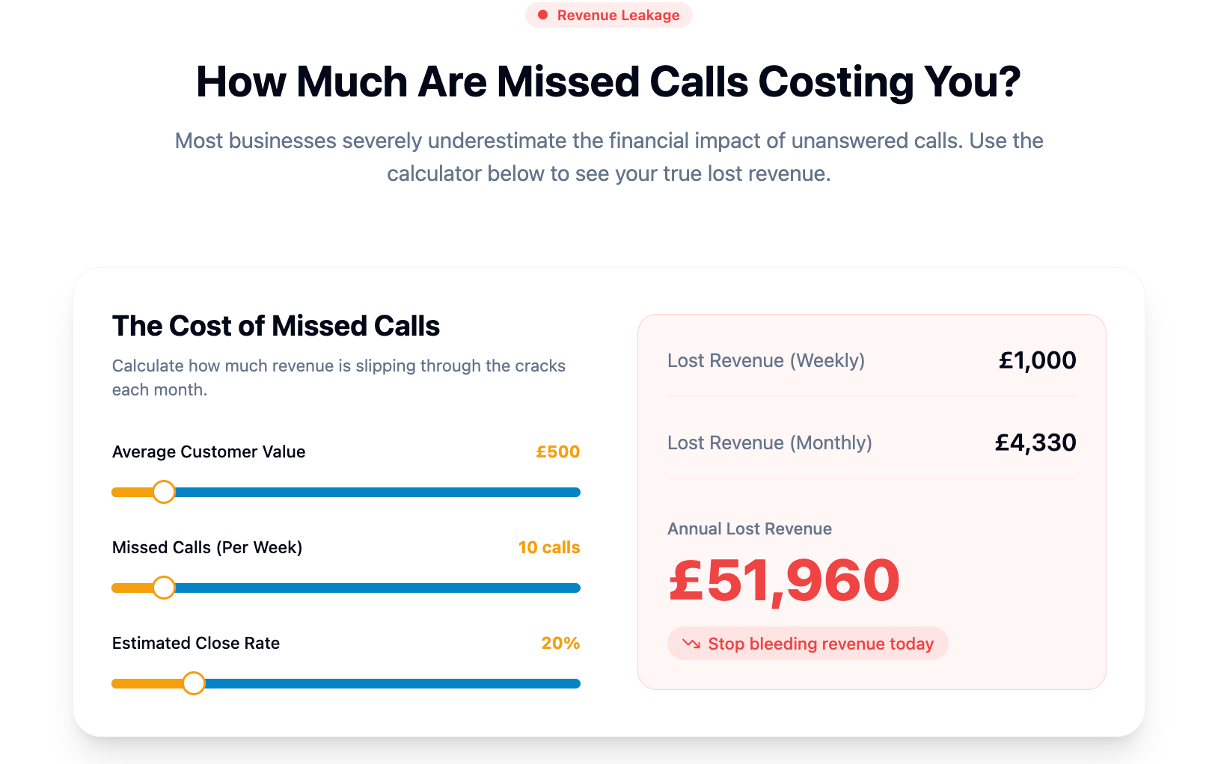
The practical next step is a guided demo connected to your own CRM and portal feeds, so you can see qualification and booking working on real enquiries rather than a generic script. If you're weighing this against building workflows yourself, a pilot removes that risk cheaply. Book a demo with Talk2Aiva and ask specifically for a pilot scoped to your current portal and CRM setup.
Frequently asked questions
What is estate agent lead automation? It's the use of software, often AI-driven, to instantly capture, qualify, respond to and book enquiries from property portals, websites and phone calls without waiting for a human to check an inbox.
How quickly should an estate agency respond to a new enquiry? Aim for under five minutes. Response times beyond 30 minutes sharply reduce your chance of reaching the enquirer at all.
Does automation replace the negotiator's role? No. It handles first response, qualification and booking, freeing negotiators to focus on the conversations and negotiations that actually close instructions.
Is estate agent lead automation GDPR compliant? It can be, provided you maintain a lawful basis for contacting each lead, record consent flags, and keep a data-processing agreement with your automation vendor.
How long does it take to implement lead automation? Most agencies can complete discovery, integration and a pilot within four to six weeks, with full rollout following once the pilot proves out.
Sources
- Lead response time in property — why the first five minutes win the instruction
- Proven real estate lead sources that convert
- Effective Lead Management Automation for Estate Agents