
Manual follow-up is defined as the practice of relying on individual agents to personally track, time, and send every lead communication without system enforcement. This approach fails agents not because they lack effort, but because the structure itself is broken. Responding within 5 minutes makes a connection 100 times more likely than a 30-minute delay. Yet manual processes routinely produce 2 to 3 hour gaps. That is why manual follow up fails agents at scale, regardless of how capable or motivated those agents are. Tools like CRM platforms, automated sequencing software, and AI-driven engagement systems exist precisely because human memory and discipline cannot match the speed and consistency that lead conversion demands.
What specific challenges cause manual follow-up to fail consistently?
Manual follow-up failure is primarily caused by structural system flaws, not personal behaviour. Three root causes appear repeatedly across real estate and service businesses.
Ownership ambiguity is the first. When a lead arrives and no system assigns it to a specific agent with a defined timeline, it sits unworked. Leads get ignored due to lack of system enforcement of ownership, timing, and follow-up visibility. Every agent assumes someone else is handling it. Nobody is.
Disconnected systems compound the problem. Most agents capture leads through portals, website forms, or social media, but those sources rarely connect directly to a CRM. The result is a manual data transfer step that introduces delay and error. By the time a lead reaches an agent's task list, the prospect has already heard from a competitor.

Human inconsistency is the third failure point. Message timing, tone, and content vary from agent to agent and even day to day for the same agent. Follow-up inconsistency damages brand perception and reduces engagement. A prospect who receives a warm message on Monday and a rushed, generic one on Thursday notices the difference.
Common manual follow-up challenges that agents face daily include:
- No automatic reminder when a lead has not been contacted within a set window
- No record of what was said, when, or by whom across a shared team inbox
- No escalation path when a lead goes cold without a response
- No way to enforce tone progression across a multi-touch sequence
Pro Tip: Set a hard rule in your CRM that any uncontacted lead older than 30 minutes triggers an automatic alert. Even a basic CRM like HubSpot or Zoho CRM can enforce this without custom development.
Manual follow-up also fails to scale. Hiring more reps does not fix follow-up inconsistency without structured systems. Adding headcount to a broken process simply multiplies the inconsistency.
How do manual follow-up failures impact lead conversion and revenue?
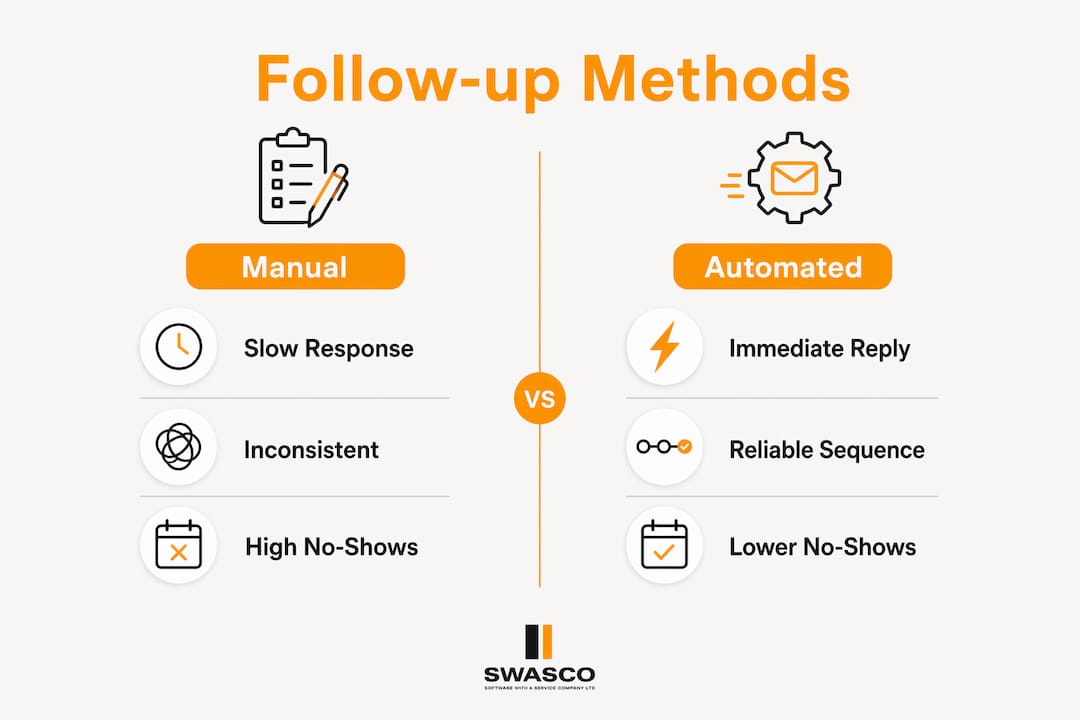
The conversion penalty for slow follow-up is severe. Manual processes typically produce 2 to 3 hour response delays, which cause a 35% lower conversion rate compared to automated systems that respond in approximately 8 minutes. That gap is not marginal. It is the difference between winning and losing a significant portion of your pipeline every single month.
Reply rates across industries have collapsed. Industry reply rates fell to 3.43% in 2026, making follow-up discipline the primary competitive advantage. At that level of baseline engagement, every missed follow-up touch is disproportionately costly.
The data on touchpoints makes the picture worse. 80% of sales sequences die after the first contact, yet 80% of sales require five or more touchpoints to close. Manual agents rarely complete more than one or two. The lead does not say no. The agent simply stops asking.
| Metric | Manual follow-up | Automated follow-up |
|---|---|---|
| Average response time | 2–3 hours | Approximately 8 minutes |
| Conversion rate impact | 35% lower | Baseline performance |
| Sequence completion rate | 23% (average agents) | 87% (elite/automated agents) |
| No-show reduction | Minimal | 30–40% improvement |
| Reply rate discipline | Inconsistent | Systematic and enforced |
The no-show problem adds another layer of revenue loss. Automated meeting confirmations and reminders reduce no-shows by 30 to 40%. Manual tracking systems cannot reliably send those reminders at the right time, to the right person, every time.
Automated follow-up vs manual: how do they compare in practice?
The core difference between automated and manual follow-up is not technology. It is reliability. Automation enforces what manual systems leave to chance.
Speed is the most visible gap. An automated system can respond to a new enquiry within minutes, at 2am on a Sunday, with a personalised message that references the specific property or service the prospect enquired about. A manual system requires an agent to be awake, available, and disciplined enough to act immediately. That combination rarely holds.
Consistency is the second gap. Elite agents complete 5-touch sequences 87% of the time, compared to 23% for average agents. The difference is not talent. It is whether a system forces the sequence to completion or leaves it to individual willpower. Automation removes willpower from the equation entirely.
Message quality is the third gap. Successful follow-ups require contextual relevance and tone progression, not just speed. A well-designed automated sequence starts with a warm, direct response, shifts to a value-add message on day two, and moves to a gentle check-in by day five. Manual agents rarely plan this arc. They send what feels right in the moment, which produces inconsistent results.
Pro Tip: When building an automated sequence, write all five messages before you launch. Tone progression only works if you plan the full arc in advance. Message one should be warm and direct. Message five should be brief and low-pressure.
Automated systems also protect revenue at the appointment stage. A 30 to 40% reduction in no-shows through automated reminders translates directly to more completed viewings, more signed agreements, and more closed deals. Manual agents who rely on a single confirmation call miss a large portion of that protection. For a deeper look at automated lead follow-up, the mechanics are worth understanding before you build your first workflow.
What best practices improve follow-up effectiveness for agents?
Improving follow-up effectiveness starts with accepting that effort alone is not the answer. The answer is a system that makes the right action the default action.
-
Automate your first response. Connect every lead source, whether that is Rightmove, Zoho, your website, or social media, directly to your CRM. The first response should fire automatically within minutes. This single change addresses the most damaging part of the lead response time problem that agents face.
-
Commit to a five-touch minimum. Build a sequence of at least five contacts across seven to ten days. Use email, SMS, and phone calls in combination. Agents who stop at one or two touches are abandoning leads that would have converted with persistence. Prospect silence is not rejection. It is almost always a timing issue.
-
Assign clear ownership at the point of capture. Every lead must have one named agent responsible for it, with a defined response window. Without this, the ownership ambiguity problem returns immediately. Your CRM should enforce this automatically, not rely on a team meeting to sort it out.
-
Integrate your lead sources with your CRM. Disconnected tools are the single biggest cause of delayed follow-up. Use native integrations or tools like Zapier to connect Rightmove, Zoho, Facebook Lead Ads, and your website form to a single CRM. For agents who want a clear explanation of why this matters, CRM integration for agents covers the fundamentals well.
-
Optimise timing based on behaviour, not habit. Send follow-up messages when prospects are most likely to engage, typically mid-morning or early evening on weekdays. Review your open and reply data monthly and adjust your send times accordingly. A sequence sent at the wrong time consistently underperforms, regardless of message quality.
The best practices for letting agent follow-up in 2026 all point in the same direction: structure beats effort, and systems beat individuals.
Key takeaways
Manual follow-up fails agents because the process relies on individual discipline to deliver what only a structured, automated system can guarantee consistently.
| Point | Details |
|---|---|
| Speed is decisive | Responding within 5 minutes is 100 times more effective than a 30-minute delay. |
| System design is the root cause | Ownership gaps and disconnected tools cause most missed follow-ups, not agent effort. |
| Five touches are the minimum | 80% of sales require five or more contacts, but most manual sequences stop at one or two. |
| Automation closes the gap | Automated systems reduce no-shows by 30–40% and enforce sequence completion reliably. |
| Context matters as much as speed | Tone progression across a sequence produces better engagement than speed alone. |
Why the system is always the problem, not the agent
I have worked with real estate agents and service businesses long enough to know that the follow-up conversation almost always goes the same way. The agent is blamed. The manager says they need to be more disciplined. Training is booked. Nothing changes.
The uncomfortable truth is that manual follow-up failure is a system failure. Agents are being asked to do something that human beings are genuinely bad at: maintaining perfect timing, consistent tone, and complete records across dozens of active leads simultaneously. No amount of motivation fixes that. A well-designed system does.
What I find most telling is the gap between elite and average agents. Elite agents complete structured five-touch sequences 87% of the time. Average agents manage 23%. That gap does not exist because elite agents are more dedicated. It exists because elite agents, whether consciously or not, have built systems that enforce the behaviour. They use CRM reminders, pre-written templates, and scheduled tasks. They have removed the decision from the equation.
The agents I see struggling most are the ones who believe that working harder will solve a structural problem. It will not. The fix is to follow up property leads systematically, with a process that runs whether the agent is busy, tired, or on a viewing. AI and automation are not shortcuts. They are the only reliable way to meet the standard that modern lead conversion actually requires.
— James Paul
How Talk2Aiva helps agents stop losing leads to slow follow-up
Real estate agents and service providers who rely on manual processes are losing revenue every day to faster, more consistent competitors. Talk2Aiva by SWASCO is built to fix that directly.
Talk2Aiva engages new leads within minutes, across calls, SMS, website chat, and social media, 24 hours a day. It qualifies enquiries, books appointments, and runs follow-up sequences automatically, without requiring an agent to be available. The entire setup, from AI training to workflow building and live launch, is handled with full technical support included. If you are ready to replace a broken manual process with a system that actually works, Talk2Aiva's automation platform is where to start.
FAQ
Why does manual follow-up fail for real estate agents?
Manual follow-up fails because it depends on individual agents to manage timing, ownership, and consistency without system enforcement. Structural gaps such as disconnected CRM tools and undefined lead ownership cause most missed contacts.
How quickly should agents respond to a new lead?
Responding within 5 minutes makes a connection 100 times more likely than waiting 30 minutes. Manual processes typically produce 2 to 3 hour delays, which significantly reduce conversion probability.
How many follow-up touches does it take to convert a lead?
Research shows 80% of sales require five or more touchpoints. Most manual agents stop after one or two, abandoning leads that would have converted with a structured, persistent sequence.
What is the difference between automated and manual follow-up?
Automated follow-up enforces response speed, sequence completion, and tone progression without relying on agent availability. Manual follow-up introduces variability in timing and message quality that costs agents conversions.
Can automation really reduce no-shows for property viewings?
Automated meeting confirmations and reminders reduce no-shows by 30 to 40%. Manual tracking systems cannot deliver reminders reliably at scale, which leads to lost viewing appointments and revenue.