
Omnichannel lead capture means collecting every inbound enquiry, whether it arrives by phone, website chat, SMS, or social message, into a single automated system that qualifies, routes, and follows up in real time. For a service-based SME, that matters because responding within five minutes of first contact dramatically increases the chance of converting a lead, yet most small businesses are still handling enquiries manually across disconnected channels. Talk2Aiva by SWASCO is built precisely for this gap: an AI receptionist that captures and qualifies leads 24/7 across every channel, so no enquiry goes unanswered and no revenue leaks through the cracks. All data handling must comply with UK GDPR from the moment of first contact.
Speed to lead is the single biggest lever. Responding within five minutes of a lead's first contact materially increases your chance of conversion. Manual processes almost never achieve that.
Table of Contents
- What is omnichannel lead capture and how does it actually work?
- Why does this matter specifically for service-based SMEs?
- How to implement omnichannel lead capture: a practical roadmap
- Which metrics tell you whether it is working?
- UK compliance checklist: GDPR, PECR, and call recording
- What tools do you need, and how does Talk2Aiva fit?
- Is omnichannel lead capture right for your business right now?
- Key takeaways
- A note on what actually makes the difference
- Useful sources and further reading
What is omnichannel lead capture and how does it actually work?
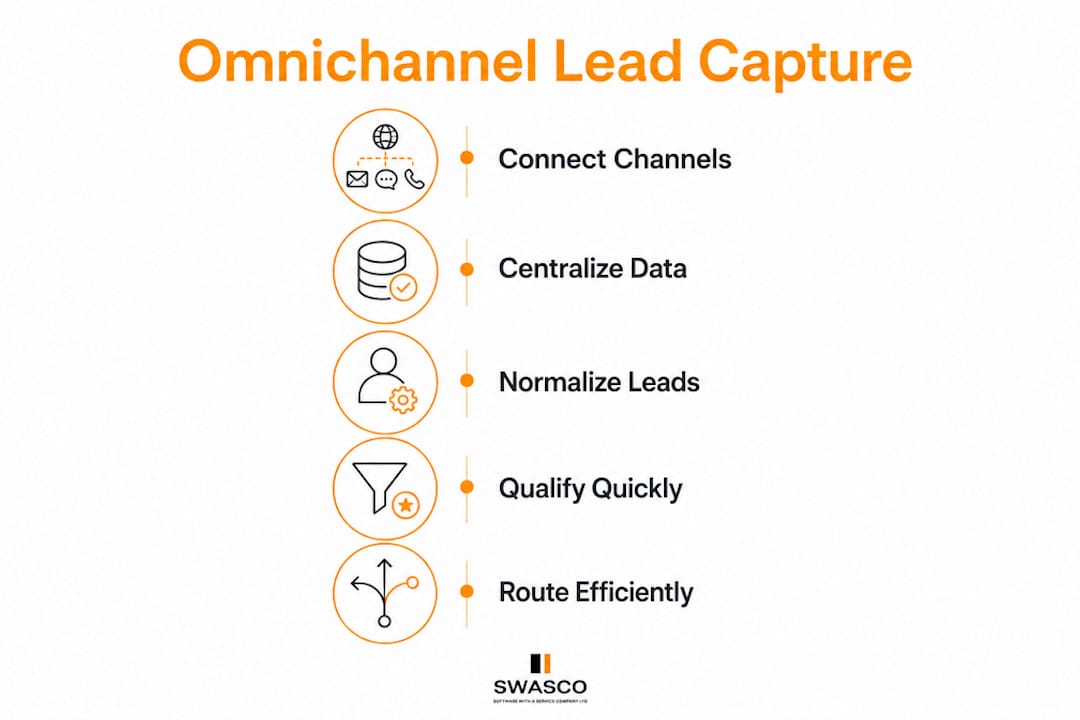
Omnichannel lead capture integrates every source channel into one automated pipeline. The common sources for a UK service business are:
- Phone calls handled by an AI receptionist that answers, qualifies, and books
- Website chat widgets that engage visitors and collect contact details
- SMS / text for inbound enquiries and outbound follow-up sequences
- Social messaging via platforms such as Facebook Messenger and Instagram DMs
- Web forms and landing pages connected via webhooks or JavaScript SDKs
Each channel feeds data into a central inbox through API connections or email connectors. The system then normalises the data, mapping fields such as name, contact number, service interest, and preferred time into a consistent format regardless of source. From there, automated rules or AI qualification logic score and route the lead: a high-intent caller gets an immediate booking prompt; a web-form submission triggers an SMS follow-up within seconds.
A simple example: a prospective client messages your Facebook page at 10 PM asking about availability. Talk2Aiva picks up the conversation, asks two qualifying questions, confirms the service type, and offers a booking slot, all without anyone on your team lifting a finger. The lead lands in your unified inbox, fully qualified, with context intact.
Pro Tip: Capture only name, contact number, and service interest at first touch. Reducing form fields removes friction and eliminating a single non-essential field can increase form conversions by up to 50%. Use automated follow-up to collect any additional detail you need.
Why does this matter specifically for service-based SMEs?
Studies show up to 73% of leads are never contacted after capture, usually because of routing failures or slow manual processes. For a service business, that is not an abstract statistic. It is a missed appointment, a job that went to a competitor, a client relationship that never started.

The revenue case is direct. A salon that misses three calls on a busy Saturday loses booking revenue it will never recover. An estate agent whose web enquiry sits unread for four hours loses the instruction to a faster rival. A dentist practice relying on a voicemail box loses NHS and private patients to the next practice that picks up. Conversational AI approaches consistently outperform static forms and voicemail in qualification rates, precisely because they respond instantly and interactively.
Wharton Executive Education frames the shift clearly: successful omnichannel adoption requires moving from channel-first to customer-first thinking, mapping the journey and aligning responsiveness across every touchpoint. For a home services firm, that means being reachable by phone, text, and chat with a consistent, professional response at any hour. Emarsys identifies automation as the critical enabler: it delivers consistent service quality without requiring proportionate staff increases, which is exactly the constraint most SMEs face.
How to implement omnichannel lead capture: a practical roadmap
-
Define your goals and pick two to three channels (Week 1–2). Identify where your highest-intent leads currently arrive. For most service SMEs, that is phone and website chat. Estate agents should add property portal enquiries; salons benefit from website chat capture. Industry guidance is clear: unify your top channels first and scale later. Launching too many at once creates integration debt and poor service quality.
-
Audit your current data flows (Week 2–3). Map where leads enter today and where they are lost. Common failure points: unanswered calls outside office hours, web forms with no automated response, social messages that sit unread for days.
-
Select your integration approach (Week 3–4). For each channel, decide whether you need a webhook, an API connector, or a native integration. Define your minimum data model: name, phone number, service type, source channel, and timestamp.
-
Deploy AI receptionist flows and routing rules (Week 4–6). Configure qualification questions, booking prompts, and escalation paths. Set up automated follow-up for any lead that does not convert at first touch. Talk2Aiva handles this end-to-end, including calendar sync and two-way SMS.
-
Pilot, measure, and scale (Week 6–10). Run a two-week live pilot. Measure speed-to-lead, capture rate, and missed-call recovery. Refine qualification scripts, then add additional channels once the core integration is stable.
Pro Tip: Train your AI receptionist on your actual service language, pricing tiers, and common objections before going live. A staged rollout, starting with after-hours coverage only, protects service quality while you build confidence in the system.
Which metrics tell you whether it is working?
| Metric | Why it matters | Practical implication |
|---|---|---|
| Lead capture rate | % of inbound contacts that become qualified records | Baseline for all ROI calculations |
| Speed-to-lead | Time from first contact to first response | Sub-five-minute response materially lifts contact rate |
| Missed-call recovery rate | Calls answered by AI vs. going to voicemail | Direct revenue recovery measure |
| Conversion rate | Qualified leads that become paying clients | Multiply by average job value for revenue impact |
| Cost per lead | Total automation cost ÷ leads captured | Benchmark against previous manual cost |
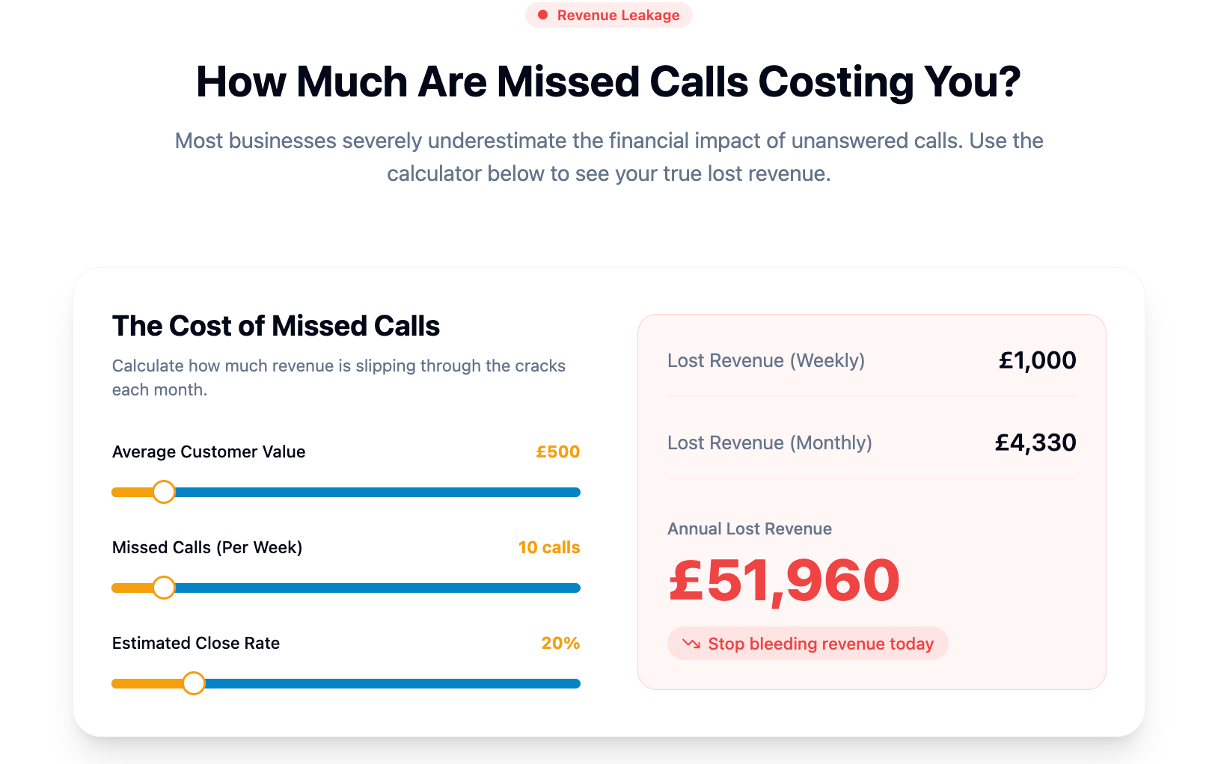
A simple ROI estimate: if your average job is worth £300 and you currently miss ten calls a week, recovering five of those through automated capture adds £1,500 per week in potential revenue. Subtract your monthly automation cost and the case is usually clear within the first month.
For deeper guidance on automated lead follow-up sequences that protect that conversion rate after capture, the mechanics are worth understanding separately.
UK compliance checklist: GDPR, PECR, and call recording
Every lead capture system operating in the UK must address these points before going live:
- Lawful basis for processing. Identify whether you are relying on legitimate interest or explicit consent for each channel and document it.
- Marketing SMS requires explicit opt-in. Under PECR, sending unsolicited marketing texts without prior consent is unlawful. Capture and store opt-in evidence at the point of contact.
- Call-recording notices. If calls are recorded, callers must be informed before the recording begins. This applies to AI-handled calls as much as human-answered ones.
- Data retention limits. Define how long lead records are held and automate deletion or anonymisation at the end of that period.
- Right to opt out. Every automated follow-up must include a clear, functioning opt-out mechanism.
- Records of processing activities. Maintain a processing register covering what data you collect, why, how long you keep it, and who has access.
Pro Tip: Build consent capture into the first interaction on every channel, not as an afterthought. A single checkbox or verbal confirmation, logged automatically by your AI receptionist, is far easier to evidence than a retrospective consent audit.
This article is general information, not legal advice. Confirm your specific obligations with the ICO or a qualified data protection adviser.
What tools do you need, and how does Talk2Aiva fit?
The core integration priorities for a service SME are: real-time routing, two-way SMS, calendar sync, social messaging capture, a unified inbox, and simple admin controls. Evaluation criteria worth pressing vendors on include webhook reliability, onboarding support, custom workflow building, and data residency (UK-based storage matters for GDPR compliance).
Talk2Aiva by SWASCO addresses all of these directly. The platform provides a 24/7 AI receptionist across calls, SMS, website chat, and social media; instant lead qualification and booking with calendar sync; automated follow-up sequences and review requests; a unified inbox with mobile app notifications; and full done-for-you setup, AI training, and ongoing technical support. That last point matters more than most vendors acknowledge: a system that is configured once and left to drift will underperform within weeks.
For businesses tracking website lead behaviour alongside conversational capture, combining visitor intelligence with Talk2Aiva's routing layer gives a more complete picture of where leads originate and where they drop off.
When evaluating any vendor, ask specifically about: SLA for webhook uptime, where data is stored, what customisation is included in the base price, and what happens to your data if you cancel.
Is omnichannel lead capture right for your business right now?
Answer yes or no to each question:
- Do you miss calls outside office hours at least once a week?
- Are you using more than one channel to receive enquiries (phone, chat, social, forms)?
- Does your current response time to web or social enquiries exceed one hour?
- Do leads sometimes fall through the gaps between team members?
- Is booking or scheduling a manual process that creates delays?
- Do you lack a clear view of how many leads you receive across all channels?
- Are you spending time on admin that could be spent delivering your service?
5–7 yes answers: Act now. The revenue leakage is measurable and the fix is straightforward. 3–4 yes answers: Run a pilot on your top two channels. 1–2 yes answers: Audit your current workflows first; you may have simpler gaps to close before adding automation.
Key takeaways
Omnichannel lead capture works because it removes the manual gaps between channels, qualifies leads instantly, and routes them before the five-minute window closes.
| Point | Details |
|---|---|
| Definition | Omnichannel capture unifies phone, chat, SMS, and social into one automated qualification and routing system. |
| Start small | Launch with two to three high-intent channels first; scale only after those integrations are stable. |
| Speed is revenue | Responding within five minutes of first contact materially increases conversion; automation is the only reliable way to achieve it. |
| Compliance first | UK GDPR and PECR require explicit consent for marketing SMS and call-recording notices before any system goes live. |
| Measure what matters | Track lead capture rate, speed-to-lead, missed-call recovery, and conversion rate to calculate real ROI. |
A note on what actually makes the difference
The businesses that get the most from omnichannel capture are not the ones with the most channels. They are the ones that picked two or three channels, set them up properly, and then let the system run.
What I see most often is a business that invests in the technology but underinvests in the setup: qualification questions that are too vague, routing rules that send everything to one inbox, follow-up sequences that fire at the wrong time. The result is a system that technically works but does not convert. The fix is almost always in the configuration, not the platform.
Talk2Aiva's done-for-you model exists precisely because that configuration work is where most SMEs stall. Onboarding, AI training, workflow building, and ongoing optimisation are included, not sold as extras. If you want to see what a properly configured system looks like for your sector, book a guided demo and we will map it to your specific channels and service type.
Useful sources and further reading
- What is omnichannel marketing? — Wharton Executive Education — Customer-first journey mapping and omnichannel strategy principles.
- Omnichannel marketing guide — Emarsys — Automation as the core enabler of consistent omnichannel service.
- API & multi-channel lead capture — Rework resources — Speed-to-lead data, uncontacted lead statistics, and routing best practice.
- Omnichannel marketing guide — NetcoreCloud — Staged rollout guidance and channel prioritisation.
- Ultimate guide to lead capture forms — Platoforms — Reducing form friction and progressive data collection.
- What is lead capture? — Komo — Signal-based capture and real-time enrichment techniques.
- What is conversational lead capture? — SWASCO Blog — How AI receptionists qualify leads through conversation.
- Role of AI in lead qualification — SWASCO Blog — AI scoring and qualification mechanics for service businesses.
- Lead response time mistakes and fixes — SWASCO Blog — Practical speed-to-lead improvements for service SMEs.
- Social media's role in lead gen — SWASCO Blog — How social channels contribute to inbound lead volume.