
AI for beauty salons means automating your receptionist and client communications so your team stops losing bookings to missed calls, slow replies, and unmanaged enquiries. The result is measurable: salon owners who implement AI-driven automation typically reclaim significant additional hours per week within the first month. That is not time saved on creative work or client care. It is time clawed back from repetitive admin that the right system can handle entirely on its own.
Client expectations have already shifted. A substantial portion of UK adults now use AI to guide their beauty decisions, which means they arrive expecting fast, responsive, brand-level service before they even walk through your door. If your phone goes unanswered or your Instagram DMs sit for hours, you are losing those clients to whoever replies first. Talk2Aiva by SWASCO is built precisely for this gap: a guided AI receptionist that captures, qualifies, and books leads 24/7 across calls, SMS, web chat, and social media.
Table of Contents
- What can AI actually do in your salon right now?
- What are the real benefits, and what does the evidence say?
- What are the limits, and what does UK law require?
- How do you choose the right AI receptionist for your salon?
- What does implementation actually cost and how long does it take?
- How Talk2Aiva works for a UK salon: workflow and onboarding
- Key takeaways
- Automation should protect the experience, not flatten it
- Stop missing bookings: Talk2Aiva for UK salons
- Useful sources and further reading
What can AI actually do in your salon right now?
The practical answer is more specific than most guides admit. A well-configured AI receptionist handles the following without any staff involvement:
- 24/7 call answering and intent detection: the AI picks up, understands what the caller wants (booking, price query, directions), and responds accordingly.
- Direct booking into your calendar: clients book confirmed appointments without a staff member touching the diary.
- SMS and chat reminders: automated messages reduce no-shows before they happen.
- Cancellation and rescheduling management: the AI handles the change, updates the calendar, and offers the freed slot to a waitlist.
- Deposit and payment capture: payment links sent automatically at the point of booking, reducing last-minute drop-offs.
- Unified inbox: calls, texts, web chat, and social enquiries appear in one place, with mobile notifications so nothing slips.
- Follow-up automation: post-visit messages, review requests, and rebooking nudges sent without manual effort.
A typical salon scenario: a client messages your Facebook page at 9 PM asking about availability for a balayage. Without AI, that message waits until morning. With an AI receptionist, the client gets an instant reply, a price summary, and a booking link. By the time you arrive the next day, the appointment is confirmed and a deposit collected. For social media enquiry handling, this kind of automated workflow is where salons recover significant lost revenue.
Pro Tip: Set your AI to capture the client's service preference and hair history during the initial conversation. That data feeds directly into their client profile, so your stylist walks in already briefed.
What are the real benefits, and what does the evidence say?
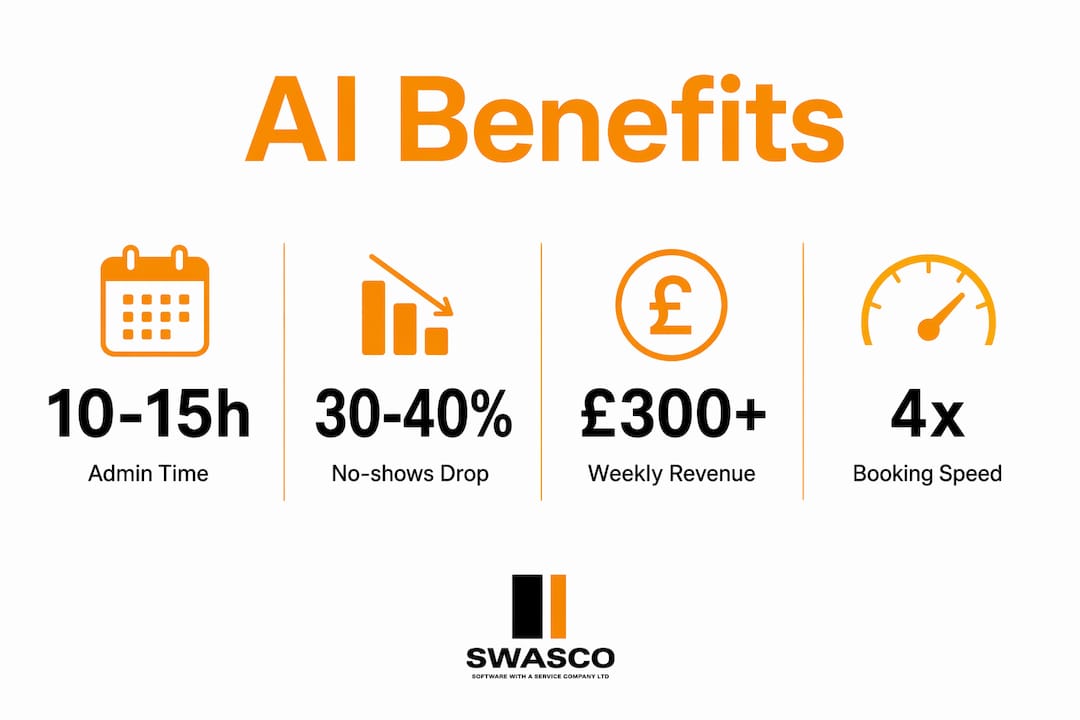
The time savings figure of 10–15 hours per week is the headline, but the commercial case goes further.
AI scheduling and automated reminders reduce no-shows by roughly 30–40% within weeks of activation. For a four-chair salon running at 70% occupancy, recovering even half those lost slots meaningfully changes monthly revenue. Personalised AI recommendations can significantly increase retail sales, and early adopters using AI-driven booking strategies have reported notable increases in booking capture. Phorest's research puts the revenue uplift from insight-driven personalisation at a meaningful level.
| Benefit | Likely range | How to measure it |
|---|---|---|
| Admin time saved | 10–15 hours/week | Track staff hours on calls and admin pre/post launch |
| No-show reduction | 30–40% | Compare no-show rate month-on-month after reminders go live |
| Booking capture increase | Up to 2.3x | Count confirmed bookings from digital channels vs. prior period |
| Retail sales uplift | — | Monitor retail revenue per visit with and without AI recommendations |
| Revenue growth (high adoption) | 1–4 percentage points higher sales growth | Review monthly revenue reports vs. prior baseline |
Those hours recovered translate directly into billable time. A senior stylist earning £30 per hour who gets back ten hours a week is worth £1,200 per month in recovered capacity, before you count a single additional booking. Follow-up automation compounds this by keeping clients returning without any manual outreach.
What are the limits, and what does UK law require?
AI is pattern recognition, not judgement. It cannot replace the in-chair experience, read a client's mood, or make a creative call about a colour correction. Phorest puts it plainly: AI is not sentient, and responsible use means augmenting client relationships rather than attempting to replicate them.
On the compliance side, UK GDPR applies to every AI receptionist deployment. The key obligations for salon owners:
- Lawful basis for processing: you need a clear legal basis (typically legitimate interest or contract) for storing client contact data and booking history.
- Call recording consent: if your AI records calls, you must inform callers at the start of the call. This is non-negotiable under UK law.
- Data minimisation: only collect what you need. A booking system does not need a client's full address.
- Retention limits: set a policy for how long client data is held and delete records beyond that window.
- Transparency: your privacy notice must explain that automated systems handle initial enquiries.
Operationally, watch for incorrect bookings caused by ambiguous client requests, and build a clear escalation path so the AI hands off to a human when a query falls outside its scope. SMS reminder compliance is a separate consideration: clients must have opted in to receive marketing messages.
Pro Tip: Review your AI's conversation logs weekly for the first month. You will quickly spot the query types that need a human response, and you can train the system to escalate those automatically.
How do you choose the right AI receptionist for your salon?
Feature lists are not the right starting point. The questions that actually matter during vendor evaluation are:
- Does it integrate with your existing calendar and POS system, with two-way sync?
- How does it handle a booking conflict or a double-booking attempt?
- Can it collect deposits via your preferred payment gateway?
- What is the escalation path when a client query goes beyond the AI's scope?
- Are conversation logs and audit trails available for compliance review?
- Can you export your client data if you switch providers?
- What does onboarding involve, and is ongoing optimisation included?
Beyond those questions, run through this checklist before signing anything:
- Confirm the vendor offers a structured onboarding process, not just a login and a help doc.
- Clarify whether setup fees are one-off or rolled into the subscription.
- Ask for a trial period with real call volume before committing.
- Check the SLA for response accuracy and what happens when the AI makes an error.
- Verify that appointment confirmation automation is included, not an add-on.
Pro Tip: Run a shadow test during the trial: let the AI handle enquiries for two weeks while your team monitors every conversation. You will identify gaps before they cost you a client.
What does implementation actually cost and how long does it take?
Most salons go live within two to four weeks. The phases look like this:
| Phase | Typical duration | What happens |
|---|---|---|
| Discovery and setup | 3–5 days | Vendor maps your services, calendar, and common enquiry types |
| AI training and workflow build | 5–7 days | Scripts, escalation rules, and booking flows configured |
| Soft launch | 3–5 days | Live with a subset of channels; team monitors and flags issues |
| Full launch and optimisation | Ongoing | All channels live; weekly review and refinement for 30–60 days |
Cost items to budget for:
- Monthly or annual subscription (varies by tier and channel volume)
- One-off setup or onboarding fee if not bundled into the subscription
- Payment gateway fees on deposits collected through the AI
- Staff time for the soft-launch monitoring period (typically 2–3 hours per week)
- Optional integrations with your CRM or loyalty programme
The first measurable admin-hours recovery usually appears within the first week of full launch. A foundation-first approach works best: get scheduling and payments stable before layering in marketing automation. For automated booking reminders, configuration is typically the fastest win and the lowest-risk starting point.
Pro Tip: Ask your vendor to activate appointment reminders on day one. No-show reduction is the fastest ROI signal and gives your team immediate confidence in the system.
How Talk2Aiva works for a UK salon: workflow and onboarding
Consider a four-chair independent salon in the UK receiving 60–80 enquiries per week across calls, Instagram DMs, and website chat. Before automation, roughly a third of those enquiries go unanswered outside business hours. Revenue leaks quietly, every week.
Talk2Aiva by SWASCO deploys across all those channels simultaneously. The AI answers calls, responds to DMs, engages website visitors, and captures SMS enquiries. It detects intent, qualifies the lead (service type, preferred date, stylist preference), and books directly into the salon calendar. A deposit request goes out automatically. Post-visit, the system sends a review request and a rebooking nudge at the interval you set.
Core features relevant to salons:
- 24/7 conversational AI across calls, SMS, web chat, and social media
- Calendar sync with direct booking and two-way updates
- Automated follow-ups, review requests, and rebooking reminders
- Unified inbox with mobile app notifications
- AI-supported cosmetics consultation and client profile building
The onboarding process Talk2Aiva provides:
- Discovery session to map your services, calendar, and enquiry types
- Workflow build and AI training specific to your salon
- Live launch with full technical support
- Ongoing optimisation and performance reviews included
What you should prepare: a list of your services and prices, your current calendar system login, your most common client questions, and a clear policy on which queries must go to a human stylist.
Pro Tip: Brief your team before launch. Staff who understand what the AI handles and what it escalates will work with it, not around it.
Key takeaways
AI for beauty salons is most valuable when it automates receptionist and communication tasks so your team recovers time, captures more bookings, and keeps clients returning without manual effort.
| Point | Details |
|---|---|
| Time recovered | Salon owners typically reclaim 10–15 hours per week within the first month of AI automation. |
| No-show reduction | Automated reminders reduce no-shows by roughly 30–40%, directly protecting booked revenue. |
| UK compliance | GDPR requires lawful basis, call recording consent, data minimisation, and a clear privacy notice for any AI receptionist deployment. |
| Selection priority | Evaluate integration, escalation paths, and onboarding support before comparing feature lists. |
| Talk2Aiva | Talk2Aiva by SWASCO provides a fully guided AI receptionist with 24/7 coverage across calls, SMS, chat, and social, plus onboarding and ongoing optimisation included. |
Automation should protect the experience, not flatten it
The salons that get the most from AI are the ones that are honest about what it is for. It is not there to replace your stylists or simulate the relationship a client has with their colourist. It is there to handle the calls that go unanswered at 8 PM, the DMs that pile up on a busy Saturday, and the follow-ups that never get sent because your team is fully booked.
Where I see salons go wrong is in over-automating. They route every client interaction through the AI and then wonder why their reviews mention feeling like they are dealing with a machine. The fix is straightforward: automate the friction, not the relationship. Booking, reminders, deposits, follow-ups. Those are zero-value admin tasks for a skilled stylist. The consultation, the colour recommendation, the moment a client trusts you with a big change: those stay human.
The other thing most guides understate is the staff change management piece. Your team needs to understand what the AI does, what it escalates, and why. A stylist who feels threatened by the system will find ways to work around it. One who sees it as the receptionist they never had will use it properly. That framing matters more than the technology itself.
Stop missing bookings: Talk2Aiva for UK salons
Missed calls and unanswered DMs are costing your salon real money every week. Talk2Aiva by SWASCO gives you a done-for-you AI receptionist that answers every enquiry, books appointments, collects deposits, and follows up with clients automatically, across calls, SMS, web chat, and social media, 24 hours a day.
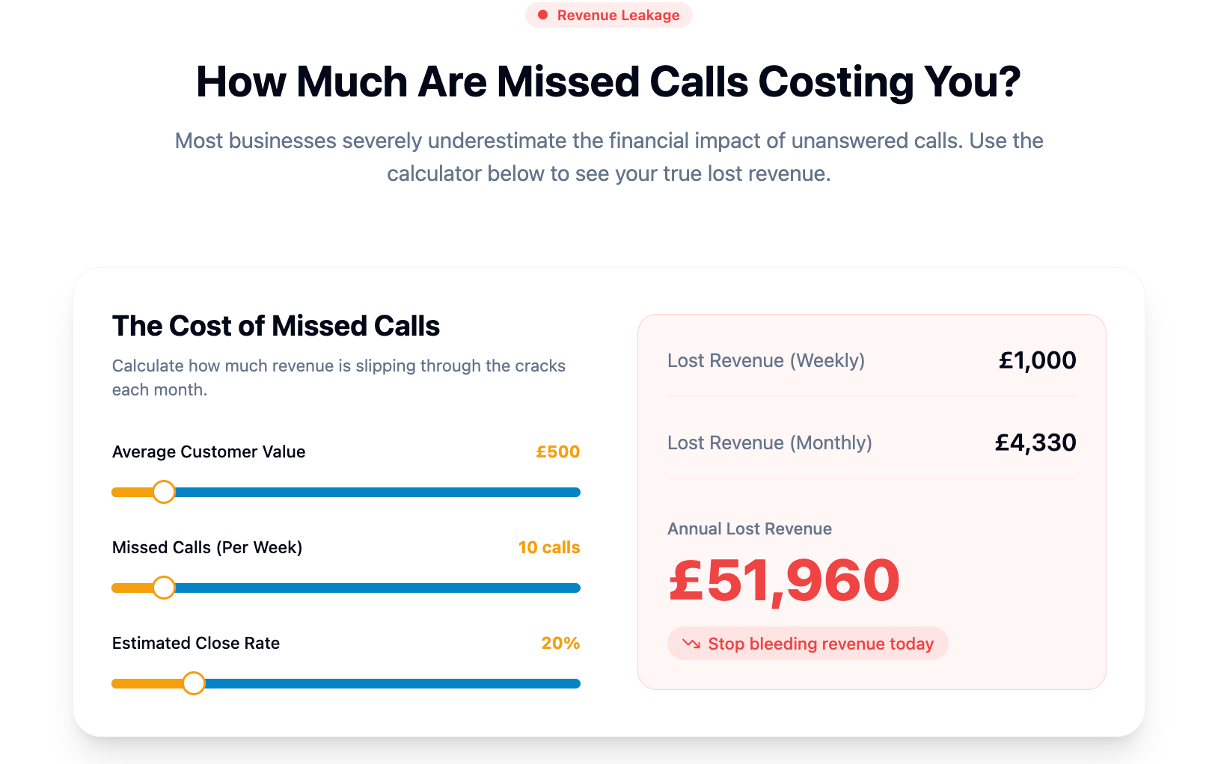
Three things that matter most to salon owners: your calendar syncs in real time so there are no double bookings; follow-up messages and review requests go out automatically after every visit; and every channel feeds into one unified inbox with mobile notifications so you never lose track of a lead. Setup, AI training, live launch, and ongoing optimisation are all included. You do not need a technical background to get started.
Book a discovery call with Talk2Aiva and see how quickly a guided AI receptionist can be live in your salon.
Useful sources and further reading
- AI & automation tools every beauty pro needs in 2026 — the source for the 10–15 hours/week savings figure, the 64% UK adults statistic, and no-show reduction data cited throughout this article.
- The ethical edge: demystifying AI in the beauty and wellness industry (Phorest) — Phorest's guidance on responsible AI use, the limits of AI in client relationships, and the 15% revenue uplift from personalisation.
- How AI is closing revenue gaps for salons and spas (Salon Today) — analysis of high-adoption locations and the 1–4 percentage point sales growth differential.
- AI for salons: the complete guide to AI-powered salon growth (Prefero) — source for the 2.3x booking capture increase reported by early adopters.
- The role of AI in cosmetics consultation: 2026 guide (SWASCO blog) — practical implementation detail on AI-supported consultation and client profile building.
- How follow-up automation works in salons (SWASCO blog) — step-by-step guide to post-visit follow-up flows and retention automation.
- How to send automatic appointment confirmations to clients — vendor-neutral guidance on confirmation flows and timing, useful for implementation planning.