
Your first reply needs to do four things and no more: acknowledge the couple by name, confirm you have their date free (or promise a personal answer within a set window), reference one detail from their enquiry, and give them a single next step, like two call times or a booking link. That single-step focus is what turns a browsing lead into a booked consult, because every extra question or vague "let's chat sometime" you add gives them a reason to stall.
TL;DR:
- Offering specific availability options with a clear schedule and booking link increases the chances of securing a consultation.
- Including a link to a relevant full wedding gallery and a transparent pricing range helps couples assess fit without back-and-forth delays.
- Personal references about the couple's venue, style, or referral source significantly boost response rate and trust.
- Automated acknowledgment messages and scheduled follow-ups with added value recover cold leads more effectively.
- Managing inquiries through a structured system ensures accurate, timely responses, reducing errors and increasing booking conversion chances.
Table of Contents
- What to include in your first wedding inquiry response
- Ready-to-use templates and subject-line examples
- How to personalise without spending hours on it
- Follow-up sequences that re-engage without pestering
- Consultation and booking: framing the next step right
- Streamline responses with tools and workflows
- Handling common client questions and objections in responses
- Legal and contract considerations to mention or address in inquiry responses
- Best practices for managing multiple inquiries simultaneously
- Cultural sensitivity and inclusivity in communication
- Technical communication tips for clarity and professionalism
- An A/B test worth running on your own enquiry replies
- How Talk2Aiva helps wedding photographers capture and convert enquiries
- Sources
What to include in your first wedding inquiry response
A wedding photography inquiry response that actually converts follows a pattern, not a script. Get four elements right and the rest of the email almost writes itself: a warm acknowledgement, a personal reference to something they told you, a direct answer to what they asked, and one clear next step. Miss any of these and you're asking a stressed couple to do extra work, which is exactly when they drift off to the next photographer in their tab bar.
Acknowledgement first. Thank them by name, mention their wedding date, and keep the opening line human rather than template. "Congratulations on the engagement, Sarah and Tom!" beats "Thank you for your inquiry" every time, because it signals a person read their message rather than a form auto-populating a reply.
A personal reference second. Pull one detail from their enquiry form or email and use it. If they mentioned a barn venue in the Cotswolds, name it. If they said a friend referred them, thank that friend by name if you know them. This single move is the cheapest form of personalisation available and it's the one most photographers skip when they're busy.
A direct answer third. If they asked about availability, answer it in the first two lines, don't bury it in paragraph four. If they asked about pricing, this is where a lot of photographers stumble. The instinct is to either dodge the question entirely or fire back a single number. Neither works well. UK wedding photography pricing varies noticeably by photographer experience and by region, and average costs shift depending on where you're based, so a single quoted figure in a first email either scares off a couple who assumed less, or undersells you to a couple who'd have happily paid more. A range, paired with a short note on what's included, does more work.
Try something like: "Full-day wedding coverage with us typically runs within a typical regional range depending on hours and add-ons, and that includes edited high-resolution images and an online gallery for sharing with family." That's specific enough to filter out mismatched budgets without forcing a negotiation before you've even spoken.
One next step fourth. This is where most inquiry responses actually lose the booking. A vague "let me know if you'd like to chat" creates decision fatigue. Give two concrete options instead: "I have consult slots this Thursday at 6pm or Saturday at 11am, or you can grab a time directly [here]." According to guidance on structuring a photography inquiry response, vague calls to action are one of the most common reasons enquiries go cold, and offering specific call options measurably reduces that friction.
What to attach or link in that first reply:
- A link to your recent full wedding gallery, ideally one similar in style or venue to theirs
- Your pricing guide or a one-page PDF if you have one
- A direct scheduling link so they can book a consult without another email exchange
- One review or testimonial line if it fits naturally, without turning the email into a sales brochure
Pro Tip: Keep your pricing range wide enough to cover your actual booking spread, but never wider than three tiers. A range that swings from £900 to £4,000 reads as uncertainty, not flexibility.
Ready-to-use templates and subject-line examples
Templates only work when they're built for the moment they're used, so here are four scenarios you'll hit constantly, plus subject lines that actually get opened. Personalised subject lines mentioning the couple's names or wedding date consistently outperform generic "inquiry received" lines, because they read like a reply, not a notification.
Subject line examples by tone:
- Warm and personal: "Sarah & Tom, excited about your September wedding!"
- Straightforward and clear: "Your Cotswolds Wedding Photography Inquiry, 14 September 2026"
- Slightly more formal: "Re: Wedding Photography Availability for Your Date"
- Casual and friendly: "Loved hearing about your barn wedding plans!"
1. Auto-reply receipt template
This fires the moment someone submits your form. Its only job is to confirm receipt and set an expectation for when the real reply lands.
Hi {FirstName}, thank you for reaching out about your wedding on {Date}! I read every enquiry personally, and I'll reply directly by {Day/Time}. In the meantime, feel free to browse recent [full weddings here].
2. Personalised availability template, short version
Use this when you're replying quickly between shoots and want something tight but still bespoke.
Hi {FirstName} and {PartnerName}, congratulations! {Venue} is a beautiful choice, and I'd love to be part of your day. I have {Date} available, and full-day coverage typically runs {price range} including edited images and an online gallery. I have consult slots {Option A} or {Option B}, or you can book directly {here}. Looking forward to hearing more about your plans!
3. Personalised availability template, full version
Use this for enquiries that included more detail, a longer message, a Pinterest board link, specific questions, and deserve a fuller reply.
Hi {FirstName} and {PartnerName},
Congratulations on your engagement! {Venue} is somewhere I've {photographed before / always wanted to shoot}, and I love that you're planning a {style detail they mentioned} celebration.
Good news, {Date} is currently open on my calendar. For a day like yours, most couples book full-day coverage, which runs between {price range} and includes edited high-resolution images, an online gallery, and {other inclusion}. I've linked a recent gallery from a similar venue [here] so you can see the kind of coverage and editing style to expect.
I'd love to jump on a short call to hear more about your plans and answer any questions. I have slots {Option A} or {Option B} this week, or you're welcome to grab a time directly {scheduling link}.
Talk soon, {YourName}
4. Unavailable or alternative suggestions template
Don't let a fully booked date end the conversation. This template keeps the door open and often generates referral goodwill even when you can't take the booking.
Hi {FirstName} and {PartnerName}, thank you so much for thinking of me for your big day! I'm already booked for {Date}, so I won't be able to be there in person. That said, I'd love to help however I can. I work with a small group of photographers whose style I trust, and I'm happy to make an introduction if that's useful. I'd also genuinely enjoy hearing about your plans if you'd like a quick call for advice on timelines or vendors.
5. Follow-up template for no response
Sent 3 to 4 days after your personal reply if you've heard nothing back.
Hi {FirstName}, just wanted to pop back into your inbox! I know wedding planning gets overwhelming fast, so no pressure at all. I thought you might like this quick [timeline planning guide] some of my couples have found useful. Happy to answer any questions whenever suits you.
Rotate the subject line on this one too, something like "Thought this might help, {FirstName}" tends to outperform a bare "Following up."
How to personalise without spending hours on it
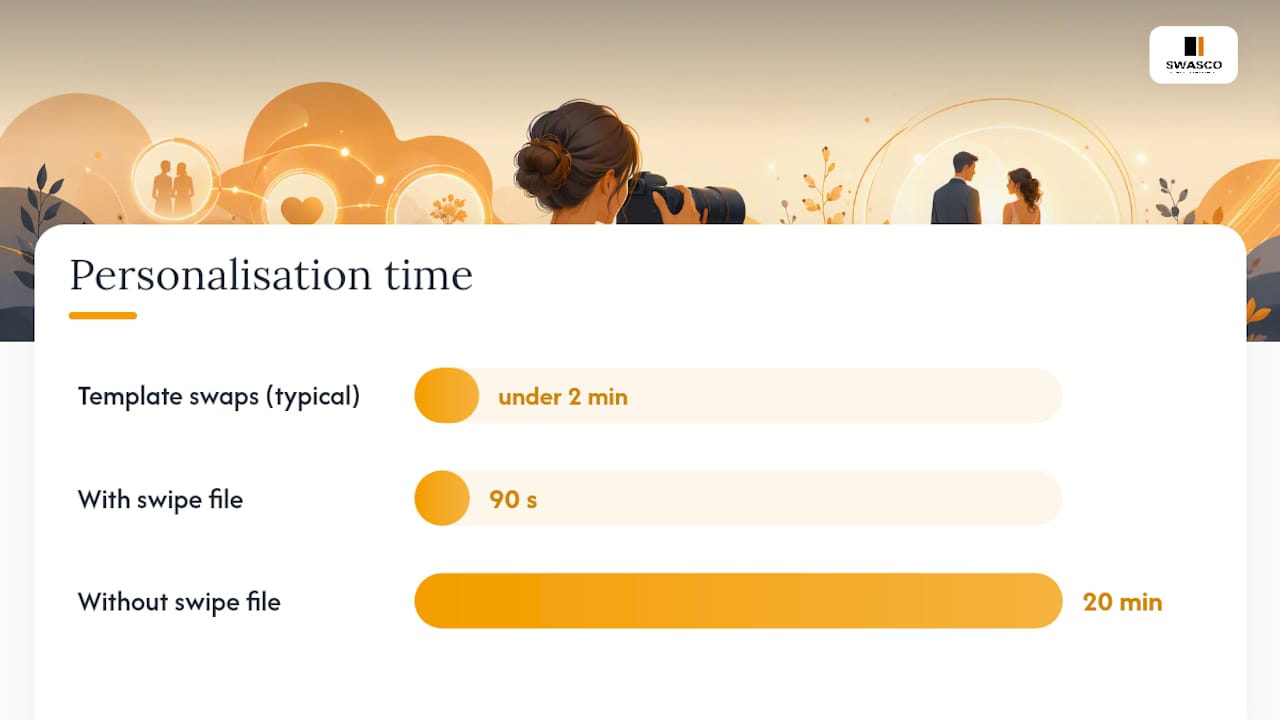
Personalisation doesn't mean rewriting every email from scratch. It means making three or four targeted swaps to a solid template, and those swaps take under two minutes once you know what to look for.
The highest-value fields on your enquiry form are the ones most photographers skim past: venue name, how the couple found you, and any style references they've included. A venue mention lets you drop in familiarity ("I photographed a wedding at {Venue} last spring and the light in that courtyard is incredible") or curiosity if you haven't been there. "How did you hear about us" tells you whether to reference a specific referring client, a Pinterest board, or an Instagram reel, each of which earns a different opening line. Style references, whether it's a mood board link or three adjectives like "relaxed, documentary, golden hour" tell you exactly which gallery example to attach.
Three sentence-level swaps make the biggest difference:
- Swap the greeting line. Replace "Thank you for your inquiry" with a specific observation about their venue, date, or story.
- Swap the gallery link. Send the gallery that most closely matches their venue type or season, not your generic "recent favourites" set.
- Swap the closing line. If their message was playful, mirror that tone. If it was formal and detail-heavy, match that register back. Consistency and tone-matching convert better than raw speed, so a reply that's thoughtful and on-brand beats one that's merely fast but generic.
Mention venue familiarity only when it's true and adds something. "I've shot at {Venue} three times and know exactly where the light works best at 4pm" is a genuinely persuasive detail. Made-up familiarity, or vague "I love that venue!" filler, reads as hollow the moment a couple asks a follow-up question you can't answer. The same goes for supplier experience, only mention a florist or planner by name if you've actually worked with them and can say something specific.
Pro Tip: Keep a swipe file of two or three sentence variations for your most common venues and referral sources. You'll reuse them constantly, and having them ready is the difference between personalising in ninety seconds and personalising in twenty minutes.
Follow-up sequences that re-engage without pestering
Most enquiries that go quiet aren't lost, they're just buried under thirty other wedding-planning emails. A simple, value-led cadence brings a good number of them back without you sounding like you're chasing.
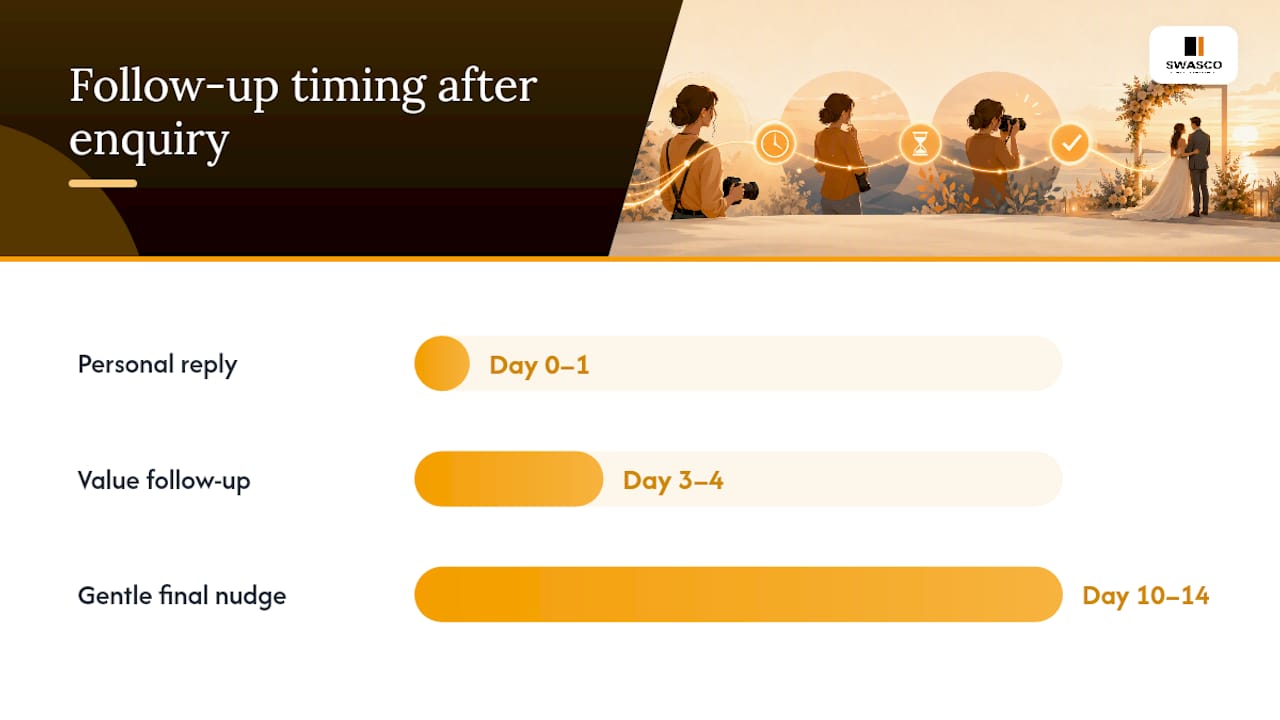
- Day 0 to 1: Personal reply. Send your tailored availability email as close to same-day as possible, ideally within 24 hours. Practitioner guidance consistently points to a personal reply within a day as the single biggest lever for moving an enquiry to a consult booking.
- Day 3 to 4: Value-based follow-up. If there's been no response, don't send "just checking in." Send something useful instead, a matching gallery, a short timeline tip, or a testimonial from a similar wedding. Follow-ups that add value outperform generic check-ins at bringing quiet leads back into conversation.
- Day 10 to 14: Gentle final nudge. Keep this one short and low-pressure. Confirm you're still holding the date if you are, and give them a clean, guilt-free way to say "not right now."
If a lead has been warm, replied once, asked detailed questions, mentioned a tight planning timeline, and then goes quiet, that's the moment to escalate beyond email. A short text or a quick call often gets a faster answer than a third email ever will, particularly for couples juggling a wedding alongside full-time jobs.
Tracking your numbers matters more than most photographers realise here. Fix that before you tinker further with timing. Building this kind of consistent follow-up rhythm without letting messages feel robotic is a skill worth investing in regardless of your niche.
Consultation and booking: framing the next step right
Asking a couple who enquired five minutes ago to commit to a 45-minute planning call is a big jump. A short discovery call, 15 to 20 minutes, framed as a chance to answer questions and see if you're a good fit, converts at a noticeably higher rate because it's a smaller commitment to say yes to.
Your CTA phrasing matters more than it seems. Compare these two:
- "Let me know if you'd like to set up a time to chat." (vague, adds decision-making work)
- "I have slots Thursday at 6pm or Saturday at 11am, or you can grab a time directly [here]." (specific, removes friction)
The second version works because it hands the couple a decision between two options rather than an open-ended task. That's a small psychological shift with a real effect on reply rates.
During the consult itself, a handful of qualifying questions keep the call efficient and help you gauge fit quickly:
- What's their total guest count and roughly how many hours of coverage do they expect to need?
- Do they have a second shooter or engagement session in mind?
- What's their rough budget range, and does it align with your packages?
- Have they booked a venue and photographer date-hold already, or are they still deciding between dates?
- What three words would they use to describe the vibe they want in their photos?
These questions do double duty: they help you tailor your pitch, and they surface budget or scheduling mismatches early, before either of you invests more time in a call that was never going to book.
Streamline responses with tools and workflows
Automation earns its place in your inquiry workflow, but only when it protects, rather than replaces, the personal reply. An auto-response that fires instantly is genuinely useful, provided it does one job well: confirming receipt and setting a clear expectation for when a human reply will land. Something like "I read every enquiry personally and will reply by Wednesday evening" buys you time without sounding like a bot, because it tells the couple exactly what to expect instead of leaving them guessing.
Scheduling widgets and CRM snippets speed up everything downstream of that first reply. A booking link embedded directly in your template removes an entire email exchange of "does Thursday work?" back-and-forth, and saved CRM snippets for your most common venue types or referral sources cut personalisation time without making replies feel copy-pasted.
This is where a conversational AI receptionist tool fits into a photographer's workflow without needing to replace your voice. Such tools can capture enquiries the moment they arrive across your website chat, calls, text, and social channels, qualify them against basic criteria like date and rough budget, and book consult slots straight into your calendar, all while you're mid-shoot or off the clock entirely. It's worth exploring as an option for photographers fielding enquiries at unpredictable hours, particularly weekends and evenings when couples do most of their vendor research.
A simple checklist for combining automation with your own follow-up:
- Let automation handle instant acknowledgement, date checks, and initial scheduling.
- Keep the actual personalised reply, the one referencing their venue and vision, in your own hands.
- Route qualified leads (right date, right budget range) straight to your consult calendar.
- Review automated messages monthly to make sure the tone still sounds like you, not a generic template.
Pro Tip: If you automate one thing this year, automate the acknowledgement, never the personal reply. Couples can tell the difference, and the personal reply is where bookings actually happen.
Handling common client questions and objections in responses
Three objections come up constantly in wedding photography inquiry responses, and each has a straightforward way to handle it without sounding defensive.
"Your price is higher than we expected." Don't discount on the spot. Restate what's included in your range, full-day coverage, edited images, an online gallery, and offer a shorter or add-on-light package if you have one. Reframing around value rather than justifying the number usually moves the conversation forward.
"Can we see your full-day galleries, not just highlights?" Have two or three full galleries ready to link immediately. Couples increasingly want to see how you handle the unglamorous stretches of a day, like the two hours between ceremony and reception, not just the golden-hour portraits.
"We're not sure about our date yet." Don't push for a decision. Offer to hold a soft tentative note and follow up closer to their venue booking. Pressuring an undecided couple tends to push them toward a photographer who feels less transactional.
"Do you travel, and what does that cost?" State your travel radius and fee structure plainly in the first reply if it's relevant to their venue, rather than making them ask a second time.
Handling these calmly in writing, rather than only on a call, sets the tone for how you'll communicate throughout the entire planning process, and couples are quietly evaluating exactly that.
Legal and contract considerations to mention or address in inquiry responses
Your first reply isn't the place for contract terms, but it's worth flagging that a contract and deposit exist, so nothing feels like a surprise later. A short line like "Once we've chatted and you're ready to move forward, I'll send over a contract and secure your date with a deposit" sets expectations without turning a warm email cold.
Save the detail for the consult or a follow-up email: your cancellation and rescheduling policy, deposit amount and what it covers, copyright and image usage terms, and your policy on second shooters or assistants if applicable. If you offer a model release for portfolio or marketing use, mention that it's covered in the contract rather than asking for it upfront.
One area worth being explicit about early: what happens if the couple's date changes. Wedding dates shift more often than photographers expect, and a brief, honest answer here, "there's a rescheduling fee only if I'm already booked elsewhere on the new date," builds more trust than silence would.
Best practices for managing multiple inquiries simultaneously
Busy season brings a genuine risk: enquiries blur together, and a couple gets a reply that references the wrong venue or the wrong date. A simple system prevents this without needing anything complicated.
Log every enquiry the moment it lands, venue, date, referral source, and key details, in one place, whether that's a spreadsheet, a CRM, or a tool that captures it automatically. Reply in the order enquiries arrived where possible, but flag and prioritise time-sensitive ones, a couple asking about a date six weeks out needs a faster answer than one planning eighteen months ahead. Batch your replies into set windows once or twice a day rather than answering piecemeal between shoots, which reduces the odds of a distracted, detail-mixing mistake. Before you hit send on any personalised template, do a ten-second scan for the couple's actual names and venue rather than trusting memory from an hour earlier.
Cultural sensitivity and inclusivity in communication
Your inquiry response is often the first real signal a couple gets about how you'll handle their wedding day, so language matters more than photographers sometimes credit it for. Default to gender-neutral phrasing until you know otherwise, "congratulations to you both" works for every couple, rather than assuming "bride" and "groom" apply.
If a couple's enquiry mentions cultural or religious traditions, a multi-day celebration, specific rituals, family customs, acknowledge it directly rather than treating it as an aside. A single sentence, "I'd love to hear more about how the ceremony traditions will flow so I can plan coverage properly," signals genuine interest rather than a generic template response. The same goes for same-sex couples, blended families, or non-traditional wedding structures: mirror the language they've used about their own relationship and day, rather than defaulting to assumptions built from a more conventional template.
Technical communication tips for clarity and professionalism
Keep sentences short and specific in every reply. A couple juggling vendor emails all day won't reread a paragraph to extract your availability, so put the answer in the first two lines.
Format for scanning: short paragraphs, one clear CTA, and bold or clearly separated pricing information rather than burying it mid-paragraph. Double-check names, dates, and venues before sending, autocomplete has quietly wrecked more than one photographer's open rate by turning "Sarah" into "Sara" in a subject line. And proofread the entire email once more for tone: an email crafted quickly between shoots can read curt even when that wasn't the intention, so read it back as if you were the couple receiving it.
An A/B test worth running on your own enquiry replies
Here's a test that surfaces useful data within a few weeks rather than months. Split your incoming enquiries: for one group, send an instant auto-receipt followed by a fully personalised reply the same day. For the other, send the same auto-receipt but delay the personalised reply by 48 to 72 hours.
Track two numbers: inquiry-to-consult booking rate, and consult-to-booking rate. If the same-day group books meaningfully more consults, speed of personal reply is your bottleneck. If both groups convert similarly at the consult stage, your actual reply content, not your timing, needs the work.
The most common pitfall photographers hit running this test is letting the "delayed" group's reply drift past 72 hours out of sheer busyness, which quietly skews results toward looking worse than a genuine 48 hour gap would. The second pitfall is judging the test on booking rate alone rather than tracking consult rate separately, because a slow reply can still book well if your consult itself is strong, and that distinction tells you exactly where to focus your energy next.
— James Paul
How Talk2Aiva helps wedding photographers capture and convert enquiries
Every template in this guide assumes you're actually available to send it quickly, which is exactly where most photographers lose bookings: enquiries land while you're mid-shoot, at a Saturday wedding, or asleep after a long reception. Talk2Aiva is built to close that gap rather than replace your voice in the reply itself.
It captures enquiries the moment they arrive across your website chat, phone, text, and social channels, then qualifies them against basic criteria like date, rough budget, and venue. From there it can:
- Confirm receipt instantly and set the expectation for your personal reply, exactly the kind of auto-response covered earlier in this guide
- Book consult slots straight into your calendar using the two-option CTA approach that converts better than an open-ended "let's chat"
- Follow up automatically with quiet leads using a value-led cadence, freeing you to focus your personal attention on the replies that need it most
- Route qualified leads to you across whichever channel the couple actually used to reach out
Pair it with the templates above: let Talk2Aiva handle the instant acknowledgement and scheduling logistics, then write your personalised reply using the venue and detail hooks it surfaces from each enquiry. If you want to see how it fits your own booking workflow, visit the Talk2Aiva landing page for a demo.
Sources
- Photography inquiry email template – what to send when a lead reaches out
- Wedding photography email templates: the 7 you actually need
- Average cost of wedding photography
- The inquiry response that books: perfecting the first email for wedding photographers