
Recording calls in the UK is lawful, but the rules differ sharply depending on whether you are an individual making a private note or a business processing personal data at scale. If you run a business, three actions are non-negotiable right now:
- Notify every caller before recording begins, using a clear automated or verbal message.
- Choose and document a lawful basis under the UK GDPR (typically legitimate interests or consent) and record your reasoning.
- Secure and retain recordings proportionately, with access controls, encryption, and a defined deletion schedule.
Get those three right and you are most of the way to compliance. The sections below explain exactly how.
Key takeaways
UK call recording law requires businesses to satisfy both interception law and UK GDPR obligations independently, with transparency, a documented lawful basis, and proportionate security as the non-negotiable foundations.
| Point | Details |
|---|---|
| Two separate legal hurdles | Interception law (RIPA/Investigatory Powers) and data-protection law (UK GDPR) must both be satisfied; clearing one does not clear the other. |
| Notify before recording starts | An IVR message or agent disclosure before the call connects meets the "reasonable efforts to inform" requirement under the telecoms regulations. |
| Document your lawful basis | Complete a Legitimate Interests Assessment or consent mechanism and keep it on file; the ICO can request it at any time. |
| Set and enforce retention periods | Match retention to purpose: 3–6 months for training, five years minimum for FCA-regulated activities; delete on schedule. |
| Talk2Aiva automates compliance steps | IVR notifications, metadata logging, and secure storage are built into Talk2Aiva's guided setup, reducing manual compliance effort from day one. |
Table of Contents
- Which UK laws govern call recording?
- How do the rules differ for individuals and businesses?
- What lawful basis should you use under the UK GDPR?
- What are the system-controller rules under telecoms regulations?
- How to tell callers their calls are recorded
- Retention periods, security controls, and when to run a DPIA
- Can you use call recordings as evidence in court?
- What are the risks of covert recording?
- A compliance checklist for businesses
- Implementing call recording with AI and automated telephony
- ICO enforcement and where to get official guidance
- Employee rights and workplace call monitoring
- Do call recording laws differ across Scotland, Wales, and Northern Ireland?
- What good implementation actually looks like
- Talk2Aiva makes compliant call handling straightforward
- Sources
Which UK laws govern call recording?
UK call recording law sits at the intersection of interception law and data-protection law. They are separate hurdles, and clearing one does not automatically clear the other. Here are the primary statutes and regulators you need to know:
- UK GDPR and the Data Protection Act 2018 — govern how personal data in recordings is collected, stored, and used. The Information Commissioner's Office (ICO) enforces these rules and can issue fines and enforcement notices. Call recording compliance under UK GDPR requires a lawful basis, transparency, and appropriate security.
- Regulation of Investigatory Powers Act 2000 (RIPA) — Section 1 of RIPA makes it a criminal offence to intentionally intercept a communication in the course of transmission without lawful authority. Consent or a statutory authorisation can provide that authority.
- Investigatory Powers Act 2016 — provides the statutory framework for interception, including the powers under which the Secretary of State can authorise business monitoring via secondary legislation.
- Investigatory Powers (Interception by Businesses etc. for Monitoring and Record-keeping Purposes) Regulations 2018 — the 2018 Regulations set out the conditions under which businesses may lawfully intercept communications for monitoring and record-keeping, and require reasonable efforts to inform users under Regulation 4.
- Telecommunications (Lawful Business Practice) (Interception of Communications) Regulations 2000 — these Regulations authorise interception or record-keeping by a system controller for specified business purposes, provided the controller has made reasonable efforts to inform users.
- FCA SYSC 10A — for regulated financial services firms, SYSC 10A requires recording of telephone conversations relating to regulated activities, with retention typically for five years.
- ICO and gov.uk guidance — the ICO publishes practical guidance on lawful basis, transparency, and DPIAs. Primary legislation is available in full on Legislation.
How do the rules differ for individuals and businesses?
The distinction matters because the legal tests are fundamentally different.
Private individuals recording their own calls for personal use fall outside the UK GDPR's scope under the "household exemption." You can record a call to help you remember what was said. The risk arises the moment you share or publish that recording. Posting a recording online, sending it to a journalist, or using it to harass someone can trigger offences under the Computer Misuse Act 1990, the Protection from Harassment Act 1997, or data-protection rules if the content identifies third parties.
Businesses almost always process personal data when they record calls, which means the household exemption does not apply. A call centre recording conversations for training purposes, an estate agent capturing a viewing enquiry, or a solicitor recording a client consultation are all processing personal data. UK GDPR obligations apply in full: lawful basis, transparency, data minimisation, purpose limitation, and security.
Three quick contrasts illustrate the gap:
- A sole trader recording a supplier call on their personal phone for their own reference sits closer to the individual end, but once those recordings are stored on business systems or shared with colleagues, data-protection rules engage.
- A contact centre recording thousands of calls per month for quality assurance is squarely in business territory and needs a documented lawful basis, a privacy notice, and a retention policy.
- An individual secretly recording a conversation with a colleague to use in an employment tribunal is a grey area: the recording may be admissible, but covert recording of colleagues without any notice carries real legal risk.
What lawful basis should you use under the UK GDPR?
Choosing the right lawful basis is the single most consequential decision in your compliance setup. Three bases are relevant to call recording:
| Lawful basis | When it fits | Key condition |
|---|---|---|
| Legitimate interests | Quality assurance, training, dispute resolution, security | Must pass a three-part balancing test; notice required |
| Performance of a contract | Recording needed to deliver the service agreed with the caller | Recording must be genuinely necessary, not just convenient |
| Consent | Where no other basis fits, or where you want to offer callers a choice | Must be freely given, specific, informed, and withdrawable |
Legitimate interests is the most common basis for business call recording. To rely on it, you must complete a Legitimate Interests Assessment (LIA) covering three steps:
- Purpose test — identify a genuine, specific business purpose (e.g. staff training, dispute resolution).
- Necessity test — confirm recording is the least intrusive way to achieve that purpose.
- Balancing test — weigh your interests against the caller's reasonable expectations and privacy rights.
Document the LIA and keep it on file. The ICO can ask to see it.
Consent is appropriate when callers have a genuine choice and you can honour withdrawal. It is harder to manage operationally because you need a mechanism to record the consent event and to stop processing if consent is withdrawn.
Copy-ready wording for legitimate interests notice: Copy-ready consent phrase (where consent is the chosen basis):
What are the system-controller rules under telecoms regulations?
The Telecommunications (Lawful Business Practice) Regulations 2000 and the 2018 Regulations both use the concept of a system controller: the person or organisation that operates the telecommunications system being used to make or receive calls. That matters because the obligation to inform users, and the authorisation to intercept, rests with the system controller.
Regulation 3 of the 2000 Regulations lists the authorised purposes for interception, including monitoring for quality control, detecting unauthorised use, preventing or detecting crime, and system operation. The explanatory note confirms that interceptions are authorised only where the controller has made all reasonable efforts to inform users and the purpose is on the permitted list.
Regulation 4 of the 2018 Regulations requires the system controller to take reasonable steps to inform every person who may use the system that interception may take place.
What counts as "reasonable efforts to inform"?
- An IVR (interactive voice response) message played before the call connects.
- A verbal disclosure by the agent at the start of the call.
- A clear statement in the terms of service or privacy notice that callers are directed to before calling.
- On-hold messaging that repeats the notice during the call.
If you use a third-party telephony provider, such as a VoIP system, you need to confirm in writing who bears the system-controller obligations. Your contract with the provider should specify whether they are a data processor acting on your instructions or a controller in their own right. This is often the single most important technical clarification in a call recording setup.
How to tell callers their calls are recorded
Transparency is not optional. Both the UK GDPR and the telecoms regulations require it, and the timing matters: notice should be given before recording starts, not buried in a 40-page terms document nobody reads.
Sample scripts and placements:
IVR/automated message (before call connects): Agent opening script: Website privacy notice snippet: Email footer (for businesses that follow up calls by email): Pro Tip: Combine your IVR notice with on-hold messaging that repeats the disclosure, and include a link to your full privacy notice in your email signature. This multi-channel approach means you can demonstrate transparency across every touchpoint, which is exactly what an ICO audit will look for.
Retention periods, security controls, and when to run a DPIA
Keeping recordings longer than necessary is a data-protection breach waiting to happen. Set retention periods by purpose and stick to them.
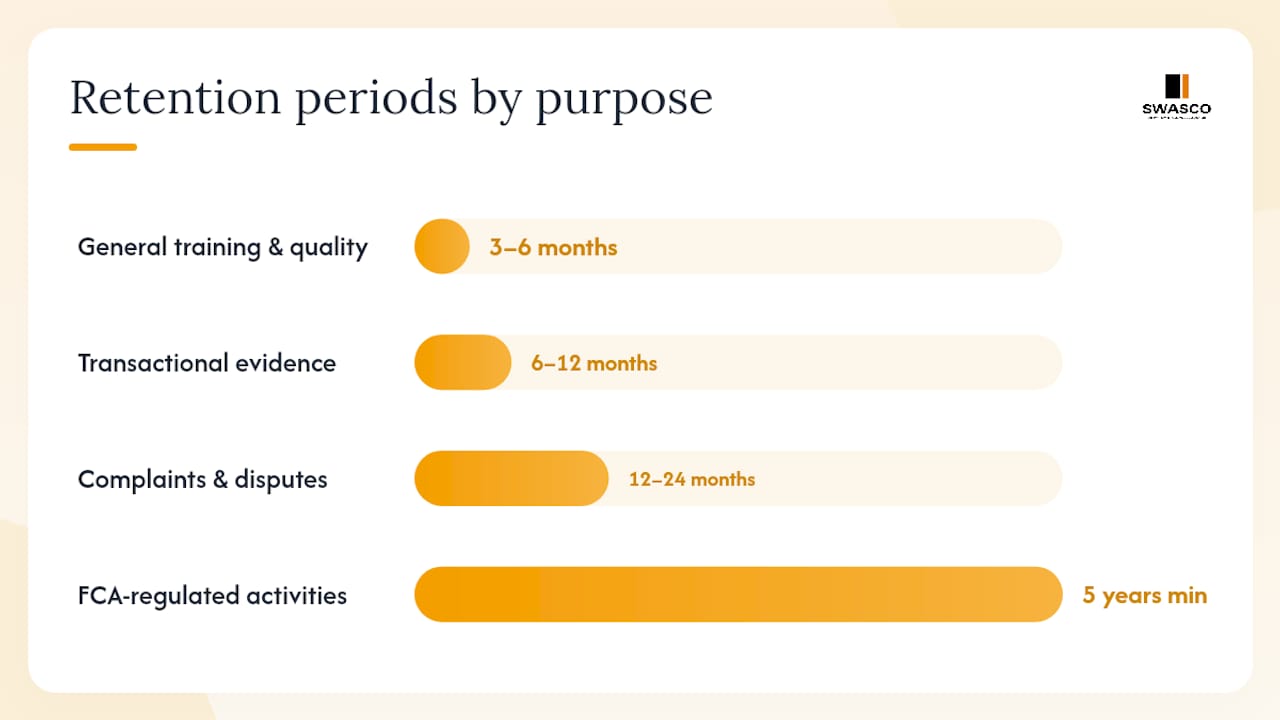
Suggested retention bands by purpose:
| Purpose | Suggested retention period | Notes |
|---|---|---|
| General training and quality | 3–6 months | Delete once training cycle complete |
| Transactional evidence | 6–12 months | Align with contract dispute limitation periods |
| Complaints and disputes | 12–24 months | Retain until resolution plus a reasonable buffer |
| FCA-regulated activities | 5 years minimum | SYSC 10A mandates this for relevant firms |
Minimum security controls:
- Encryption at rest and in transit for all stored recordings.
- Role-based access controls so only authorised staff can retrieve recordings.
- Access logging with timestamps so you can show who accessed what and when.
- Secure deletion procedures that overwrite or cryptographically erase files at end of retention.
- Regular access reviews to remove leavers and role-changers promptly.
When to run a Data Protection Impact Assessment (DPIA):
A DPIA is advisable, and in some cases mandatory, when recording is likely to result in high risk to individuals. Triggers include:
- Large-scale recording of calls involving sensitive personal data (health, financial, legal matters).
- Using AI or analytics tools to process recordings (sentiment analysis, voice profiling).
- Sharing recordings with third parties or across international borders.
- Systematic monitoring of employees' calls.
A DPIA should document the purpose, the necessity and proportionality of recording, the risks identified, and the measures taken to mitigate them. The ICO's DPIA template is a practical starting point.
Can you use call recordings as evidence in court?
Yes, recordings can be used as evidence in civil and criminal proceedings in England and Wales, but admissibility depends on how they were obtained and how well you have preserved their integrity.
- Secure the original file immediately. Do not edit, compress, or re-encode the recording. Store the original in a write-protected location.
- Log the metadata. Capture the date, time, duration, caller ID, and the system that made the recording. This forms the chain of custody.
- Create a tamper-evident copy. Use a hash (such as SHA-256) to verify the file has not been altered since capture.
- Prepare a witness statement. A statement from the person responsible for the recording system explaining how it works and how the recording was preserved adds significant weight.
- Seek legal advice before disclosure. If you intend to rely on a recording in litigation, or to share it publicly, take legal advice first. Disclosing recordings without authority can itself create liability.
Covertly obtained recordings are not automatically inadmissible, but courts have discretion to exclude evidence obtained unlawfully, and the circumstances of capture will be scrutinised.
What are the risks of covert recording?
Covert recording, where one party records without any notice to the other, sits in legally dangerous territory for businesses. Under RIPA Section 1, intentionally intercepting a communication without lawful authority is a criminal offence. The telecoms regulations and the 2018 Regulations both require reasonable efforts to inform users, so a business that records with no notice at all cannot rely on those authorisations.
Red flags that should stop recording and trigger legal advice:
- The call involves sensitive personal data (health conditions, financial distress, legal proceedings).
- The caller makes allegations of criminal conduct or whistleblowing disclosures.
- There are threats of violence or safeguarding concerns.
- A recording was made by an employee without management knowledge or authorisation.
- You discover a recording that was made outside your documented policy.
If you discover an unauthorised or suspect recording:
- Isolate the file and restrict access immediately.
- Preserve it without alteration.
- Escalate to your Data Protection Officer or legal counsel before taking any further action.
A compliance checklist for businesses
Work through this in order. The first week is about mapping; the first month is about implementation.
First week:
- Map every call flow in your business: inbound, outbound, internal, and any third-party handled calls.
- Identify who the system controller is for each call flow, including any third-party telephony providers.
- Decide the lawful basis for each recording purpose and document your reasoning.
First month:
- Implement IVR notifications and agent scripts for every recorded line.
- Update your privacy notice to describe call recording, the lawful basis, retention periods, and how callers can exercise their rights.
- Complete a Legitimate Interests Assessment (or consent mechanism) for each recording purpose.
- Run a DPIA if any recording activity meets the high-risk triggers above.
- Configure technical controls: encryption, access logging, role-based access, and secure deletion schedules.
- Train all staff who handle recorded calls on the policy, the notice requirements, and how to handle access requests.
- Establish an audit trail: document every decision, policy version, and training session with dates.
Ongoing:
- Review retention schedules quarterly and delete recordings that have passed their retention period.
- Audit access logs at least annually and remove access for leavers promptly.
Implementing call recording with AI and automated telephony
AI receptionist and automated telephony systems can make compliance easier, but only if they are configured correctly from the start. For omnichannel call handling that spans phone, SMS, and web chat, the configuration checklist below applies to each channel where recording or data capture occurs.
System configuration checklist:
- Enable IVR notification messages on every recorded line before the call connects.
- Configure consent flags in the call-handling system so that consent events (or notice events for legitimate interests) are logged against each call record.
- Store consent or notice timestamps in the call metadata, not just in a separate spreadsheet.
- Activate redaction features for any recordings that may capture payment card data (PCI DSS compliance) or other sensitive information.
- Set role-based access controls so that recordings are accessible only to authorised users.
- Enable audit logs that capture who accessed, downloaded, or deleted a recording and when.
When using a third-party telephony provider, confirm in your contract whether they are a data processor or a joint controller. Providers offering managed telecoms services for property and facilities management, for example, may hold recordings on their infrastructure, which affects where your data-protection obligations sit.
Pro Tip: Log the IVR notification timestamp and any agent confirmation in the call metadata automatically. When a subject access request or ICO inquiry arrives, you can pull a single record that shows the notice was given, when, and by which channel. That single audit trail can resolve a complaint in minutes rather than days.
ICO enforcement and where to get official guidance
The ICO has broad enforcement powers. It can issue fines of up to £17.5 million or 4% of global annual turnover (whichever is higher) for serious breaches of the UK GDPR, issue enforcement notices requiring specific remedial action, and publish reprimands that damage reputation even without a financial penalty.
If you receive a complaint or an ICO inquiry:
- Preserve all relevant recordings, metadata, and policy documents immediately. Do not delete anything.
- Notify your legal counsel or Data Protection Officer as soon as possible.
- Prepare your DPIA, LIA, and records of processing activities for review.
- Respond to the ICO within the timeframes it sets; late responses are treated as aggravating factors.
For official guidance, the ICO's website at ico.org.uk covers lawful basis, transparency, DPIAs, and subject access requests in detail. Primary legislation is available on legislation.gov.uk. The FCA handbook covers sector-specific recording obligations for financial services firms.
Employee rights and workplace call monitoring
Employees have data-protection rights even when their employer records their calls. The UK GDPR applies to employee data, and the ICO's Employment Practices Code sets out the standard employers are expected to meet.
Before recording employee calls, you must:
- Tell employees clearly that their calls may be recorded, what recordings will be used for, and how long they will be kept. This should appear in the employment contract, staff handbook, and any relevant training materials.
- Identify a lawful basis. For most employers, legitimate interests or performance of a contract covers routine quality monitoring. Covert monitoring of employees' calls requires a much higher justification and carries significant legal risk.
- Carry out a DPIA if monitoring is systematic or large-scale.
Employees have the right to submit a subject access request for recordings of their own calls. You must respond within one calendar month. They also have the right to request deletion where the recording is no longer necessary for the purpose it was collected.
Covert monitoring of employees, without any notice, is rarely justifiable and can constitute a breach of the right to privacy under Article 8 of the European Convention on Human Rights, as incorporated into UK law. Employment tribunals have considered covertly obtained recordings in unfair dismissal and discrimination cases, but the manner of obtaining them is always scrutinised.
Do call recording laws differ across Scotland, Wales, and Northern Ireland?
The short answer is: not significantly for most businesses. The UK GDPR, the Data Protection Act 2018, RIPA, and the Investigatory Powers Act 2016 all apply across the whole of the United Kingdom, including Scotland, Wales, and Northern Ireland. There is no devolved call recording legislation that overrides or supplements these UK-wide rules for private sector businesses.
A few nuances are worth noting:
- Scotland has its own legal system, and some procedural rules around evidence and court admissibility differ from those in England and Wales. If you intend to use a recording in Scottish civil or criminal proceedings, take advice from a Scottish solicitor on the applicable rules of evidence.
- Northern Ireland operates under the same UK-wide data-protection and interception framework. The Information Commissioner's Office covers Northern Ireland, and there is no separate Northern Irish data-protection regulator.
- Wales has no devolved data-protection or interception powers. Welsh public bodies are subject to the same UK GDPR obligations as their English counterparts.
For businesses operating across all four nations, a single UK-wide call recording policy, drafted to meet UK GDPR and the Investigatory Powers framework, covers the compliance requirements in each jurisdiction. Where recordings may be used in legal proceedings, local legal advice on evidential rules is always prudent.
What good implementation actually looks like
The businesses that handle call recording compliance well are not necessarily the ones with the longest policies. They are the ones that have made compliance frictionless by building it into the system rather than bolting it on afterwards.
The most resilient setup combines three things: an IVR message that fires automatically before every recorded call connects, a consent or notice flag that is written to the call metadata at the same moment, and access controls that mean only the people who genuinely need to hear a recording can retrieve it. That combination means you can answer an ICO inquiry, a subject access request, or an internal audit query from a single system report rather than a manual trawl through spreadsheets and email chains.
What most businesses underestimate is the system-controller question. Many assume their telephony provider handles compliance on their behalf. In practice, the provider is usually a data processor, and the compliance obligations rest with the business. Clarifying that in writing, before you go live, is the step that prevents the most expensive surprises.
Talk2Aiva makes compliant call handling straightforward
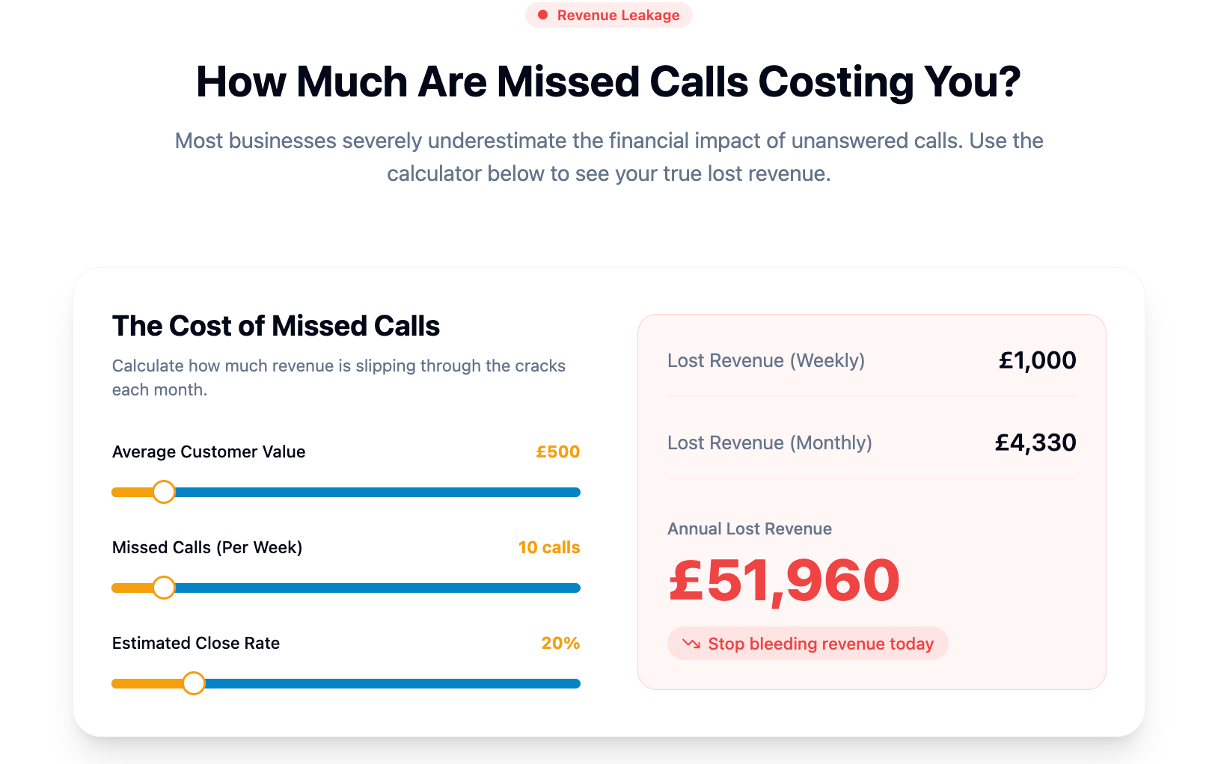
Missed calls cost revenue. Poorly configured call recording costs compliance. Talk2Aiva by SWASCO addresses both at once, with a guided AI receptionist that handles inbound calls 24/7, fires IVR notifications automatically, logs consent and notice events in call metadata, and stores recordings securely with configurable retention settings.
Every Talk2Aiva setup includes done-for-you onboarding, IVR configuration, and ongoing technical support so your call handling is compliant from day one, not retrofitted later. For service businesses, from estate agents to legal firms, that means fewer missed leads and a clear audit trail if the ICO ever comes knocking. Book a compliance-focused demo and see how Talk2Aiva fits your specific call flows.
Sources
Primary legislation and regulator pages to verify the rules yourself:
- The Telecommunications (Lawful Business Practice) (Interception of Communications) Regulations 2000
- The Investigatory Powers (Interception by Businesses etc. for Monitoring and Record-keeping Purposes) Regulations 2018
- Regulation of Investigatory Powers Act 2000 — section 1 (unlawful interception)
- Investigatory Powers Act 2016 — contents
- The Telecommunications (Lawful Business Practice) (Interception of Communications) Regulations 2000 — explanatory note
This article is general information, not a substitute for advice from a qualified lawyer. Consult a qualified legal professional about your own circumstances before acting on anything here.