
Yes, a specialist answering service can capture emergency calls, qualify quote requests, and book site visits while you're up a tree or halfway through a felling job. Services built for the trade record the exact details your team needs, from tree species to access constraints, and route them straight to your calendar. Talk2Aiva offers a UK-focused version of this, with guided onboarding and 24/7 lead capture built in.
TL;DR:
- Effective tree surgeon answering services must offer 24/7 emergency routing, capturing detailed site information like species, access restrictions, and TPO status.
- Response time and the percentage of calls converted into booked site visits are critical metrics to gauge the service's impact on emergency jobs and revenue.
- Integration with calendar and SMS workflow ensures swift handovers with job briefs, reducing manual follow-up and improving operational efficiency.
- Call scripts should focus on safety signals such as proximity to power lines or partial tree falls, with escalation protocols trained into staff or AI systems.
- Choosing a guided AI receptionist setup, like Talk2Aiva, can ensure accurate data capture and quick deployment tailored to tree work operations.
Table of Contents
- Why a tree-surgery-specific answering service matters
- Must-have features for tree surgeon call answering
- Typical call scenarios and the exact data to capture
- How to implement an answering service: setup, costs and timetable
- Handling compliance and call data safely in the UK
- Handling insurance and liability inquiries specific to tree surgery
- Integration with job management or CRM software used by tree surgeons
- Staff training on safety protocols and urgent hazard recognition during calls
- Why a guided AI receptionist is a practical option for tree surgeons
- Get started with Talk2Aiva for tree surgeon call answering
- Sources
Why a tree-surgery-specific answering service matters
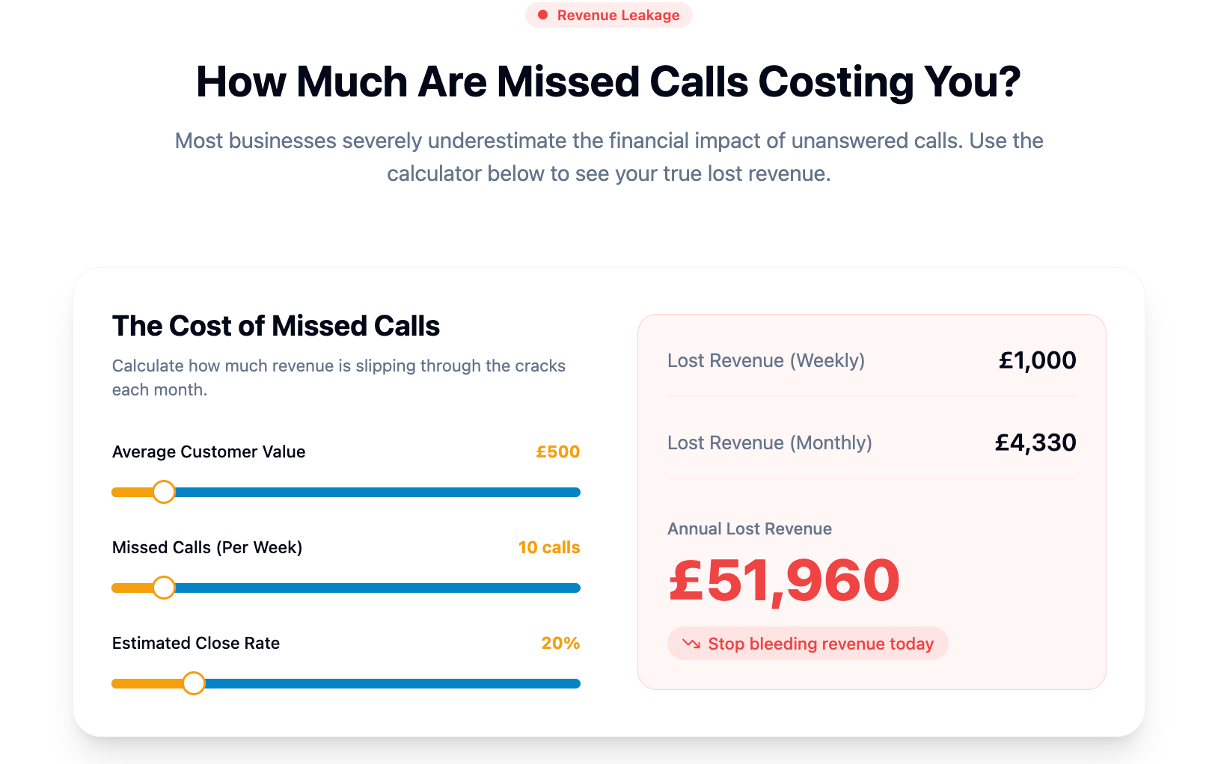
Storm damage doesn't wait for your lunch break. When a branch comes down on someone's conservatory, the homeowner is calling three or four tree surgeons in the space of ten minutes, and the first one to pick up the phone usually wins the job. Many UK tree surgery firms already advertise 24/7 emergency phone coverage precisely because that speed determines who gets the work, not who does the best job once they arrive.
The trouble is obvious once you say it out loud: you cannot safely run a chainsaw thirty feet up and answer your mobile at the same time. Phone handling has to be delegated to someone, whether that's an office manager, an answering service, or increasingly, a system that never needs a lunch break of its own.
What separates a service that actually helps from one that just adds another subscription bill comes down to a few numbers worth tracking:
- Calls answered versus calls missed — a rough proxy for how much emergency work is going to a competitor instead.
- Response time — how quickly a caller gets a real answer, not a voicemail greeting.
- Quote-to-visit conversion — how many enquiries actually turn into a booked site visit.
Get those three right and the rest of the business tends to follow.
Must-have features for tree surgeon call answering
Not every answering service understands tree work, and that gap shows up fast when a caller mentions a TPO (Tree Preservation Order) and gets met with silence. Before signing anything, check the service covers these basics.
- 24/7 availability with emergency routing — genuine round-the-clock cover, not a daytime-only line with an answerphone bolted on for evenings.
- Scripted data capture built for tree work — species, approximate height and diameter, site access, and whether the tree sits within a conservation area or under a TPO.
- Calendar integration and SMS summaries — so a booked visit lands directly in your diary and your operative gets a text brief before they arrive.
- Omnichannel capture — phone, web chat, and WhatsApp or SMS, since many customers now expect to send a photo of the damage before they'll even book a call. Hampshire-based firms already lean on WhatsApp for exactly this kind of triage.
- Done-for-you script writing — someone who builds the conversation flow around your typical jobs, rather than a generic template lifted from a dentist's reception desk.
Pro Tip: Ask any vendor to show you a sample transcript of a storm-damage call before you commit. If it doesn't ask about access for a crane or chipper, it wasn't written for tree surgeons.
Typical call scenarios and the exact data to capture
A good answering service doesn't ad-lib. It follows a script tight enough to capture the details your team needs, whatever the call is about.
- Emergency call. Safety comes first: is anyone in immediate danger? Then the exact location, what structure or person is at risk, access for vehicles or equipment, any live hazards such as downed power lines, and an urgency rating so your team knows whether to drop what they're doing.
- Quote request. Species if the caller knows it, rough height and diameter, the work wanted (crown reduction, felling, stump grinding), whether photos can be sent, and any parking or access restrictions on the property.
- Booking confirmation. Available time windows, deposit policy if one applies, who's turning up on the day, and a follow-up text with a short job brief and a link to any photos the customer sent.
Every one of those calls ends the same way behind the scenes: a concise handover to the operative. That means an SMS brief with the key facts and the customer's photos attached to the job record, so nobody arrives on site guessing what they're dealing with. A service that offers calendar sync and SMS job briefs as standard removes most of the manual chasing that eats into an office manager's day.
How to implement an answering service: setup, costs and timetable
Getting a service live doesn't need to be a drawn-out project. Most vendors follow a similar path.
- Discovery — a short conversation about your typical jobs, service area, and the questions you always wish callers had answered.
- Script build — writing the conversation flow around emergency calls, quotes, and bookings specific to tree work.
- Training and soft launch — testing the script against real call types before it goes fully live.
- Ongoing optimisation — adjusting scripts as you learn which questions actually save site visits and which ones don't.
Standard setups can go live within a week. Bespoke workflows, particularly ones that need to talk to job management software, tend to take one to two weeks. On cost, expect subscription bands rather than a flat fee, with genuine 24/7 emergency cover typically sitting in a higher tier than daytime-only answering. Once live, judge it against the same figures that matter before you signed up: response time, the percentage of calls actually captured, booked site visits, and revenue you can trace back to jobs that would otherwise have gone to voicemail.
Handling compliance and call data safely in the UK
Call recording and customer data aren't optional extras to think about later. Get the basics wrong and you're looking at a regulatory headache on top of a missed job.
- Lawful basis and notice — recordings need a lawful basis under UK GDPR, and callers should be told clearly that the call may be recorded, with retention kept to what you actually need.
- PECR and SMS consent — marketing texts need proper consent, but transactional messages like job confirmations sit under different rules. Don't assume one covers the other.
- Vendor due diligence — check where data is stored, who has access, and whether there's a clear deletion policy once a job's closed.
For the full detail on recording obligations, see this breakdown of UK call recording law.
Handling insurance and liability inquiries specific to tree surgery
Insurance questions come up on almost every call that involves damage to a neighbour's property, a car parked too close to a felling zone, or a tree that's already partly fallen. Callers want reassurance fast, and a script that fumbles this loses trust before you've even quoted a price.
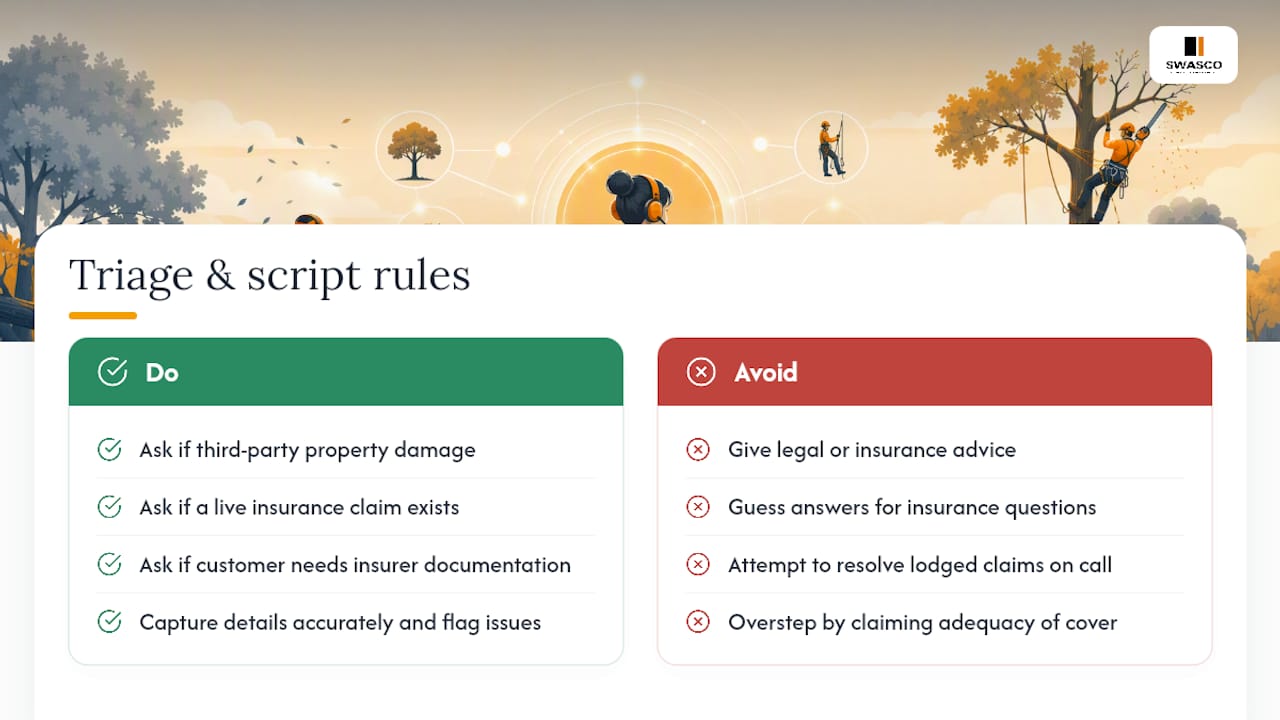
A well-built answering service asks the right follow-up questions rather than guessing: does the enquiry involve third-party property damage, is there a live insurance claim already in progress, and does the customer need documentation for their own insurer once work's complete? None of this requires the answering service to give legal or insurance advice, and it shouldn't try to. Its job is to capture the details accurately and flag anything that needs your direct input, particularly claims involving public liability or where the customer is asking whether your firm carries adequate cover.
It's worth having a standard, pre-approved line ready for the answering service to use when someone asks about your insurance. Something plain and factual, confirming your firm holds public liability cover and that documentation is available on request, keeps the call moving without anyone overstepping into advice they're not qualified to give. Where a call touches on a genuine dispute or a claim already lodged with an insurer, the script should flag it as a priority callback rather than attempt to resolve it there and then. Getting this triage right protects both the customer's confidence in you and your own liability exposure.
Integration with job management or CRM software used by tree surgeons
An answering service that lives in its own bubble, disconnected from whatever system you actually run jobs through, creates more admin than it saves. The value comes from the handover: a captured call needs to land somewhere your team already looks, not in a separate inbox nobody checks until Friday.
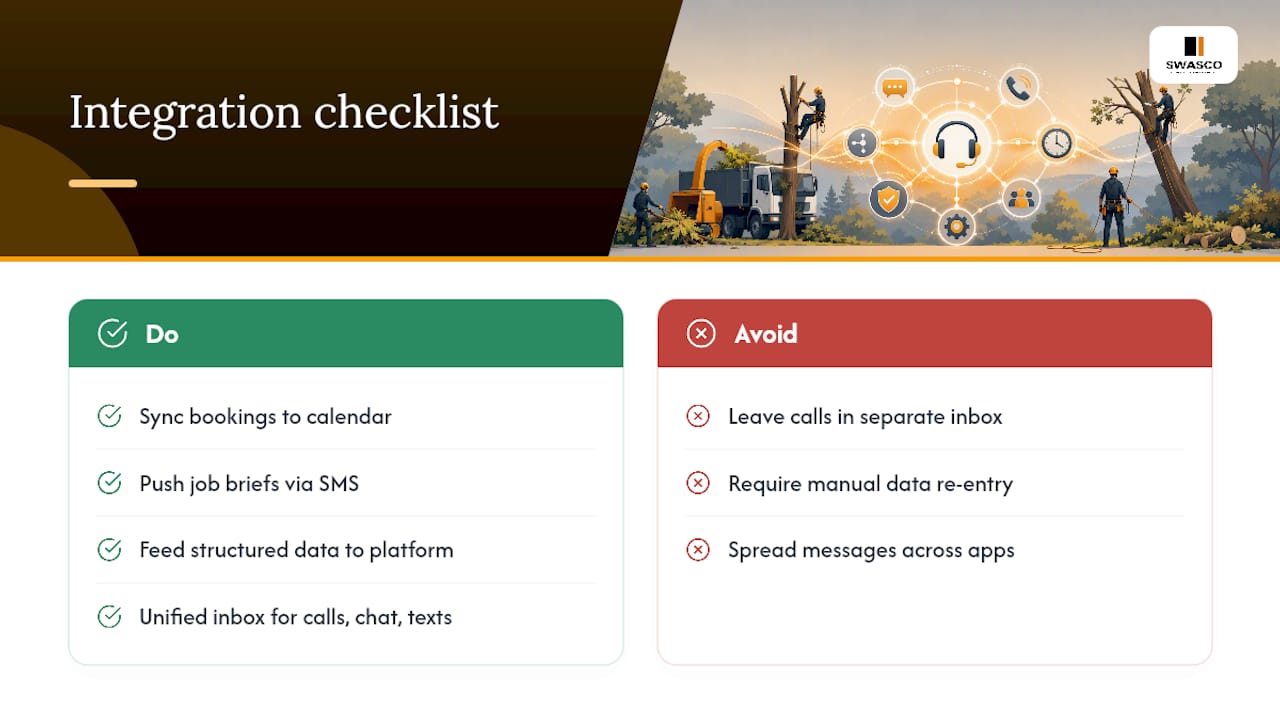
Look for a service that can sync bookings to your calendar, push job briefs by SMS, and ideally feed structured data into whatever job management platform you use for scheduling and invoicing. Field-service businesses increasingly rely on dedicated platforms to coordinate jobs and crews, and a home services management platform built for that kind of coordination shows how much smoother a job runs when call data, scheduling, and crew assignment sit in one connected flow rather than three disconnected tools.
If you're still running your business from a paper diary and a WhatsApp group, that's fine, plenty of firms do. But even then, a unified inbox that keeps phone, web chat, and text enquiries in one place saves the daily task of chasing three different message threads to work out who's booked in for Thursday. The goal isn't complexity, it's making sure a captured lead never sits stranded in a system nobody else on the team can see.
Staff training on safety protocols and urgent hazard recognition during calls
Not every urgent call sounds urgent. A caller might mention, almost as an aside, that a large limb is hanging over their driveway where their car is parked, or that a tree near a power line has split in the wind. Recognising which details signal genuine danger, rather than a routine job that can wait until next week, is a skill that has to be trained into whoever answers the phone.
A script alone won't catch everything. Whoever handles your calls, whether that's an in-house receptionist, a human answering service, or a trained AI system, needs clear criteria for escalation: proximity to power lines, structural damage to a building, blocked access roads, or a tree that's already partially fallen and could go further. These are the calls that jump the queue, and getting that triage wrong in either direction costs you, either a dangerous delay or a wasted emergency callout for something that could have waited.
Practical training here means giving whoever takes the call a short, memorable list of red flags rather than a lengthy manual nobody reads twice. It also means the person or system on the phone knows exactly who to escalate to and how fast, so a hazard flagged at 9pm on a Sunday doesn't sit unread until Monday morning.
Why a guided AI receptionist is a practical option for tree surgeons
Most tree surgery firms are two or three people deep, which means nobody has spare capacity to sit by a phone all day. That's the gap a guided AI receptionist is built to close. Talk2Aiva's setup process includes script writing for scenarios specific to tree work, calendar sync, and multichannel capture across calls, text, and web chat, so the system asks the right questions from day one rather than learning on the job.
The bit people underestimate is the ongoing optimisation. A script written in week one won't cover every call type you get by month three, and scripted prompts paired with live training genuinely cut down on incorrect job briefs reaching your team, which is exactly the kind of small friction that causes wasted site visits. Done-for-you setup matters less as a convenience and more as the difference between a system that actually captures the right details and one that just answers the phone.
— James Paul
Get started with Talk2Aiva for tree surgeon call answering
Talk2Aiva gives tree surgeons a fully guided AI receptionist that answers every call, text, and web chat enquiry around the clock, captures the exact site details your team needs, and books qualified visits straight into your calendar, without you needing to write a single script yourself.
Unlike hiring an extra office hand or relying on an answerphone that catches nothing while you're on-site, Talk2Aiva's setup is done for you: onboarding, script writing for emergency and quote calls, training, and ongoing optimisation are all included, so the system is already fit for tree work before it ever takes a live call. Booking a demo takes a short conversation about your typical jobs and service area. From there, your first call includes discovery, a walkthrough of how emergency routing and calendar sync will work for your business, and a realistic timeline to launch. Book a demo with Talk2Aiva to see how it handles your next storm-damage call before it happens.
Sources
This guide draws on published UK tree surgery pages showing common practice around emergency cover, out-of-hours answering, and phone-call booking, including Clearcut Tree Surgery, Gildergreen Tree Surgery, Kneebone Trees, and Arbor-Call. For related reading on the operational side of call handling, see this guide to UK call recording law and this overview of after-hours enquiry handling.
- Tree Surgeon Bournemouth And Dorset | Free Quotes