
A good service enquiry script does one job: it takes a caller from "I'm just after a price" to a booked appointment, a confirmed callback or a clear next step. This guide gives you word-for-word receptionist call scripts for the moments that matter: the greeting, the qualifying questions, the "we're fully booked" call, the missed call and the follow-up. You can use them on your own phone, hand them to your team, or build them into an AI receptionist that never misses a call.
TL;DR
- A script is a call flow, not a speech: a short set of questions in a natural order that ends in an action, such as a booking, a message or a transfer.
- Every enquiry script needs five parts: greeting, reason for the call, qualifying questions, a clear next step and a follow-up.
- Never leave a caller with "we'll get back to you". Give a time, a name or a booking.
- Missed calls are where revenue leaks. A same-minute text and a set follow-up sequence recover many of them.
- You can run these scripts 24/7 across calls, text, web chat and social media with an AI receptionist, so no enquiry goes unmanaged.
Table of Contents
- What a service enquiry script is for
- The five parts of an enquiry script
- Script 1: the greeting
- Script 2: understanding the enquiry
- Script 3: qualifying questions
- Script 4: when the slot or service is unavailable
- Script 5: closing with a clear next step
- Script 6: the missed call and the follow-up
- Making scripts sound human
- Perspective: why scripts alone are not enough
- Turning your scripts into an AI receptionist
- How to roll out your scripts in a week
- FAQ
- Sources
What a service enquiry script is for
A receptionist call script, sometimes called a call flow, is a list of questions used to get information from callers, arranged so the conversation feels natural and logical. FFB describes scripts as guiding a call to an end point and an action: collecting information, taking messages, transferring callers, booking appointments, resolving issues or qualifying leads.
For a service business, that end point is almost always the same: a booked job or appointment. Tree surgeons, groomers, dentists, garages and letting agents all handle the same shape of call:
- Someone has a need and rings round.
- The first business to answer well, and make the next step easy, usually gets the job.
- Everyone else becomes a missed opportunity.
That is why scripts matter. They make sure every caller gets the same professional experience, whether you answer on the first ring while holding a pair of clippers or someone covers on a busy Monday.
The five parts of an enquiry script
Before the examples, here is the skeleton. Every script in this article is built on it.
| Part | Purpose | Example line |
|---|---|---|
| Greeting | Identify the business, sound welcoming | "Good morning, Hartley Tree Care, Sam speaking. How can I help?" |
| Reason for the call | Let the caller explain in their own words | "Tell me a bit about what you need." |
| Qualifying questions | Get the details to price or book properly | "Where is the job, and roughly how big is it?" |
| Next step | Commit to an action and a time | "I can book a survey for Thursday at 10. Does that suit?" |
| Follow-up | Confirm in writing and stay in touch | "I've texted you the details. We'll remind you the day before." |
Script 1: the greeting
The first ten seconds set the tone. The Rightmove guide on handling enquiries advises answering within three rings, using the caller's name sparingly, confirming details and stating a clear next step before ending the call. The CAI code of conduct for its members likewise asks for the company name to be identified immediately and for enquiries to be dealt with courteously.
Template
"Good [morning/afternoon], [Business name], [your name] speaking. How can I help you today?"
Keep it short. Resist adding slogans or long offers: the caller wants to be heard, not pitched.
Out of hours or when you are busy
"Thanks for calling [Business name]. We're with a customer at the moment, but I can take your details and get you booked in right now. What's your name, and what do you need help with?"
Notice that this does not send the caller to voicemail. It keeps the conversation going.
Script 2: understanding the enquiry

Let the caller talk first. Then use open questions to understand the job before asking closed ones. NHS England's example call scripts show the same pattern in a healthcare setting: structured questioning to understand the enquiry, gathering relevant details, routing the caller to the right person or service, confirming arrangements and explaining what happens next. You can borrow that logic for any trade.
Template
"Happy to help. Can you tell me a bit about what's happened / what you're looking for?"
"Is this for a one-off job, or something regular?"
"When would you ideally like this done?"
Listen for urgency, budget cues and decision-makers. A caller who says "it came down in the storm last night" needs a different response from one who says "I'm getting a few quotes for the spring".
Script 3: qualifying questions
Qualifying is how you avoid wasted visits and long back-and-forth messages. At minimum, capture the caller's name, contact number, and reason for calling. Depending on the business, add email, address and a screening question such as whether they are an existing customer or how they heard about you, as Pocket Receptionist suggests.
Keep questions in a logical order and stop when you have enough to book. Here are qualifying sets for different types of business.
Tree surgeons and roofers
- "What's the job: removal, pruning, a repair or an emergency?"
- "What's the postcode?" (so you know you cover the area)
- "Are there any protected trees or a conservation area, as far as you know?"
- "Could you text me a photo? Then I can give you a sensible estimate range."
Dog groomers
- "What breed is your dog, and how old?"
- "When were they last groomed?"
- "Any matting, nervousness or health issues we should know about?"
- "Are they up to date with vaccinations?"
Dentists and aesthetics practitioners
- "Are you registered with us already, or would this be your first visit?"
- "What's the reason for your visit: a check-up, a specific problem or a treatment you're interested in?"
- "Are you in any pain at the moment?"
- "Do you have a preferred day or time?"
For anything that sounds like a medical emergency, your script should send the caller to the right urgent service rather than a booking slot. Agree that rule with your clinical lead and write it into the script.
MOT centres, garages and tyre shops
- "What's the registration number?"
- "What's the problem, or is it for an MOT or a service?"
- "Is the car driveable at the moment?"
- "Do you need to wait, or can you leave it with us?"
Estate and letting agents, conveyancers
- "Are you looking to buy, sell, let or rent?"
- "Which property or area is this about?"
- "Where are you in the process, and is there a deadline?"
- "What's the best number and email to send details to?"
Salons, gyms, yoga, dance and martial arts studios
- "Have you trained or visited with us before?"
- "What are you hoping to achieve?"
- "Would you like to try a taster session this week?"
- "What days and times suit you?"
Script 4: when the slot or service is unavailable
Saying "no" badly loses the lead. Saying "not that, but here's what I can do" keeps it. The rule is simple: never end on the unavailable part. Offer an alternative, a waiting list or a firm callback.
Fully booked this week
"I'm sorry, we're fully booked this week. I can offer you Tuesday the 12th at 2pm, or I can put you on our cancellation list and text you the moment something opens. Which would you prefer?"
A service you don't offer
"That's not something we do, I'm afraid. What I can tell you is [what you do offer that is close]. Would that help, or would you like me to point you in the right direction?"
Out of your area
"We don't cover [area] at the moment. If you'd like, I can note your details in case that changes."
A price that depends on a visit
"It really depends on the job, so I don't want to guess and get it wrong. I can book a free look at it on [day]. Would morning or afternoon be better?"
(Only offer a free visit or quote if that is genuinely your policy.)
Script 5: closing with a clear next step
The best closes are specific and time-bound. A vague close such as "we'll be in touch" is the single most common reason enquiries go cold. The Marketing Chain advises ending first conversations with a time-bound next step, and Rightmove's guidance asks agents to restate the next step before the call ends.
Template
"Right, so I've got you down for [service] on [day] at [time] at [address]. I'm sending a confirmation by text now. If anything changes, reply to that message or call this number. Is there anything else I can help with?"
Check the checklist before you hang up:
- Name and number repeated back correctly
- Date, time and place confirmed
- Confirmation sent in writing
- Any preparation explained (photos, access, documents)
Script 6: the missed call and the follow-up
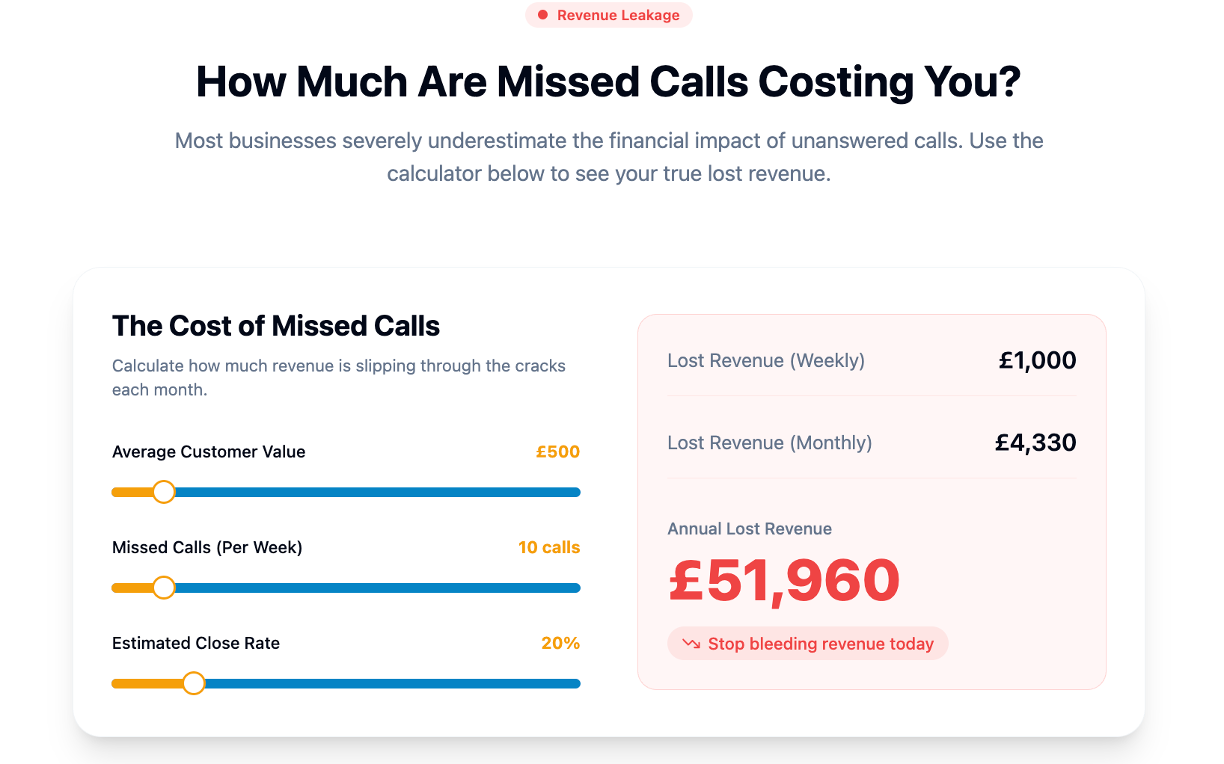
You will miss calls. You are on a roof, in a treatment room or with a dog on the table. What matters is what happens in the next few minutes. Someone with an urgent need who gets voicemail will usually ring the next business on the list.
Instant text after a missed call
"Hi, it's [Business name]. Sorry we missed your call. How can we help? Reply here and we'll get you sorted, or tell us a good time to ring you back."
Follow-up if they have not replied (same day)
"Hi [Name], just checking you got our message. We have space on [day] if you'd like to book. Want me to hold a slot?"
Follow-up after a quote
"Hi [Name], it's [Business name]. Just following up on the quote for [job]. Happy to answer any questions or adjust anything. Would you like to go ahead?"
After the job
"Thanks for choosing us, [Name]. If you were happy, a quick review would really help us: [link]."
Log every follow-up request and who owns it. The CAI code asks members to log all follow-up requests, and the principle holds for any business: an enquiry nobody owns is an enquiry lost.
Making scripts sound human
A script read word for word sounds like a script. Treat it as a guide:
- Use a flow, not a wall of text. Scripts work best as branching call flows, with different questions depending on the type of enquiry and the caller's answers, as FFB's guide explains.
- Expect the unexpected. Scripts fall apart when a prospect says something you did not plan for, so build in a "something else" branch that takes a message and promises a callback.
- Slow down for people who need time. The Business Disability Forum advises speaking clearly, giving callers time to respond, not rushing or interrupting, and expecting that the call may take longer. Do not cut a call short because a script says to move on.
- Use their name sparingly. Once or twice feels warm. Every sentence feels like a sales trick.
Perspective: why scripts alone are not enough
We see the same pattern in service businesses of every size. The script is rarely the problem. The problem is that nobody is free to use it at the moment the phone rings.
A tree surgeon up a tree, a groomer mid-appointment and a dentist's front desk with three people queuing cannot all give a caller their full attention. So the best script in the world still ends up as a voicemail. That is revenue walking out of the door.

That is why we built Talk2Aiva as a fully guided system rather than a tool you set up alone. We write the call flows with you, train the AI on your services, prices and booking rules, connect your calendar and launch it live. Then we keep optimising and supporting it. Your scripts stay yours. The difference is that they are delivered on every call, text, web chat and social message, at 2pm or 2am.
Our advice: write your scripts first, even on a single page. Use them yourself for a fortnight. Note where callers go off-script. Those gaps are the improvements that make the automated version excellent.
— James Paul
Turning your scripts into an AI receptionist
Once your scripts work, automation is the next step. An AI receptionist follows the same call flow you have just written: greeting, questions, booking, confirmation and follow-up. It simply does it every time, instantly.
Talk2Aiva by SWASCO covers:
- 24/7 call answering with human-like voice and multilingual support
- Conversational AI across calls, SMS, website chat and social media
- Instant lead capture and qualification
- Appointment booking with calendar sync
- Automated lead follow-ups and review requests
- A unified inbox and mobile app notifications
- Outbound calling and CRM integration
- Setup, onboarding, AI training and ongoing technical support
There are three annual plans, as published on our site: the Software Suite at £970 per year, the Ultimate AI Suite at £2,970 per year and the Elite AI Suite at £4,970 per year. Setup and ongoing support are included with every subscription, and you can compare what each plan includes on the Talk2Aiva plans page.
If you would rather see your own scripts working on a live call than read about it, start with Talk2Aiva and we will guide you from onboarding to launch.
How to roll out your scripts in a week
- Day 1: list your enquiry types. Most service businesses have four to six: new booking, price request, emergency, existing customer, something you do not offer, and a general question.
- Day 2: write one flow per type. Greeting, three to five questions, a close. One page each.
- Day 3: add the awkward moments. Fully booked, out of area, unhappy customer, price objection.
- Day 4: write your text templates. Missed call, confirmation, reminder, quote chase and review request.
- Day 5: practise aloud. Read each flow with a colleague and trim anything that sounds stiff.
- Days 6 and 7: go live and review. Keep a note of every call that went off-script, then update the flow.
Review monthly. Check how many enquiries became bookings, how quickly you replied and which questions callers struggled with.
FAQ
How long should a service enquiry script be?
Short enough to remember: a greeting, three to five questions and a close for each enquiry type. If a flow runs past one page, split it into branches. Callers should feel they are in a conversation, not a form.
Should receptionists read scripts word for word?
No. Use the script as a call flow that keeps the questions in a sensible order and makes sure nothing is missed. The wording should sound like you. Keep exact wording only for things that must be accurate, such as safety advice or terms you must state.
What should I say when I cannot take a booking right away?
Offer an alternative slot, a waiting list or a firm callback with a time. Take the caller's name and number first, then confirm by text. Never finish with a vague promise to get back to them.
What is the best way to deal with missed calls?
Reply by text within minutes, ask how you can help and offer a booking or callback time. Then follow up once more the same day or the next morning if there is no reply. An AI receptionist can do this automatically, so nobody has to remember.
Can an AI receptionist use my own scripts?
Yes. With Talk2Aiva, we build your call flows, services, prices and booking rules into the AI during setup, then keep tuning them after launch so they match how you actually speak to customers.
Sources
- A quick guide to writing a great call answering script, FFB
- Handling enquiries, Rightmove
- CAI Code of Conduct
- NHS England, example phone messages and call scripts
- How to make the best call answering service script, Pocket Receptionist
- How to run a diagnosis-led first conversation, The Marketing Chain
- Talking to disabled customers on the phone, Business Disability Forum