
Service-based AI is defined as an AI system that delivers a completed service outcome autonomously, rather than simply providing software tools for humans to operate. This is not a subtle distinction. It represents a fundamental shift in how businesses buy, deploy, and measure AI. Where traditional software hands you a tool and expects you to do the work, service-based AI does the work and hands you the result. Early 2026 analysis shows 92% of C-suite leaders are actively building AI-focused teams, and Europe's business AI adoption has reached 54%. Those figures signal that service-oriented AI is no longer a future consideration. It is a present commercial reality, and understanding it is the first step to acting on it.
What is service-based AI explained: tools versus outcomes
The clearest way to understand service-based AI is to contrast it with what came before. Software as a Service, or SaaS, gives you access to a platform. You log in, you operate it, and you produce results through your own effort. Service-based AI removes that middle step entirely.
The industry term most commonly used alongside this concept is "AI as a Service" or, more precisely, "Service as Software." The phrase captures the idea that AI does not just support a service. It is the service. The distinction matters enormously when you are deciding where to invest.
The difference between AI assistants and AI agents sharpens this further:
- AI assistants are prompt-driven. They respond to human instructions and help complete tasks, but a person remains in control of each step.
- AI agents are goal-driven. They autonomously execute multi-step workflows across systems without constant human input, making decisions and taking actions to reach a defined outcome.
- Service-based AI typically deploys agents, not assistants, because the commercial promise is a delivered result, not a helpful suggestion.
The implications for your business are direct. When you buy a tool, you own the responsibility for results. When you buy a service-based AI outcome, the accountability shifts to the outcome itself. That changes how you evaluate suppliers, how you measure success, and how you budget.
Pro Tip: Before evaluating any AI solution, ask one question: does this deliver a completed result, or does it require my team to operate it? The answer tells you whether you are buying a tool or a service.

How are service-based AI systems priced?
Pricing is where service-based AI diverges most sharply from traditional software. Legacy billing models charge by time, by seat, or by effort. None of those units reflect what AI actually delivers.
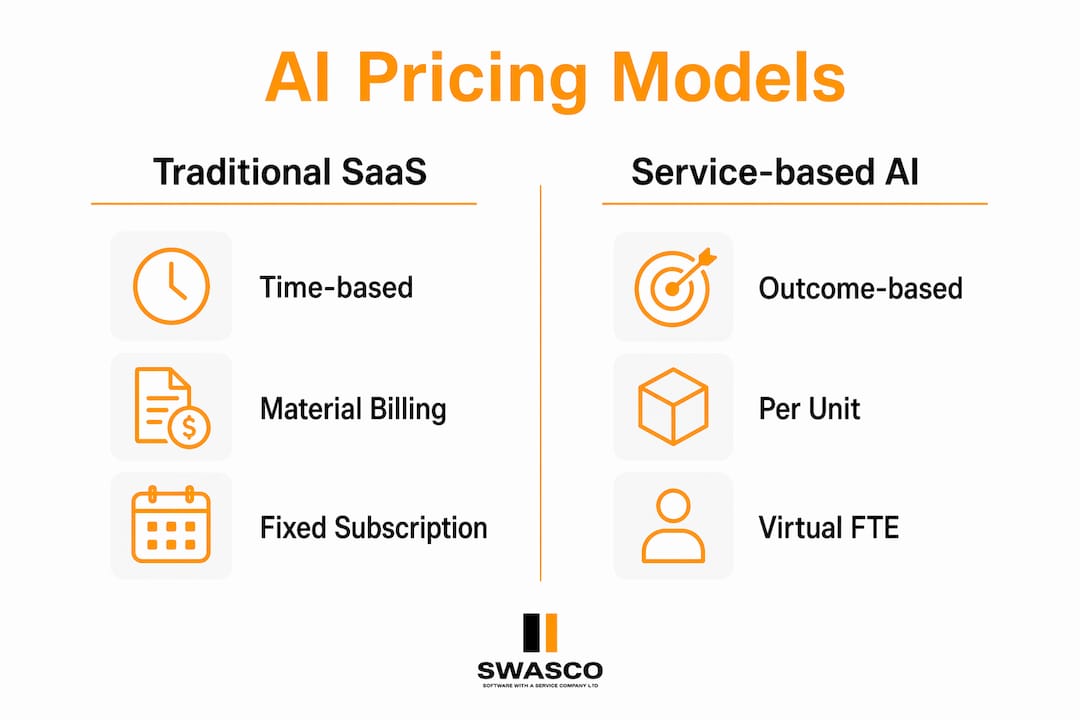
Pricing models in service-based AI must shift from time-and-material billing to outcome-based charges. This is not a preference. It is a commercial necessity. When AI resolves a support ticket in seconds rather than minutes, billing by the hour destroys the value proposition for both sides.
The most practical outcome-based models in use today include:
| Billing model | When it works best | Potential pitfall |
|---|---|---|
| Per resolved ticket | High-volume customer support | Defining "resolved" clearly upfront |
| Per qualified lead | Sales and marketing pipelines | Agreeing on qualification criteria |
| Virtual FTE pricing | Replacing repeatable human roles | Requires clear output benchmarks |
| Per completed booking | Appointment-based service businesses | Cancellation and no-show policies |
Virtual FTEs standardise pricing by equating AI-delivered outputs to human labour units. This gives buyers a familiar reference point and gives suppliers a sustainable commercial model. A Virtual FTE is not a person. It is a priced unit of AI-delivered work that mirrors what a human employee would produce.
Outcome-based pricing applies best when the output is observable, attributable, and valuable enough to price as a discrete unit. A resolved support ticket meets all three criteria. A vague "AI assistance" does not.
Front-runners in this space separate product economics from service economics, with 44% already selling AI-delivered outcomes at scale. Businesses that embed AI inside legacy pricing structures without separating these economics leave significant value on the table.
Pro Tip: When negotiating an AI service contract, insist on a written definition of the deliverable unit before signing. "AI support" is not a unit. "Per verified appointment booked" is.
How does service-oriented AI architecture actually work?
Understanding the technical structure behind service-based AI helps you ask better questions of any supplier. You do not need to build it. You do need to know what makes it reliable.
Modern AI architectures favour decomposed, specialised stateless workers orchestrated by a central planner. The analogy is a kitchen brigade. The head chef coordinates. Specialist cooks handle their stations. No single person does everything, and the kitchen keeps running if one station has a problem.
The orchestrator-worker model works as follows:
- The orchestrator receives the goal, breaks it into tasks, and assigns each task to the appropriate specialist agent.
- Specialist agents handle defined functions: one qualifies a lead, another books an appointment, another sends a follow-up message.
- Defined interfaces between agents mean each component communicates in a structured way, reducing errors and making the system auditable.
- Isolated failure domains mean that if one agent encounters an error, it does not bring down the entire system.
- Governance layers sit across the whole architecture to manage reliability, compliance, and observability.
This structure mirrors microservices architecture in software engineering. The principle is the same: decompose complexity into manageable, testable, replaceable parts. For business owners, the practical benefit is that a well-architected service-based AI system is more reliable, easier to monitor, and simpler to update than a single monolithic AI agent trying to do everything at once.
Viewing AI as a distributed system, rather than a product feature, is what separates operationally reliable deployments from expensive experiments.
What are the real-world benefits of service-based AI in service industries?
Service-based AI applications improve customer engagement and operational efficiency by automating repeatable service outcomes with verifiable results. The gains are not theoretical. They show up in measurable business metrics.
Consider three common service industry scenarios. A plumbing firm misses calls after hours and loses bookings to competitors who answer. A legal practice has enquiries sitting in a contact form for 48 hours before anyone responds. A clinic's reception team spends 40% of their day rescheduling appointments. Service-based AI addresses all three by delivering the completed outcome: the call answered, the enquiry qualified, the appointment booked.
The benefits businesses report across these scenarios include:
- Speed. AI responds to enquiries in seconds, not hours. That speed directly affects conversion rates, because most customers contact multiple businesses and choose whoever responds first.
- Accuracy. Specialist AI agents follow defined qualification criteria every time, without fatigue or inconsistency. AI-driven lead qualification removes the human variability that causes good leads to be mishandled.
- Cost efficiency. Automating repeatable outcomes reduces the labour cost per transaction without reducing quality.
- 24/7 availability. Service-based AI does not take lunch breaks or annual leave. Enquiries handled outside business hours represent revenue that would otherwise be lost.
- Continuous improvement. Every interaction generates data. That data feeds back into the system, improving qualification accuracy and response quality over time.
Talk2Aiva applies these principles directly to service businesses. It handles calls, qualifies leads, books appointments, and follows up with prospects across calls, text, website chat, and social media. The outcome is not "AI assistance." It is revenue recovered from enquiries that would otherwise go unanswered. You can read more about AI in customer service models and how this shift is reshaping service delivery.
For businesses exploring how AI affects their digital presence, AI-driven search visibility is an adjacent consideration worth understanding alongside service-based AI adoption.
Key takeaways
Service-based AI delivers verified, completed outcomes autonomously, shifting business value from software access to measurable results that directly improve revenue and operational efficiency.
| Point | Details |
|---|---|
| Outcomes, not tools | Service-based AI delivers completed results, not software for your team to operate. |
| Agents over assistants | AI agents execute multi-step workflows autonomously; assistants only support human-led tasks. |
| Outcome-based pricing | Price AI by the unit of delivered value, such as a booked appointment or a resolved ticket. |
| Architecture matters | Orchestrator-worker models are more reliable and auditable than monolithic AI agents. |
| Revenue recovery | Service-based AI captures revenue from missed calls, slow responses, and unmanaged enquiries. |
Why most businesses are still thinking about AI the wrong way
The most common mistake I see is businesses treating AI as a productivity tool rather than a service delivery mechanism. They buy an AI chatbot, bolt it onto their website, and measure success by how many conversations it starts. That is the wrong metric entirely.
The shift that actually matters is moving from "how many interactions did AI handle" to "how many outcomes did AI deliver." A conversation that does not end in a booking, a qualified lead, or a resolved query has not delivered a service. It has just generated activity.
Early adopters who get this right share one habit: they define the outcome before they deploy the AI. They know exactly what a "completed service" looks like in their business, whether that is a confirmed appointment, a qualified prospect passed to sales, or a support ticket closed with a verified resolution. That clarity is what makes outcome-based pricing viable and what makes the AI system genuinely accountable.
The businesses that will struggle are those waiting for AI to become simpler before they act. The architecture is already mature. The commercial models are already proven. The gap between early adopters and late movers is widening every quarter. Selecting repeatable, verifiable outcomes to automate first is the lowest-risk entry point, and it is available to any service business right now.
— James Paul
How Talk2Aiva puts service-based AI to work for your business
Talk2Aiva by SWASCO is built on exactly the principles covered in this article. It does not hand you a tool and leave you to figure it out.
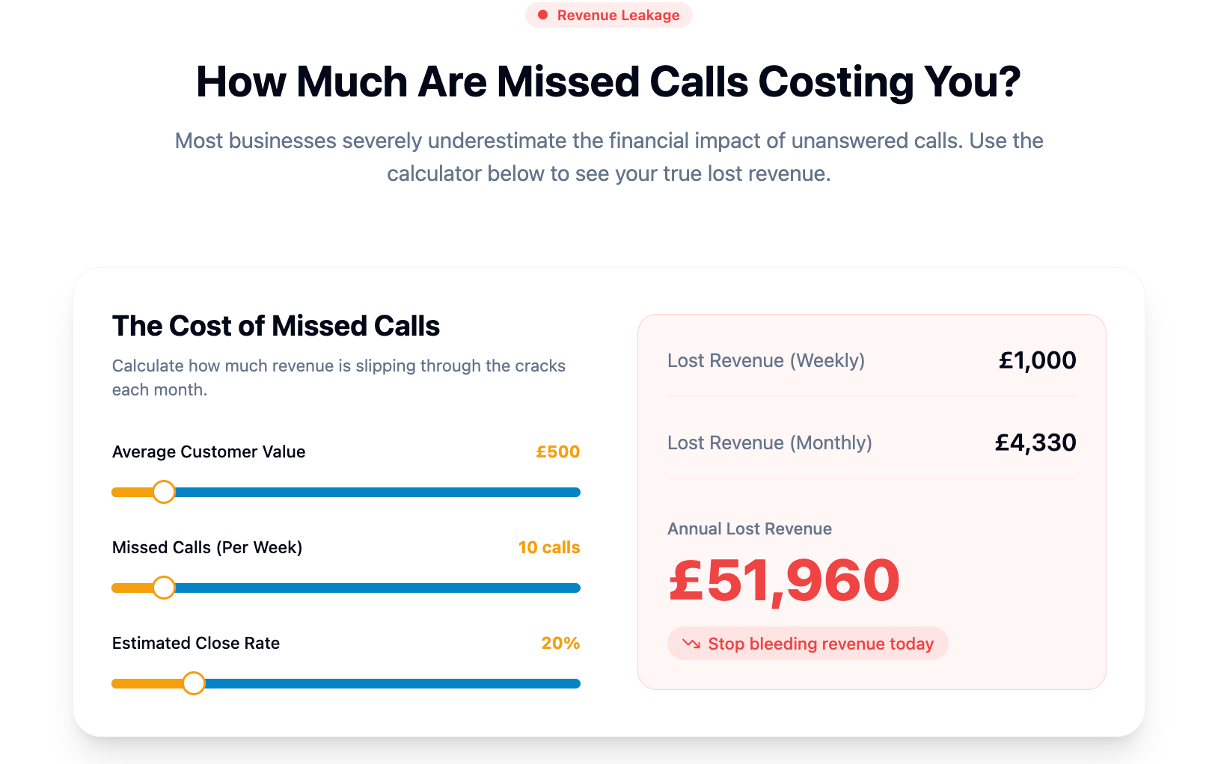
Talk2Aiva delivers completed outcomes: calls answered, leads qualified, appointments booked, and follow-ups sent, across every channel your customers use, 24 hours a day. The entire process, from setup and AI training to live launch and ongoing support, is handled for you. If your business is losing revenue from missed calls or slow responses, Talk2Aiva's voice AI is designed to stop that immediately. You can also explore the full SWASCO platform to see how outcome-based AI delivery applies across your sales and marketing operations.
FAQ
What is service-based AI?
Service-based AI is an AI system that delivers a completed service outcome autonomously, such as booking an appointment or resolving a support ticket, rather than providing software for humans to operate.
How does a service-based AI assistant differ from an AI agent?
An AI assistant is prompt-driven and supports humans in completing tasks. An AI agent is goal-driven and executes workflows autonomously without constant human input, making it the core technology behind service-based AI delivery.
What are examples of service-based AI in practice?
Common examples include AI systems that handle inbound calls, qualify leads, book appointments, and resolve customer support tickets, all without human involvement in each individual interaction.
How is service-based AI priced?
Service-based AI is priced by the unit of delivered outcome, such as per resolved ticket, per qualified lead, or per completed booking, rather than by time, seat, or software access.
Is service-based AI suitable for small service businesses?
Service-based AI is particularly well-suited to small service businesses because it replaces the cost of missed calls and delayed responses with verified outcomes, without requiring a large in-house team to operate it.