
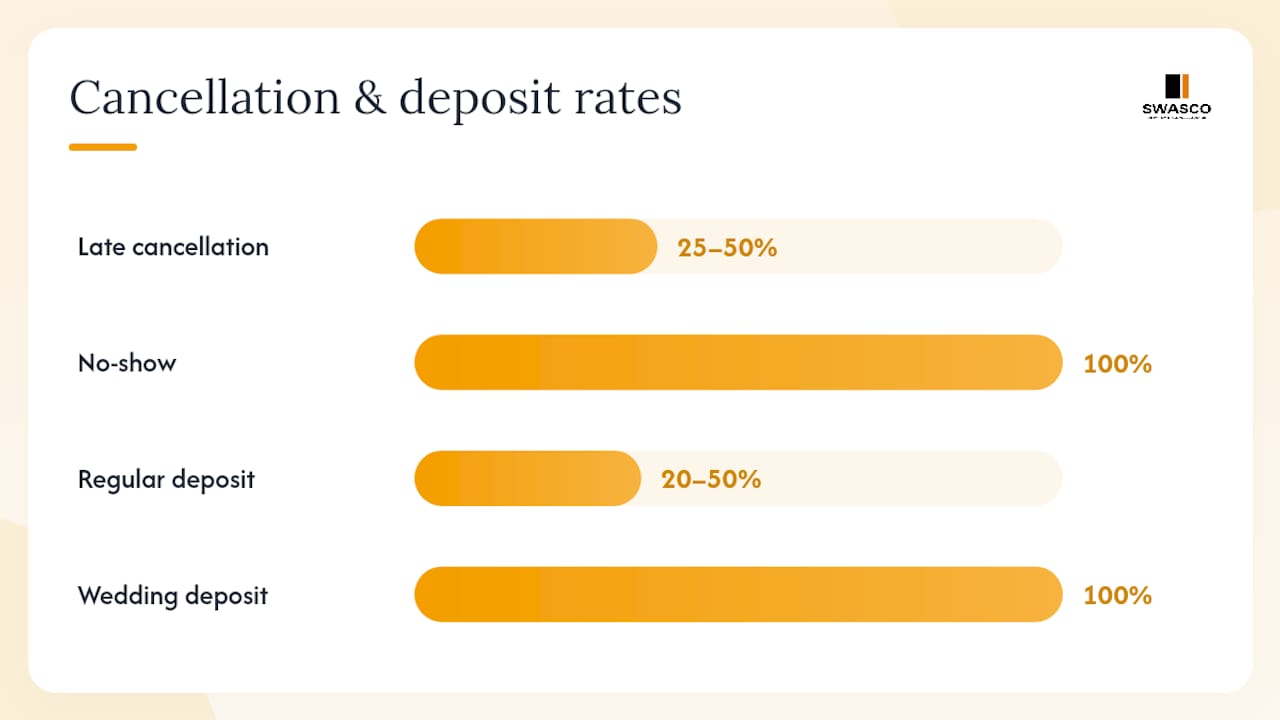
That structure is the industry norm because it protects revenue without alienating regular clients, and it's the starting point for every policy you'll see in this guide.
Last-minute cancellations commonly drain 12 to 15% of monthly revenue from salons with no clear policy in place. Two things matter more than any other detail here:
- Notice window: 24 hours for standard cuts and colour, 48 hours for chemical services or multi-hour appointments.
- Fee structure: partial charge for late cancellations, full charge for no-shows, backed by a card on file or deposit.
Do this today: add a one-line notice requirement to your booking confirmation, and start collecting card details at booking for new clients. Talk2Aiva can automate that collection step alongside your reminders, which we'll cover further down.
Key Takeaways
A clear notice window, tiered fees, and card-on-file deposits recover most of the revenue that unmanaged last-minute cancellations quietly cost UK salons.
| Point | Details |
|---|---|
| Set a tiered notice window | Use 24 hours for standard services, 48 for chemical or multi-hour work, 72 for weddings. |
| Charge by risk level | Apply 25 to 50% for late cancellations and 100% for no-shows, full price on materials-heavy services. |
| Get consent at booking | Use a checkbox or recorded confirmation, not just website terms, to make fees enforceable. |
| Automate the recovery loop | Staged reminders and waitlist messaging can lift same-day rebooking into the 30 to 50% range. |
| Consider Talk2Aiva | It automates deposit collection, reminders, and waitlist messaging so cancelled slots refill without manual chasing. |
Table of Contents
- How to calculate the real cost of last-minute cancellation costs to your salon
- Benchmarks: notice periods, fee levels and when to require deposits
- Legal and consumer-rights considerations when charging cancellation fees
- Ready-to-use cancellation policy wording for confirmations and booking pages
- Step-by-step checklist to set the right fee for your business
- How reminders, waitlists and an AI receptionist reduce cancellations
- Frequently asked questions
- Sources
How to calculate the real cost of last-minute cancellation costs to your salon
The lost service fee is only part of the bill. You're also paying for stylist time that can't be resold, product you've already portioned out, and the tip that vanishes along with the appointment.
Use this formula:
(Average ticket × lost slots per week × working weeks) + wasted consumables + lost rebooking value
A worked example makes this concrete. A stylist charging a £95 average ticket with a 10% no-show rate can lose roughly £14,250 a year across 50 working weeks, before factoring in wasted colour product or missed tips.
| Input | Typical value |
|---|---|
| Average ticket price | £95 |
| No-show rate | 10% |
| Working weeks per year | 50 |
| Estimated annual loss | ~£14,250 |
To build your own figure:
- Pull your actual no-show and late-cancellation rate from your booking system's last three months.
- Multiply your average ticket by the number of weekly lost slots, then by your working weeks.
- Add wasted consumables (colour, wax, product opened but unused) and an estimate of lost rebooking value from clients who don't return after a bad scheduling experience.
That last figure, client churn following an unmanaged cancellation, is the one most owners never track, and it's often larger than the missed appointment itself.
Benchmarks: notice periods, fee levels and when to require deposits
Your notice window should scale with how much of your day a client's slot occupies. A quick fringe trim doesn't carry the same risk as a four-hour balayage.
- 24 hours' notice for standard cuts, blow-dries, and single-process colour.
- 48 hours' notice for chemical services, extensions, or anything over two hours.
- 72 hours' notice for wedding parties or group bookings that block out multiple chairs.
On fees, industry practice generally settles around a 24 to 48 hour window with tiered charges: 25 to 50% for late cancellations, and 100% for no-shows. High-cost, materials-heavy services (colour correction, keratin treatments) justify charging the full amount even on a late cancellation, since the product cost alone can wipe out your margin.
Deposit ranges of 20 to 50% for regular bookings, rising to 100% for weddings or special packages, give you a collected sum rather than a debt to chase.
Pro Tip: Reserve mandatory deposits for new clients and repeat offenders rather than your whole book. Loyal regulars rarely need the friction, and reserving deposits for risk cases keeps your booking flow smooth for everyone else.
Legal and consumer-rights considerations when charging cancellation fees
A cancellation fee holds up when it's fair, transparent, and agreed before the appointment, not invented after the fact. UK consumer protection principles centre on clients knowing exactly what they signed up for. This is general guidance, not legal advice, and you should get a solicitor's view if disputes become frequent or a client formally challenges a charge.
Build these habits into your booking flow:
- Get explicit acknowledgement at booking, a checkbox or recorded confirmation, not just a policy buried on your website.
- Show the fee amount in your confirmation email or SMS, not only in your terms and conditions.
- Keep a simple audit trail of when the policy was agreed and when notice was given.
- Have a fair, documented process for genuine emergencies, illness, bereavement, transport failure, so you're not enforcing rigidly against goodwill.
Relying on a website policy alone is a common enforcement gap; explicit consent at the point of booking is what actually makes a charge defensible.
A policy only protects your revenue if you can prove the client agreed to it. Consent at booking beats terms and conditions nobody reads.
Ready-to-use cancellation policy wording for confirmations and booking pages
Copy and adapt these directly.
Standard (24-hour): "We require 24 hours' notice for any cancellation or change."
High-value (48-hour + deposit): "This service requires 48 hours' notice to cancel or reschedule. No-shows forfeit the full service price."
Wedding/group (72-hour): "Group and wedding bookings require 72 hours' notice. A full deposit is taken at booking and is non-refundable for cancellations inside this window."
Salon Ultimo's published policy follows this exact pattern: 24 hours' standard notice, 50% for late cancellations, 100% for no-shows, and 48 hours for specialty services, proof that clear, simple wording is what clients actually respect.
Place the policy in three spots: the online booking flow (as a checkbox), the confirmation email or SMS, and a visible page on your website. Record any waived fee with a short note on the client's file, so exceptions stay exceptions rather than becoming the new normal.
Waivers should be rare enough that your team can name every one from memory. If you can't, the policy isn't really being enforced.
Step-by-step checklist to set the right fee for your business
- Measure your baseline. Pull your no-show and late-cancellation rate from the last three months of bookings.
- Run the cost formula. Apply the calculation from the cost-impact section to get your weekly and annual loss figure.
- Choose your fee type. Flat fee for lower-ticket services, percentage bands for mid-range work, deposits for high-cost or repeat-risk bookings.
- Simulate the change. Cutting your no-show rate from 10% to 5% roughly halves your annual loss, often outperforming a price rise of the same value.
| No-show rate | Estimated annual loss (£95 ticket) |
|---|---|
| 10% | ~£14,250 |
| 5% | ~£7,125 |
Test one fee tier for 60 days, track rebooking rates and complaints, then adjust before rolling it out salon-wide.
How reminders, waitlists and an AI receptionist reduce cancellations
Two-step confirmations plus staged SMS reminders at 48, 24, and 2 hours catch clients before they forget, not after. Add an instant rebooking link inside each reminder so a client who does need to cancel can shift their own slot without a phone call.
The strongest workflow combines three elements: a card-on-file deposit at booking, automated reminders on that staged schedule, and a waitlist that pushes the freed slot straight to matching clients. Salons using rapid automated waitlist messaging see same-day rebooking rates land between 30 and 50%, a huge improvement over hoping someone calls in.

Track three numbers monthly: your no-show rate, your fill rate for cancelled slots, and the revenue recovered through rebooking.
Pro Tip: A conversational AI system like Talk2Aiva can handle the entire loop, sending SMS reminders, collecting deposits, and messaging your waitlist the moment a slot opens, without your front desk lifting a finger.
Author perspective: what salon owners report works in practice
Consistency beats complexity. Simple rules, applied every time, generate far fewer disputes than clever policies enforced selectively. The most common pitfall is a stylist waiving the fee for one client and charging the next, undermining the entire system. Start small: pilot your policy on one service category, communicate it plainly, and expand once it's proven.
How Talk2Aiva helps you recover lost revenue automatically
Chasing a no-show fee by phone after the fact rarely works. Talk2Aiva flips that timing, collecting card authorisation and confirming notice terms before the appointment ever happens, so there's nothing to chase.
- Talk2Aiva answers calls, texts, and website chat 24/7, confirming bookings and capturing card-on-file details without a receptionist on shift.
- When a client cancels, Talk2Aiva can message your waitlist instantly, matching the freed slot to clients likely to accept it, using the same automation logic that lifts rebooking rates.
Pilot it on your busiest chair first, measure the fill rate for a month, then expand. Book a look at Talk2Aiva and see how the setup fits your current booking system.
Frequently asked questions
What counts as a last-minute cancellation? Most salons define it as any cancellation inside the notice window stated in their policy, typically 24 to 48 hours before the appointment.
How much should I charge for a no-show?
Can I legally take a deposit before the appointment? Yes, provided the client agrees to the terms at booking and the amount and conditions are clearly stated in advance.
Will a strict cancellation policy put clients off? A balanced policy with reasonable notice and partial fees tends to reduce friction better than an aggressive, punitive one, while still protecting revenue.
This article is general information, not a substitute for advice from a qualified lawyer. Consult a qualified legal professional about your own circumstances before acting on anything here.
Sources
- Salon Cancellation Policy: Templates That Actually Get Paid | DoTheBeauty
- How Much Do Salon No-Shows Really Cost You Each Year? - Tabby
- Salon Cancellation Fees Guide | Bella Booking
- Salon policies | Salon Ultimo
- How to Fill Last-Minute Cancellations at Your Salon - Hair Kempt
Get local legal advice before finalising wording if you expect frequent disputes.