
Use an AI-guided intake plus a short diagnostic checklist and score-based routing to capture, triage and dispatch roofing leads. This combination gets estimators in front of decision-makers faster, cuts wasted appointments, and can noticeably improve close rates when the pre-appointment qualification is rigorous. A system like Talk2Aiva handles the repeatable checks around the clock, leaving your team to focus on the leads worth their time.
TL;DR:
- Automated intake systems should verify fit, urgency, and decision-maker presence before routing leads, ensuring only qualified prospects are booked.
- Prioritize routing high-score leads instantly with SMS alerts to prevent delays that could cause missed opportunities during peak periods.
- Limit daily appointments to two or three per estimator to maintain quality and increase close rates, with automated reminders confirming attendance.
- Segment nurtures based on lead readiness, using personalized content and re-scoring windows to keep warm prospects engaged without manual effort.
- AI intake handles routine data collection, but complex issues like insurance disputes or safety concerns must be escalated to human judgment.
Table of Contents
- What is the roofing lead qualification checklist?
- How do you build an automated intake system?
- What does a good lead scoring rubric look like?
- How many roofing appointments should an estimator run daily?
- How do you nurture warm and low-priority roofing leads?
- What KPIs should you track after launch?
- What legal and compliance rules apply to lead data?
- How can you spot a fake or fraudulent roofing lead?
- Why conversational AI changes the intake game
- How Talk2Aiva builds this system for you
- Sources
- FAQ
What is the roofing lead qualification checklist?
Roofing lead qualification is the process of separating leads that are ready to book from those that need more information, nurturing, or a polite referral elsewhere. The strongest checklists split every check into three buckets: fit, urgency, and readiness. Treating those as three separate facts rather than one blended score stops a genuinely urgent lead from getting buried because they live outside your service area, or a well-qualified prospect from stalling because nobody confirmed who actually signs the cheque.
At intake, capture these facts:
- Service-area fit: full address, checked against your coverage zone.
- Property type: residential, commercial, or multi-unit, since the sales process differs for each.
- Reported problem: active leak, planned replacement, or general inspection request.
- Roof age and material: asphalt shingle, tile, flat membrane, and how old it is.
- Decision-maker presence: is the person on the call or form the homeowner, or a tenant who needs to loop someone else in?
- Stated timeline: this week, this quarter, or "just researching."
- Insurance involvement: has a claim been filed, or is storm damage suspected but unreported?
Every check needs a defined answer for "unknown," and a named owner for chasing it down. A checklist template that allows "unknown, pending callback from Sarah" beats one that forces a guess. Route to book when fit, urgency, and a decision-maker are all confirmed. Route to gather more information when a critical fact is missing. Route to educate or refer when the job sits outside your scope entirely, such as a flat commercial membrane job for a residential-only crew.
How do you build an automated intake system?
An adaptive AI contact form changes its follow-up questions based on what the prospect just told it. Select "active leak" and the form immediately asks where the water is entering and whether it has reached the ceiling or walls, rather than moving straight to a generic "tell us more" box. This kind of adaptive questioning improves lead quality because the follow-up feels relevant instead of generic, and it sets the right tone in the confirmation message too. An active leak deserves "we're prioritising your call," not a standard "thanks, we'll be in touch within 48 hours."
Build the intake around three practical steps:
- Unify the channels. Phone, web form, website chat, and SMS should all feed one inbox with the same data fields, so a lead who calls Monday and texts Wednesday is recognised as one record, not two.
- Enrich before contact. Pull property records, satellite imagery, and local storm history against the address before a human ever picks up the phone. An estimator walking in already knowing the roof is 18 years old and sat under last month's hailstorm qualifies faster and asks sharper questions.
- Set immediate alert triggers. Interior water reported, an insurance claim already started, or visible storm damage mentioned should all bypass the queue and ping a human straight away.
Pro Tip: Build your alert triggers around the three or four scenarios that genuinely cannot wait, and resist the urge to mark everything as urgent. If every lead pings the estimator's phone, the truly urgent ones stop standing out.
Storm-damage and insurance leads that get enriched and routed with priority tend to convert at higher rates simply because the contractor reaches them before three competitors do.
What does a good lead scoring rubric look like?
A points-based rubric turns subjective judgement into a repeatable rule. One workable scoring model assigns weight to the facts that actually predict a booked, profitable job:
- Insurance claim already filed: high points
- Visible storm or structural damage reported: high points
- Roof age over 15 years: moderate points
- Confirmed decision-maker on the record: moderate points
- Stated timeline within 90 days: moderate points
- Service-area and property-type match: pass/fail gate before scoring even starts
Translate the total into an action, not just a label:
- Hot (top band): immediate SMS alert to the on-duty estimator, with a call-back target measured in minutes.
- Warm (middle band): routed to inside sales for a qualifying call within the same business day.
- Nurture (lower band): dropped into an automated sequence rather than a live call queue.
- Auto-reject (out of scope): sent educational resources or a referral, never just ignored.
Build a backup rule too: if the primary estimator doesn't respond within a set window, the hot lead escalates automatically to the next available person. Log every score, including the rejects, since a nurture-band lead today can become a hot lead after the next storm rolls through.
How many roofing appointments should an estimator run daily?
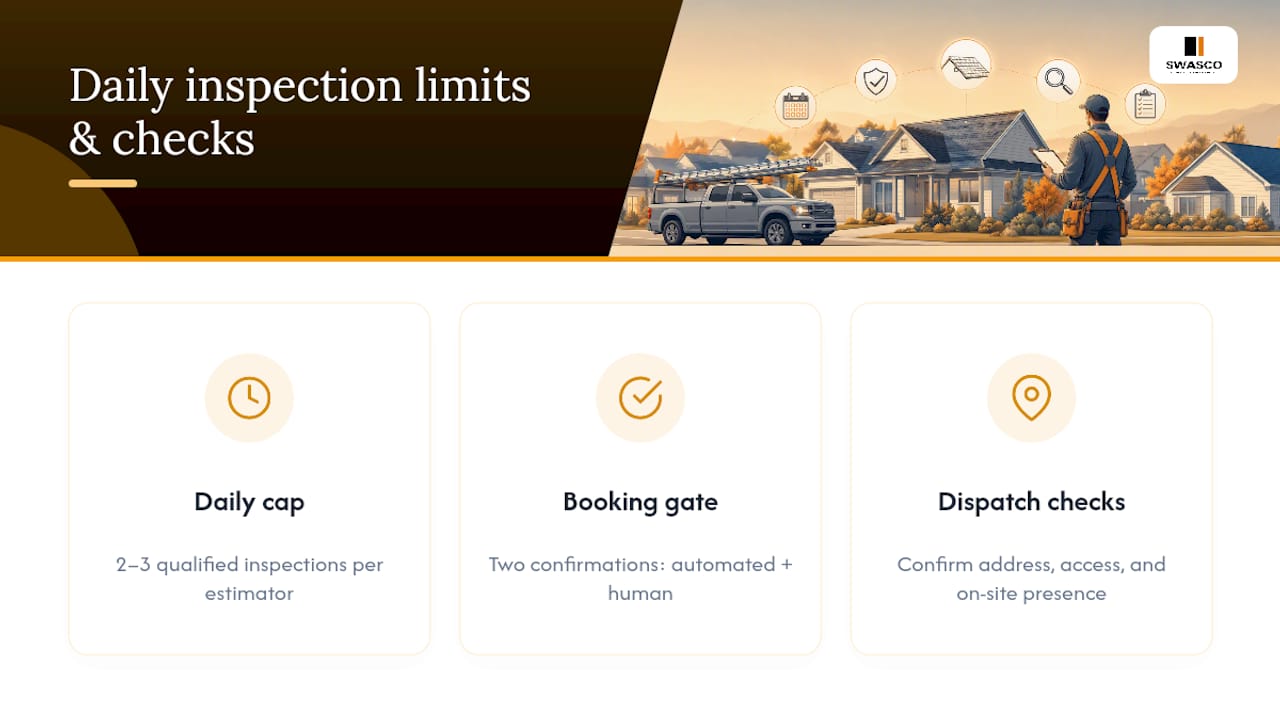
Cap qualified inspections at two to three appointments per estimator per day. Push beyond that and presentation quality drops, along with close rates, because rushed estimators skimp on the walkthrough that actually earns trust. Gate every booking behind a double-confirmation: one automated reminder the day before, one human check on the morning of, verifying the decision-maker will actually be present. Skip the gate and you'll fill the calendar with appointments nobody shows up for.
Urgent cases, like an active leak during heavy rain, can jump the queue, but they still need a minimum safety and consent check before a crew gets dispatched: confirmed address, confirmed access, and confirmed that someone will be on-site.
How do you nurture warm and low-priority roofing leads?
Not every lead is ready today, and treating them all the same wastes the ones who'll convert in three months. Segment mid-tier leads into sequences that match their actual situation:
- Storm education for leads unsure if their roof was even damaged.
- Replacement planning for older roofs with no urgent trigger yet.
- Insurance navigation for prospects intimidated by the claims process.
- Financing options for leads who liked the quote but stalled on price.
Personalise every touch using the fields captured at intake. A lead who mentioned a 20-year-old tile roof should get tile-specific content, not a generic asphalt shingle email. Set a re-scoring window, commonly 30 to 60 days, and a clear rule for pulling a contact back into active outreach the moment a new trigger appears, such as a storm alert for their postcode. Structured lead nurturing sequences exist precisely to keep this kind of contact warm without burning staff hours on manual follow-up.
What KPIs should you track after launch?
Roll out the system in a fixed order, and don't skip the testing step:
- Document your service rules and scope boundaries in writing.
- Build the intake checklist covering fit, urgency, and readiness.
- Configure the forms, chat, and call flows to capture those exact fields.
- Train intake staff on the "unknown" pathway and who owns follow-up.
- Run five fictional edge cases through the rules before going live.
- Launch, then measure and adjust weekly for the first month.
Testing against edge cases before launch catches the ambiguous scenarios, like a homeowner reporting a leak but refusing to give a timeline, that otherwise cause inconsistent handoffs between staff.
Once live, track: time to first contact, qualified appointments booked per day, lead-to-booking rate, close-rate change month over month, average job value, and SLA compliance on response times. Automating the routine parts of qualification can free up 12 to 18 hours a week for a sales team, time better spent closing the leads that are actually ready.
What legal and compliance rules apply to lead data?
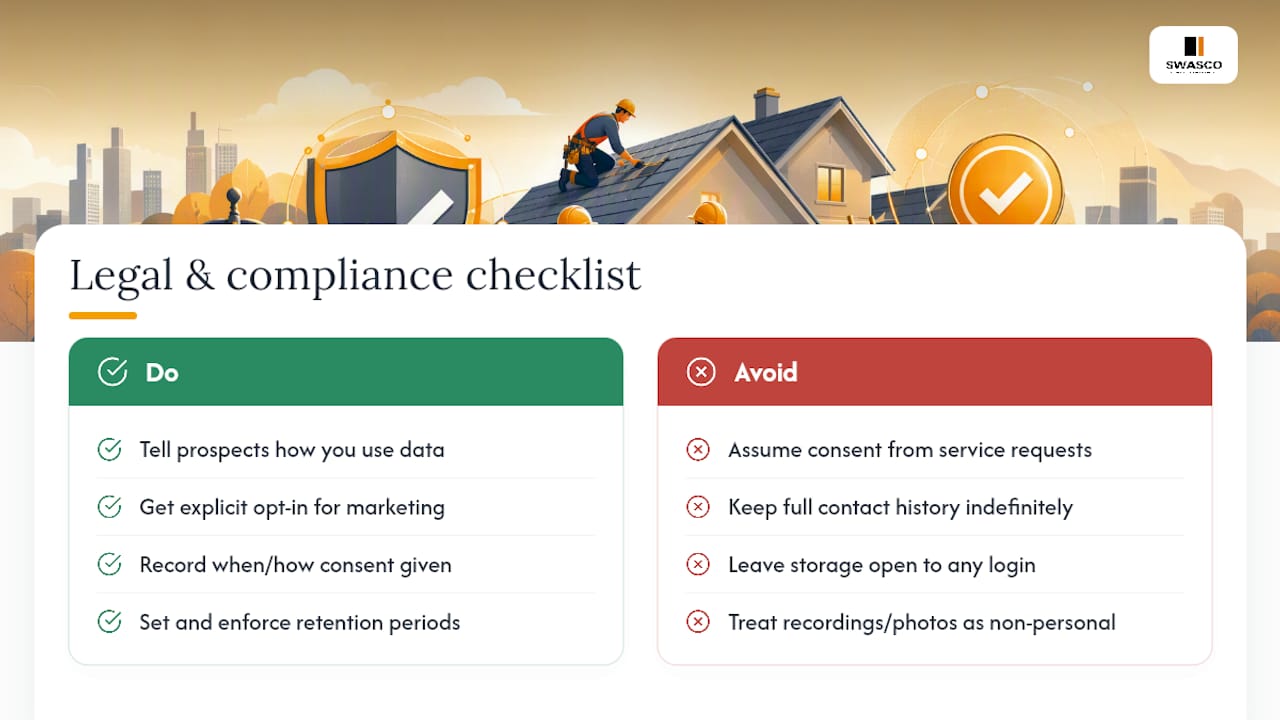
Collecting a name, address, phone number, and details about someone's property means you're handling personal data, and that comes with obligations. If you operate in the UK, that means complying with UK GDPR and the Data Protection Act 2018: telling prospects clearly what you'll do with their information, storing it securely, and giving them a way to have it deleted on request.
Practical steps that keep a roofing business on the right side of this:
Get explicit consent before adding a lead to a marketing sequence, not just a service follow-up. A homeowner who submits a callback request for a leak hasn't automatically agreed to a six-month email nurture campaign; that needs its own opt-in, and PECR rules on electronic marketing communications apply on top of general data protection law. Keep records of when and how consent was given, since "we assumed it was fine" won't hold up if a prospect complains.
Retention matters too. There's little reason to keep an auto-rejected lead's full contact history indefinitely; set a retention period and stick to it. If you use call recording for training or quality purposes, that recording is also personal data and needs the same disclosure and security treatment as a written enquiry.
Finally, if insurance details or photos of storm damage get uploaded through your intake form, treat that as sensitive commercial information. Restrict who on your team can view it, and make sure whatever platform stores it, whether that's a CRM, a unified inbox, or a spreadsheet, is access-controlled rather than open to anyone with a login.
How can you spot a fake or fraudulent roofing lead?
Fake leads waste estimator time and skew your KPIs, so catching them early matters as much as qualifying the genuine ones. A few patterns show up consistently.
Watch for a phone number and address that don't match, or a form submission with an obviously invalid address, like a P.O. box for a roof inspection request. Multiple submissions from the same IP address within minutes, using slightly different names, usually points to a bot testing your form or a competitor probing your response time. A prospect who refuses to confirm the property address at all, even after several exchanges, is a strong signal something's off, since genuine homeowners rarely hesitate on that detail.
Be wary too of leads that request a quote with unusually specific, jargon-heavy language that doesn't match how a homeowner normally describes a problem, since this can indicate a competitor or a subcontractor fishing for pricing information rather than an actual customer. And a lead who insists on email-only contact, refusing every call or text attempt, deserves extra scrutiny before an estimator's time gets booked against it.
None of these signals alone proves fraud, but two or three together justify a manual review before dispatching anyone. Building this check into your intake flow, rather than relying on an estimator to notice after driving out, saves the wasted trip entirely.
Why conversational AI changes the intake game
Automation handles the repeatable facts well: address, timeline, roof age, decision-maker status. What it shouldn't touch is judgement: a complicated insurance dispute, a safety concern, or a prospect who needs reassurance rather than a form. The right system, backed by guided onboarding and ongoing optimisation, knows the difference and hands off accordingly.
— James Paul
How Talk2Aiva builds this system for you
Talk2Aiva is the done-for-you alternative to piecing together forms, call-routing software, and a spreadsheet yourself. Instead of stitching three tools together and hoping they stay in sync, you get one AI receptionist answering phone, SMS, website chat, and social messages, guided onboarding to build your qualification workflow, calendar sync so booked appointments land straight on the estimator's schedule, and ongoing optimisation once you're live.
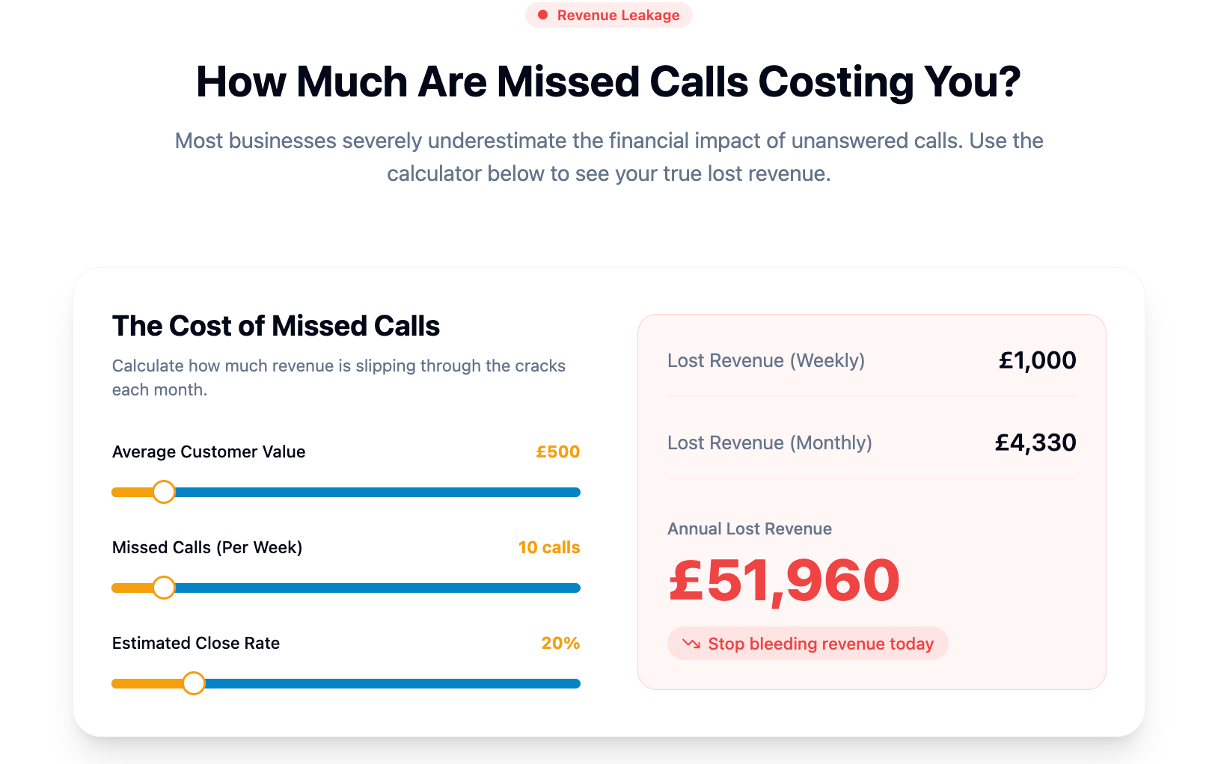
This suits roofing business owners and managers who are tired of missed calls turning into missed jobs, and who'd rather have the checklist, scoring, and routing rules built for them than build them from scratch. Plans run from the Software Suite at £970 per year up to the Elite AI Suite. The voice AI receptionist and multi-channel capture are included at every tier. If you want to see how the onboarding and workflow process actually works before committing, that's the page to check first, then request a demo when you're ready to stop losing leads to a full voicemail inbox.
Sources
Start with the roofing lead qualification checklist template, then review the instant lead qualification guide and Talk2Aiva's how it works page for the implementation steps behind this article.
- How Do You Build a Lead Control System for Your Roofing Company? - RoofCoach
- Automated Lead Qualification for Roofing Contractors (2024)
- What Qualifying Questions Should a Roofing Contact Form Ask? - AcuteSEOAI
FAQ
What is roofing lead qualification?
It's the process of checking a new enquiry against fit, urgency, and readiness before booking an estimator, so you only send someone out when the job is real and the prospect can actually say yes.
How many qualified appointments should a roofing estimator handle per day?
Two to three per day preserves presentation quality and protects close rates; pushing beyond that tends to lower both.
What score should trigger an immediate estimator alert?
A lead scoring in the top band on a rubric that weights insurance involvement, visible damage, and a confirmed decision-maker should trigger an immediate SMS alert rather than sitting in a queue.
Can AI fully replace human judgement in roofing sales?
No. Automation handles repeatable facts and routing reliably, but complex insurance cases, safety concerns, and reassurance still need a human, which is why systems like Talk2Aiva escalate those cases rather than trying to resolve them automatically.
How much does Talk2Aiva cost for a roofing business?
Talk2Aiva runs on three annual plans: the Software Suite at £970, the Ultimate AI Suite at £2970 pounds per year, and the Elite AI Suite at £4970 pounds per year, each including onboarding and ongoing support.