
AI lead qualification is defined as the automated process of scoring, verifying, and routing inbound leads using machine learning and conversational AI, without requiring manual input from a sales team. The role of AI in lead qualification has shifted from a niche experiment to a core sales function. AI qualification agents now handle a 10x increase in lead volume without adding headcount, cutting response times from over four hours to under 30 seconds. That shift alone changes the economics of sales for any service-based business. The industry standard framework for automated scoring uses three dimensions: Fit, Intent, and Timing. Talk2Aiva applies this same logic to help service businesses engage, qualify, and route enquiries the moment they arrive, 24 hours a day.
How does AI lead qualification improve sales efficiency?
AI-driven qualification produces measurable results that manual processes cannot match. Companies using predictive lead scoring report 38% higher lead-to-opportunity conversion rates and 28% shorter sales cycles compared to rule-based scoring alone. Those are not marginal gains. They represent the difference between a sales team that chases every enquiry and one that only speaks to prospects who are genuinely ready to buy.
The core mechanism is the Fit, Intent, and Timing framework. Automated scoring assigns each lead a value on a 0 to 100 scale: Fit accounts for up to 40 points, Intent for up to 40 points, and Timing for up to 20 points. Any lead scoring 75 or above is routed immediately to a sales rep. Leads below that threshold enter a nurture sequence. This removes the guesswork from prioritisation entirely.

The contrast with static, rule-based scoring is significant. Rule-based systems apply fixed criteria: if a lead ticks three boxes, it passes. They cannot adapt to changing buyer behaviour or detect fading intent. AI-driven models analyse firmographic data, behavioural signals, and engagement patterns simultaneously. They update scores in real time as new information arrives.
For service-based businesses, the practical benefit is clear. You stop wasting time on cold enquiries and start focusing your energy where conversion is most likely. Automated lead follow-up handles the nurture side, so no lead is ever simply abandoned.
| Metric | Rule-based scoring | AI predictive scoring |
|---|---|---|
| Conversion rate improvement | Baseline | +38% |
| Sales cycle length | Baseline | 28% shorter |
| Response time | Hours | Under 30 seconds |
| Lead volume capacity | Fixed headcount | 10x without extra staff |
What AI techniques are used in lead qualification?
Predictive lead scoring is the most widely used AI method in lead qualification. It trains on historical CRM data to identify patterns that correlate with conversion. Accurate predictive models require at least 200 successfully converted leads gathered over a 6 to 12 month period. Without that volume of clean historical data, the model lacks the signal it needs to make reliable predictions.
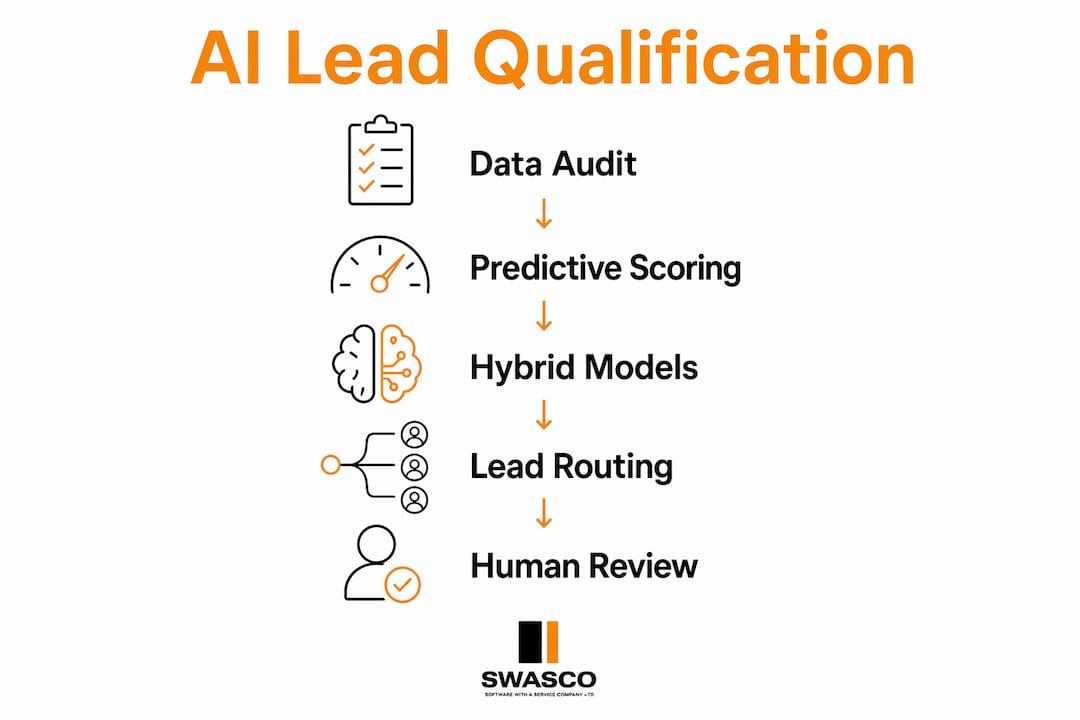
Hybrid qualification models are now considered best practice. The 2026 standard combines rule-based filters for explicit criteria with predictive or large language model (LLM) AI to decode nuanced intent signals. Rule-based filters handle the obvious disqualifiers quickly. The AI layer then interprets the subtler signals that rules cannot capture, such as the pattern of pages visited, the timing of return visits, or the tone of a chat enquiry.
Autonomous conversational qualification uses a method called driven Q&A. AI agents following the BANT framework prompt prospects on Budget, Authority, Need, and Timeline. When a prospect gives an off-topic or unclear answer, the agent loops back to the relevant question rather than moving on. This keeps the qualification conversation on track and produces consistent, structured data.
Key AI techniques used in lead qualification include:
- Predictive lead scoring: trains on historical conversion data to rank new leads by likelihood to close
- Behavioural signal analysis: tracks page visits, email opens, and chat interactions to detect intent
- Firmographic enrichment: pulls company size, industry, and role data to assess fit automatically
- Driven Q&A scripting: guides prospects through BANT questions using conversational AI
- Confidence scoring: assigns a numerical confidence level to each qualified lead for human review
Pro Tip: Before deploying predictive scoring, audit your CRM for data quality. A model trained on incomplete or inaccurate records will produce unreliable scores regardless of how sophisticated the AI is.
Does AI replace human judgement in lead qualification?
AI handles volume sorting, initial outreach, and structured qualification conversations. Sales leaders agree that AI should support human reps by managing the heavy lifting, freeing people to focus on complex negotiations and high-value accounts. That division of labour is not a compromise. It is the most efficient use of both resources.
The human-in-the-loop model is the accepted standard for top-tier accounts. Experienced operators apply human spot-checks to the top 5 to 20% of accounts, particularly senior-level contacts at smaller companies where data latency or incomplete records can mislead an AI model. A director at a 12-person firm may look like a low-value lead on paper. A human reviewer catches that context immediately.
The risks of over-automation are real and worth understanding directly:
- Automating a broken process: AI requires clear qualification gates defined before deployment. Without them, it replicates existing flaws at scale.
- Losing context on complex deals: AI cannot read the room in a sensitive negotiation or adapt to relationship dynamics built over months.
- CRM data decay: AI models degrade when the data they rely on becomes stale. Regular data hygiene is not optional.
- Misrouting senior contacts: Automated systems can undervalue high-potential leads if firmographic data is incomplete.
Pro Tip: Map your qualification gates on paper before touching any AI configuration. Write down exactly what makes a lead qualified or disqualified in your business. If you cannot define it clearly, the AI cannot apply it reliably.
The role of AI in property sales pipelines illustrates this balance well. AI handles the volume of initial enquiries while human agents manage viewings, negotiations, and relationship-sensitive conversations. The same principle applies across any service-based business.
How can service businesses implement AI lead qualification?
Implementation follows a logical sequence. Rushing to deploy AI before mapping your current process is the single most common mistake service businesses make.
-
Map your existing qualification gates. Write down the criteria that currently define a good lead versus a poor one. Include budget thresholds, service type, geography, and urgency signals.
-
Structure your AI pipeline. AI-assisted qualification pipelines follow five steps: ingestion, research, verification, enrichment, and scoring. Each step adds data or removes noise before the final confidence score is produced.
-
Set your confidence score thresholds. Leads scoring below 70 should be flagged for human review rather than routed automatically. Leads scoring 75 or above go directly to your sales team or booking system.
-
Fast-track hot leads. Any lead that meets your top-tier criteria should receive a response within 30 seconds. Slow lead response is one of the most damaging and preventable causes of lost revenue in service businesses.
-
Nurture lower-scoring leads automatically. Leads that do not meet the immediate routing threshold should enter a structured follow-up sequence. AI detects fading buyer intent over time and triggers personalised re-engagement without manual intervention.
-
Feed closed data back into the model. Every closed-won and closed-lost outcome is training data. The model improves with each cycle, provided you log outcomes consistently in your CRM.
The cost consideration for service businesses is straightforward. AI qualification replaces the cost of manual screening time and the revenue lost to slow or missed responses. The ROI calculation starts with your current lead volume, your average conversion rate, and your average deal value. Even a modest improvement in conversion rate produces a significant return when applied across hundreds of monthly enquiries.
Pro Tip: Start with a single channel, such as website chat or inbound calls, before rolling out AI qualification across all touchpoints. A focused pilot gives you clean data to validate your scoring thresholds before scaling.
| Implementation stage | Manual approach | AI-assisted approach |
|---|---|---|
| Initial response | Sales rep calls back within hours | Automated response within 30 seconds |
| Lead scoring | Subjective rep assessment | Fit, Intent, Timing score on 0–100 scale |
| Data enrichment | Manual CRM entry | Automated firmographic and behavioural data |
| Nurture sequences | Ad hoc follow-up | Triggered by score and intent signals |
Key takeaways
AI lead qualification delivers its greatest value when clear qualification criteria, clean data, and human oversight are combined with automated scoring and routing.
| Point | Details |
|---|---|
| Speed of response matters | AI reduces response times to under 30 seconds, directly protecting conversion rates. |
| Scoring framework is standard | Fit, Intent, and Timing on a 0–100 scale is the accepted model for automated lead routing. |
| Data quality drives accuracy | Predictive models need at least 200 converted leads over 6–12 months to produce reliable scores. |
| Human oversight remains critical | Apply human review to the top 5–20% of accounts to catch context AI cannot assess from data alone. |
| Define gates before deploying AI | Automating an undefined process replicates its flaws. Map qualification criteria first. |
AI in lead qualification: what I have learned from the field
The businesses that get the most from AI lead qualification are not the ones with the most sophisticated technology. They are the ones with the clearest definition of what a good lead looks like before they switch anything on.
I have seen service businesses deploy AI qualification tools and see no improvement, not because the technology failed, but because their internal qualification criteria were never written down. The AI faithfully replicated a vague, inconsistent process at speed. That is not a technology problem. It is a process problem that technology exposed.
The hybrid model is not a transitional phase on the way to full automation. It is the destination. AI handles the volume, the speed, and the data processing that humans cannot sustain at scale. Humans handle the judgement calls, the relationship context, and the edge cases that data cannot fully represent. Neither replaces the other.
The most underrated benefit of AI qualification is what it does to your team's focus. When your sales reps stop spending time on cold or unqualified enquiries, their energy goes where it produces results. That shift in focus compounds over time in ways that a conversion rate metric alone does not capture.
The next frontier is AI that adapts its qualification questions in real time based on the conversation, rather than following a fixed script. That capability is already emerging. The businesses that will benefit most are those that have already built clean data pipelines and clear qualification logic. The technology rewards preparation.
— James Paul
Talk2Aiva: AI-powered lead qualification for service businesses
Service businesses lose revenue every day from missed calls, slow responses, and unmanaged enquiries. Talk2Aiva by SWASCO addresses that directly.
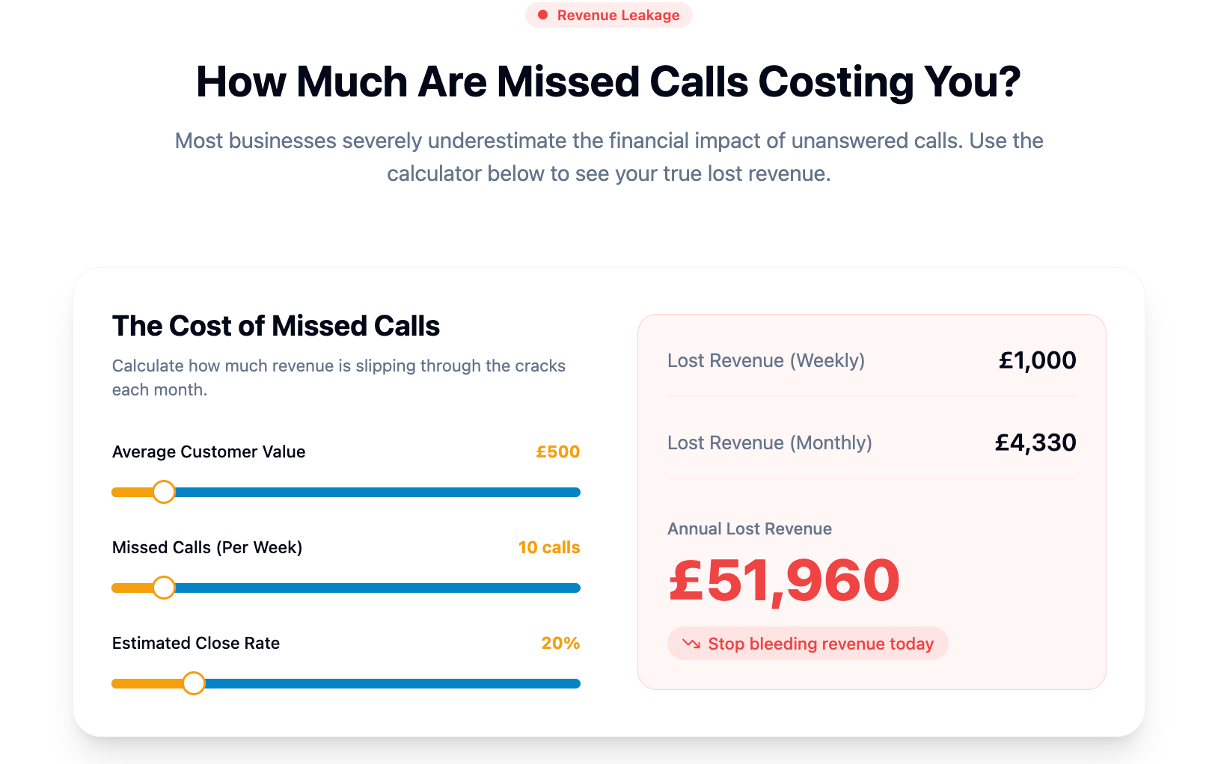
Talk2Aiva uses conversational AI to engage, qualify, and route leads the moment they arrive, across calls, website chat, text, and social media, 24 hours a day. The system applies the Fit, Intent, and Timing scoring logic covered in this article, with full setup, AI training, and ongoing support included. You do not need a technical team to run it. Swasco's end-to-end automation platform handles the pipeline from first contact to booked appointment, so your team focuses on clients, not admin. If you want to see how the qualification workflow operates in practice, the how it works page walks through the full process.
FAQ
What is AI lead qualification?
AI lead qualification is the automated process of scoring, verifying, and routing inbound leads using machine learning and conversational AI. It replaces manual screening with real-time scoring based on Fit, Intent, and Timing signals.
How does AI lead scoring differ from rule-based scoring?
Rule-based scoring applies fixed criteria and cannot adapt to changing behaviour. AI lead scoring analyses multiple signals simultaneously and updates scores in real time, producing 38% higher conversion rates than rule-based methods alone.
How much data does a predictive lead scoring model need?
Predictive models require at least 200 successfully converted leads gathered over 6 to 12 months to produce accurate qualification patterns. Models trained on less data produce unreliable scores.
Should AI fully replace human sales reps in lead qualification?
No. AI handles volume sorting and initial qualification. Human reps should review the top 5 to 20% of accounts, particularly senior contacts at smaller companies where data quality may be limited.
What is the BANT framework in AI qualification?
BANT stands for Budget, Authority, Need, and Timeline. AI agents use driven Q&A scripting to guide prospects through these four questions, looping back when answers are unclear to produce consistent, structured qualification data.