
AI-powered upselling in grooming is the practice of using artificial intelligence to deliver targeted, contextually timed product and service suggestions that increase average transaction values and customer satisfaction. The role of AI in grooming upselling has moved well beyond simple "you might also like" prompts. Today, AI chatbots, generative AI models, and recommendation engines analyse customer behaviour in real time to surface offers that feel personal rather than pushy. Grooming and salon businesses using AI chatbots for contextual upselling report 15–32% increases in average transaction value and a 38% rise in booking volume. Those numbers signal a genuine shift in how grooming businesses grow revenue.
How does AI personalise upselling in grooming businesses?
Personalised upselling, known in the industry as intent-based recommendation, works by reading signals customers leave behind as they browse, book, and buy. AI systems process that data and return offers matched to where the customer is in their journey, not just what they last purchased.
The main techniques grooming businesses use include:
- Intent recognition from browsing and purchase data. AI tracks which services a client books repeatedly, which products they view without buying, and how long they spend on certain pages. A client who books beard trims every three weeks and lingers on beard oil pages is a clear candidate for a conditioning treatment upsell.
- Generative AI analysing unstructured data. Unlike older systems that rely on fixed rules, generative AI reads free-text inputs such as chat messages, review comments, and consultation notes. It extracts context that structured data misses, for example a client mentioning dry skin in a booking chat triggers a moisturiser recommendation.
- AI chatbots delivering real-time offers. A chatbot handling a booking conversation can introduce a relevant add-on at the exact moment a client confirms their appointment. That timing matters. AI upselling is most effective when suggestions appear at moments customers are already discussing related services, which keeps the offer feeling helpful rather than intrusive.
- Routine builders and virtual consultants. Beauty brands using AI routine builders that replace single-item recommendations with bundled regimens drive 38% higher average order value by encouraging fuller skincare routines. Grooming businesses can apply the same logic by bundling a haircut with a scalp treatment and a finishing product.
Pro Tip: Set your AI to trigger upsell offers only after a booking is confirmed, not during the selection process. Interrupting the booking flow is the fastest way to lose the sale entirely.
The shift from reactive to proactive recommendations is what separates AI-driven grooming strategies from traditional upselling scripts. Your team no longer needs to remember which client prefers which product. The system does that work automatically.

Rule-based vs generative AI: which upselling approach fits your grooming business?
The distinction between rule-based and generative AI systems is the most important technical decision grooming businesses face when adopting AI upselling. Both approaches work, but they suit different business sizes and complexity levels.
| Feature | Rule-based systems | Generative AI systems |
|---|---|---|
| How it works | Fixed if-then logic (e.g. "if client books X, offer Y") | Analyses unstructured data and infers intent dynamically |
| Explainability | High. Every recommendation has a traceable rule | Lower. Decisions emerge from model patterns |
| Setup complexity | Low. Rules are written manually | Higher. Requires training data and model configuration |
| Conversion performance | Baseline | 22–35% higher conversion rates than rule-based engines |
| Best fit | Small grooming businesses with limited data | Growing businesses with rich booking and purchase history |
Rule-based systems are a solid starting point. They are transparent, easy to audit, and require no machine learning expertise to manage. A small pet grooming business can write a rule that offers a de-shedding treatment to every dog owner who books a standard bath, and that rule will fire consistently every time.
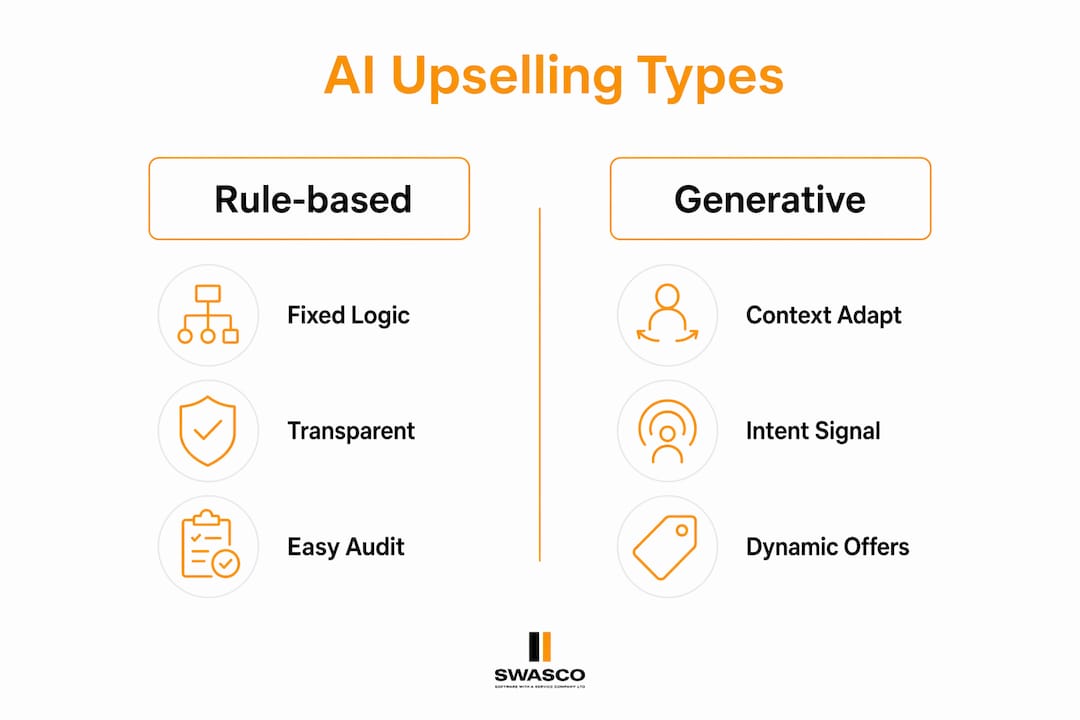
Generative AI goes further. It reads the shift from rule-based to intent-based signals and adapts offers based on context that no fixed rule could anticipate. A client who mentions in a chat that their dog has been scratching more than usual receives a skin-soothing treatment recommendation, not just the standard upsell for their breed. That level of personalisation is what drives the conversion gap between the two approaches.
The practical advice is to start with rule-based logic to build your upselling foundation, then layer generative AI as your customer data grows. Trying to implement generative AI without sufficient historical data produces poor recommendations and erodes client trust quickly.
Why does governance matter in AI grooming upselling strategies?
Governance is the set of rules, checks, and human oversight processes that keep your AI upselling system aligned with your brand values and your customers' best interests. Without it, AI systems optimise purely for short-term revenue and damage the client relationships that grooming businesses depend on.
The core governance practices every grooming business should implement are:
- Suppression rules. AI suppression capabilities prevent overselling by tracking when a client declines an offer and removing that offer from future interactions. A client who says no to a conditioning treatment three times should never see that offer again. Ignoring decline signals is the single fastest way to lose a loyal client.
- Frequency caps. Set a maximum number of upsell prompts per booking session. One well-timed offer converts far better than three competing ones.
- Brand voice review. Generative AI can produce recommendations that are technically accurate but tonally wrong for your brand. Human review of AI-generated offer copy keeps your communications consistent. This is where balancing AI with human oversight becomes non-negotiable.
- Ethical guardrails. Avoid upselling to clients who have just complained or requested a refund. AI systems without ethical filters will attempt upsells in those moments because the data shows the client is engaged. That is technically correct and commercially disastrous.
Pro Tip: Review your AI's declined-offer log monthly. Patterns in what clients consistently reject tell you more about product-market fit than any survey.
AI excels at identifying buying intent, but human judgement is necessary to maintain brand voice and long-term customer trust. The businesses that get the most from AI upselling are those that treat the technology as a capable assistant, not an autonomous sales agent.
How to implement AI upselling in your grooming business
Implementation is where most grooming businesses either gain a real competitive advantage or waste significant time and budget. The following steps reflect what actually works in practice.
-
Audit your current upselling touchpoints. Map every moment in your customer journey where an upsell currently occurs or could occur. Booking confirmation, post-service follow-up, and product recommendation emails are the three highest-value touchpoints for grooming businesses. Understanding your baseline makes it possible to measure AI's actual impact.
-
Test in a sandbox before going live. Optimising only for average order value without considering conversion rate impact can harm overall sales. Run your AI upsell logic in a test environment against a sample of real bookings before exposing it to your full client base. This step prevents the scenario where a poorly timed offer causes clients to abandon their booking entirely.
-
Time your offers contextually. The booking confirmation moment is the highest-converting window for grooming upsells. A client who has just confirmed a haircut appointment is mentally committed to spending money. Introducing a scalp treatment or a styling product at that exact moment aligns with their mindset. Contextual discovery reduces cart abandonment by matching the offer to the customer's current intent rather than interrupting their decision process.
-
Bundle products into routines, not single items. Single-item upsells convert at a fraction of the rate of bundled routines. AI routine builders in the beauty sector consistently outperform individual product recommendations. Build bundles around your most popular services and let the AI surface the right bundle based on the client's booking history. You can explore how AI in small pet businesses applies the same bundling logic to grooming service packages.
-
Measure net conversion impact, not just AOV. Measuring net conversion impact means tracking whether your upsell offers increase total completed transactions, not just the value of transactions that were already going to happen. A 20% AOV lift means nothing if it comes with a 25% drop in booking completions.
-
Use follow-up automation to extend the upselling window. A client who did not take an upsell during booking may respond to a well-timed follow-up message 24 hours later. Follow-up automation in salons extends the revenue window beyond the booking moment and keeps your offers in front of clients without requiring manual effort from your team.
AI agents acting as strategic growth levers blend digital and in-store experiences to personalise shopping and reduce returns significantly. In beauty e-commerce, AI consultations reduce product returns by up to 66% through better-informed purchases. That figure matters for grooming businesses selling retail products alongside services.
Key takeaways
AI-powered upselling in grooming businesses drives measurable revenue growth when it combines intent recognition, contextual timing, suppression governance, and routine-based bundling.
| Point | Details |
|---|---|
| Intent recognition drives personalisation | AI reads browsing, booking, and chat data to surface offers matched to each client's actual behaviour. |
| Generative AI outperforms rule-based systems | Generative models deliver 22–35% higher conversion rates than fixed rule engines in comparable deployments. |
| Suppression rules protect client relationships | Tracking declined offers and removing them from future interactions prevents client fatigue and protects loyalty. |
| Bundled routines outperform single-item upsells | Regimen-based recommendations drive up to 38% higher average order value compared to individual product suggestions. |
| Test before you go live | Sandbox testing prevents upsell offers from harming booking completion rates before full deployment. |
My honest view on AI upselling in grooming
I have worked with grooming and personal care businesses at various stages of AI adoption, and the pattern I see most often is this: businesses invest in the technology and then underinvest in the governance. They get excited about the conversion numbers, skip the suppression setup, and within three months they are fielding complaints from loyal clients who feel pestered.
The businesses that genuinely grow with AI upselling are the ones that treat it as a client relationship tool first and a revenue tool second. When you frame it that way, the decisions become clearer. You suppress aggressively. You cap offer frequency. You review the copy your AI produces before it reaches clients. You measure whether clients are actually happier, not just whether the average order value has ticked up.
The other thing I would say is that the gap between rule-based and generative AI is real, but it is not a reason to rush. A well-governed rule-based system will outperform a poorly governed generative one every time. Build the discipline first, then scale the technology. The grooming businesses I have seen grow fastest with AI are not the ones with the most sophisticated models. They are the ones with the clearest processes.
— James Paul
How Talk2Aiva helps grooming businesses upsell smarter
If you are running a grooming or personal care business and you are still relying on your team to remember which clients need which upsell at the right moment, you are leaving revenue on the table every single day.
Talk2Aiva by SWASCO is built to handle exactly this. The platform engages your clients 24/7 across calls, text, website chat, and social media, qualifying leads, confirming bookings, and delivering contextually timed upsell offers automatically. From setup and AI training through to live launch and ongoing support, the entire process is managed for you. Explore Talk2Aiva's voice AI to see how grooming businesses are automating upselling without losing the personal touch that keeps clients coming back.
FAQ
What is AI upselling in grooming businesses?
AI upselling in grooming is the use of artificial intelligence to deliver personalised product and service recommendations at contextually relevant moments in the customer journey, with the goal of increasing average transaction value and client satisfaction.
How much can AI increase revenue for grooming businesses?
Grooming and salon businesses using AI chatbots for contextual upselling report average transaction value lifts of 15–32% and a 38% rise in booking volume, based on current industry data.
What is the difference between rule-based and generative AI upselling?
Rule-based systems follow fixed if-then logic, while generative AI analyses unstructured data such as chat messages and consultation notes to infer intent dynamically. Generative AI delivers 22–35% higher conversion rates than rule-based engines.
How do suppression rules protect customer relationships?
Suppression rules track when a client declines an upsell offer and remove that offer from future interactions. This prevents repeated prompts that cause client frustration and damage long-term loyalty.
When is the best time to present an upsell offer in a grooming business?
The booking confirmation moment is the highest-converting window. Presenting a relevant add-on immediately after a client confirms their appointment aligns with their spending mindset and avoids interrupting the decision process.