
For most service businesses, a good response time is under five minutes for a new enquiry, under a minute for live chat, and a call answered or returned the same hour. These are working targets, not laws. Different channels and different customer intent need different standards. This guide gives you benchmarks by channel, shows you how to measure first response time properly, and explains how to cut it without sending rushed, poor replies.
If you run a salon, a garage, a dental practice, an estate agency or a tree surgery firm, every slow reply costs you a booking. Customers rarely wait. They move on to the next business on the list.
TL;DR
- Aim to reply to new enquiries within 5 minutes, to live chat within 1 minute, and to calls immediately or within the hour. Treat these as targets to test against your own results.
- Measure first response time as the first meaningful reply minus the time the enquiry arrived. Automated acknowledgements do not count.
- Report the median and the 90th percentile, not just the average, and separate business hours from clock hours.
- Speed only helps if the reply is useful. Set an owner, a script and a fallback for every channel.
- Out of hours is where most small firms lose enquiries. An AI receptionist can cover those gaps and keep replies useful.
Table of Contents
- What response time actually means
- Why the first minutes matter
- Response time benchmarks by channel
- How to measure response time properly
- How to find missed and delayed enquiries
- How to improve response time without lowering quality
- What to do about out-of-hours enquiries
- Perspective: why speed is a system, not a staffing problem
- Where an AI receptionist fits
- A 30-day plan to hit your benchmarks
- When a faster response does not help
- FAQ
- Sources
What response time actually means
Response time is the gap between a customer getting in touch and receiving a reply that moves things forward. Two terms get mixed up:
- First response time (FRT): how long until the customer gets the first substantive reply from a person. Automated acknowledgements do not count, because the customer is still waiting.
- Time to resolution (TTR): how long until the issue is completely resolved, from first contact to close.
For a service business, think of it in sales terms. FRT is how long a new lead waits before someone engages. Resolution is the booking confirmed, the quote accepted or the question fully answered. Speed on the first matters most for winning the work. Speed on the second matters for keeping customers happy.
Why the first minutes matter
The strongest evidence on speed comes from lead handling research. A Harvard Business Review study of 1.25 million sales leads in the US found that firms contacting a lead within an hour were nearly seven times as likely to qualify it as those that waited even an hour longer, and more than 60 times as likely as those that waited 24 hours or more. The research is American and over a decade old. It deals with web enquiries to larger firms, so do not treat the exact multiples as a promise for your salon or garage. The direction is what matters: leads go cold quickly.
UK evidence from small firms shows the same gap between what customers want and what businesses deliver:
- A Shopify UK guide reports that nearly one-third of customers expect an email reply within an hour, while the average response time it cites is 12 hours.
- A 2020 study of 132 UK surveying firms found that 46.9% replied to a quote enquiry within an hour, while 15.9% did not respond at all.
That second figure is the one to remember. Roughly one in six firms in that study never replied. If you reply promptly and professionally, you are already ahead of many of the businesses you compete with.
Response time benchmarks by channel
There is no single official UK standard for how fast a private business must reply. The table below is our recommended set of working targets for service businesses, built from the ranges commonly used across the industry. Use it as a starting point, then adjust once you have your own data.
| Channel | Strong | Acceptable | Too slow |
|---|---|---|---|
| Phone call (inbound) | Answered live, or a reply within 5 minutes | Returned within 1 hour | Next working day |
| Live website chat | Under 1 minute | 1 to 3 minutes | Over 5 minutes |
| SMS and WhatsApp | Under 5 minutes | Within 30 minutes | Over 2 hours |
| Web form or quote request | Under 5 minutes | Within 1 hour | Over 4 hours |
| Social media DMs | Under 30 minutes | Within 2 hours | Over 1 working day |
| Within 1 hour | Within 4 hours | Next working day |
Two points explain the shape of this table.
Intent changes the standard. Someone who calls a tyre shop with a flat tyre, or fills in a form to book a valuation, is ready to buy now. A general question by email can wait longer. Set your fastest standards for high-intent enquiries: missed calls, booking requests, quote forms and chat.
Channel signals urgency. A phone call or chat message suggests the customer expects an immediate answer. An email suggests they will wait an hour or two. Match the pace the customer chose.
Benchmarks for typical service businesses
The same logic applies across the trades and practices we work with:
- Tree surgeons, roofers, junk removal and pest control: the customer often rings two or three firms in a row. You are on site or up a tree, so calls go unanswered. The target is a reply within minutes, even if it is only to qualify the job and offer a call-back slot.
- Garages, MOT centres and tyre shops: urgency is high. Customers want to know if you can take the car today. Aim to answer or reply by text within minutes.
- Salons, gyms, studios and dog groomers: staff are with clients all day. Most enquiries are bookings, so a quick reply with available slots wins the booking.
- Dentists, aesthetics practitioners and conveyancing firms: enquiries are higher value and often arrive out of hours. A fast acknowledgement with a clear next step matters as much as speed.
- Estate and letting agents, finance brokers, wedding photographers: a single lead can be worth hundreds or thousands of pounds. The first firm to hold a real conversation often gets the instruction.
How to measure response time properly
Most businesses do not know their response time. They know how fast they feel. Measuring it takes four decisions.
1. Decide what counts as the first response
Metabase's guidance on first-response time recommends calculating it as the first human reply timestamp minus the enquiry created timestamp, and excluding bots, autoresponders, internal notes and customer messages. Follow the same rule. An automated "thanks for your message" is not a response. A reply that answers the question or offers a booking is.
2. Choose business hours or clock hours
Business-hours measurement shows how efficient your team is. Clock-hours measurement shows what the customer actually experienced, including the night and the weekend. Both views are useful. For a lead that arrives at 9pm on a Friday, the customer's wait is the clock-hours number. Label which one you are reporting.
3. Use the median and the 90th percentile
An average hides the worst experiences. If nine enquiries get a reply in 3 minutes and one waits two days, the average looks poor and tells you nothing useful. The median shows the typical customer. The 90th percentile shows how long your slowest customers wait. Metabase recommends reporting the median and p90 rather than a single average.
A simple way to work out both in a spreadsheet:
- List each enquiry with its arrival time and the time of the first real reply.
- Subtract to get the wait for each one.
- Sort the waits from shortest to longest.
- The middle value is your median. The value 90% of the way down the list is your p90.
4. Segment and compare over time
The UK Government Service Manual advises collecting accurate data, checking it for errors, segmenting your analysis, setting a baseline and monitoring continuously. That is written for public services, but the principle suits a small business well. Split your numbers by channel, by time of day and by enquiry type. A single blended figure will hide that, for example, your Instagram messages wait six hours or that every Monday morning is a bottleneck.

How to find missed and delayed enquiries
Response time only measures enquiries you replied to. The bigger loss is the ones nobody logged. Start with a small review, as one UK agency advises: look at your enquiry history to find the main leakage point before making a bigger change.
A one-week audit is enough to start:
- Count missed calls on your phone log and see how many were called back.
- Check unread website chat messages, form submissions and social DMs.
- Note how many enquiries had no booking or quote after the first contact.
- Mark which hours and days produce the most gaps.
Most owners find the same pattern. The gaps cluster around lunch, the end of the day, weekends and any time the team is hands-on with a customer. That is where faster response pays back first.
How to improve response time without lowering quality
Speed on its own is not the goal. A fast reply that is unhelpful does not improve the customer journey, and an automated acknowledgement should not be used to claim a fast response if the customer is still waiting for a real answer. Here is how to get both.
Set standards by channel and intent
Use the table above as a draft. Write down your own target for each channel and each type of enquiry. Put it where your team can see it.
Give every channel an owner and a fallback
Someone must be responsible for each inbox. Someone else must be the fallback when the owner is busy, on holiday or with a customer. Without this, enquiries sit in a shared inbox that everyone assumes someone else is watching.
Use scripts and templates for the first reply
You do not need a long reply. You need the right one. A good first reply:
- uses the customer's name and the service they asked about;
- answers the most likely question (price range, availability, location);
- offers a clear next step, such as a booking link or two time slots.
Check quality as well as speed
Each week, read ten replies at random. Ask whether they answered the question, whether the tone was right, and whether a booking or quote followed. The same source recommends sampling reply quality alongside speed.
Fix the biggest leak first
If missed calls are your biggest gap, do not start by redesigning your website. If social DMs are the problem, do not hire a receptionist. Work down your audit from largest loss to smallest.
What to do about out-of-hours enquiries
For many service businesses, the largest share of missed enquiries arrives when nobody is in. Evenings, early mornings and weekends are when customers research, compare and send forms.
A sound out-of-hours approach has three parts:
- A helpful acknowledgement. Say who will reply and when. Set an honest expectation rather than promising something you cannot deliver.
- Defined routing and cover. Decide who picks up the queue first thing, and who covers if they are off.
- Escalation for urgent jobs. A burst pipe, a fallen tree or a dental emergency should not wait for 9am. Route these to a named person.
This is where automation earns its place, as long as it goes beyond a generic auto-reply.
Perspective: why speed is a system, not a staffing problem
We built Talk2Aiva because we kept seeing the same pattern in service businesses. The owner is good at the work. The work is exactly why the phone goes unanswered. A groomer has a dog on the table. A roofer is on a ladder. A dentist is with a patient. Nobody is being careless. There are simply not enough hands.
Hiring another person to sit by the phone is expensive and still leaves nights and weekends uncovered. A tool that only sends "we'll get back to you" does not fix anything, because the customer is still waiting and still shopping around.

Our view is that a good response has four parts: it is instant, it is useful, it is on the customer's preferred channel, and it ends in a next step. That means engaging the lead, qualifying them, booking the appointment into your calendar and following up if they go quiet. It also means handling calls, text, website chat and social media in one place, so nothing falls between inboxes.
We also believe that technology should not be left for the business owner to configure alone. That is why setup, AI training, workflow building, launch and ongoing support are part of how we work. A system that is tuned to your services, your prices and your way of speaking will answer better than a generic one.
— James Paul
Where an AI receptionist fits
An AI receptionist is software that answers calls and messages, holds a natural conversation, captures the customer's details and books them in, at any hour. Used well, it closes the gap between the benchmark and what a small team can deliver by hand.
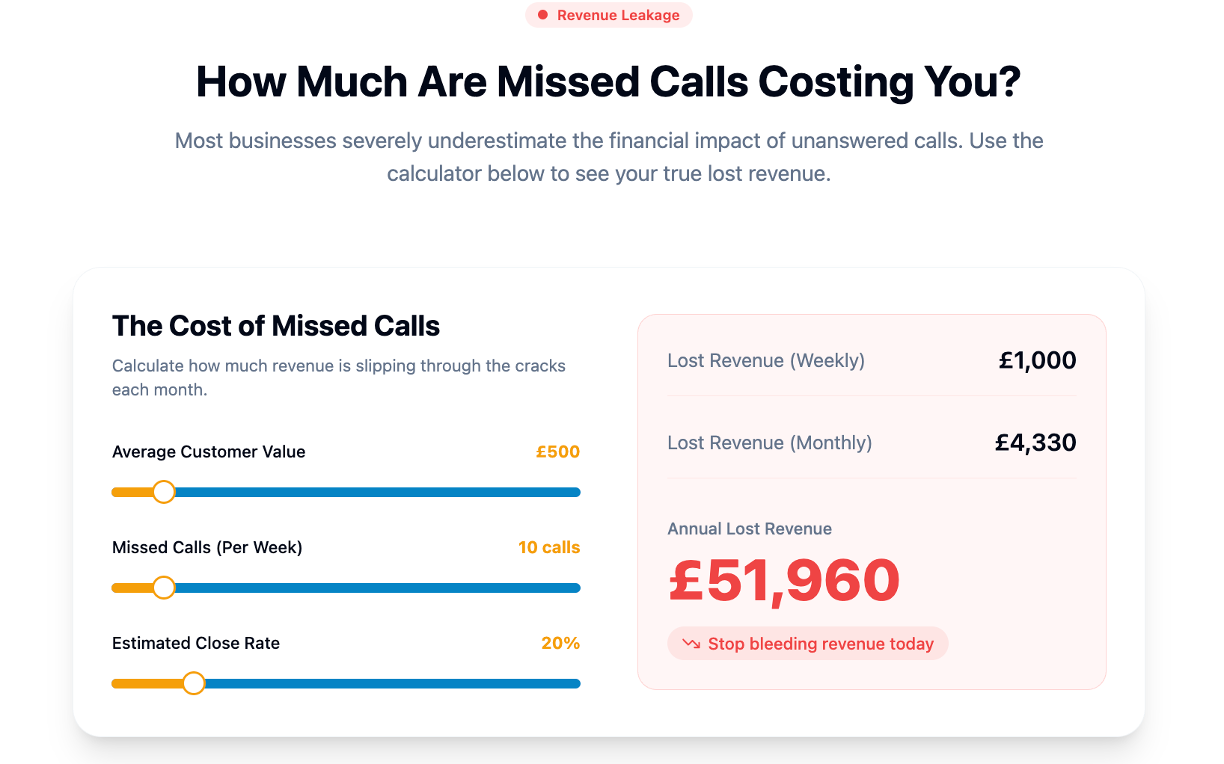
Talk2Aiva by SWASCO is built for service businesses that want to stop losing revenue from missed calls, delayed responses and unmanaged enquiries. It engages, qualifies, books and follows up with leads 24/7 across calls, text, website chat and social media. Calendar sync, automated follow-ups, review requests, a unified inbox and mobile app notifications are part of the system, and setup and ongoing technical support come with it.
There are three plans, published as annual prices: the Software Suite at £970 per year, the Ultimate AI Suite at £2,970 per year and the Elite AI Suite at £4,970 per year. You can compare them on the Talk2Aiva plans page.
If you want to see how your own enquiry flow would be handled, start from the Talk2Aiva home page and choose the plan that fits the volume of calls and messages you receive.
A 30-day plan to hit your benchmarks
You can move from guessing to a reliable standard in a month.
Week 1: Measure. Log every enquiry across every channel. Record arrival time, first real reply time and outcome. Do not change anything yet.
Week 2: Find the leaks. Work out your median and p90 by channel. Mark the hours with the worst gaps. Pick the single biggest leak.
Week 3: Fix and standardise. Write first-reply templates, name an owner and a fallback for each channel, and set your targets from the table. If the biggest leak is out of hours or missed calls, put automated cover in place for those slots.
Week 4: Review quality. Sample replies, check bookings and quotes against enquiries, and tighten the scripts. Re-run your median and p90 and compare them with week 1.
Keep measuring monthly. A response standard that is not tracked drifts back to the old habits.
When a faster response does not help
Speed has limits. Be careful in three situations.
- The reply is poor. A quick, vague or wrong answer damages trust more than a slightly slower, accurate one.
- The acknowledgement pretends to be the answer. If the customer gets an instant auto-reply and then silence for a day, you have been fast on paper only.
- There is no ownership. Speed has to be connected to a script, a sequence and a named person, or it does not turn into bookings.
The aim is a reply that is quick, correct and ends with something the customer can do next.
FAQ
What is a good response time for a new customer enquiry?
For high-intent enquiries such as calls, chat and quote forms, aim for under five minutes. For email, within an hour is strong and within four hours is acceptable. There is no official UK standard for private businesses, so treat these as targets and adjust them using your own results.
How is first response time different from resolution time?
First response time is how long a customer waits for the first meaningful reply from a person. Resolution time is how long it takes to fully close the issue. For winning new work, first response time is usually the more important of the two.
How do I measure response time without special software?
Keep a simple spreadsheet with the arrival time, first real reply time and outcome for each enquiry. Subtract to get the wait, then find the median and the 90th percentile for each channel. Exclude automated replies, and say whether you are counting business hours or clock hours.
How can I reduce response time if I am on the job all day?
Set a named owner and fallback for each channel, use templates for first replies, and cover the busiest gaps automatically. An AI receptionist can answer calls and messages instantly, qualify the lead and book them into your calendar while you work.
Does a faster reply always win the customer?
No. A fast reply that is unhelpful does not improve the experience. Check reply quality alongside speed, and make sure every response ends with a clear next step.
Sources
- The Short Life of Online Sales Leads, Harvard Business Review
- How to set performance metrics for your service, GOV.UK Service Manual
- How to calculate first response time, Shopify UK
- Surveyor Lead Response Study 2020
- How quickly should you respond to a new enquiry?
- First-Response Time: Definition and how to track it, Metabase
- First response time: the complete guide, SparrowDesk
- What is Time to Resolution, Klaviyo
- Resolution Time: What It Is and How to Reduce It, Gorgias