
Cold lead reactivation is the process of reviving dormant property enquiries that have gone silent, typically after 90 or more days of no contact, and moving them back into an active sales pipeline. For real estate agents and property managers, this is one of the highest-return activities available. Your CRM already holds the contacts. The cost of acquisition has already been paid. The only question is whether you have a system to re-engage cold property leads before a competitor does. Done well, reactivation produces first re-engagement conversations by week 2, pipeline qualification by weeks 4–6, and closed deals by months 3–4. Tools like CRM automation platforms, AI-driven outreach systems, and compliance frameworks such as PECR make this achievable at scale without burning your contact list.
How to segment and prioritise cold leads for re-engagement
Segmentation is the single most important step before any outreach begins. Treating all cold leads as one group produces generic messaging that nobody responds to. The fix is to sort your database by dormancy period and lead quality before writing a single word of copy.
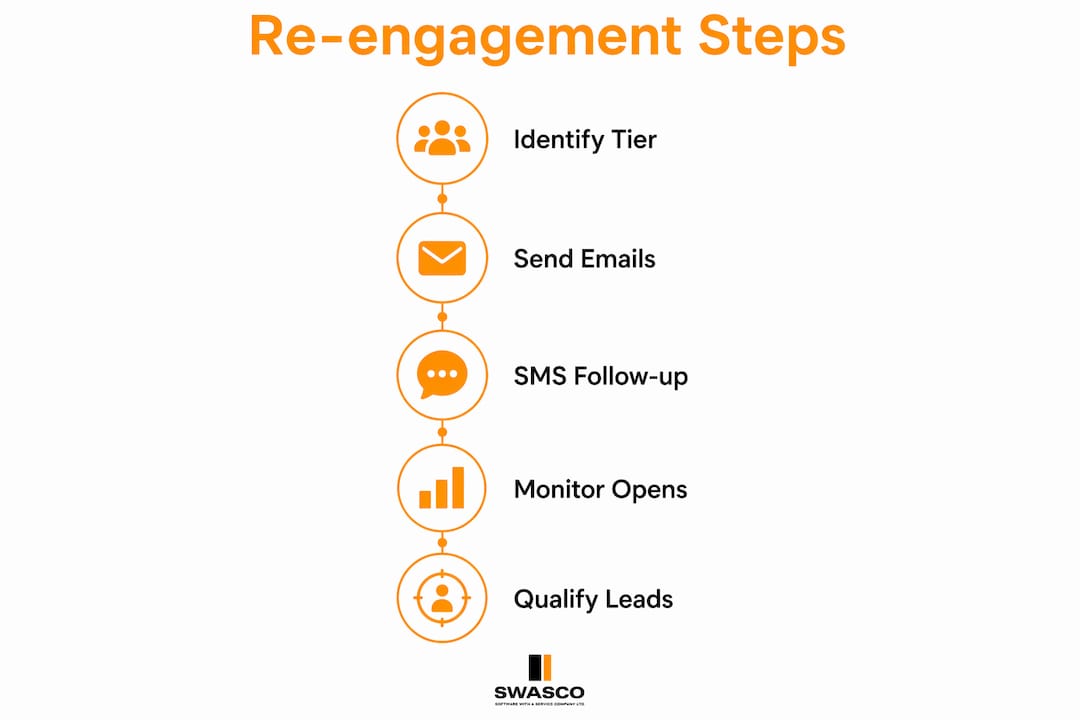
A practical segmentation model uses three tiers based on inactivity:
- Tier 1 (90–180 days inactive): These leads went quiet recently. They likely still have the same property goals. Use a direct, low-friction message that references their original enquiry and offers a clear reason to reconnect, such as a new listing or a market update.
- Tier 2 (180–365 days inactive): Motivation may have shifted. These leads need a softer re-entry. Lead with a value-add, such as a local market report or a mortgage rate update, before asking for a conversation.
- Tier 3 (365+ days inactive): Treat these as near-cold prospects. A short, curiosity-driven message works better than a detailed pitch. Keep the sequence short and accept a lower response rate.
Segmenting contacts by dormancy period allows tailored campaign framing and timing for improved relevance. That relevance is what separates a re-engagement that converts from one that generates unsubscribes.
Within each tier, apply a secondary filter based on lead quality. Score contacts by original enquiry type, property budget, and whether they previously booked a viewing. High-fit leads in Tier 1 get the most personalised sequences and the shortest intervals between touchpoints. Low-fit leads in Tier 3 get a single short sequence before suppression.

Pro Tip: Never run all three tiers simultaneously in the same campaign. Stagger launches by one week per tier so you can monitor response rates and adjust messaging before committing your full list.
What does an effective re-engagement sequence look like?
A well-designed re-engagement sequence is not a single email. It is a coordinated series of touchpoints across email, SMS, and voice, timed to feel relevant rather than persistent. The goal is not visibility. Re-engagement emails function as triggers to move prospects back into active sales stages, not simply to remind them you exist.
For Tier 1 leads, a 2–3 email sequence spaced over a few days following 90 days of inactivity is the recommended starting point. Each email serves a distinct purpose: the first re-establishes context, the second adds value, and the third creates a low-pressure close. SMS works well as a supplement after the second email, particularly for time-sensitive triggers like a new listing or a rate change.
The table below shows how each channel performs for cold lead reactivation:
| Channel | Best use case | Typical response window | Compliance note |
|---|---|---|---|
| Value-led nurturing, market updates | 24–72 hours | Requires soft opt-in or valid consent | |
| SMS | Time-sensitive triggers, short CTAs | Under 2 hours | Requires explicit consent under PECR |
| Voice call | High-value Tier 1 leads post-email | Same day | Automated calls need prior consent |
| Social DM | Warm re-entry for engaged contacts | Variable | Platform terms apply |
Market timing signals such as mortgage rate drops or inventory shifts are the most effective triggers for outreach that feels timely. Without a legitimate reason to contact, outreach reads as generic cold marketing and fails.
Automation platforms, including those that integrate with CRM tools like Act!, allow you to build these sequences once and trigger them automatically based on inactivity thresholds. The key rule: sequences must pause immediately when a lead responds, routing the contact back to an agent with full context for personalised follow-up. Automation handles scale. The human handles the conversation.
Pro Tip: Set your CRM to flag any lead who opens three or more emails without replying. These contacts are warming up. A direct, personal call at this point converts far better than another automated email.
What are the PECR compliance rules for re-engaging leads?
UK marketing law requires specific conditions before you can send electronic marketing to cold contacts. The Privacy and Electronic Communications Regulations, known as PECR, govern emails, SMS, and automated calls. Getting this wrong risks ICO enforcement and damages trust with the very contacts you are trying to win back.
The core requirements are:
- Valid consent or soft opt-in: You need either explicit consent or a soft opt-in exemption, which applies when a contact previously enquired about a similar property service and has not opted out.
- Clear unsubscribe option: Every email and SMS must include a working opt-out mechanism. There are no exceptions.
- Prompt opt-out processing: PECR requires opt-outs to be processed promptly, typically within 28 days. Delayed processing is a compliance failure.
- Consent record-keeping: Consent records must archive the exact wording, timestamp, source, and contact identifiers to satisfy an ICO audit.
Consent records are not optional documentation. They are your legal defence if a complaint is raised. Store them in your CRM against each contact record, not in a separate spreadsheet.
Automated calling sequences carry the strictest rules. Prior explicit consent is required before any automated call is made to a contact. If you are using an AI voice system for outreach, verify that consent was captured at the point of the original enquiry. A CRM integration guide for lead nurturing can help you map consent fields correctly across your database before launching any campaign.
How do you measure and improve re-engagement campaign results?
Measurement turns a re-engagement campaign into a repeatable system. Without defined metrics, you cannot tell whether a low response rate reflects poor timing, weak copy, or a list that needs suppression.
Track these metrics by segment from day one:
- Response rate by tier: Tier 1 should outperform Tier 2 and Tier 3 significantly. If it does not, your segmentation criteria need review.
- Re-qualified leads: Define what "re-qualified" means before the campaign launches. Sales and marketing must agree on the threshold. Misalignment on lead status wastes calls and burns goodwill with contacts who are not yet ready.
- Conversion timeline: Track how long it takes from first re-engagement to a booked viewing or signed instruction. This tells you whether your sequence length is correctly calibrated.
- List health indicators: Monitor delivery rates, bounce rates, and spam complaints. Treating re-engagement as a monitored pipeline stage with defined suppression thresholds protects your sender reputation and inbox placement.
The three most common mistakes in re-engagement campaigns are over-messaging, poor timing, and generic content. Over-messaging means sending more than three touchpoints to Tier 3 contacts who have shown no signal of interest. Poor timing means launching outreach with no market trigger. Generic content means sending the same message to a first-time buyer who enquired 100 days ago and a landlord who went silent two years ago.
Pro Tip: After each campaign cycle, suppress any contact who received your full sequence with zero opens. These contacts are not dormant. They are disengaged. Continuing to message them harms your deliverability and skews your metrics.
You can build a systematic follow-up process that connects your re-engagement data directly to your active pipeline, so no re-qualified lead falls through the gap between marketing and sales.
Key takeaways
Reviving inactive property leads requires segmentation by dormancy period, contextual multi-channel outreach, and a monitored pipeline stage with clear requalification thresholds.
| Point | Details |
|---|---|
| Segment before outreach | Divide contacts into 90–180, 180–365, and 365+ day tiers before writing any message. |
| Use market triggers | Mortgage rate changes and inventory shifts make outreach feel timely and relevant, not generic. |
| Comply with PECR | Every email and SMS needs a valid consent basis and a working opt-out mechanism. |
| Pause on response | Automated sequences must stop the moment a lead replies, routing them to an agent immediately. |
| Measure list health | Track bounces, complaints, and suppression rates to protect deliverability and attribution accuracy. |
The mistake most agents make with cold leads
The most common error I see is treating re-engagement as a one-off campaign rather than a permanent pipeline stage. An agent will send a batch of emails in january, get a handful of responses, and then let the remaining contacts sit untouched until the next slow quarter. That approach misses the point entirely.
Cold leads do not all wake up at the same time. Some will re-engage when mortgage rates shift. Others will respond when a specific property type comes to market. The agents who win consistently are the ones who have automated lead follow-up running continuously in the background, triggered by inactivity thresholds and market signals, not by how busy the office feels that week.
The second mistake is confusing automation with depersonalisation. Automation handles the timing and the trigger. The message itself still needs to reference something specific: the original enquiry, a relevant new listing, or a genuine market development. Contextual relevance dramatically improves response rates and reduces the cold-marketing fatigue that kills deliverability over time.
My advice is to build re-engagement into your CRM as a named pipeline stage with entry criteria, exit criteria, and a suppression rule. Treat it with the same rigour you apply to your active pipeline. The contacts are already there. The system just needs to be built once and maintained.
— James Paul
How Talk2Aiva helps you reactivate lost property enquiries
Real estate agents and property managers lose revenue not because their cold leads are unrecoverable, but because no system is working on them consistently.
Talk2Aiva by SWASCO is an AI receptionist and revenue recovery system that engages, qualifies, and follows up with leads 24/7 across calls, text, website chat, and social media. For cold lead reactivation, Talk2Aiva handles the outreach sequences, pauses automatically on response, and routes re-engaged contacts to your team with full context. The platform includes setup, AI training, workflow building, and ongoing support, so you are not left to configure it alone. If your database holds dormant property enquiries, Talk2Aiva's voice AI and sales automation gives you the system to work them without adding to your workload.
FAQ
What counts as a cold property lead?
A cold property lead is a contact who has made no meaningful engagement for approximately 90 days or more. Defining the threshold clearly in your CRM before launching any re-engagement campaign is the first step.
How long does it take to see results from re-engagement?
First re-engagement conversations typically appear by week 2, with pipeline qualification by weeks 4–6 and closed deals by months 3–4, depending on lead quality and sequence design.
Do I need consent to email cold property leads in the UK?
Yes. PECR requires either explicit consent or a valid soft opt-in exemption, such as a prior enquiry about a similar service. Every message must also include a clear unsubscribe option.
How many touchpoints should a re-engagement sequence include?
Tier 1 leads (90–180 days inactive) suit a 2–3 email sequence supplemented by SMS. Tier 3 leads (365+ days) should receive no more than two touchpoints before suppression to protect list health.
What is the biggest reason re-engagement campaigns fail?
Campaigns fail when outreach lacks contextual new information or when sales and marketing disagree on what a re-qualified lead looks like. Both problems are solved by defining criteria before the campaign launches.