
Conversational AI wins the resolution and CSAT battle for most contact centres, resolving 60–80% of calls autonomously versus 10–30% for legacy IVR. IVR still earns its place for simple routing, regulator-mandated DTMF confirmations, and air-gapped environments where nothing touches the cloud. The smart move isn't ripping out your phone tree overnight. It's a phased, intent-by-intent migration with IVR kept on as a safety net, which is exactly what the rest of this guide walks through.
TL;DR:
- Moving from 20% to 70% containment with conversational AI can reduce agent workload for specific intents by over two-thirds.
- AI-driven resolution rates currently reach 60-80%, significantly outperforming legacy IVR systems that resolve only 10-30% of calls autonomously.
- Deployment of conversational AI scales rapidly, with intents scoped and launched in days rather than weeks, enabling frequent testing and adjustments.
- Important use cases include appointment scheduling, order status, payments, and lead qualification, with fallback options for non-ambiguous IVR routing.
- Successful migration requires phased rollout, thorough integration testing, and continuous monitoring of KPIs like containment, AHT, escalation, and CSAT.
Table of Contents
- IVR vs conversational AI: the key technical differences
- What the numbers actually show: containment, AHT and CSAT
- When IVR still makes sense, and where conversational AI wins fast
- The migration playbook: from pilot to full rollout
- Implementation checklist: integrations, handoffs and governance
- Measuring ROI: the KPIs that actually matter
- Why the phased approach beats the "big bang" every time
- How Talk2Aiva supports a safer, faster migration
- Sources
IVR vs conversational AI: the key technical differences
IVR runs on menus. You press 1 for sales, 2 for support, and the system routes you through a fixed decision tree using DTMF (dual-tone multi-frequency) tones. Conversational AI works differently: it listens to natural speech through automatic speech recognition (ASR), interprets meaning with natural language understanding (NLU) and large language models, and then calls backend tools to actually complete tasks, not just route them, following modern approaches detailed by Interval AI.
That architectural gap changes everything downstream.
- Latency matters more in voice than text. A conversational AI voice agent needs sub-800ms round-trip response to feel natural; anything slower and callers sense the lag, talk over the system, or hang up.
- Routing is deterministic in IVR, stateful in AI. IVR follows the same branch every time. Conversational AI holds context across a conversation, so it can handle "actually, can you also check my last invoice?" mid-call.
- Integration depth differs sharply. IVR typically routes to a queue. Conversational AI can query a CRM, check a calendar, or trigger a payment, which is why tool-calling to CRM systems is often the real economic lever, not the per-minute telephony cost.
- Accessibility still needs DTMF fallback. Not every caller wants to talk to a machine, and some environments (noisy warehouses, hearing-impaired callers) genuinely need a keypress option, so smart deployments keep it available even alongside AI.
Traditional IVR is linear by design, built for a handful of fixed paths. Conversational AI scales to hundreds of intents when it's properly wired into backend systems, which is the entire point of replacing one with the other rather than just running both in parallel forever.
What the numbers actually show: containment, AHT and CSAT
The containment gap is the number CX leaders should care about most. Legacy IVR resolves roughly 10 to 30% of calls without human intervention. Modern AI voice agents in production commonly reach 60 to 80% autonomous resolution on comparable intent sets.
The containment swing in numbers: moving from a 20% containment rate to 70% on a high-volume intent (say, appointment rescheduling) doesn't just cut agent workload by half. It can cut it by more than two-thirds on that specific intent, which is where the real headcount and cost story lives.
That gap isn't cosmetic. Three things tend to move together once conversational AI is live on an intent:
- Average handle time (AHT) drops because the AI resolves simple requests (order status, appointment changes) without transferring.
- CSAT tends to rise on straightforward, high-volume intents, largely because customers stop repeating themselves to three different systems.
- Blended cost per call falls, even though the per-contained-call cost of running an AI model is often higher than a DTMF menu, because so many more calls never reach a paid agent.
There's a second advantage that rarely makes it into vendor pitch decks: deploy velocity. Legacy IVR changes typically take four to eight weeks to build, test, and release. Conversational AI intents can be scoped, deployed, and iterated in two to five days. That cadence lets teams A/B test wording, tone, and fallback logic weekly instead of quarterly, which compounds fast.
When IVR still makes sense, and where conversational AI wins fast
Not every intent deserves an AI agent, and pretending otherwise is how migrations stall. Three scenarios still favour IVR outright: regulator-mandated DTMF confirmations (common in banking and insurance, where a keypress creates an auditable consent record), pure call routing with no decision logic, and air-gapped, on-premises environments where nothing can touch a cloud LLM.
Everywhere else, conversational AI tends to win quickly on a specific set of use cases:
- Appointment booking and rescheduling — high volume, low ambiguity, clear calendar integration.
- Order and delivery status — a lookup task, ideal for early tool-calling wins.
- Payments and balance queries — structured data, fast resolution, measurable containment.
- Lead qualification and intake — natural conversation beats a menu when you need nuance.
The pattern leading teams use isn't "IVR or AI" but combining both deliberately: conversational AI for intent-rich interactions, IVR as the fallback when the AI can't resolve something or the caller asks for a human. Run a parallel DID (a second phone number) so live traffic never fully depends on the new system on day one, and expand intent coverage only once containment data backs it up.
Before scoping anything, ask your team three questions: which five intents account for most call volume, what does "resolved" mean for each one, and what's the acceptable escalation rate before you pause the rollout?
Pro Tip: Start with your single highest-volume, lowest-complexity intent. If you can't get that one past 60% containment in a pilot, the problem is your data or integration, not the concept, so fix that before expanding scope.
The migration playbook: from pilot to full rollout
Replacing an IVR safely is a sequencing problem, not a technology problem. The teams that get this right treat it as five deliberate stages rather than a single cutover weekend.
- Scope and baseline. Map your top ten to fifteen intents by call volume, then define what success looks like for each: target containment, acceptable AHT, and a CSAT floor.
- Build on a parallel DID. Stand the AI agent up on a second number rather than replacing the main line immediately, so a bad flow never takes down live traffic.
- Ramp traffic gradually. A sensible cadence is 1% of calls, then 10%, then 25%, then 50%, with a review gate at each step before moving on.
- Monitor and A/B test continuously. Track containment and escalation daily during ramp; design A/B tests around specific prompt or flow changes, not vague "improvements."
- Expand by intent, not by volume alone. Add the next intent only once the current one clears its containment and CSAT targets for at least one full reporting cycle.
Two things need to be locked down before any of that ramp begins:
- Integration and failover. Confirm multi-LLM redundancy, SBC (session border controller) compatibility with your existing telephony, and clear tool-calling permissions into your CRM.
- Governance checkpoints. Set data-handling rules, escalation triggers, and a rollback plan before, not during, the first live percentage bump.
Successful adopters consistently offload high-volume, low-complexity intents first, keeping a "press 0 for a person" fallback live throughout. That single safety net is often what makes stakeholders comfortable enough to approve the next ramp stage.
Implementation checklist: integrations, handoffs and governance
Most failed rollouts fail on plumbing, not on the AI's conversational quality. Before launch, confirm the following are actually built and tested, not just planned:
- API and CRM wiring with a working sandbox demo of real tool calls, not a scripted mock.
- Latency acceptance testing under real network conditions, not just in a quiet office.
- Warm handoff data pushed to the agent desktop, including transcript, intent summary, sentiment, and any relevant attachments, before the human connects.
- Carrier and SBC integration with observability on call quality and latency SLAs (service level agreements).
- Adversarial testing: barge-in handling, multiple accents, background noise, and at least one deliberately ambiguous request per intent.
- Governance basics: source-linked answers where accuracy matters, clear PII handling rules, and SOC2 or BAA considerations if you're in a regulated sector.
The handoff point deserves special attention. Best practice is pushing structured metadata, not just audio, to the agent before the call connects, so the customer never has to repeat themselves.
Pro Tip: Test barge-in behaviour deliberately. If a caller can't interrupt the AI mid-sentence the way they would a human, that single friction point does more damage to CSAT than a slightly higher error rate elsewhere.
Measuring ROI: the KPIs that actually matter
Five metrics tell you whether a migration is working: containment (first-contact resolution), AHT, escalation rate, CSAT, and blended cost per call.
- Containment is your headline number, but always split it per intent. Aggregate containment can look healthy while your highest-value intent quietly underperforms.
- AHT should fall for AI-handled calls but watch it on escalated ones too. If escalated calls take longer than they used to, your handoff data is probably incomplete.
- Escalation rate by intent tells you exactly where to focus the next optimisation sprint.
- CSAT needs a consistent survey trigger point to compare fairly against pre-AI baselines.
- Blended cost per call combines AI platform cost, agent cost, and telephony, so it should fall as containment climbs, even if per-call AI cost looks higher in isolation.
Watch for procurement red flags during vendor evaluation: single-provider LLM lock-in, no native SBC integration, and no auditability are the three most common warning signs in 2026 buyer conversations.
Why the phased approach beats the "big bang" every time
Most vendors selling conversational AI want you to believe the technology itself is the hard part. It isn't. The genuinely difficult work is sequencing the rollout so you don't break something that already works while you're fixing something that doesn't.
That's the part conventional wisdom gets backwards. A guided approach to onboarding, workflow building, and ongoing optimisation, the kind Talk2Aiva uses for service businesses, exists precisely because most failure isn't technical. It's a missing governance conversation that should have happened before the first percentage ramp.
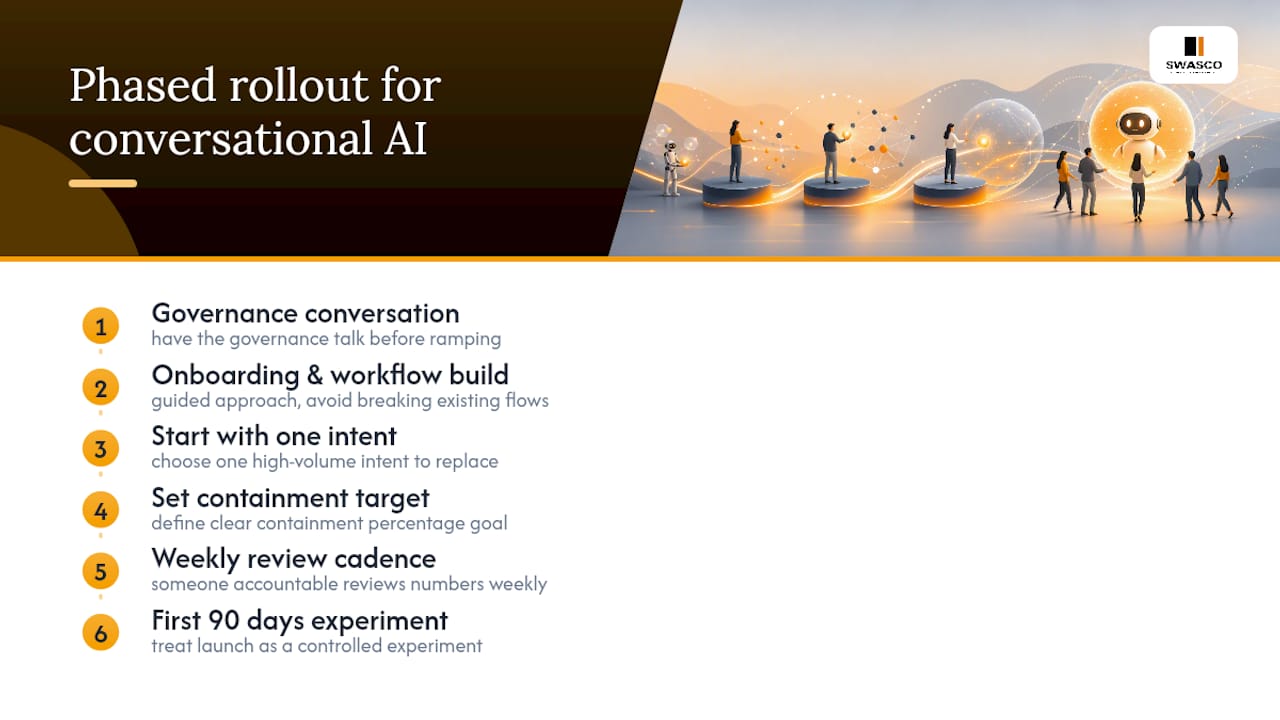
For smaller service businesses without a dedicated CX engineering team, the phase-replace model still applies, just compressed. You don't need fifteen intents mapped before you start; you need one high-volume intent, a clear containment target, and someone accountable for reviewing the numbers weekly. Skip that discipline and even the best conversational AI platform will underperform a mediocre IVR, because nobody was watching the data closely enough to catch the problem early.
The businesses that get this right treat the first 90 days as a controlled experiment, not a finished deployment.
— James Paul
How Talk2Aiva supports a safer, faster migration
Talk2Aiva handles this phased approach end-to-end for service-based businesses; calls, SMS, website chat, and social media all flow into one system that qualifies leads, books appointments, and follows up automatically, 24/7.
Rather than leaving you to wire up integrations and monitor containment rates alone, Talk2Aiva bundles setup, AI training, and ongoing technical support into the process, so your team gets guided implementation instead of a self-serve dashboard and a manual. That matters most in the first weeks of any migration, when small handoff and integration mistakes do the most damage to CSAT.
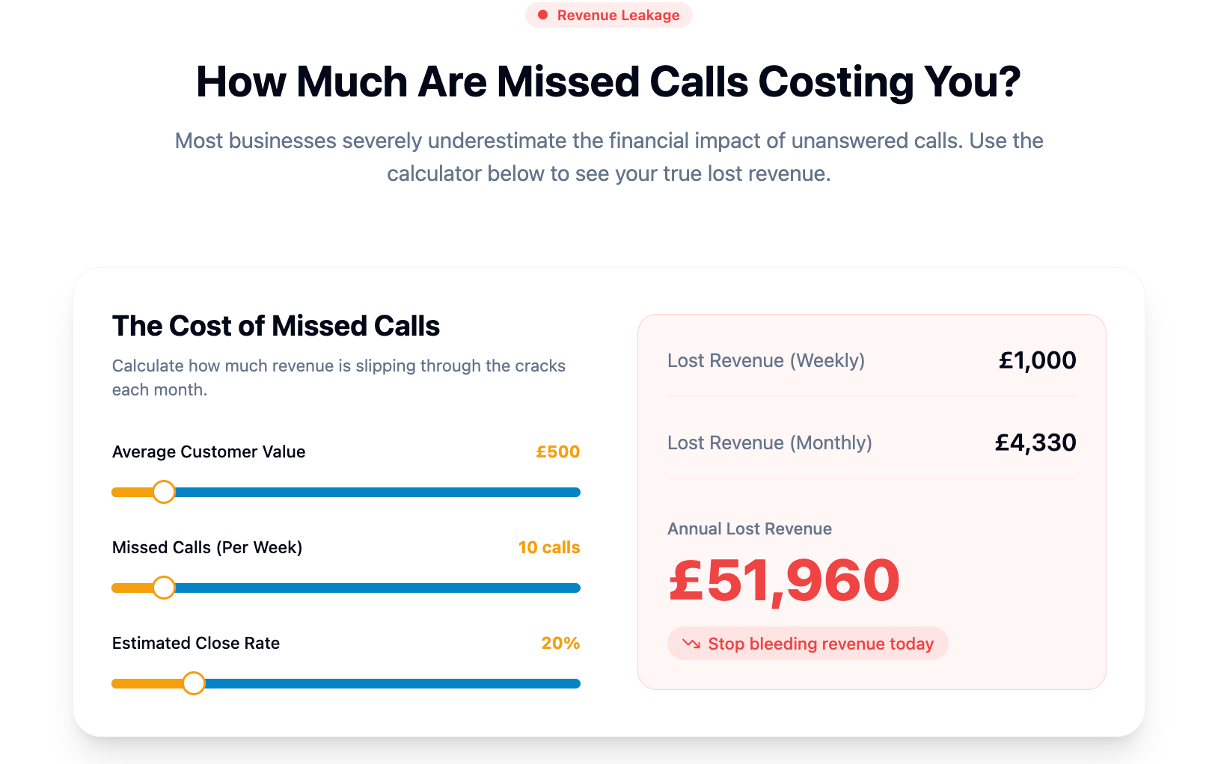
If missed calls and slow response times are costing you booked jobs right now, the practical next step is to see how the Talk2Aiva setup works for your business type, and get a guided rollout plan instead of building one from scratch.
Sources
- Replacing IVR with Conversational AI: Migration Playbook | Plivo
- AI voice agent vs IVR: 2026 enterprise buyer's guide | Finn
- How to replace legacy IVR with voice AI in 2026 | 3Clogic
- In conversation: the difference between IVR and conversational AI | Verint