
Intent-based call routing sends each caller to the right place based on what they say they want, not on which number they dialled or which key they pressed. A caller says "I need to move my MOT" or "my tooth is broken", the system works out the purpose of the call, and it books, answers, transfers or takes a message. For a small service business, that means fewer missed enquiries, fewer wasted minutes and no "press 1 for sales" maze.
This guide explains how it works, where it helps, where it falls short and what UK rules apply. It is written for owners and managers of service firms, not for 500-seat contact centres.
TL;DR
- Intent-based routing listens to what the caller says, identifies the reason for the call, and sends it to the right person, calendar or automated answer.
- Traditional routing uses fixed rules (time of day, menu key, ring order). Intent-based routing adds understanding of the request itself.
- For small firms, the biggest gains are 24/7 answering, instant booking and no lost enquiries when your team is busy.
- Unclear requests, unavailable staff and out-of-hours calls need clear fallback rules. Set them up before launch.
- Tell callers they are speaking to an AI and handle their data in line with UK GDPR.
Table of Contents
- What intent-based call routing actually is
- How it differs from traditional call routing
- How the system identifies intent and chooses a destination
- Benefits for UK service businesses
- Limitations you should plan for
- Privacy, data and telling callers it is AI
- Our perspective: routing is only half the job
- How to tell whether your routing is working
- Setting it up: a practical sequence
- Where Talk2Aiva fits
- FAQ
- Sources
What intent-based call routing actually is
Every call has a purpose. A new customer wants a quote. An existing one wants to rearrange an appointment. A supplier wants to speak to the owner. Intent-based routing identifies that purpose in the first few seconds of conversation and acts on it.
Technically, the system turns speech into text, classifies the request into a category (an "intent"), and triggers the action linked to that category. A caller who says "can I get a quote for taking down a large oak" is classified as a new quote enquiry. A caller who says "I'm running ten minutes late" is classified as an appointment update.

The key difference is that the caller speaks naturally. They do not have to guess which menu option fits their problem.
How it differs from traditional call routing
Traditional routing follows rules you set in advance. The rules are useful, but they know nothing about why the person is calling.
| Method | How it decides | Typical weakness |
|---|---|---|
| Call forwarding | Sends every call to one number | Nobody answers if that phone is busy or off |
| Time-based routing | Changes destination by day and hour | Treats every caller the same within each time slot |
| Menu (IVR) routing | Caller presses a key | Callers pick the wrong option or hang up |
| Skills or ring-group routing | Sends the call to a team or the next free person | Still does not know what the caller wants |
| Intent-based routing | Understands the request and acts on it | Needs good setup and sensible fallbacks |
Menu systems remain common. The Call and Contact Centre Expo reported in 2024 that 75% of UK contact centres used IVR for call routing, and that conventional set-ups often meant little more than choosing sales or service. Only about half said they knew something about the topic a customer wanted to discuss, and that was often just the department.
Time-based rules are still a sound foundation. Modern phone systems can send calls to a mobile, voicemail or a recorded message depending on the day and time, including weekends and bank holidays. Intent-based routing sits on top of that: the schedule decides who is available, and the intent decides what the caller needs.
How the system identifies intent and chooses a destination
Most AI call routing follows the same four steps.
- Greeting and listening. The AI answers instantly and asks an open question, such as "How can I help?"
- Understanding. It converts the caller's words into text and matches them against the types of request you handle.
- Checking context. It looks at the time, your calendar, staff availability and, where connected, what it already knows about the caller.
- Acting. It books, answers, transfers, takes a message or sends a follow-up text.
The decision is rarely a single choice. A good set-up combines the intent with other signals. A caller asking to book a groom for a Saturday goes straight to your calendar. A caller who says "there's a leak coming through the ceiling" is flagged as urgent and pushed to an on-call phone.
Examples by trade
- Tree surgeons and roofers: quote requests are captured with address and job type, while "tree down on my car" is flagged as an emergency and sent to your mobile.
- Dentists and aesthetics practitioners: new patient enquiries are booked, existing patients are routed to rescheduling, and pain or swelling is escalated to the practice.
- Estate and letting agents: viewing requests, landlord valuations and tenant repair reports are separated and sent to the right negotiator or inbox.
- MOT centres, garages and tyre shops: booking requests go to the diary, "is my car ready?" goes to a status answer or message, and breakdowns go to a person.
- Salons, gyms, studios and groomers: bookings, cancellations and membership questions are handled in one conversation.
Benefits for UK service businesses
If you run a small firm, you are probably the receptionist, the technician and the owner at once. Calls arrive while your hands are busy.
- No unanswered calls. The call is picked up instantly, whether you are under a car, with a client or closed for the night.
- Faster, better-qualified enquiries. The caller gives their name, need and preferred time before anyone on your team gets involved.
- Bookings made on the call. A caller who is ready to book does not have to wait for a callback, and by then they may have rung a competitor.
- Less interruption. Only calls that need a human reach you.
- Follow-up that happens. Missed or unfinished enquiries get a text or call-back rather than sitting forgotten.
- One record. Calls, texts, web chat and social messages end up in a single inbox instead of five.
Larger contact centres see the same logic at scale. The Expo article above says predictive intelligent routing can personalise service, cut call times and improve first-call resolution. For a small firm, the equivalent is simpler: more callers reach an answer the first time.
Limitations you should plan for
Intent-based routing is not magic. These are the places it can go wrong, and what to do about each.
Unclear or mixed requests
Callers ramble, change topic or describe a problem without naming it. A well-built system asks one clarifying question ("Is this about a new booking or an existing one?"). If it is still unsure after that, it should offer to take a message or transfer to a person, rather than guess. Decide how many attempts you allow before it hands over.
Staff who are unavailable
A transfer to a busy or switched-off phone is worse than no transfer. Set a fallback for every transfer rule: try a second number, then take a message and text the caller a confirmation. Mobile notifications let you see urgent items immediately.
Calls outside business hours
Out of hours, the system should still understand the request but act differently. A quote or booking request can be completed in full. An emergency can go to your on-call number if you offer one. A general question can be answered and a callback booked for the morning. Write these rules down per intent, not just per time slot.
Accents, background noise and unusual terms
Speech recognition has improved but it is not perfect. Trade jargon, place names and noisy environments such as a busy street or a gym floor can trip it up. This is why training on your own services, locations and terms matters. Test the system with real recordings of your own calls before you rely on it.
Sensitive situations
Some calls should never be fully automated: complaints, distressed callers, anything involving safety or a legal dispute. Build rules so that certain words or tones lead straight to a person.
Privacy, data and telling callers it is AI
A call can contain personal data: a name, number, address or details about someone's health or property. UK GDPR applies from the first word.
The ICO's guidance says organisations must provide privacy information covering their purposes for processing, retention periods and who they share data with, and must provide it at the point of collection when gathering data directly from people. In practice, that means a short disclosure at the start of the call, and a fuller privacy notice on your website that the caller can be pointed to.
The ICO also says people have the right to be informed about whether their personal data is being processed, and the right not to be subject to solely automated decisions with legal or similarly significant effects. Booking a haircut is not that. Declining a mortgage enquiry or refusing a tenancy on an AI's say-so could be, so keep a person in those decisions.
On accountability, the ICO has said that organisations remain responsible for customers' personal data processed by large language models, and should address transparency, human oversight, data minimisation, security and data-protection impact assessments. A sensible checklist for your own business:
- Tell callers at the start that they are speaking to an AI assistant.
- Collect only what you need to book or quote.
- Know where call recordings and transcripts are stored and for how long.
- Make it easy to reach a human.
- Check your provider's data terms and consider a data-protection impact assessment, especially for health or financial enquiries.
If you handle sensitive data (dental, aesthetics, finance, conveyancing), take advice from your data protection lead or the ICO's small business resources before launch.
Our perspective: routing is only half the job
We see the same pattern in service firms again and again. The phone rings during a job, nobody picks up, and the caller moves on to the next name in the search results. The problem is rarely a lack of demand. It is a lack of someone to answer.

Smart routing helps, but it is not enough on its own. A system that identifies intent perfectly but leaves you to build the workflows, train the AI and fix problems yourself just moves the pain. That is why we built Talk2Aiva as a guided service, not a do-it-yourself tool. We set up the intents with you, train the AI on your services and your wording, connect your calendar and then keep tuning it after launch.
Our advice is to start with your top five reasons for calls. Write down what you want to happen for each one, in hours and out of hours. Get those right, then add more. Most firms do not need dozens of intents. They need the common ones handled well and a clean handover for everything else.
— James Paul
How to tell whether your routing is working
You do not need a dashboard full of numbers. Track a handful consistently and compare month to month.
- Answer rate: how many calls get a response, from a person or the AI.
- Abandonment: how many callers hang up before reaching an outcome.
- Speed to answer: how quickly the call is picked up.
- First-contact resolution: how often the caller's need is dealt with in one conversation.
- Bookings and enquiries captured: how many calls became appointments or qualified leads.
- Transfers and fallbacks: how often callers hit the "take a message" route, which shows where your intents need work.
The UK Contact Centre Decision-Makers' Guide 2024 from ContactBabel points to measures such as first-contact resolution, abandonment and average speed to answer, tracked consistently over time. It puts mean first-contact resolution across UK contact centres at 78% in 2024. That is a large-operation benchmark, not a target for your garage or salon, but it is a useful reminder that resolution on the first call is the measure that matters.
Listen to a sample of calls each week for the first month. You will quickly spot phrases the system misreads and requests you had not planned for.
Setting it up: a practical sequence
- List your call types. Quotes, bookings, changes, status checks, emergencies, suppliers, spam.
- Decide the outcome for each. Book, answer, transfer, take a message or send a text.
- Set fallbacks. What happens if the person is busy, the request is unclear or it is out of hours.
- Connect your tools. Calendar, CRM and the numbers you want notifications on.
- Add the disclosure. A clear AI notice and a privacy notice.
- Test with real scenarios. Ring it yourself, with colleagues and with different accents.
- Launch, then review weekly. Adjust wording and rules based on real calls.
Where Talk2Aiva fits
Talk2Aiva by SWASCO is an AI receptionist and revenue recovery system for service-based businesses. It answers calls 24/7, qualifies and books leads, follows up by text, and brings calls, texts, website chat and social messages into one inbox. Setup, AI training, launch and ongoing technical support are part of the service, so you are not left to configure it alone.
There are three annual plans: Software Suite at £970 per year, Ultimate AI Suite at £2,970 per year and Elite AI Suite at £4,970 per year. You can see what each includes on the Talk2Aiva plans page.
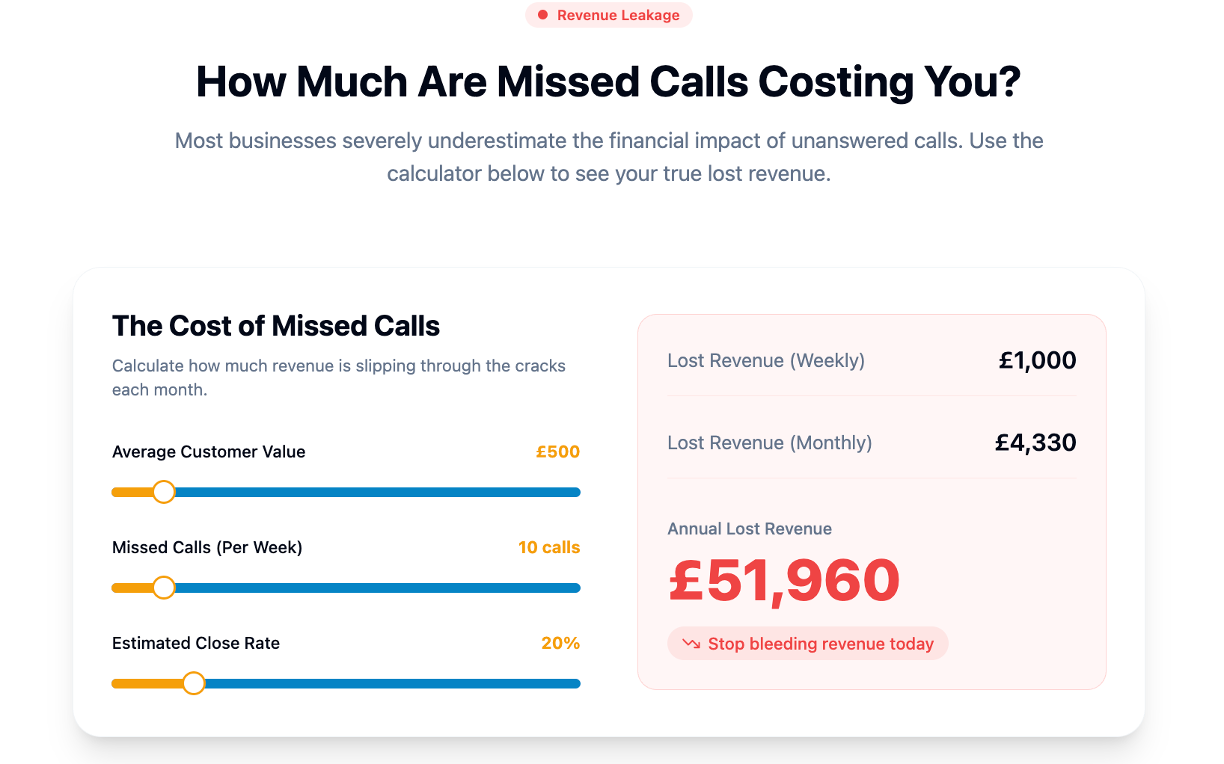
If missed calls are costing you jobs, talk to us about routing your calls by intent, so every enquiry gets a response and every booking lands in your diary.
FAQ
Is intent-based call routing the same as AI call routing?
Mostly, yes. AI call routing is the wider label, and intent-based routing is its most useful form: the AI works out what the caller wants and acts on it. Some AI routing only picks the right department, while a full set-up can also book, answer questions and follow up.
Is smart call routing worth it for a small business?
It is worth it if calls are going unanswered while you are working. Even a few missed enquiries a week can add up to meaningful lost income for trades, clinics and studios. If you rarely miss a call and mostly take repeat bookings, simple time-based rules may be enough.
What happens if the AI does not understand the caller?
It should ask one clarifying question, then fall back to a defined route: transfer to a person, take a message or arrange a callback. You decide the fallback during setup. Reviewing real calls in the first weeks shows you where the wording needs improving.
Do I have to tell callers they are talking to an AI?
You should. UK data protection law requires transparency about how personal data is used, and ICO guidance stresses clear privacy information at the point of collection. A short disclosure at the start of the call is good practice and builds trust.
Can it handle calls when my team is closed or busy?
Yes. You set different actions per type of request. Bookings can be completed automatically, urgent jobs can be sent to your mobile, and everything else can be logged with a follow-up for the next working day.
Sources
- Personalise your customer service with predictive intelligent routing, Call and Contact Centre Expo
- How do we ensure transparency in AI?, ICO
- Generative AI fourth call for evidence, ICO
- Information Commissioner's response to the Lords committee call for evidence on LLMs
- The UK Contact Centre Decision-Makers' Guide 2024, ContactBabel
- Can I set different call routing rules for after hours and weekends?