
Instant lead qualification uses AI to score, filter and route a new enquiry within seconds of it arriving, so only genuine prospects reach a salesperson's calendar. The recommended approach for most service businesses is a multichannel AI qualifier that screens for spam, applies knock-out rules, scores intent, and books qualifying leads directly into the diary. James Paul, who covers this space for Talk2Aiva, has repeatedly seen the same pattern: teams that start simple and automate speed-to-lead first see the fastest measurable gains.
TL;DR:
- Speed-to-lead remains critical, with AI qualification typically reducing response times from hours to seconds, significantly boosting qualification chances.
- Effective systems must process leads across multiple channels 24/7, ensuring no enquiry, especially outside office hours, goes unnoticed or unqualified.
- Real-time scoring models are most valuable when they include transparent knock-out rules, allow custom logic, and escalate borderline cases for human review.
- Vendors should offer deep CRM integration, enrichment capabilities, and support for automation of booking and follow-up processes to maximize ROI.
- Starting with simple knock-out rules and a minimal scoring model before expanding ensures faster deployment and more reliable results during initial pilots.
Table of Contents
- What is instant lead qualification and how does it work?
- What features matter most when qualifying leads automatically?
- How do you evaluate vendors for instant lead evaluation?
- How do you roll out instant lead qualification step by step?
- What ROI can you expect from automated lead screening?
- How does Talk2Aiva apply instant lead qualification in practice?
- What do teams get wrong about qualifying leads instantly?
- Get instant lead qualification live without building it yourself
- Sources
What is instant lead qualification and how does it work?
Real-time lead assessment starts the moment someone fills a form, sends a text, opens a chat window, or calls. Rather than sitting in a queue until a rep has five free minutes, the enquiry gets processed by an AI layer that decides, almost immediately, whether it's worth a human's time and where it should go next.
That pipeline typically pulls from five entry points:
- Website forms and landing pages
- Live chat widgets embedded on the site
- Voice calls, including after-hours and missed-call callbacks
- SMS and messaging channels
- Social media direct messages and comments
Once a lead lands, the AI does several jobs in sequence, not one. It checks for spam and bot signatures first (throwaway email domains, nonsensical form entries, known scraper patterns), because filtering junk before it reaches scoring saves processing time and keeps the qualified queue clean. Automated qualifiers built for this purpose can classify a web lead, strip out spam, and route the survivors within seconds, according to Domo's documentation on its lead triage agent.
Next comes intent capture: the system asks a handful of qualifying questions (budget range, timeline, service needed, location) either through a conversational form or a live AI voice/chat agent. Academic research into conversational intent models backs this up directly. Current natural language models can detect intent reliably enough for near real-time workflows, provided they're paired with hard business rules for the edge cases, per research published on arXiv.

From there, scoring happens automatically. Signals such as stated budget, urgency, service match, and even response tone feed a scoring model that outputs a simple confidence rating. High-confidence leads get written straight into the CRM, enriched with any extra data the system can pull (company size, location, prior contact history), and pushed onto a booking calendar. Borderline cases get flagged for human review instead of being silently dropped, which matters more than it sounds.
You can dig deeper into how the scoring layer itself gets built in this guide to lead scoring for agents, and into the conversational side in this piece on conversational lead capture.
What features matter most when qualifying leads automatically?
Not every "AI lead qualification" product does the same job well. Some are little more than a scored contact form; others run a full conversational layer across voice, text and chat. When you're comparing systems, the feature list below is where the real differences show up.
24/7 responsiveness with sub-minute classification. A system that only works during office hours defeats the purpose. The value of automated lead screening is precisely that it doesn't sleep, doesn't take lunch, and doesn't let a Saturday enquiry go cold until Monday morning. Classification latency, the time between a lead arriving and it being scored and routed, should be measured in seconds, not minutes.
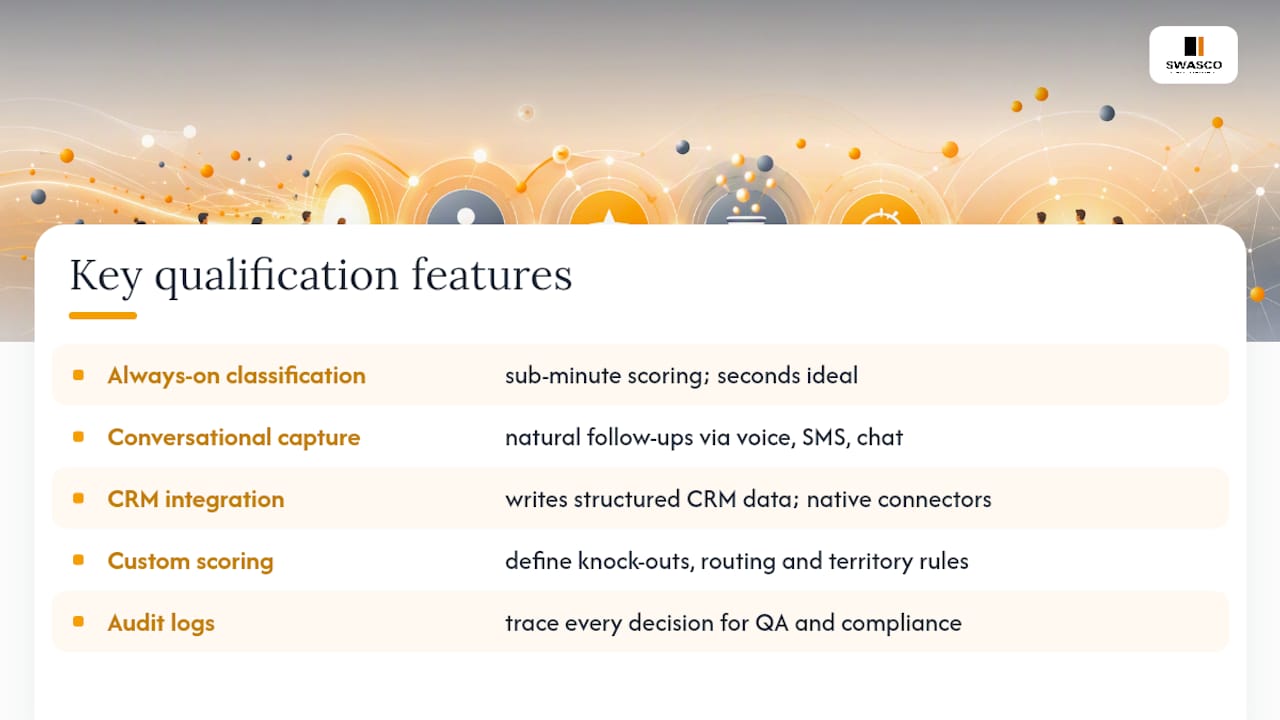
Conversational capture that feels like a conversation. Static forms convert poorly and gather thin data. AI agents that ask follow-up questions naturally, whether by voice, SMS or chat, capture far richer qualifying detail and can move a warm lead straight into a booked appointment without a human touching it.
Deep CRM integration and enrichment. The qualifier needs to write clean, structured data back into whatever CRM your sales team actually lives in. Vendor documentation for tools in this category commonly lists native connections to platforms such as HubSpot, Salesforce and Pipedrive, alongside alerting through Slack, email or webhooks, according to Lead Qualification AI's product overview. Enrichment matters just as much: a lead record that arrives with company size, location and prior contact history already attached is far more useful to a rep than a bare name and phone number.
Custom scoring logic, knock-out rules and routing policies. You should be able to define your own disqualifiers (wrong geography, budget below a threshold, wrong service type) and your own routing logic (by territory, by rep availability, by deal size), rather than accepting a vendor's generic model as-is.
Audit logs. Every automated decision, why a lead was scored the way it was, why it was routed or rejected, needs to be traceable. This matters for quality control and, increasingly, for compliance reviews.
Pro Tip: Don't judge a vendor on their scoring model alone. Ask to see what happens to a lead that scores in the ambiguous middle range, roughly 40 to 60 out of 100. Systems that quietly discard borderline leads are far riskier than ones that escalate them to a human.
How do you evaluate vendors for instant lead evaluation?
Choosing a system to trial isn't primarily a features exercise. It's about matching a vendor's strengths to your volume, your channel mix and the integrations you can't live without. Use this sequence to build a shortlist rather than getting lost comparing spec sheets:
- Map your lead volume and channel mix first. A business fielding 20 enquiries a week across one channel has very different needs from one handling 500 across calls, chat and social. Vendors optimised for high-volume web forms may handle voice poorly, and vice versa.
- Check integration depth against your actual stack, not a generic "CRM compatible" claim. Ask specifically how fields map, what triggers a sync, and what happens when a field doesn't exist on either side.
- Clarify who does the setup work. Some vendors hand you a dashboard and leave the flow-building and CRM mapping entirely to your team; others bundle guided onboarding and ongoing optimisation into the contract. The second model carries far less implementation risk for a smaller sales or marketing team.
- Review the SLA on response time and support. If a lead qualification tool goes down or misroutes leads, how fast does the vendor respond, and what's the guaranteed uptime?
- Ask direct questions about data handling. Where is lead data stored, how long is it retained, and does the vendor's process satisfy your obligations under UK GDPR for personal data collected through forms, chat or voice?
- Understand the pricing model before you pilot. Some solutions charge per lead processed, others per seat or per channel; total cost of ownership can look very different once volume scales, so model your expected lead flow against each pricing structure before committing.
Time-to-value should factor heavily into the decision too. A vendor that promises sophisticated custom scoring but takes three months to configure is a worse choice, for most service businesses, than one that gets a working knock-out model live in a week.
How do you roll out instant lead qualification step by step?
Running a pilot well matters more than picking the perfect vendor on paper. Follow this sequence and you'll have usable data within a fortnight rather than guessing for a quarter.
- Define your knock-out rules before anything else. Write down the three or four hard disqualifiers that make a lead not worth a rep's time, wrong postcode, budget below your minimum, wrong service category, and build those first. This is the highest-leverage, lowest-effort step in the entire rollout.
- Build a minimal scoring model, not an elaborate one. Three or four weighted signals (budget, timeline, service match) will outperform a twelve-variable model that nobody on the team fully understands or trusts.
- Set up the qualifying conversation flow. Decide exactly which questions the AI needs to ask, by voice, SMS or chat, to gather what a rep would ask in the first two minutes of a discovery call.
- Map CRM fields and connect the calendar. Every qualifying answer should land in a specific CRM field, and a qualified lead should be able to book directly into an available slot without a human in the loop.
- Write simple routing rules. Route by territory, by deal size, or by rep availability, whichever matches how your team already splits work.
- Set pilot KPIs before you launch, not after. Speed-to-lead, qualification accuracy against a manual sample, and meetings booked per hundred leads are the three worth tracking from day one, echoing the checklist approach Highspot recommends for measuring inbound qualification success.
- Run the pilot for two to four weeks, then iterate. Adjust scoring weights and knock-out thresholds based on what the data actually shows, not on assumptions made before launch.
Pro Tip: Resist the urge to add more qualifying questions after week one. A flow that asks six questions and converts is worth more than one that asks eleven and gets abandoned halfway through.
What ROI can you expect from automated lead screening?
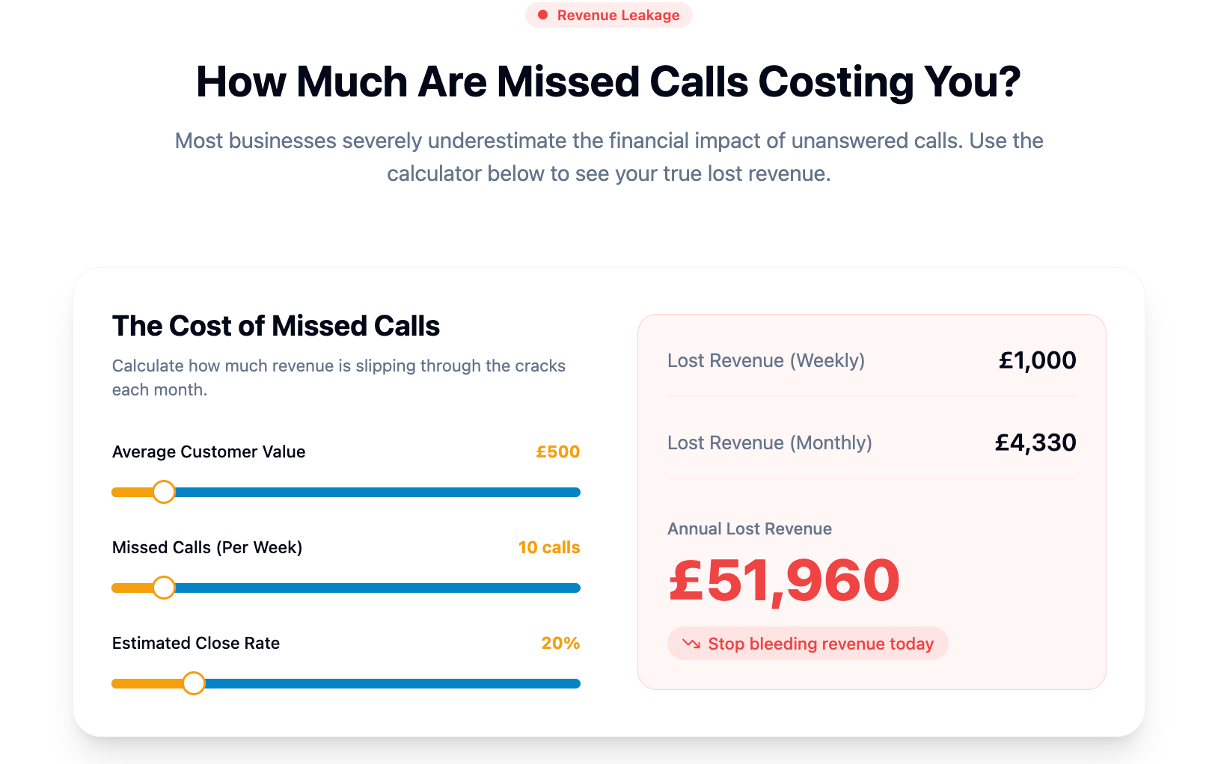
The business case for instant qualification rests on one number more than any other: speed-to-lead. Contacting an inbound lead within the first hour materially increases the odds of qualifying it, and every hour of delay after that erodes the opportunity further, particularly for leads that arrive on evenings or weekends when no rep is watching the inbox. Automated systems close that gap entirely, because they're evaluating every lead the moment it arrives regardless of the time on the clock.
Industry commentary on automated triage points to speed-to-lead compressing from hours to seconds once qualification is automated, according to Proking Solutions, a shift that directly changes how many conversations even get started.
Three other metrics matter once speed-to-lead is under control. Qualified-to-meeting rate tells you whether the leads your system marks as qualified are actually converting into booked calls; a low rate here usually means the scoring model is too generous. Meeting-to-deal rate tells you whether the leads reaching sales are the right ones, a persistently poor rate suggests your qualifying questions aren't capturing the signals that actually predict a sale. Operational time saved is the quieter win: every lead the AI correctly filters or auto-books is a manual triage task a rep no longer performs, and that time compounds across a team fast.
Qualification accuracy itself should be checked periodically against a manual sample, say fifty leads a month reviewed by a human, so scoring drift gets caught before it costs you real pipeline.
How does Talk2Aiva apply instant lead qualification in practice?
Talk2Aiva runs this exact pipeline for service-based businesses, estate agents, dentists, gyms, salons, home services firms and legal practices among them, across the channels where their leads actually arrive.
- Multi-channel intake, covering inbound calls, SMS, website chat and social media messages, all answered around the clock rather than only during office hours.
- Instant capture and qualification, so a new enquiry gets screened, scored and either booked or escalated within moments of arriving, not left in a queue.
- Appointment booking with calendar sync, meaning a qualified lead can go straight from conversation to a confirmed slot without a rep touching the process.
- CRM writeback and a unified inbox, so every conversation and its outcome lands in one place instead of being scattered across email, a missed-calls list and a spreadsheet.
- Automated follow-ups and review requests, which keep leads warm and close the loop after the initial qualifying conversation.
What differs from a plug-and-play tool is the setup itself. Talk2Aiva pairs the platform with guided onboarding, AI training specific to the business, and workflow building, so the knock-out rules, qualifying questions and routing logic covered earlier in this guide get built with support rather than left to an internal team to configure alone. Ongoing optimisation and technical support continue after launch, which maps directly onto the evaluation criteria a careful buyer should be applying: who does the mapping, what's covered under the SLA, and how much implementation risk sits with your team versus the vendor.
What do teams get wrong about qualifying leads instantly?
The most common mistake is over-engineering the scoring model before you've proven the basics work. Teams sometimes spend weeks building elaborate scoring algorithms when a few sharp knock-out rules, such as wrong region, budget too low, or wrong service, deliver most of the value quickly. Start there. Add scoring sophistication only once you've watched the knock-out rules run against real leads for a few weeks.
The second mistake is trying to launch across every channel simultaneously. Pick the one channel generating the most volume or the most missed opportunity, usually inbound calls or web forms, get routing right there, then expand once it's proven. A qualifier that works brilliantly on chat but misroutes half of your phone leads has cost you more than it's saved.
Track speed-to-lead and conversion lift from day one of the pilot, not after a full quarter. Waiting for a "clean" dataset before you start measuring is how teams end up flying blind for months.
— James Paul
Get instant lead qualification live without building it yourself
Building the pipeline described in this guide, knock-out rules, conversational capture, CRM writeback, routing logic, from scratch takes engineering time most service businesses don't have spare. Talk2Aiva gets that same real-time scoring and routing running across your calls, SMS, web chat and social messages without you needing to write a line of code or hire someone to maintain it.
Setup includes guided onboarding, AI training tailored to how your business actually qualifies leads, and workflow building for booking and CRM sync, followed by ongoing optimisation and technical support so the system keeps improving after launch rather than sitting static. That combination, done-for-you configuration plus continued support, is what separates a fast, low-risk pilot from a project that stalls halfway through implementation.
If you're ready to see how instant qualification would work across your own channels, book a look at Talk2Aiva and, if voice is your highest-volume channel, the voice AI features are worth reviewing first.
Sources
- arXiv — conversational intent/AI research (2023)
- Lead Qualification Process: The 2026 Sales Checklist
- Web Lead Triage AI Agent | Automated Lead Filtering & Qualification