
Inbound call triage is the process of capturing, classifying and routing incoming calls so each caller reaches the right owner quickly: capture, classify, route, record. Done well, it cuts transfers, lifts first call resolution, and speeds up escalation of urgent calls. Done badly in clinical settings, it can miss red flags without proper safety-netting and DPIA-compliant governance. Conversational AI platforms offer a guided way operations teams deploy inbound call triage without building it from scratch.
TL;DR:
- Call routing rules must focus on the top five most common reasons for contact and include explicit fallback procedures to ensure safety and efficiency.
- Continuous auditing of misrouted calls and metrics like repeat contacts and first call resolution are essential to measure system performance and improve accuracy.
- Deployment requires compliance with data protection laws, including DPIA, proper data retention schedules, and transparency on AI bias and safety monitoring.
- Guided AI platforms can handle routine triage tasks across channels, reducing the need for building custom systems and supporting ongoing optimization.
Table of Contents
- How does inbound call triage actually work?
- Who should triage calls, and when do you escalate?
- What technology actually supports reliable triage?
- How do you design triage rules that actually hold up?
- What metrics actually prove your triage system works?
- What does a compliant triage rollout checklist look like?
- Triage is a system design problem, not a headcount problem
- Get inbound call triage running without building it yourself
- Sources
- FAQ
How does inbound call triage actually work?
Every triage system follows the same four-stage flow, whether it's run by a receptionist, a nurse, or a voice AI.
- Capture — the call arrives, and any recording or consent disclosure happens immediately, before questioning starts.
- Classify — scripted questions, caller-line identification lookup, decision support prompts, or voice-AI classification work out what the caller actually needs.
- Route — the call moves to its outcome: clinician callback, booked appointment, self-care advice, or immediate escalation to emergency services.
- Record — audio, transcript and a triage note get logged, usually into an EHR or CRM, so the next person handling that caller has full context.
Roughly half of primary care calls handled by nurses or doctors can be resolved with self-care advice alone, according to a systematic review of telephone triage. That single fact should shape how you design step two. If your classification stage cannot confidently identify the self-care cohort, you are routing far more calls to expensive specialist time than you need to.
Who should triage calls, and when do you escalate?
Non-clinical staff should never make clinical decisions. Their job is to follow a defined question set and hand over cleanly when a call falls outside it, a principle UK medical indemnity guidance is explicit about regarding safe telephone triage.
Role boundaries need to be written down, not assumed:
- Care navigators handle routine bookings, general enquiries and known self-care scenarios.
- Clinicians own anything involving symptoms, medication, or a caller who sounds uncertain about their own condition.
- AI assistants capture, qualify and book straightforward requests, then hand over the moment a call doesn't fit a known pattern.
- Red-flag triggers (chest pain, breathing difficulty, a child under one with a fever) get immediate escalation, no matter who answers first.
Pro Tip: Give every caller a specific callback window and tell them exactly what to do if it's missed. A vague "someone will call you back" is how safety-netting quietly fails.
What technology actually supports reliable triage?
A decision support system (DSS) shapes the conversation structure, which improves consistency but can make calls feel scripted if it's too rigid. The best DSS implementations augment judgment rather than replace it, leaving room for the operator to adapt.
Voice AI earns its place at capture, qualification, and appointment booking. It should hand over to a human the moment a call touches anything clinical or ambiguous. To make that handover invisible to the caller, a few integrations need to be solid:
- Telephony provider with reliable call routing and CLI data
- Speech-to-text accurate enough to feed classification logic
- EHR or appointment system sync, so bookings and history stay current
- CRM and calendar integration, so no lead or follow-up gets dropped
Each call generates several data artefacts, audio, transcript, and triage note, and each one carries its own retention and deletion obligation once you're storing it against a real person's health information.
How do you design triage rules that actually hold up?
Start with your highest-transfer call types, not your rarest ones. Fixing the calls that repeat most often gives the biggest return on a small rule change.
- Identify the top five reasons people call and write the minimum question that distinguishes each from the others.
- Separate reason for contact from requested outcome. A caller might explain a symptom but actually just want reassurance, not an appointment.
- Build a small, fixed set of routing outcomes. Too many possible destinations makes the classification stage guess rather than decide.
- Write explicit fallback rules for anything that doesn't match, defaulting to the safer, more senior handover rather than the cheaper one.
- Audit a sample every week, checking for misroutes, then refine the rule set based on what actually went wrong.
This mirrors advice from call centre operators: designing for the minimum distinguishing question keeps specialist queues from being overloaded by calls that never needed them.
What metrics actually prove your triage system works?
First call resolution is the headline number, but it's frequently driven by system access and process design rather than agent skill, per Salesforce's FCR research. A high FCR built on rushed calls that miss red flags is worse than a lower one that catches them.
Under-triage risk rises measurably during midnight to 06:00 hours and on shorter-duration calls, according to an observational study of nearly 99,000 urgent care calls. Clinician-led secondary triage showed higher specificity; primary triage showed higher sensitivity.
Repeat contacts typically make up 25 to 30% of inbound volume, so tracking repeat-contact rate alongside FCR, and triangulating both against clinician review and caller surveys, tells you far more than either metric alone. Read more on cutting repeat calls and lifting FCR for a practical breakdown.
What does a compliant triage rollout checklist look like?
Governance isn't a bolt-on, and performing an effective AI Search Audit is crucial to ensure responsible AI deployment and compliance. It has to sit inside the same rollout plan as your call flows and routing rules.
- Run a DPIA and document the lawful basis for every processing purpose, per ICO guidance on AI and data protection.
- Map every data artefact (audio, transcript, embeddings, logs) to its own retention schedule with automated deletion, since voice AI storage obligations apply per artefact, not per call.
- Train staff on the full question set, then sample-audit calls for safety-netting completeness, not just speed.
- Build in transparency and bias monitoring from day one, since the ICO treats this as a legal obligation, not a nice-to-have, especially where AI classification touches health data.
Pro Tip: Before launch, run 20 real transcripts through your rule set by hand. It surfaces the gaps a live pilot would otherwise expose to real callers.
A tool like Talk2Aiva's platform can help structure this testing phase before go-live.
Triage is a system design problem, not a headcount problem

Most teams try to fix repeat contacts by hiring more people. That rarely works, because the root cause usually sits in the rules and the routing logic, not the number of hands answering the phone. Fix the classification questions and the transfer rate drops before you add a single seat.
The real skill is combining safety-first clinical rules with the efficiency AI genuinely delivers, without pretending the two are in tension. Pilot it with a fixed KPI set, first call resolution, under-triage flags, and callback adherence, before rolling it out wide.
— James Paul
Get inbound call triage running without building it yourself
There are guided solutions to inbound call triage for service businesses seeking to avoid building classification logic, DSS scripts and CRM integrations from scratch. Such solutions run conversational AI across calls, SMS and website chat around the clock, qualify and book enquiries into calendars, and keep every conversation in one inbox instead of scattering them across channels.
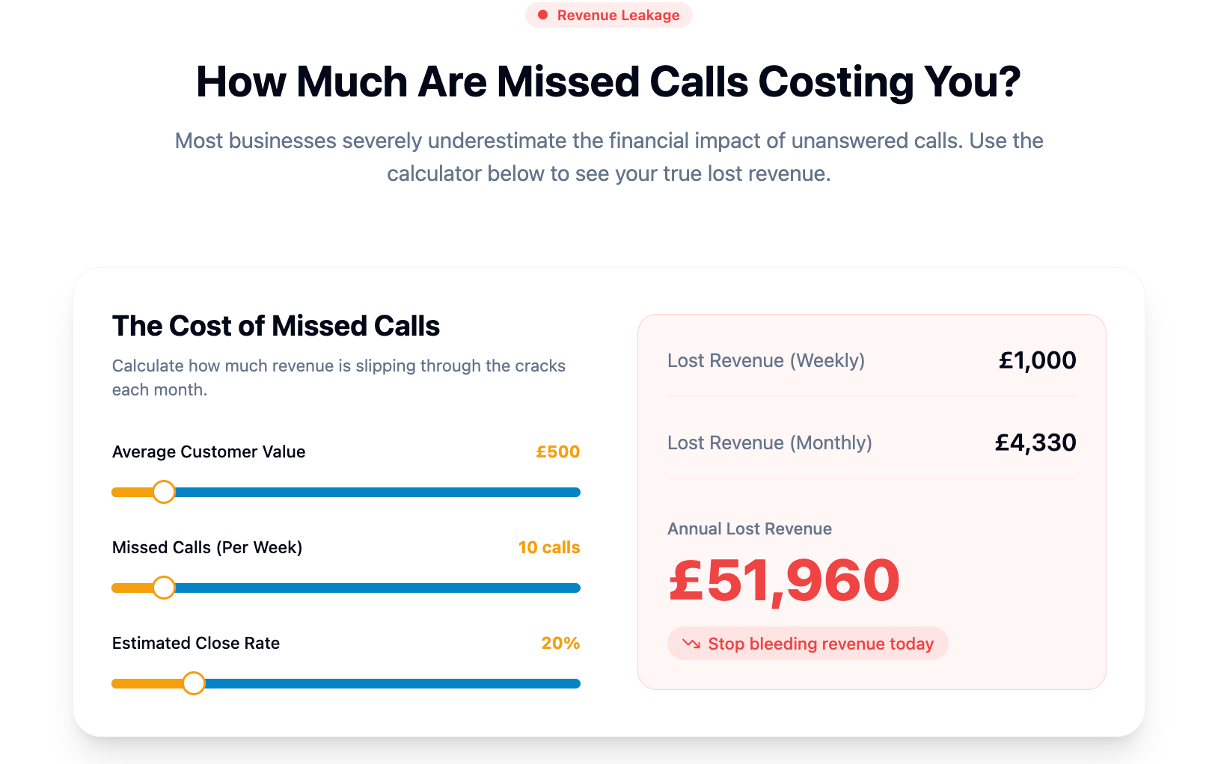
A pilot typically runs in three stages: guided setup and AI training on your specific call types, live test calls with monitoring, then ongoing optimisation as real patterns emerge. Onboarding and technical support are included throughout, covered across the Software Suite, Ultimate AI Suite, and Elite AI Suite plans, so you're not left tuning routing rules alone after launch. Visit Swasco to see plan details and start a pilot with a fixed set of KPIs from day one.
This article is general information, not a substitute for advice from a qualified doctor. Consult a qualified healthcare professional about your own circumstances before acting on anything here.
Sources
- How do we ensure lawfulness in AI? | ICO
- Factors affecting communication during telephone triage in emergency primary healthcare — systematic review
- Safety and accuracy of digitally supported primary and secondary urgent care telephone triage in England
FAQ
What is call triage in a call centre context?
Call triage is the structured process of assessing an inbound call to decide urgency and the correct destination, whether that's a booking, advice, or immediate escalation. In healthcare settings it specifically means sorting calls by clinical urgency using red-flag questions and defined escalation rules.
What counts as an inbound call?
An inbound call is any call initiated by a customer or patient to a business or service, covering enquiries, bookings, complaints, urgent requests and follow-ups. Examples include a patient calling about symptoms, a customer chasing an order, or someone requesting an appointment.
What does "inbound call" mean exactly?
It simply means the call originates from the caller, not from the business or clinic. This distinguishes it from outbound calls, which staff or automated systems initiate to reach a customer or patient.
How many inbound calls should a triage line expect per day?
Volume varies enormously by service size and sector, so there's no universal figure to quote. What matters more operationally is tracking your own repeat-contact rate, since industry benchmarking shows repeat contacts often make up 25 to 30% of total inbound volume regardless of overall scale.
Does Talk2Aiva replace clinical triage staff?
No. Talk2Aiva handles capture, qualification and booking for straightforward enquiries across calls, SMS and chat, then hands over anything clinical or ambiguous to a human. Pricing and plan details, including onboarding and ongoing support, are listed on the Talk2Aiva site.