
Follow-up texts reliably lift rebooking rates because they combine near-universal read rates with a single-tap booking action that removes every excuse not to rebook. CRM-driven rebooking automation typically produces a 30–50% lift in repeat bookings within 90 days when sequences are timed to service intervals and include prefilled booking links. The mechanism is straightforward: your client reads the message within minutes, taps the link, and the slot is confirmed before the impulse fades. Talk2Aiva by SWASCO is built specifically to automate this entire process for UK service businesses, from workflow setup through to live launch and ongoing support.
Table of Contents
- Why SMS follow-ups drive more rebookings for service businesses
- What to say: SMS templates that actually get clients to rebook
- When to send: timing rules and cadence for rebooking texts
- How to automate follow-up texts so rebookings happen at scale
- UK compliance and etiquette for SMS follow-ups
- How to measure whether your SMS rebooking campaign is working
- Key takeaways
- A practical note on SMS rebooking from the field
- Stop losing rebookings to silence: Talk2Aiva handles it for you
- Useful resources for UK SMS rebooking implementation
Why SMS follow-ups drive more rebookings for service businesses
SMS open rates reach as high as 98%, compared with roughly 20% for email. That gap alone explains why a well-timed text outperforms a well-written email newsletter for rebooking prompts. The message lands, it gets read, and it arrives at a moment when the client still remembers their last visit.
Beyond the numbers, several behavioural factors work in your favour:
- Convenience: A text requires no login, no app, and no phone call. One tap on a prefilled booking link and the appointment is done.
- Timely prompts: Most clients do not forget you deliberately. They get busy. A message arriving at the right point in their service cycle is genuinely useful, not intrusive.
- Scarcity and priority slots: Mentioning that a preferred slot is available creates mild urgency without pressure.
- Reciprocity: A same-day thank-you text after a visit builds goodwill. Clients who feel valued are more likely to rebook with you than to drift to a competitor.
Operationally, SMS lets you embed one-tap booking links prefilled with the client's preferred provider and service. That single UX detail can effectively double rebooking conversion compared with a generic link that drops the client on a blank booking page.
The industries that benefit most are those with predictable service intervals: hair salons (5–6 weeks), dental practices (6 months), gyms and personal trainers (weekly or fortnightly), and letting agents managing periodic property inspections. In each case, the rebooking window is known in advance, which makes automated, timed SMS sequences straightforward to build.

Pro Tip: Rebooking reminders are the highest-ROI SMS campaign type for service businesses. Segment by service type from day one so messages stay relevant and opt-out rates stay low.
What to say: SMS templates that actually get clients to rebook
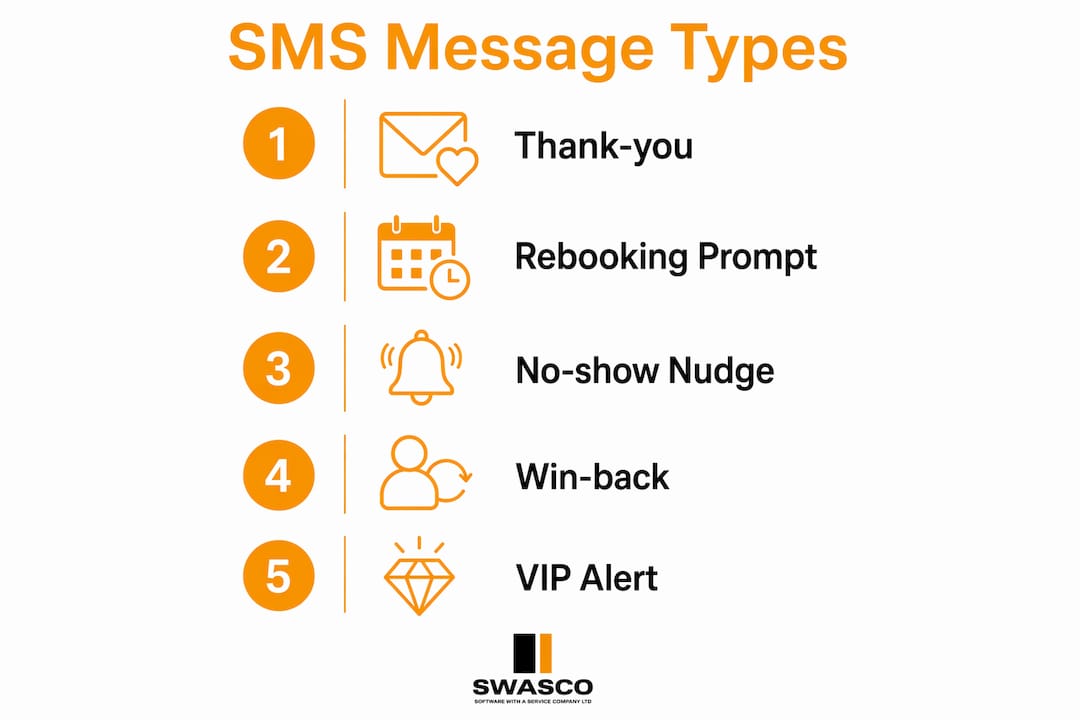
The message type matters as much as the timing. Group your texts into five categories and you will cover every common rebooking scenario.
Same-day thank-you and confirmation
Send within two hours of the appointment ending. This is not a sales message; it is a service touchpoint that sets the tone.
Service-interval rebooking prompt
Send at the 50% mark of the typical rebooking window (e.g., three weeks after a six-week haircut cycle). This is your primary revenue-recovery message.
No-show and reschedule nudge
Send within 24 hours of a missed appointment. Keep the tone warm, not accusatory.
Win-back and reactivation
For clients who have not visited in 60–90 days. Personalised messages that reference the specific service and provider consistently outperform generic "we miss you" blasts.
VIP and high-value client prompt
For your top spenders, add a priority-slot angle.
Pro Tip: Always include a pressure-release phrase such as "No worries if now's not right" or "Reply NO and we'll leave you in peace." Offering an easy out raises reply rates and reduces unsubscribes — clients engage more freely when they know they are not being cornered.
Two-way SMS is worth setting up from the start. Simple reply keywords (YES, NO, RESCHED, HELP) let you triage responses automatically and route anything that signals a problem straight to a staff member before it becomes a negative review.
When to send: timing rules and cadence for rebooking texts
Timing is where most businesses get it wrong. Either they send too early (before the client is ready to think about rebooking) or too late (after the client has already booked elsewhere). The rule of thumb: send your first nudge at roughly 50% of the typical service interval, and a second at 80% if no booking has been confirmed.
| Service type | Typical interval | First SMS | Second SMS |
|---|---|---|---|
| Haircut / colour | 5–6 weeks | Week 3 | Week 5 |
| Facial / skin treatment | 4 weeks | Day 14 | — |
| Botox / injectables | — | Week 6 | Week 9 |
| Dental check-up | 6 months | Month 3 | Month 5 |
| Personal training | Weekly | Day 5 | Day 7 |
| Property inspection | 3 months | Week 6 | — |
The "three-text rule" in a business context means: an initial nudge, a short reminder if no response, and one final friendly prompt before pausing contact. Three messages is the ceiling for a single rebooking cycle. Going beyond that without a response tips from helpful into persistent, and persistent increases opt-outs.
- Timing windows: Send between 9 AM and 7 PM only. Texts arriving at 7:30 AM or 9 PM feel intrusive regardless of how good the message is.
- Same-day thank-you: Send within two hours of appointment completion, not the next morning.
- 48–72 hours: A short satisfaction check ("How did everything go? Reply 1=Great 2=Questions") works well at this point and surfaces issues before they become reviews.
- High-value clients: Consider a phone call at the third touchpoint rather than a third text. The personal touch lands differently for clients spending £200+ per visit.
For client segmentation, split your list into at minimum two groups: high-frequency clients (monthly or more) and low-frequency clients (quarterly or less). High-frequency clients tolerate a tighter cadence; low-frequency clients need more space between messages or opt-out rates climb.
How to automate follow-up texts so rebookings happen at scale
Manual follow-up fails because staff forget. AI-triggered messages tied to appointment completion remove that dependency entirely. The sequence fires whether the front desk is slammed or the business is closed.
Core automation triggers to set up
- Appointment completed: fires the same-day thank-you and, after 48 hours, the satisfaction check.
- No rebooking on file after X days: fires the service-interval rebooking prompt at the 50% and 80% window marks.
- No-show / cancellation: fires the reschedule nudge within 24 hours.
- Time-since-last-visit threshold: fires the win-back sequence at 60 or 90 days.
- Negative reply keyword (NO, STOP, CONCERN): immediately pauses automation and creates a staff task.
Workflow setup checklist
- Capture opt-in at checkout and log it with a timestamp in your CRM. No opt-in, no SMS.
- Prefill booking links with the client's preferred provider and service so they land on a ready-to-confirm screen, not a blank calendar.
- Set reply routing rules so YES confirms the booking, NO pauses the sequence, and HELP or CONCERN routes to a named staff member within the hour.
- Map each service type to its own cadence so a facial client and a Botox client receive messages on different clocks.
- Connect calendar sync so a booking made via the SMS link updates your schedule in real time and stops the automation sequence automatically.
- Build an escalation path for negative replies. A complaint that sits unanswered for 24 hours becomes a public review.
Talk2Aiva by SWASCO handles all of this as a done-for-you implementation. The platform covers 24/7 SMS and call handling, appointment booking automation, workflow building, calendar sync, and ongoing optimisation support. For UK service businesses that want results without building the infrastructure themselves, it is a practical fast-start route. You can see how the same approach works specifically for salons in this follow-up automation guide for salons.
For a technical overview of how automatic appointment confirmations connect to rebooking prompts, the implementation steps are well documented and apply across most booking platforms.
UK compliance and etiquette for SMS follow-ups
Sending texts without proper consent is not just bad practice in the UK. It is a breach of GDPR and the Privacy and Electronic Communications Regulations (PECR), both enforced by the Information Commissioner's Office (ICO).
- Express opt-in required: clients must actively agree to receive marketing SMS. A pre-ticked box does not count. Capture consent at checkout, on your booking form, or via a double opt-in text.
- State the purpose clearly: "Receive appointment reminders and rebooking prompts from [Business Name] via SMS."
- Log consent with a timestamp: store the date, method, and wording of the opt-in in your CRM. This is your audit trail if a complaint is raised.
- Include STOP instructions in every message: "Reply STOP to opt out" must appear in each text. When a client opts out, remove them from SMS sequences immediately and log the opt-out.
- Acceptable hours: 9 AM to 7 PM, Monday to Saturday. Avoid Sundays and bank holidays unless the client has explicitly opted into those windows.
- One channel per follow-up attempt: sending SMS, email, and a phone call for the same rebooking nudge reads as omnichannel overload and increases unsubscribes. Pick the right channel for the urgency level.
Pro Tip: Create a simple consent log in your CRM with three fields: client ID, opt-in date, and opt-in method. If the ICO ever asks, you can produce a timestamped record within minutes. Without it, you are relying on memory.
How to measure whether your SMS rebooking campaign is working
You cannot improve what you do not measure. Track these five KPIs from the first week.
- Rebooking rate (14-day): the percentage of clients who book a follow-up appointment within 14 days of their last visit. This is your headline metric.
- Follow-up conversion rate: messages sent divided by bookings confirmed. If you send 100 texts and 22 result in a booking, your conversion rate is 22%.
- Reply rate: the percentage of recipients who reply to any message. A healthy reply rate signals that your tone and timing are right.
- CTR on booking links: how many recipients tap the booking link. Low CTR with a decent reply rate suggests the link itself is the friction point, not the message.
- Opt-out rate: anything above 2–3% per campaign suggests your messages are too frequent, too generic, or arriving at the wrong time.
Simple A/B tests to run first
- Prefilled link vs. generic link: send half your list a link that lands on a ready-to-confirm screen; send the other half a generic booking page. Measure CTR and conversion separately.
- Provider named vs. generic: "Your next appointment with Sarah" vs. "Your next appointment." Named messages consistently outperform generic ones.
- Two-way reply prompt vs. one-way CTA: "Reply YES to confirm" vs. "Tap here to book." Two-way prompts often lift reply rates for clients who prefer not to click links.
For a reliable read on A/B results, run each test across at least 50 recipients per variant before drawing conclusions. Optimise one variable at a time. Review opt-out rates alongside conversion so a winning message does not quietly erode your list.
Key takeaways
Follow-up texts increase rebookings because they reach clients at the right moment, remove booking friction with one-tap links, and can be fully automated to fire at service-specific intervals without relying on staff memory.
| Point | Details |
|---|---|
| Open rates make SMS the right channel | SMS open rates reach as high as 98%, giving follow-up texts a delivery advantage email cannot match. |
| Timing drives conversion | Send the first nudge at 50% of the service interval and a second at 80%; cap each cycle at three messages. |
| Prefilled links double conversion | One-tap booking links prefilled with provider and service can double rebooking conversion compared with generic booking page links. |
| Compliance is non-negotiable | UK businesses must capture express opt-in, log consent with a timestamp, and include STOP instructions in every message. |
| Talk2Aiva automates the whole process | Talk2Aiva by SWASCO provides done-for-you workflow setup, calendar sync, 24/7 SMS handling, and ongoing optimisation for UK service businesses. |
A practical note on SMS rebooking from the field
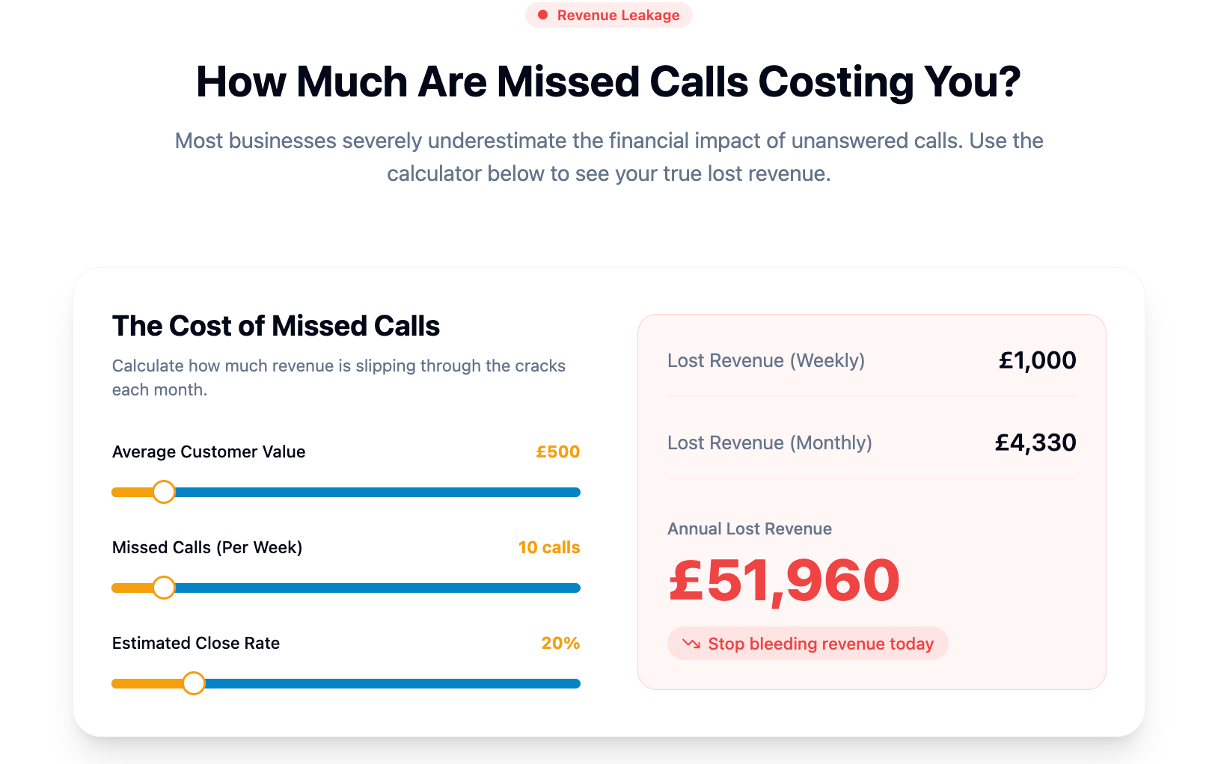
Most businesses that struggle with rebooking are not failing on the quality of their service. They are failing on the follow-through. The appointment ends, the client leaves happy, and then nothing happens. No text, no nudge, no booking link. The client means to rebook and simply does not get round to it.
What the evidence consistently shows is that the businesses recovering the most revenue from follow-up texts are not the ones with the cleverest copy. They are the ones with the most reliable automation. A mediocre message that sends every time beats a brilliant message that depends on someone remembering to press send. If you take one thing from this guide, make it this: get the trigger right before you obsess over the wording. Once the sequence fires automatically at the right moment in the service cycle, you can refine the message over time. The other way round rarely works.
Stop losing rebookings to silence: Talk2Aiva handles it for you
Every client who leaves without a confirmed next appointment is a rebooking you are hoping for rather than securing. Talk2Aiva by SWASCO closes that gap with a fully built SMS rebooking system: workflow setup, AI training, calendar sync, prefilled booking links, 24/7 SMS and call handling, and ongoing optimisation support. You do not need to build the infrastructure or manage the sequences yourself.
The entire system is set up for you, tested, and launched with support included. For UK service businesses that want a fast, reliable route to higher rebooking rates without the technical build, Talk2Aiva is the practical next step. Book a demo or request a rebooking audit to see exactly what the system would look like for your business.
Useful resources for UK SMS rebooking implementation
- ICO — Direct Marketing Guidance: The primary UK authority on GDPR and PECR compliance for SMS marketing. Read this before sending a single text.
- SchedulingKit SMS Marketing Guide: Covers open rate benchmarks, segmentation strategy, and rebooking-specific campaign types for service businesses.
- SchedulingKit CRM Rebooking Playbook: Step-by-step guide to CRM-driven automation, prefilled booking links, and measuring 30–50% rebooking lift.
- Keystone Post-Visit Revenue Playbook: Detailed cadence scripts, two-way SMS check-in templates, and KPI dashboards for service businesses.
- Talk2Aiva by SWASCO: Done-for-you implementation of SMS rebooking automation for UK service businesses, with setup, AI training, and ongoing support included.
- AI in appointment management: Background on how AI scheduling platforms handle rebooking triggers, retention logic, and two-way SMS routing.