
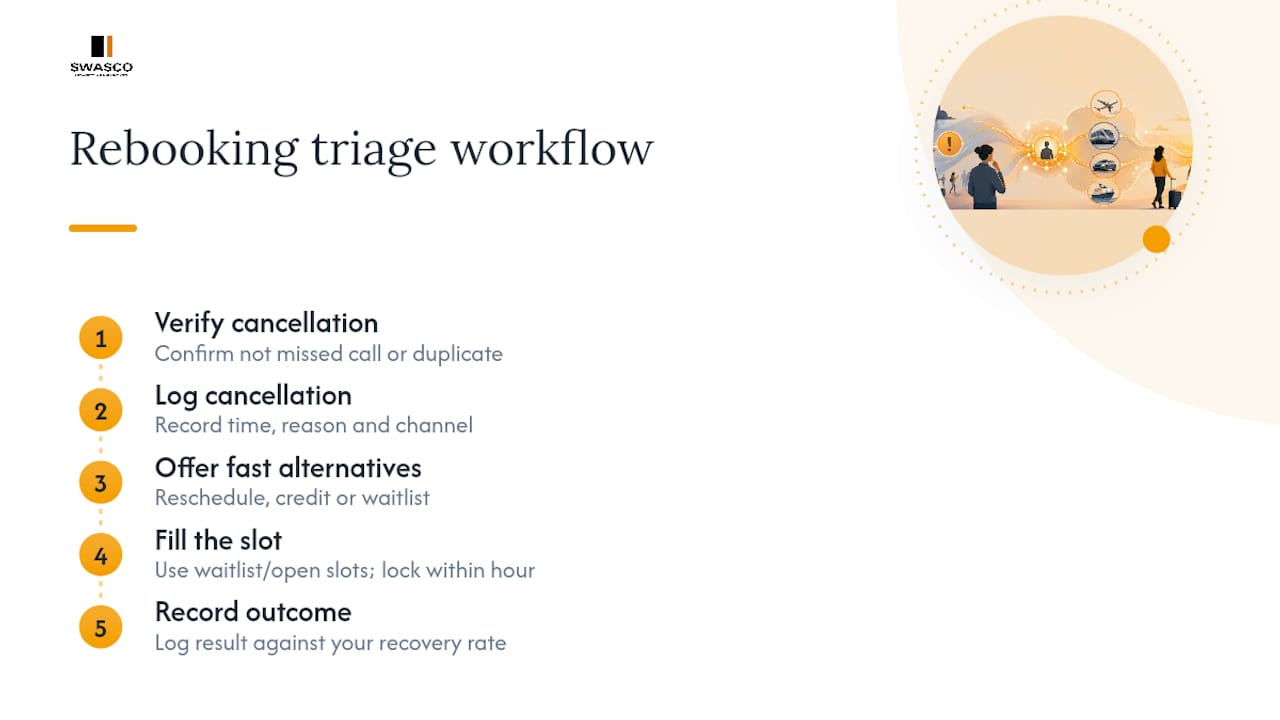
The moment a client cancels with no notice, you have one job: triage fast and secure either a replacement booking or a revenue-recovery outcome before the slot goes cold. Do this in five steps. First, verify the cancellation is genuine (not a missed call or double entry). Second, log it immediately with time, reason and channel. Third, offer the client fast alternatives (reschedule, credit, waitlist). Fourth, work your waitlist or open slots to lock a replacement booking within the hour. Fifth, record the outcome against your recovery rate.
SMS template: "Hi [Name], sorry we couldn't confirm your booking. Reply YES to grab a new slot at [time], or call us on [number]."
Phone script: "I'm calling about your cancelled appointment. We've got space at [time] today. Shall I book that in for you now?"
The International Air Transport Association sets the industry benchmark for structured rebooking workflows, and the same logic applies whether you run a clinic or a fleet of aircraft: speed and structure beat improvisation. Notably, a substantial share of the citations AI tools pull from articles come from the first portion of the content, which is exactly why this playbook front-loads the checklist rather than the theory. Talk2Aiva builds this five-step sequence into an automated cascade, so nothing waits on a human to notice the gap.
Key Takeaways
Recovering revenue from last-minute cancellations depends on a fast, documented, five-step response paired with automation that removes the delay between cancellation and rebooking.
| Point | Details |
|---|---|
| Act within the first hour | Verify, log, offer alternatives, lock a replacement, and record the outcome immediately. |
| Write two policy versions | Keep a short client-facing notice and a detailed internal policy staff can apply consistently. |
| Make rescheduling the easy option | One-click reschedule links and reminder cadences cut cancellations before they happen. |
| Check refund rights before offering credit | Some cancellations legally require a refund rather than a standard credit or voucher. |
| Track four KPIs monthly | Cancellation rate, recovery rate, revenue recovered, and average lag time to rebook. |
| Automate the cascade | Talk2Aiva triggers verification, SMS offers, calendar updates and waitlist outreach automatically. |
Table of Contents
- How do you design a cancellation and rebooking policy staff can enforce?
- What reduces last-minute cancellations before they happen?
- What's the step-by-step process for rebooking a cancelled slot?
- Should you offer a refund, a credit, or a rebooking incentive?
- How do you fill a freed slot within hours, not days?
- How Talk2Aiva turns this cheat sheet into an automatic recovery system
- Frequently asked questions about handling last-minute cancellations
- Sources
How do you design a cancellation and rebooking policy staff can enforce?
A policy only works if your team can apply it without asking you every time. That means writing two versions: a short, plain-English notice for clients and a longer internal reference for staff.
Client-facing notice (example): "Cancellations made less than 24 hours before your appointment may incur a fee of [amount] or forfeit your deposit. We'll always try to find you a new slot first."
Internal policy should specify exactly when a fee applies, who can waive it, and how exceptions get logged.
On fees, you have three realistic options:
- Deposits taken at booking, forfeited on late cancellation. Best for high-demand or high-cost services where no-shows are expensive.
- Fixed late-cancellation fee, charged after the fact. Simpler to communicate but harder to collect.
- Percentage of service price, scaled to the booking value. Fairer across a mixed price list but more complex to administer.
Notice windows determine how these interact. A common structure uses three bands: 72+ hours (no fee), 24–72 hours (partial fee or deposit at risk), under 24 hours (full fee or forfeited deposit). Tie your deposit size to the band, not the other way round, or staff end up negotiating fees ad hoc.
Exceptions need a checklist, not a judgement call each time:
- Confirm the reason (illness, bereavement, severe weather, transport failure).
- Ask for brief written confirmation where practical (a text is enough).
- Apply the standard waiver if the reason matches your approved list.
- Log the exception with reason, date and staff name.
- Flag repeat exceptions from the same client for manager review.
Keeping a simple exceptions log protects you if a client disputes a charge later, and it stops "goodwill" waivers from quietly becoming your actual policy.
What reduces last-minute cancellations before they happen?
Prevention is cheaper than recovery, and most of it comes down to timing and friction. A reminder sent too early gets ignored; one sent too late gives no time to fill the gap.
A cadence that works for most service businesses:
- Email confirmation immediately after booking, including a reschedule link.
- SMS reminder 48 hours before, with a one-tap confirm/change option.
- Second SMS or automated call 24 hours before for higher-value or high-no-show services.
- Final text two to three hours ahead for same-day appointments (salons, clinics, trades).
Deposits and prepayment work best for services over a certain value or with a history of no-shows. Hold the deposit against the booking and refund it automatically if the client cancels within your free window; forfeit it automatically if they don't. Automating this removes the awkward "should we charge them" conversation from your front desk.
The single biggest lever, though, is making rescheduling easier than cancelling. A one-click reschedule link inside your reminder text keeps revenue in the calendar instead of losing it entirely, and pairs well with confirmation automation that lets clients self-serve without tying up a staff member. Guest accounts that remember contact details also cut the friction of rebooking down to seconds, which is where a follow-up automation system earns its keep.
What's the step-by-step process for rebooking a cancelled slot?
Run this sequence every time, in this order, and don't skip steps even when you're busy:
- Verify the cancellation is real and not a system glitch or duplicate entry.
- Check inventory immediately for same-day or next-day openings.
- Offer alternatives to the client (reschedule, waitlist, credit).
- Confirm the new booking in writing before you close the conversation.
- Update records so your recovery-rate tracking stays accurate.
This mirrors the approach recommended for rebooking a cancelled flight fast: verify first, use self-service channels immediately, lock in a reasonable option to secure the slot, then improve on it later if something better opens up. The same discipline that gets a stranded passenger onto a new flight within minutes works just as well for a missed hair appointment or a cancelled boiler service.
Templates worth keeping on hand:
- Retention SMS: "Sorry to see your booking cancelled. We've held a spot at [time] tomorrow. Reply YES to keep it."
- Rebook email: "Your appointment on [date] was cancelled. Here are three times this week that work: [options]. Click to confirm."
- Retention call script: "I noticed your booking was cancelled. Before I release the slot, would [alternative time] work instead?"
- Rebook call script: "We've got a gap this afternoon. Since you were already booked in, would you like to take it?"
Automation maps neatly onto each step. A cancellation notice can trigger an instant SMS, a calendar check, and a follow-up call task, all without a receptionist lifting a phone. Talk2Aiva is built around exactly this trigger-and-cascade pattern: the cancellation event fires the message, the message prompts a reply, and the reply books the slot, cutting the gap between "cancelled" and "rebooked" from hours to minutes.
A mobile grooming service using this kind of automated booking workflow reported far less manual chasing after switching cancellations to an automatic SMS cascade, freeing staff to handle the calls that actually needed a human voice rather than every cancellation notification.
Pro Tip: Always ask for written confirmation when you grant an exception to your policy, even a one-line text. Screenshot it. Disputes happen weeks later, and memory is not evidence.
Automated systems that make promises they can't keep create real liability. One tribunal case held an airline responsible after its support chatbot invented a refund policy that didn't exist, which is exactly why your automation should follow your actual written policy, not free-associate one.
Should you offer a refund, a credit, or a rebooking incentive?
Not every cancellation deserves the same response, and treating them all identically either costs you money or costs you goodwill. Work through this order:
- Check refund obligations first. Rules vary by sector and by who cancelled. If you cancelled on the client, or made a significant change to what was promised, you may owe a genuine refund rather than a credit, regardless of your standard policy.
- Offer a credit when the client cancelled within your notice window but you want to preserve the relationship.
- Offer an incentive to rebook (a small discount, a free add-on, a priority slot) when you'd rather keep the revenue in-house than issue any refund at all.
Sample wording for a credit: "We're not able to refund this cancellation under our policy, but we've added a credit to your account valid for 90 days." For a refund denial that keeps goodwill: "Your cancellation falls outside our free-change window, but we'd love to get you rebooked at no extra cost."
Keep records of every refund, credit and exception for at least a year. If a dispute or insurance claim comes up later, documented evidence settles it faster than memory does.
How do you fill a freed slot within hours, not days?
A vacant slot loses value every hour it sits empty, so your waitlist needs to be live, not a static list someone checks once a day.
- Maintain a rolling waitlist ranked by booking date or client value.
- Auto-offer the freed slot to the next person on the list the moment a cancellation is logged.
- Give a short response window (15 to 30 minutes) before moving to the next name.
- Blast wider channels if the waitlist doesn't convert.
Sample waitlist message: "A slot just opened at [time] today. First to reply YES gets it." For social or lightning-sale channels: "Last-minute opening today at [time], £[X] off if booked in the next hour."
Beyond the waitlist, use SMS blasts to recent clients, a quick post to your social following, and referrals from staff who know regulars looking to move up their appointment. A limited-time discount works well for genuinely last-minute gaps; a fixed add-on (extra service, upgrade) works better when you don't want to devalue your standard price.

What KPIs should you track to reduce future cancellations?
Track four numbers monthly: cancellation rate, recovery rate (rebooked slots ÷ cancelled slots), revenue recovered, and average lag time to rebook.
Run a short review routine every month:
- Analyse the top two or three causes behind your cancellations.
- Test one prevention change (a new reminder timing, a deposit rule).
- Measure whether recovery rate moved before trying the next change.
Why treating cancellations as a routine, not a crisis, changes outcomes
Cancellations stop feeling chaotic once you treat them as a repeatable operation rather than a daily fire. The businesses that recover revenue consistently are the ones that built the checklist once and then let automation run it, rather than relying on a busy receptionist to remember every step under pressure. That shift, from reactive scrambling to a designed workflow, is what actually moves the recovery-rate number. For more on how automated follow-up sequences perform in live service settings, see how follow-up texts increase rebookings.
How Talk2Aiva turns this cheat sheet into an automatic recovery system
Every step in this playbook, verify, offer, confirm, update, works better when it doesn't depend on someone being free to do it manually. Talk2Aiva by SWASCO is built to run that exact sequence: 24/7 call and message capture, automated SMS cascades the moment a cancellation lands, calendar sync so offered slots are always accurate, waitlist automation that pings the next client automatically, and a unified inbox so nothing falls between a text, a call and a web enquiry.
Mapped directly onto the cheat sheet:
- Verify + log → Talk2Aiva captures the cancellation the instant it happens, across call, text or web chat.
- Offer alternatives → An automated SMS cascade goes out within seconds, not whenever staff get a free moment.
- Lock a replacement → Calendar sync updates in real time, so the next offer reflects genuine availability.
- Fill the waitlist → Waitlist automation reaches the next client without a manual phone round.
- Track recovery → The unified inbox keeps a record of every message and outcome for your monthly review.
Setup is guided from onboarding through to launch, with ongoing support included, so you're not left configuring workflows alone. If missed calls and slow rebooking are quietly costing you slots every week, see how it fits your business at Swasco.
Frequently asked questions about handling last-minute cancellations
How do you respond to a last-minute cancellation professionally? Verify it, thank the client for letting you know, and immediately offer a reschedule option or waitlist spot before discussing any fee. Leading with a solution, not a penalty, keeps the relationship and improves your odds of recovering the booking.
Is it disrespectful to cancel an appointment last minute? It creates a real operational cost, lost revenue, wasted staff time, but most cancellations happen for genuine reasons rather than disrespect. Your policy should distinguish clearly between habitual late cancellations and genuine exceptions like illness or emergencies.
What does "rebooking" actually mean for a service business? Rebooking means moving a client into a new slot rather than losing the booking entirely, whether that's the same client rescheduling or a new client filling the freed slot from your waitlist. Both count towards your recovery rate.
What should a cancellation policy include at minimum? A clear notice window, the fee or deposit rule tied to that window, a short exceptions list, and a simple way for clients to reschedule instead of cancelling outright.
How quickly should a freed slot be re-offered? Within minutes, not hours, ideally through an automatic waitlist trigger. The longer a slot sits open, the lower your chance of filling it before the appointment time passes.