

First contact resolution (FCR) measures the share of customer enquiries fully closed during their first interaction, with no callback, follow-up email or repeat contact needed. It's the single metric most tightly linked to customer satisfaction and cost to serve because every repeat contact costs you agent time twice for one problem. Get FCR right and you're measuring and improving it deliberately, not hoping it improves on its own.
TL;DR:
- Automating initial contact and providing agents with a complete customer history can significantly improve FCR in service-driven industries.
- Segmenting FCR analysis by channel and issue category reveals specific problem areas, enabling targeted improvements over broad averages.
- Setting clear internal definitions for resolution and consistent recontact timeframes are crucial for meaningful FCR measurement and comparison.
- Combining technology solutions like AI routing with proper agent training and process audits drives higher FCR without sacrificing customer satisfaction.
- Monitoring FCR alongside recontact rates, CSAT, and escalation data helps identify whether improvements reflect genuine resolution or gaming of metrics.
Table of Contents
- What is first contact resolution and how does it differ from first call resolution?
- Why does first contact resolution matter so much?
- How do you actually measure first contact resolution?
- Diagnosing low first contact resolution: where do problems actually come from?
- What actually improves first contact resolution?
- How do you track first contact resolution without fooling yourself?
- How does a guided AI receptionist actually raise first contact resolution?
- A 90-day approach to lifting first contact resolution
- Where a guided AI receptionist fits your first-contact goals
- Sources
What is first contact resolution and how does it differ from first call resolution?
FCR is a customer-centred measure: did the issue get resolved in that one interaction, full stop, with no follow-up required from either side? That's different from first call resolution, an older, narrower term that only counts voice calls. Modern contact centres run across phone, email, live chat, SMS and social media, so FCR has effectively replaced first call resolution as the key metric, even though many managers still use the terms interchangeably.
The tricky part is deciding what counts. A transfer between departments still resolves in one customer interaction if the issue closes before they hang up or leave the chat. A partial fix, where you solve most but not all of the problem, should not count as resolved.
Before you measure anything, agree internally on:
- Whether a same-session transfer counts as a first-contact resolution or a failure.
- Whether you count enquiries where the customer never re-contacts you but the issue technically remains open.
- Whether scheduled follow-up work (an engineer visit, a refund that takes days to clear) counts as resolved at the point of promise, or only once completed.
Get this wrong and your FCR figure becomes meaningless for comparing teams or channels over time.
Why does first contact resolution matter so much?
FCR sits closer to the customer's actual experience than almost any other contact-centre KPI. Customers rarely complain about hold times if their problem gets fixed straight away, but they remember being passed around or asked to call back. That's why FCR correlates so strongly with customer satisfaction scores and with churn: a customer who has to chase a resolution starts questioning whether they should be your customer at all.
The financial case is just as strong. Every recontact means paying for the same enquiry twice, sometimes three times, once you count the extra handling, escalation and admin time behind it. Cutting recontact volume frees up agent capacity without hiring, which is the fastest lever most managers have for improving cost to serve.
First contact resolution and satisfaction. Verint notes that a commonly cited "good" FCR benchmark sits between roughly 70 and 80%, though SQM Group data across industries averages nearer 68%. The gap between average and top performers is where most of the customer satisfaction and cost savings actually live.
There's a morale dimension too. Agents who spend their day fielding the same unresolved issues repeatedly burn out faster than agents who close problems cleanly. Chasing delight metrics on top of that, rather than reliable resolution, often makes things worse: Harvard Business Review's research on customer loyalty argues that over-servicing customers rarely earns loyalty, while simply solving the problem, once, does.
How do you actually measure first contact resolution?
The standard formula is straightforward: divide the number of enquiries resolved at first contact by the total number of enquiries, then multiply by 100. Call Centre Helper's guidance frames this as the baseline calculation every contact centre should run, with AI-powered routing and unified customer histories helping agents close more cases at that first touch.
Where it gets complicated is deciding how you'll know a case didn't get resolved. There are two broad approaches.
Internal measurement tracks whether the same customer contacts you again about the same issue within a defined window, commonly somewhere between 24 hours and 7 days. It's cheap to run since it uses data you already hold, but it misses customers who give up rather than recontact, and it can flatter your numbers if agents close tickets prematurely.
External measurement asks the customer directly, usually via a short post-interaction survey, whether their issue was fully resolved. It captures dissatisfaction that never turns into a recontact, but response rates are typically low and self-selecting, often skewing toward extremes of happy or angry customers.
Your recontact window changes your number significantly. A tight 24 to 72 hour window will always report a higher FCR than a 7 day window, because it simply hasn't given enough time for slower-brewing problems to resurface. Neither window is universally correct; you need one you can defend and, critically, keep consistent so month-on-month comparisons mean something.
| Method | What it measures | Strength | Weakness |
|---|---|---|---|
| Internal recontact tracking | No repeat contact within a chosen window | Cheap, uses existing data | Misses silent churners, easy to game |
| Post-interaction survey | Customer-reported resolution | Captures true sentiment | Low response rate, self-selecting |
| Benchmark comparison | Your rate against industry norms | Context for target-setting | Averages vary hugely by sector |
For benchmarking, treat 70 to 80% as a reasonable aspiration rather than a pass mark, and remember the industry average sits lower, closer to 68% by Verint's cited SQM figures. Complex B2B service issues will never hit the same FCR as simple retail returns, so compare yourself against your own history before you compare against a sector average.
Diagnosing low first contact resolution: where do problems actually come from?
Low FCR rarely has a single cause. It usually comes from a mix of three sources, and the fix depends entirely on which one is dominant.
- Technical causes: siloed systems that force agents to ask customers to repeat information, no unified customer history, and routing logic that sends complex issues to generalist queues.
- People causes: onboarding that rushes past product depth, agents without the authority to issue refunds or overrides, and coaching that focuses on call length rather than resolution quality.
- Process causes: no shared definition of "resolved," fragile handoffs between teams with no context passed along, and missing service-level agreements for follow-up work.
Segment your FCR data by channel and issue type before you fix anything, because the picture at the aggregate level is often misleading. Sprinklr's guidance on FCR recommends this segmentation specifically because a low overall rate can hide one broken issue category dragging the whole average down while everything else performs fine.
Pro Tip: Pull your three lowest-performing issue categories from the last 90 days and read the actual transcripts, not just the tags. You'll usually spot the root cause in the first ten conversations, whether that's a missing knowledge base article, a routing rule sending the wrong tickets to the wrong queue, or agents who simply don't have permission to fix the problem themselves.
What actually improves first contact resolution?
Fixing FCR works best as a combined push across people, process and technology, not a single initiative. Genesys makes the same point in its breakdown of FCR: AI routing, unified customer timelines and accessible knowledge bases are recurring, effective technical levers, but they only work alongside trained, empowered agents.
People fixes:
- Build onboarding around your top ten enquiry types by volume, not a generic product tour.
- Set clear escalation rules so agents know exactly when they can act without approval, rather than defaulting to "let me check with my manager."
- Run quality coaching on resolution outcomes, not average handle time, so agents aren't punished for taking the extra ninety seconds that actually fixes the issue.
Process fixes:
- Write down, in one sentence, what "resolved" means for each major issue type, and train the whole team to it.
- Audit your handoff points; every transfer is a chance for context to get lost and the customer to have to repeat themselves.
- Run a monthly root-cause review on your worst-performing issue categories rather than reacting ticket by ticket.
Technology fixes:
- Give agents one unified view of a customer's history across every channel, so nobody starts from zero, as explained in detail in Omnichannel marketing: Unifying customer experience for growth.
- Use AI-powered call handling and routing to get the right enquiry to the right agent or automated flow the first time.
- Build in-call suggestion tools and searchable knowledge bases so agents aren't guessing at policy on live calls.
- Automate follow-up confirmations so customers aren't left wondering whether their issue actually closed.
Speed matters here too. Slow initial response to a lead or enquiry raises the odds of a recontact simply because the customer chases you before you've finished the first attempt, a pattern well documented in lead response time research. Quick wins, like tightening a routing rule or updating a script, can move your number within weeks. Bigger investments, an omnichannel platform or an AI pilot, take longer but compound.
Pro Tip: Start with one quick win and one strategic bet running at the same time. The quick win proves momentum to your team; the strategic bet is what actually moves the number six months from now.
How do you track first contact resolution without fooling yourself?
A single FCR number on a monthly report tells you almost nothing about where the problem sits. Build a dashboard that breaks FCR down by channel and issue type, and pairs it with:
- Recontact rate, the mirror image of FCR and often easier to explain to non-specialists.
- Customer satisfaction (CSAT), checked against FCR to catch cases where a "resolved" ticket still left the customer unhappy.
- Average handle time (AHT), watched alongside FCR so you're not just pushing calls through faster while resolution quality drops.
- Escalation rate, which flags whether agents are handing off cases they should be equipped to close themselves.
Review the raw numbers daily at an operational level, hold a weekly team review on the worst-performing categories, and run a proper root-cause improvement cycle monthly. Triangulate your internal recontact data against survey results regularly; if internal FCR suddenly jumps while CSAT stays flat or drops, someone is likely closing tickets prematurely rather than genuinely resolving them. Assign clear ownership for the metric, because a KPI nobody owns tends to drift without anyone noticing.
How does a guided AI receptionist actually raise first contact resolution?
Most FCR failures trace back to the same two problems: the enquiry gets missed or delayed in the first place, or the agent who eventually handles it lacks the context to close it in one go. Talk2Aiva is built around solving both.
- 24/7 engagement across calls, text, web chat and social media means enquiries get answered the moment they arrive, rather than sitting in a queue until a customer gives up and recontacts through a different channel.
- Instant qualification and booking resolve straightforward requests immediately, without waiting for a human agent to be free.
- A unified inbox gives whoever picks up a conversation the full history, so nobody asks a customer to repeat themselves, one of the most common causes of a failed first contact.
- Guided onboarding and ongoing technical support mean the system is trained on your actual enquiry types, not generic scripts, from day one.
For service-based businesses fielding a steady stream of enquiries, missed calls and delayed replies aren't a side issue. They're the direct cause of the recontacts dragging your FCR down.
A 90-day approach to lifting first contact resolution
Days 1 to 30: diagnose. Segment FCR by channel and issue, and read transcripts on your three worst categories. Days 30 to 60: fix the cheap stuff, escalation rules, routing tweaks, a knowledge base gap. Days 60 to 90: pilot one automation change and measure it against CSAT, not FCR alone, before scaling. Avoid chasing the number itself: a rising FCR with flat CSAT usually means someone is gaming the definition of resolved.
— James Paul
Where a guided AI receptionist fits your first-contact goals
Talk2Aiva is the alternative to bolting together separate call-answering, booking and follow-up tools for service businesses that are still losing enquiries to voicemail, slow replies or context that never reaches the agent handling the case. It answers calls, texts, web chat and social messages around the clock, qualifies and books the straightforward jobs on the spot, and hands every human agent a unified inbox with full history attached, so first contact resolution stops depending on which channel the customer happened to pick or who was free at the time.
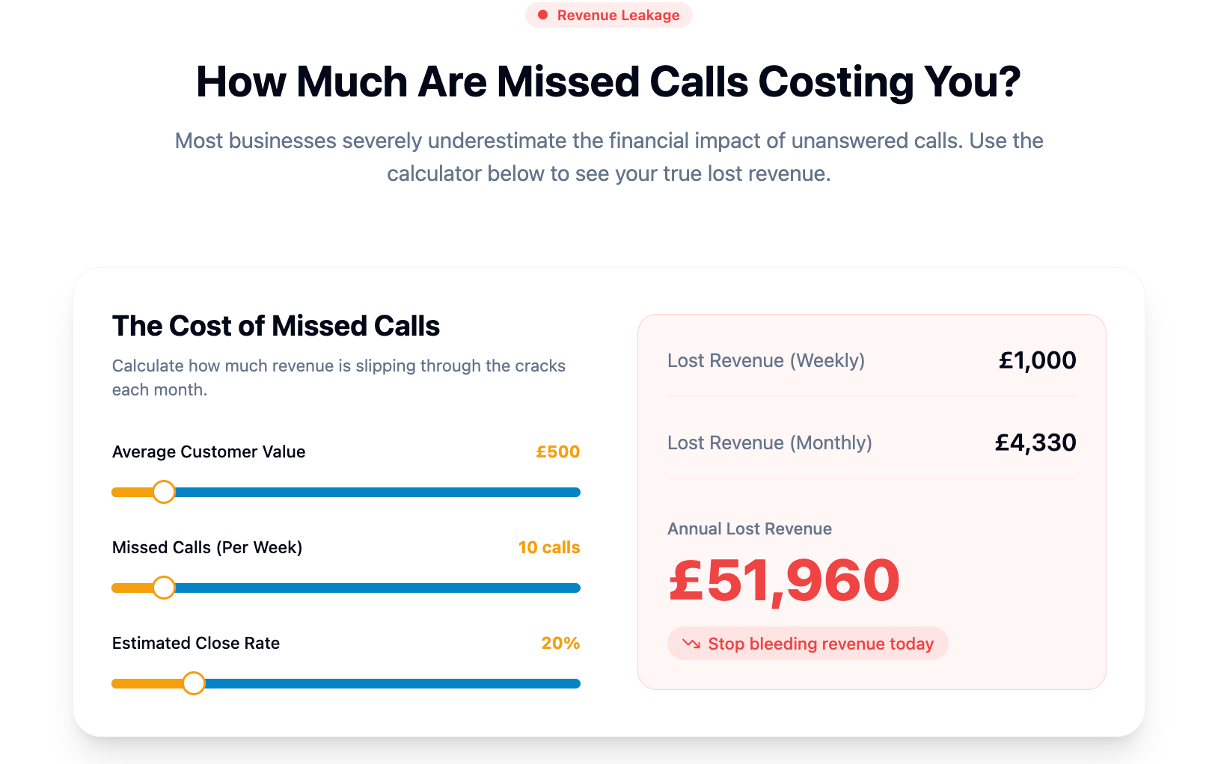
It suits service-based SMEs, estate agents, dental practices, gyms, salons, home services and legal firms, where every missed call is a missed booking and every recontact is a customer wondering if you're actually paying attention. Onboarding, AI training and ongoing technical support come bundled in, so you're not left configuring workflows alone after launch. If recontacts and missed enquiries are quietly eroding your resolution rate, see how Talk2Aiva works and get a sense of what a guided setup could look like for your team.
Sources
- How to calculate first contact resolution | Call Centre Helper
- What is first call resolution? | Verint
- Stop trying to delight your customers | Harvard Business Review