
Enquiry management is defined as the structured process of capturing, tracking, and responding to every customer enquiry promptly and consistently to convert interest into revenue. For small businesses, this process is not optional. Without it, leads slip through the cracks, revenue is lost, and growth stalls. The industry standard for follow-up spans a 10-day contact sequence, beginning with an immediate response and closing with a final outreach on day 10. Speed is the most critical variable. Responding within 5 minutes during business hours significantly increases the chance of converting an enquiry into a paying customer.
What is enquiry management for a small business?
Enquiry management for small businesses is the practice of receiving, organising, and following up on all customer enquiries through a repeatable, documented process. The industry term is "lead intake management," though enquiry management is the phrase most small business owners use day to day. Both refer to the same core discipline.
The process covers every channel where a prospect might reach you. That includes phone calls, emails, website contact forms, social media messages, and live chat. Without a defined system, enquiries pile up in different places and get forgotten.
Effective enquiry handling has three non-negotiable elements. First, every enquiry must be captured and logged. Second, someone must own the response. Third, every interaction must end with a clear next step. Miss any one of these and the process breaks down.
For small businesses, the benefits of enquiry management are direct and measurable. You reduce lost leads, shorten the time from first contact to booking, and build a reputation for reliability. Customers who receive a fast, clear response are far more likely to proceed than those left waiting.
What does effective enquiry management entail?
Effective enquiry management for a small business starts with centralising all incoming enquiries into one place. Leads scattered across emails, social media, and phone cause missed opportunities. A shared inbox or a basic CRM solves this immediately.

For teams of five or fewer, complex lead routing is unnecessary. A single lead intake owner who monitors one shared number or inbox improves visibility and response consistency far more than any automated routing system. Simplicity wins at this scale.
Every enquiry should be logged with three pieces of information: the source (where it came from), the date received, and the current status. This takes under a minute and prevents any lead from going cold without you noticing.
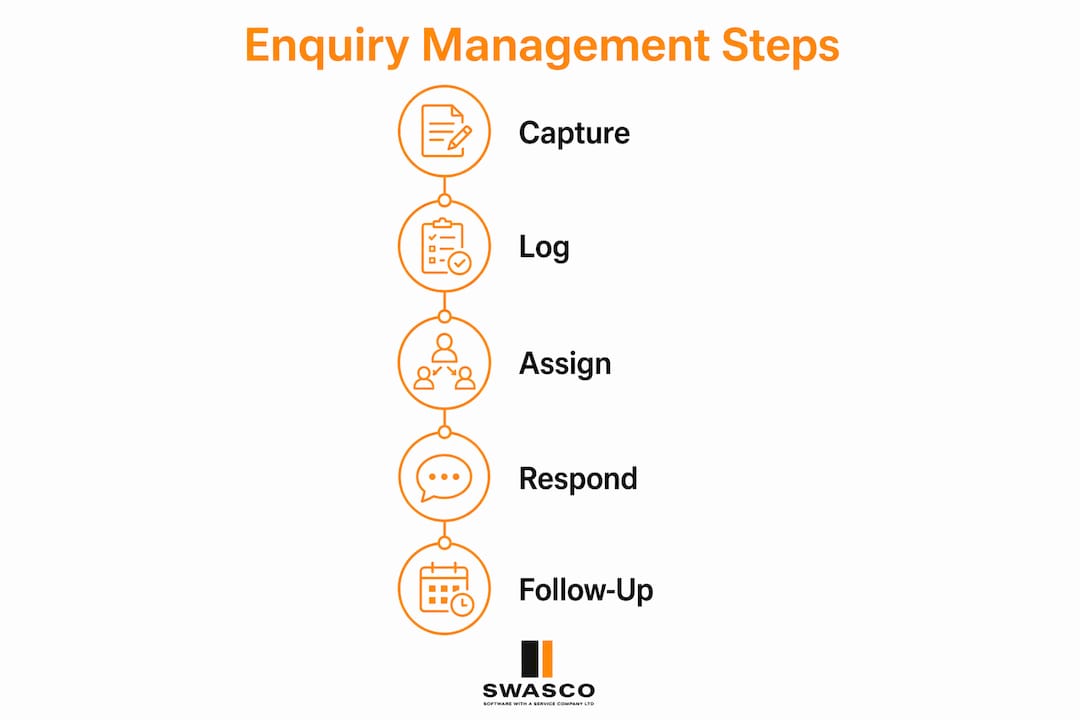
Pro Tip: Set up a simple shared inbox or a free CRM like a spreadsheet with columns for Name, Source, Date, Status, and Next Action. Review it every morning. This five-minute habit will recover more revenue than any software feature.
Key components of an effective small business enquiry process:
- Centralise all channels into one inbox or CRM, not separate email accounts or apps
- Assign one owner for lead intake, even if that person is you
- Log every enquiry with source, date, and status on receipt
- Acknowledge within the hour with a message that confirms receipt and sets a clear next step
- Follow a defined sequence rather than responding ad hoc
- Close every message with a specific action, such as booking a call or completing a short form
Why does response speed increase conversions?
Responding within 5 minutes during business hours is the single most effective thing you can do to convert an enquiry. That finding is confirmed repeatedly by lead management professionals. Every minute of delay reduces the likelihood of contact and conversion.
Most small businesses respond far too slowly. A prospect who submits a form at 10am and hears nothing until 4pm has likely already contacted a competitor. The window of peak interest is short.
Automated acknowledgements close this gap. Setting up an automated reply that confirms receipt, sets expectations, and offers a next step keeps the prospect engaged even when you are busy or unavailable. This is not a replacement for a personal response. It is a bridge that prevents the lead from going cold.
Common speed mistakes small businesses make:
- Waiting to craft the "perfect" reply before sending anything
- Checking messages only once or twice a day
- Leaving enquiries in a general inbox with no assigned owner
- Failing to follow up after the initial response
Pro Tip: Write three response templates now: one for phone enquiries, one for email, and one for social media messages. Each should acknowledge the enquiry, confirm the next step, and take under 30 seconds to personalise and send. Speed beats perfection every time.
You can read more about common response time mistakes and how to fix them if delayed replies are a recurring problem in your business.
How do you centralise enquiries from multiple channels?
Enquiries arriving across five different channels without a central system create confusion and lost revenue. The fix is straightforward: route everything into one place before you do anything else.
A basic CRM or shared inbox is the most immediate and effective step for small teams to prevent lost leads. Centralising enquiry sources into a shared inbox or CRM prevents the most common failure point in small business enquiry handling. You do not need an enterprise platform to achieve this.
| Enquiry source | Simple handling method |
|---|---|
| Phone calls | Log to shared CRM or spreadsheet immediately after the call |
| Route all enquiry addresses to one shared inbox | |
| Website contact form | Connect form to CRM or email a shared address |
| Social media messages | Check one designated account daily; log to CRM |
| Live chat | Use a tool that sends transcripts to your shared inbox |
The table above covers the five most common enquiry sources for small businesses. Each one has a low-cost, low-complexity solution. The goal is not a perfect system on day one. The goal is that no enquiry exists only in one person's head or personal inbox.
Proper centralisation also gives you visibility. You can see at a glance how many open enquiries you have, which ones are overdue, and where your leads are coming from. That information shapes every decision about where to focus your time.
How do you build a follow-up process that actually sticks?
A structured follow-up process is what separates businesses that convert enquiries from those that lose them. The industry-standard 10-day sequence provides a proven framework. It runs as follows:
- Immediate: Send an acknowledgement within minutes of receiving the enquiry
- Day 1: Make a personal call or send a tailored message to open the conversation
- Day 3: Share a proof point, such as a case study, testimonial, or relevant example of your work
- Day 5: Send a brief status check to confirm whether the prospect still needs your help
- Day 10: Send a final close message that makes it easy to say yes or to opt out cleanly
This sequence works because it maintains momentum without being aggressive. Each touchpoint has a purpose. None of them are vague check-ins.
Tailor the sequence to your business type. A trades business may move faster than a consultancy. A high-value service may warrant a longer nurture period. The structure is the constant. The timing and tone flex to fit your context.
Set calendar reminders or CRM tasks for each step. Log every interaction. If a prospect goes silent after day 3, continue the sequence. Many conversions happen on day 5 or day 10 from prospects who simply needed more time.
Structured follow-up timelines and technology-supported methods apply well beyond any single industry. The principle is universal: consistent contact beats sporadic effort every time.
Pro Tip: Write a script for each touchpoint in your follow-up sequence. Keep each one under 100 words. Scripts reduce the mental effort of following up, which means you actually do it. Consistency beats creativity in lead conversion.
Every response should end with a clear, low-friction next step. "Let me know if you have questions" is not a next step. "Here is a link to book a 15-minute call" is. Open-ended communication stalls the sales process regardless of how quickly you respond.
What are the most common enquiry management pitfalls?
The biggest failure point in small business enquiry management is not a lack of software. Inconsistent follow-up rhythm is the real culprit. Businesses invest in tools and then fail to use them consistently. The tool is irrelevant without the habit.
Common pitfalls to avoid:
- No assigned owner: If everyone is responsible, no one is. Assign one person to own every incoming enquiry, even in a solo operation.
- Open-ended responses: Ending a message with "let me know if you need anything" hands control to the prospect. Always close with a specific next step.
- Scattered enquiries: Leads living in personal email, WhatsApp, and a Facebook inbox simultaneously will get lost. Centralise before anything else.
- Overreliance on software: Focusing on software features rather than consistent follow-up rhythm is the most common mistake practitioners observe. A spreadsheet used daily beats a CRM used monthly.
- Ignoring speed: A hot lead goes cold within hours. Delaying your first response because you want to craft the perfect message costs you the conversion.
- No accountability: Without a log of every enquiry and its status, you cannot know what has been followed up and what has not.
Speed and clear ownership combined are the two factors that most reliably prevent leads falling through the cracks. Fix those two things first, before adding any complexity.
Key takeaways
Effective enquiry management for small businesses requires speed, ownership, and a repeatable follow-up sequence to convert leads into customers.
| Point | Details |
|---|---|
| Define the process first | Capture, log, and assign every enquiry before choosing any software. |
| Respond within 5 minutes | Speed of response is the single most critical factor in lead conversion. |
| Use the 10-day sequence | Follow a structured contact plan from day 1 to day 10 to maintain momentum. |
| Centralise all channels | Route calls, emails, forms, and social messages into one shared inbox or CRM. |
| End every message with a next step | Open-ended replies stall the sales process; always close with a specific action. |
The system matters less than the habit
Most small business owners I speak with believe their enquiry problem is a software problem. They think the right CRM will fix the leaks. It rarely does. The real issue is almost always a missing habit: nobody owns the inbox, nobody follows up on day 3, and nobody reviews what is sitting open at the end of the week.
The businesses that convert enquiries well are not using the most sophisticated tools. They are using a shared inbox, a simple log, and a follow-up sequence they actually stick to. That discipline is worth more than any feature set.
Speed is where I see the most immediate gains. When a business commits to responding within the hour, conversion rates improve noticeably. Not because the response is better written. Because the prospect is still warm, still engaged, and still comparing options. You get there first.
My honest advice: build the simplest possible system that you will actually use every day. A spreadsheet you review every morning beats a CRM you log into once a fortnight. Start with the habit. Add the technology when the habit is solid.
— James Paul
How Talk2Aiva handles enquiry management for you
Managing enquiries manually works until it does not. Missed calls, delayed replies, and forgotten follow-ups cost real revenue every week.
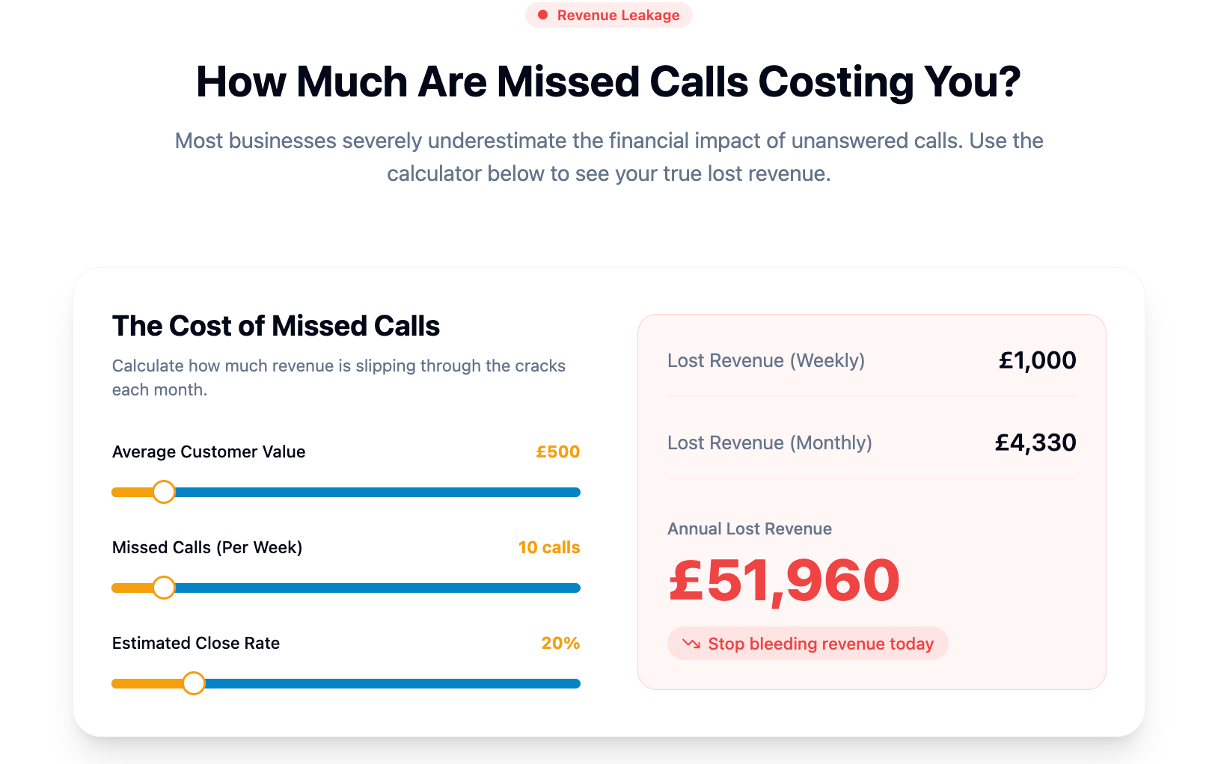
Talk2Aiva by SWASCO is an AI receptionist and revenue recovery system built for service-based businesses. It captures enquiries across calls, website chat, text, and social media, responds instantly 24/7, qualifies leads, and follows up automatically so nothing falls through the cracks. Setup, AI training, and ongoing support are all included. If you want a fully managed enquiry system that works from day one, Talk2Aiva is built for exactly that.
FAQ
What is enquiry management in a small business?
Enquiry management is the structured process of capturing, logging, and responding to all customer enquiries consistently to convert them into sales. It covers every channel, including phone, email, website forms, and social media.
How quickly should a small business respond to an enquiry?
Responding within 5 minutes during business hours significantly increases conversion rates. Automated acknowledgements can maintain engagement outside of working hours.
What is the best follow-up process for small business enquiries?
The industry-standard approach is a 10-day follow-up sequence with contact points on day 1, day 3, day 5, and day 10. Each touchpoint should end with a clear next step.
Do small businesses need CRM software to manage enquiries?
A basic CRM or even a shared spreadsheet is sufficient for most small teams. Centralising enquiries in one place prevents loss and improves follow-up consistency without requiring expensive software.
Why do small businesses lose enquiries?
The most common cause is inconsistent follow-up and no assigned owner for incoming leads. Scattered enquiries across multiple channels without a central system are the primary driver of lost revenue.