
Conversational AI for booking is software that talks to your customers, by voice or text, and turns an enquiry into a confirmed appointment without anyone on your team picking up the phone. It answers instantly, asks the right questions, checks your real calendar, books the slot and follows up. If you run a salon, garage, dental practice, tree surgery firm or letting agency, it is the difference between a missed call and a booked job.
This guide explains how it works step by step, what it can and cannot handle, what to check before you commit (including UK data protection), and what it costs.
TL;DR
- Conversational AI for booking handles the whole enquiry: greeting, questions, availability check, booking, confirmation and follow-up, across calls, text, web chat and social messages.
- It differs from a simple scheduling link because the AI holds the conversation and proposes times, rather than waiting for the customer to pick a slot.
- Check calendar and CRM integration, how the AI hands over to a person, data protection under UK GDPR, and who looks after the system after launch.
- Our plans start at £970 per year, with guided setup and ongoing technical support included.
- Start with your busiest missed-call window, not your whole business.
Table of Contents
- What conversational AI for booking actually is
- How an enquiry becomes a confirmed booking
- Voice booking AI: calls are where the money is
- Beyond the phone: text, web chat and social
- Which tasks suit AI, and which need a person
- Benefits for a UK service business
- Limitations to be honest about
- What to check before you buy
- Our perspective: setup decides whether it works
- What it costs and what you get
- How to get started without overcomplicating it
- FAQ
- Sources
What conversational AI for booking actually is
A chatbot with a fixed menu forces people down a script. Conversational AI understands ordinary language, spoken or typed, so a customer can say "Can you fit my dog in Thursday after work?" and get a sensible reply.
You will see the same idea under several names: AI appointment booking, voice booking AI, an AI booking assistant, an AI receptionist. They overlap heavily. In practice they describe one job: take the enquiry, work out what the person needs and get them into your diary.
One published definition describes an AI booking assistant as software that automates scheduling by coordinating the conversation: proposing times, processing replies, managing follow-ups and confirming the meeting. The same source contrasts this with a scheduling link, where the other person has to choose a slot themselves.
That contrast matters for service businesses. Many customers will not click a link and browse a calendar. They ring, they text, they message you on Instagram. They want an answer in the channel they used.
How an enquiry becomes a confirmed booking
Here is the typical journey, from first contact to the appointment sitting in your calendar.
- Instant response. The AI answers the call or message in seconds, at 7pm on a Sunday as readily as 10am on a Tuesday.
- Understanding the request. It identifies what the person wants: an MOT, a valuation, a first consultation, a quote for a tree removal.
- Qualifying. It asks the questions you would ask. Which vehicle? What postcode? Is it urgent? Is it a new or existing customer?
- Checking availability. It reads your live calendar, so it only offers slots that are genuinely free.
- Booking and confirming. It books the slot, sends a confirmation by text or email and records the details.
- Reminders and changes. It sends reminders and handles reschedules or cancellations in the same conversation.
- Follow-up. If someone enquires but does not book, it chases them. After the job, it can ask for a review.
The value sits in steps 1 and 7. Most lost revenue is not a customer who said no. It is a customer who rang, reached voicemail and rang the next business on the list.
Voice booking AI: calls are where the money is
For most trades and local services, the phone is still the main booking channel. It is also the channel you cannot answer when you are under a car, with a client or on a roof.
Good voice booking AI does four things well:
- Answers every call, including during busy periods when two people ring at once.
- Sounds natural. Modern voice AI speaks at a human pace, handles interruptions and can support more than one language, which matters in places like Birmingham, Wolverhampton and London.
- Books against your real calendar rather than taking a message for someone to call back.
- Passes the call on when a person is needed, with the details already captured so the customer does not repeat themselves.
The call-back model is where bookings leak. Every hour between a missed call and your reply is an hour in which the customer can book elsewhere. Booking during the first call removes that gap.
Beyond the phone: text, web chat and social
Customers rarely stick to one channel. Someone sees your Instagram post, sends a direct message, then texts the number on your website. If those arrive in four different places, something gets dropped.
Conversational AI can handle:
- Calls: answering, qualifying, booking, transferring.
- SMS: confirming appointments, sending reminders, replying to "what time am I booked in?"
- Website chat: answering questions about price, opening hours and services, then booking.
- Social messaging: replying to enquiries on the platforms your customers already use.
The best setups put all of this into a single inbox, so you see one conversation history per customer rather than a pile of separate threads. That is also how you avoid a customer being asked the same question twice.
Which tasks suit AI, and which need a person
AI is excellent at repeatable, rules-based conversations. It is weaker where judgement, empathy or negotiation is required.
| Task | AI handles it | Hand to a person |
|---|---|---|
| Booking, rescheduling, cancelling | Yes | Unusual or complex multi-visit requests |
| Opening hours, location, services, standard prices | Yes | Bespoke quotes needing a site visit |
| Lead qualification | Yes | High-value leads you want to speak to personally |
| Reminders and no-show follow-up | Yes | Repeated no-shows needing a conversation |
| Review requests after a job | Yes | Complaints |
| Distressed or upset callers | Take details and escalate | Always |
| Clinical or legal advice | Never | Always |
Set the handover rules up front. For a dental practice, a caller describing severe pain should reach a human quickly. For a conveyancing firm, a client asking about the status of a live transaction should go to the case handler. For a letting agent, a tenant reporting a leak needs urgent routing, not a booking slot.
Benefits for a UK service business
You stop losing out-of-hours enquiries. Many people search for a service in the evening or at weekends. An AI that answers then captures work you would otherwise never see.
You free up your team. Receptionists and owners spend less time on repetitive calls and more on the customer in front of them.
You respond consistently. Every enquiry gets the same prompt, polite, accurate reply. No bad days, no holidays.
You get a record of everything. Every conversation is logged, so you can see what customers ask most and where they drop out.
You can run follow-up properly. Chasing unconverted leads is the task most small businesses mean to do and never get round to. Automation does it every time.
Limitations to be honest about
- It is only as good as its training. An AI that does not know your services, prices and rules will give vague answers. This is why setup quality matters more than the software itself.
- Accents, background noise and unusual requests can still trip it up. Plan a sensible fallback to a person.
- It needs clean calendar data. If your diary is full of informal blocks and unlabelled entries, the AI cannot reason about availability. Tidy it first.
- Some customers prefer a human. Make it easy to ask for one.
- It needs looking after. Services change, prices change, staff leave. Someone has to keep the AI current.
What to check before you buy
Calendar and CRM integration
The AI must read and write to the calendar you actually use, in real time. A booking tool that works from a separate diary creates double bookings. Ask whether it connects to your CRM too, so new leads and appointment history land where your team already works.
Data protection under UK GDPR
An AI that takes bookings collects names, phone numbers and sometimes sensitive details. You remain responsible for that data. The ICO's guidance for organisations says an organisation is a controller for information it receives to train its own AI model and should keep controller-processor relationships under review. In plain terms, check what your supplier does with your customers' data and make sure the contract reflects it.
The same ICO page explains that valid consent must be freely given, specific and informed, and that explicit consent is needed to process special category data. That matters most for dentists, aesthetics practitioners and gyms, where callers may mention health information. Decide what the AI should and should not ask for, and tell customers clearly that they are speaking to an AI and how their details will be used. If you are unsure how this applies to your firm, ask your data protection adviser or read the ICO guidance directly.

Outbound calls and marketing rules
Booking inbound enquiries is straightforward. Outbound calling needs more care. For live sales calls, the Privacy and Electronic Communications Regulations (PECR) require screening against the Telephone Preference Service before use and at least every 28 days afterwards, unless the person has told you they do not object. That requirement is set out in this regulator bulletin on direct marketing, published in 2014, so check the ICO's current guidance on direct marketing before you launch any outbound campaign. Following up a customer who has just enquired with you is a different situation from cold calling, but get the distinction right before you switch anything on.
Support after launch
This is the check most owners skip. Ask:
- Who sets the AI up, you or the supplier?
- Who trains it on your services and prices?
- Who fixes it when something goes wrong?
- Who improves it as you learn which questions come up?
Many tools hand you a login and leave you to configure everything. If you are running a roofing firm or a dog grooming salon, you do not have the hours for that.
Our perspective: setup decides whether it works
We build Talk2Aiva for owners who are busy doing the work, not managing software. Our experience of this market is simple: businesses rarely lose bookings because they do not care. They lose them because nobody can answer the phone at the moment it rings.
So we do not treat booking AI as a gadget to install. We treat it as a revenue recovery system. That means we guide you through onboarding, train the AI on how your business actually works, build the workflows that move an enquiry from first message to booked job, launch it live, and keep optimising it with technical support included.

We see the biggest gains when a business starts with a clear problem: missed calls on weekday mornings, unanswered weekend enquiries, leads that go cold after a quote. Fix that first. Expand to more channels once it is working.
Our view on AI is also practical. It should handle the repeatable conversations so you and your team can spend your time on the work that needs a human. Make the handover to a person smooth, and customers barely notice the difference between a good AI and a busy receptionist. They just notice that someone answered.
— James Paul
What it costs and what you get
Pricing varies widely across the market, from DIY tools to managed services. Our plans are published as annual subscriptions:
| Plan | Price |
|---|---|
| Software Suite | £970 per year |
| Ultimate AI Suite | £2,970 per year |
| Elite AI Suite | £4,970 per year |
Talk2Aiva brings 24/7 call answering, conversational AI across calls, SMS, website chat and social media, appointment booking with calendar sync, automated follow-ups and review requests, a unified inbox and mobile app notifications into one platform, with guided setup and ongoing technical support. Done-for-you setup is bundled into the higher tiers.
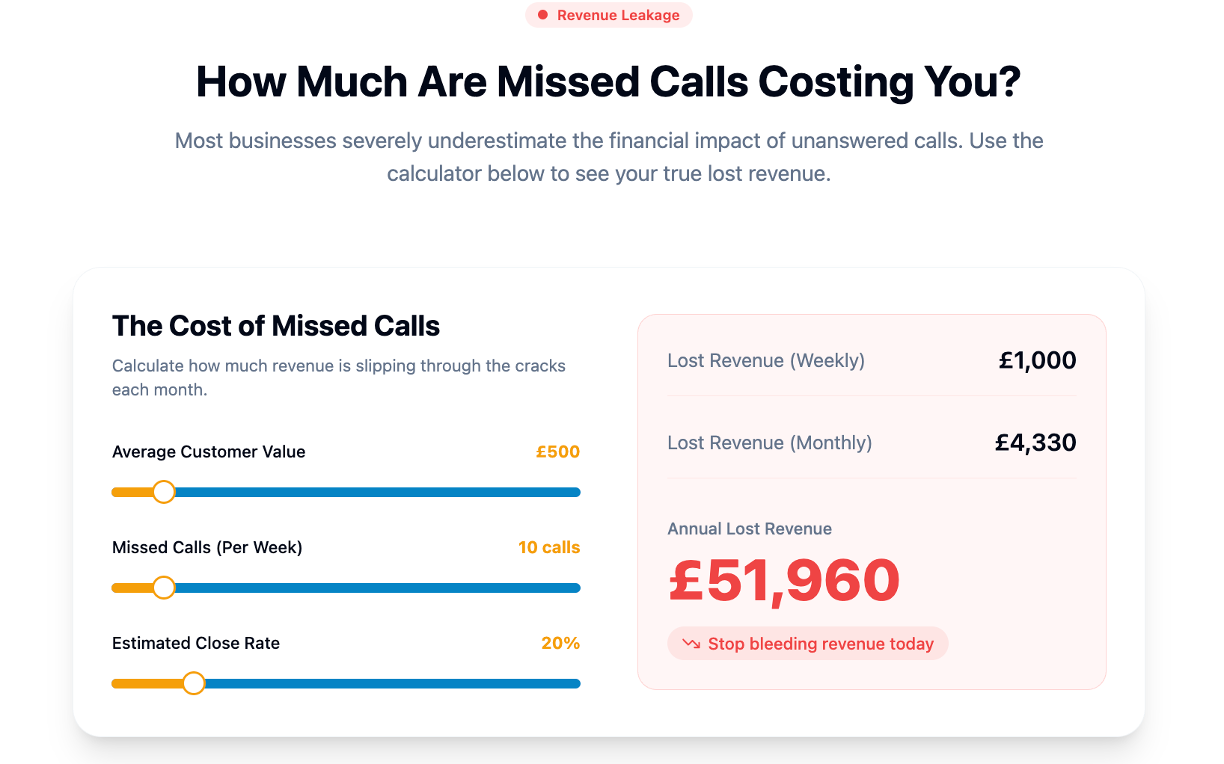
To put the price in context, work out what one missed booking is worth to you. For a tree surgeon, that might be a job worth hundreds of pounds. For a dentist, a new patient's lifetime value. If the system recovers a handful of those a year, it pays for itself.
If you want to see which plan fits your business, take a look at our plans and tell us which calls and enquiries you are missing right now.
How to get started without overcomplicating it
- Find your leak. Check your call log for missed and unreturned calls over the last month. Note the times.
- List your top ten questions. Prices, opening hours, services, parking, how long a job takes. These train the AI.
- Tidy your calendar. Clear labels, clear working hours, clear buffers between appointments.
- Set your handover rules. Decide who gets the call when the AI should step aside, and what counts as urgent.
- Tell customers. A short line such as "you may speak to our AI assistant" builds trust and supports your transparency duties.
- Launch on one channel, then expand. Start with calls, add text and chat once you are happy.
- Review weekly at first. Listen to calls, read transcripts and refine answers.
FAQ
Is conversational AI the same as a chatbot?
No. A basic chatbot follows a fixed script and breaks when someone phrases things unexpectedly. Conversational AI understands natural language, spoken or typed, so it can handle varied requests and still steer towards a booking. It can also work on the phone, which most chatbots cannot.
Can AI really book appointments by phone?
Yes. Voice AI can answer the call, ask qualifying questions, check your live calendar, book a slot and send a confirmation. It should also be able to transfer to a person when the request falls outside its rules.
Is it legal to use AI to answer customer calls in the UK?
Using AI to handle inbound enquiries is permitted, but you must handle personal data lawfully under UK GDPR and be open with callers. Outbound sales calling is more tightly regulated, including TPS screening. Check the ICO's guidance, and speak to a data protection adviser for your own situation.
Will customers mind talking to an AI?
Most customers care about getting a quick, accurate answer. A natural-sounding voice, a clear route to a human and fast booking go a long way. Being upfront that it is an AI assistant helps keep trust.
What should I look for in the best AI booking assistant?
Look for live calendar sync, CRM integration, coverage of every channel your customers use, sensible handover to staff, clear data protection terms and real support after launch. The last one often decides whether the system keeps working six months in.