
The three biggest common salon receptionist bottlenecks are missed calls and slow responses, manual check-in backlogs, and diary sync errors causing double bookings. The two fastest fixes: switch on 24/7 AI lead capture so that every missed call becomes a captured enquiry, and add a QR self-check-in to clear the front-desk queue instantly. Talk2Aiva offers a guided pilot for both. Automated reminders from booking platforms typically reduce no-shows by 20–40% within 60 days, recovering predictable revenue with no extra labour cost.
Three actions you can take within 48 hours:
- Enable AI after-hours call capture so no enquiry goes unanswered overnight or at weekends
- Add a QR code at your entrance for self-check-in, removing the bottleneck at the desk during walk-in surges
- Switch on automated SMS confirmations for every new booking — this typically reduces no-shows by 20–40% within 60 days.
Table of Contents
- What do common salon receptionist bottlenecks actually cost you?
- When do these bottlenecks typically hit your salon?
- What can AI receptionist automation actually fix, and what can't it?
- Prioritised fixes you can implement this week
- Implementation roadmap: audit, pilot, and scale
- How do you measure ROI from AI receptionist automation?
- How do you protect your receptionist from burnout?
- How Talk2Aiva helps salons stop losing revenue
- Key takeaways
- Why the hybrid model is the only honest answer
- Ready to run a guided AI receptionist pilot?
- Further reading and sources
What do common salon receptionist bottlenecks actually cost you?
Your receptionist controls the salon's most valuable asset: time. Small failures at the front desk compound fast.
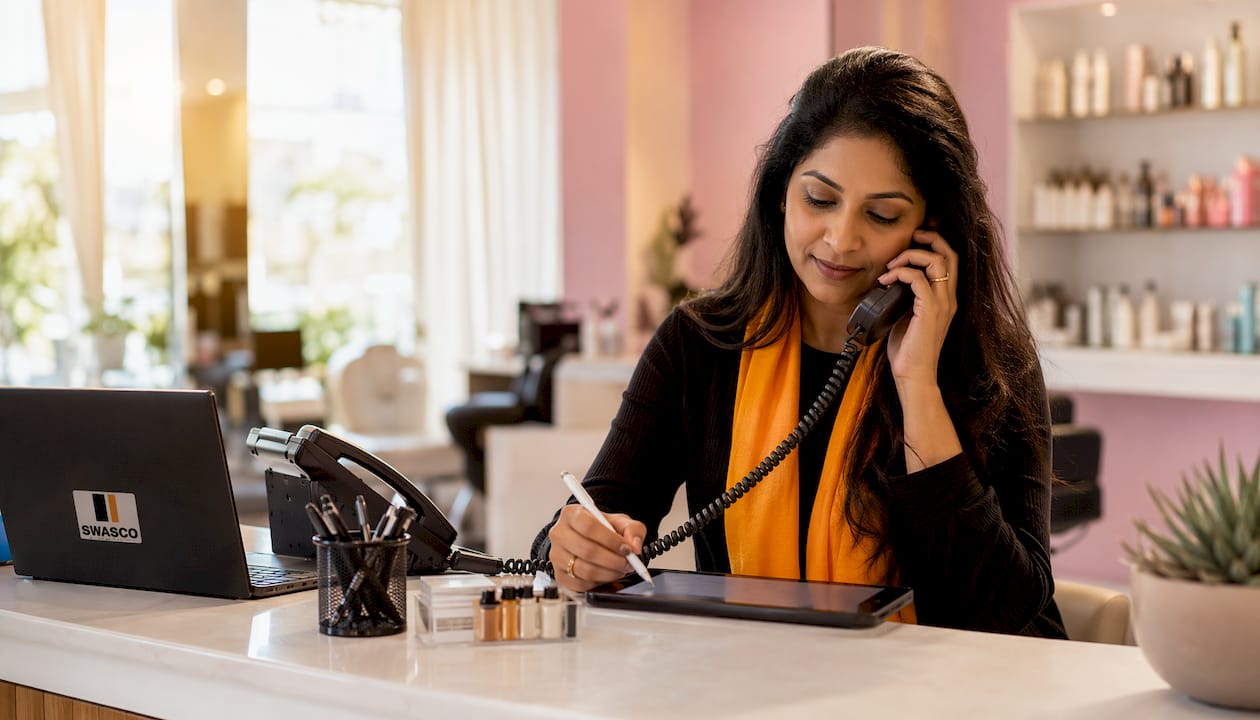
Missed calls and slow responses are the most direct revenue leak. A client who rings at 7pm on a Friday and hears voicemail will book elsewhere before Monday morning. Most salons have no system to capture that lead at all.
Manual check-in backlogs hit hardest during walk-in surges. When your receptionist is processing one client's paperwork, the queue builds, and the next two clients feel ignored before a stylist has even said hello. Self check-in via QR or tablet removes this entirely, freeing staff for floor management.
Double bookings and diary errors are a trust issue as much as an operational one. A client who arrives to find their slot given away rarely returns. Fragmented systems — one person on the phone, another on Instagram DMs, a third on a walk-in sheet — make conflicts almost inevitable.
Fragmented channels mean leads fall through the cracks daily. WhatsApp, Instagram DMs, website chat, and phone calls each need a response, and without a unified inbox, messages get missed or answered hours too late.
Slow follow-up on no-shows and enquiries is quiet revenue loss. A client who cancels last-minute and receives no follow-up message simply does not rebook. The slot stays empty.
"Every contact we have with a customer influences whether or not they'll come back." The front desk is where that contact begins — and where most salons lose clients they never knew they had.
Checkout delays add a final friction point. A receptionist juggling a ringing phone while processing a card payment makes errors, slows throughput, and reduces the chance of a retail upsell.
When do these bottlenecks typically hit your salon?
Most front-desk failures are predictable. They cluster around four triggers.
- Peak Saturday mornings — walk-ins, phone calls, and online bookings all arrive simultaneously. A single receptionist cannot triage all three channels without dropping one.
- Promotional spikes — a last-minute offer sent via SMS or social media generates a burst of inbound enquiries. Without automation, most go unanswered until the promotion has expired.
- Last-minute cancellations — a cancellation at 8am requires immediate outreach to a waitlist. Manual processes mean the slot stays empty.
- Staff absences — when a receptionist calls in sick, scope creep accelerates. Other staff absorb check-in duties, phone answering, and follow-ups on top of their own roles. Scope creep is the leading driver of receptionist burnout and turnover.
A typical service day surfaces bottlenecks in sequence: arrival and check-in (queue anxiety, missed greetings), service delivery (scheduling conflicts, mid-service interruptions), checkout (billing delays, missed retail prompts), and post-visit follow-up (no rebook, no review request).
Pro Tip: Watch for repeated front-desk context switches — your receptionist stopping a check-in to answer a call, then stopping the call to handle a walk-in. Three or more switches per hour is a reliable early warning sign that the workflow needs restructuring.
What can AI receptionist automation actually fix, and what can't it?
The honest answer: AI handles the repetitive, time-sensitive tasks reliably. It cannot replace human judgement in high-touch moments.
AI handles well:
- 24/7 lead capture across calls, SMS, website chat, and social media
- Appointment booking and calendar sync with instant confirmation
- Automated reminders and waitlist notifications
- Simple FAQ responses (pricing, availability, directions, parking)
- Post-visit follow-up and review requests
Humans must stay involved for:
- Complex intake for medspa or clinical services requiring clinical judgement
- In-person conflict resolution with upset clients
- High-value upsell conversations that require reading body language
- Situations involving language barriers or emotive complaints
The hybrid model is the most effective approach for salons with five or more chairs, and for any medspa offering clinical treatments. AI handles off-hours and overflow; your team handles the moments that require genuine human presence.
Escalation decision flow:
- Client query arrives via any channel
- AI qualifies intent and books if it is a standard appointment
- If the query involves a complaint, clinical question, or language difficulty, the bot flags it and routes to a staff member with full context
- Staff respond with the conversation history already visible
For AI handling higher-risk consultations, setting clear escalation thresholds before launch is non-negotiable.
Prioritised fixes you can implement this week
Start with the highest-impact, lowest-disruption changes first.
- Enable 24/7 AI lead capture — every missed call becomes a captured enquiry, not a lost booking.
- Set automated SMS and WhatsApp confirmations — send immediately on booking. See the SMS reminders guide for timing and copy.
- Add QR self-check-in signage at your entrance — requires a tablet or printed QR code and a brief staff briefing.
- Standardise service durations with buffer windows — prevents cascade delays across the diary.
- Centralise all communications into a single inbox — one place for calls, texts, DMs, and chat.
Sample SMS confirmation: "Hi [Name], your appointment at [Salon] is confirmed for [Date] at [Time] with [Stylist]. Reply STOP to cancel or call us to rebook."
Sample waitlist message: "Hi [Name], a slot has opened on [Date] at [Time]. Reply YES to confirm within 2 hours or we'll offer it to the next client."
Prerequisites: calendar API access for your booking system, a 30-minute staff training slot, and printed QR signage for the entrance.
Pro Tip: During your busiest hours, assign one staff member as the designated escalation point for AI-flagged queries. This prevents the bot from holding a client in limbo while everyone assumes someone else is handling it.
Implementation roadmap: audit, pilot, and scale
Phase 1 — Audit (week 1)
- Log call volume, peak hours, and missed-call rate for seven days
- Estimate monthly missed-lead value (calls missed × average booking value)
- Map all communication channels and identify which have no coverage after hours
- Confirm calendar system and API access for integration
Phase 2 — Pilot (weeks 2–9)
- Configure AI for your top five FAQ responses and standard booking flow
- Set escalation rules and test with a small volume before full launch
- Run automated follow-up sequences for no-shows and enquiries
Phase 3 — Scale (ongoing)
- Review KPIs monthly and retrain the AI on new service types or promotions
- Expand to additional channels as confidence grows
| Item | Indicative UK cost |
|---|---|
| Pilot setup and onboarding | Included in Talk2Aiva guided pilot |
| Managed onboarding (done-for-you) | Bundled in higher tiers |
| Expected time to measurable gains | 4–8 weeks |
Core KPIs to track: leads captured, booking conversion rate, no-show rate, average response time, and receptionist hours saved per week.
How do you measure ROI from AI receptionist automation?
| Metric | Calculation example |
|---|---|
| Monthly leads recovered | Missed calls per month × booking conversion rate |
| Incremental revenue | Recovered bookings × average booking value |
| No-show reduction saving | (Previous no-show rate − new rate) × average booking value × monthly appointments |
| Net monthly gain | Incremental revenue + no-show saving − subscription cost |
Track weekly during the pilot, then monthly once you scale. Give the pilot at least four weeks before drawing conclusions — you need enough booking cycles to see a pattern. For AI's role in client retention and lifetime value, a 90-day view gives a clearer picture.
How do you protect your receptionist from burnout?
Emotional agility — the ability to switch rapidly between de-escalation and warm welcome without carrying stress forward — is the single skill that separates good receptionists from great ones. It cannot be sustained when the role is buried in manual admin.
Keep in the role:
- Client greeting and relationship management
- Complex scheduling decisions and conflict resolution
- Upsell conversations and retail recommendations
Offload to automation:
- Check-in processing and queue management
- Appointment confirmations and reminders
- Post-visit follow-up and review requests
- Answering standard FAQs after hours
Removing low-value manual tasks reduces scope creep, which is the primary operational driver of burnout. Salons that redesign the role this way report lower turnover and stronger client satisfaction scores.
Pro Tip: When hiring, prioritise organisational and scheduling aptitude over personality alone. A warm manner matters, but a candidate who cannot manage a complex diary under pressure will cost you more in errors and turnover than the recruitment fee.
How Talk2Aiva helps salons stop losing revenue
A busy independent salon with six chairs was missing calls every evening and weekend. Walk-in check-in created a bottleneck every Saturday morning, and no-shows were running at roughly one in five appointments with no follow-up system in place.
During a Talk2Aiva pilot, the salon activated 24/7 AI call capture, automated SMS confirmations, and a post-visit follow-up sequence. Escalation rules were set so any complaint or clinical query routed immediately to the owner's mobile with full context.
Guided onboarding and ongoing optimisation materially improve pilot outcomes. Vendors that bundle setup and support show faster time-to-value — and that support is what makes the difference between a tool that gets switched off after a month and one that becomes part of how the business runs.
Within eight weeks, the salon had measurably fewer missed enquiries, a lower no-show rate, and the receptionist was spending the majority of her time on client-facing work rather than admin. Ongoing optimisation and technical support are included as standard in Talk2Aiva's higher tiers, so the system improves as the business grows.
Key takeaways
The most effective way to fix common salon receptionist bottlenecks is to automate the repetitive, time-sensitive tasks first, then redesign the human role around the work that genuinely requires a person.
| Point | Details |
|---|---|
| Top three bottlenecks | Missed calls, manual check-in backlogs, and diary sync errors drive the most revenue loss. |
| Fastest fixes | Enable 24/7 AI lead capture and QR self-check-in within 48 hours for immediate impact. |
| No-show reduction | Automated reminders from booking platforms typically reduce no-shows by 20–40% within 60 days, recovering predictable revenue. |
| Hybrid model works best | AI handles off-hours and repetitive tasks; humans manage high-touch intake and conflict resolution. |
| Talk2Aiva guided pilot | Talk2Aiva provides a done-for-you pilot with audit, configuration, live launch, and ongoing support. |
Your next three steps:
- Audit your missed calls and after-hours enquiries this week to quantify the revenue gap
- Enable 24/7 AI capture so no enquiry goes unanswered from tomorrow
- Pilot QR self-check-in for two weeks and measure queue time and receptionist interruptions
Why the hybrid model is the only honest answer
The debate about AI replacing receptionists misses the point entirely. The question is not whether AI can answer a phone. It clearly can. The real question is whether your receptionist's time is currently being spent on things a person actually needs to do.
In most salons, the answer is no. A significant portion of the front-desk workload is repetitive, time-sensitive, and rule-based. That is exactly what automation handles reliably. What it cannot do is read a client's mood, de-escalate a complaint with genuine warmth, or make a nuanced upsell recommendation.
The salons that get this right treat AI as a staff multiplier, not a replacement. They free their receptionist to do the high-value work that builds loyalty and drives retail revenue. That is the model Talk2Aiva is built around: guided onboarding, clear escalation rules, and ongoing support so the system keeps improving. Owners who approach it that way see results. Those who treat it as a set-and-forget tool do not.
Ready to run a guided AI receptionist pilot?
Revenue lost to missed calls and slow responses adds up faster than most owners realise. Talk2Aiva gives you a done-for-you pilot that covers the full process: audit, AI configuration, live launch, and ongoing optimisation with support included.
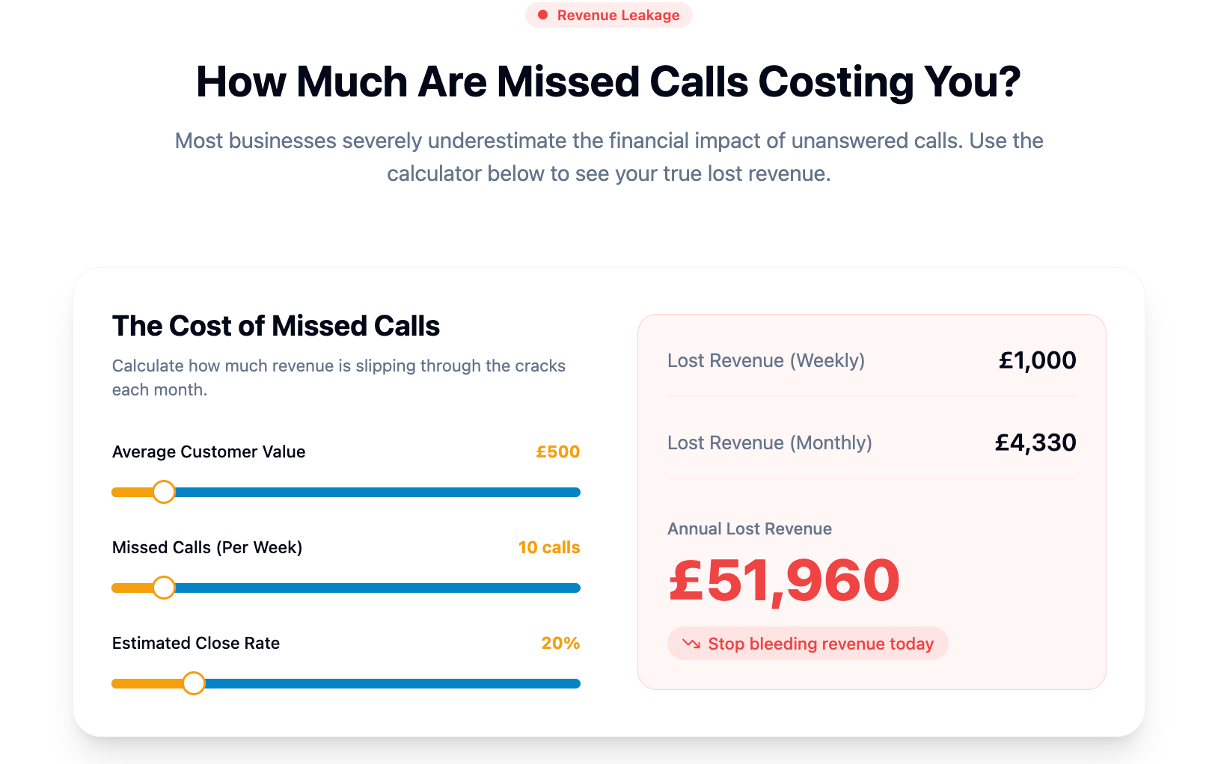
The pilot covers 24/7 multichannel capture across calls, SMS, website chat, and social media, plus calendar sync, automated follow-up sequences, and a unified inbox for your team. Most salons see measurable gains within four to eight weeks. Your website's uptime and booking reliability matter too — keeping your site available is a prerequisite for any AI booking flow to work consistently.
Start your guided pilot with Talk2Aiva and stop losing revenue to problems that are entirely fixable.
Further reading and sources
- Automate beauty appointment reminders in 2026 — step-by-step guide to configuring reminders; supports the pilot setup and KPI sections above
- How follow-up automation works in salons — templates and flow diagrams for no-show and lead follow-up sequences
- SMS appointment reminders for salons: 2026 guide — timing, copy, and compliance guidance for SMS confirmations
- Types of salon promotional campaign examples that fill chairs — promotional campaign examples relevant to managing promo-driven booking spikes
- Talk2Aiva by SWASCO — the guided AI receptionist and revenue recovery platform referenced throughout this article
- WaitQ: reducing walk-in wait times — independent guidance on self check-in and queue management cited in the bottlenecks and quick-wins sections
- Workspace burnout and scope creep research — underpins the role redesign and wellbeing section