
Respond to every new enquiry within five minutes, then run a structured 7-touch cadence across phone, email, LinkedIn and video over roughly three weeks. Automate the first three touches; hand touches four onwards to a human. Contacting a lead within five minutes makes them 21 times more likely to qualify than waiting half an hour, and most commercial finance deals require multiple follow-up contacts before they close
TL;DR:
- Responding within five minutes significantly increases the likelihood of qualifying a lead, yet 80% of brokers stop after one follow-up attempt.
- A seven-touch, multi-channel cadence—including phone, email, LinkedIn, and video—maximizes contact probability and builds client relationships over three weeks.
- Automation handles repetitive tasks such as instant replies and qualification questions, while human brokers focus on objection handling and negotiations.
- Personalised messaging based on the lead's sector, trigger, and stage of the buying journey improves reply rates more than generic templates.
- Using additional tools like AI-powered responders, content automation, and video messaging ensures a consistent, effective follow-up process beyond a CRM’s capabilities.
Table of Contents
- What does a commercial finance lead follow up cadence actually look like?
- Which channel should you use at each touch?
- What should your follow-up templates and scripts say?
- How should automation and your CRM handle the workload?
- Which leads deserve a rep's time right now?
- Which metrics actually prove your cadence works?
- How does Talk2Aiva support this playbook in practice?
- What legal and compliance rules apply to follow-up communications?
- How do you handle objections that come up during follow-up?
- How much does personalisation actually move engagement?
- What does a working follow-up playbook look like in practice?
- Which tools actually support this beyond your CRM?
- The one habit worth changing this week
- Try a guided route to faster lead follow up
- Sources
What does a commercial finance lead follow up cadence actually look like?
Speed wins the first contact. Persistence wins the deal. Those are two separate skills, and most brokers only build one of them.
The MIT Lead Response Management Study found that leads contacted within five minutes convert at dramatically higher rates than those left for half an hour, yet 80% of sales require five or more follow-up contacts to close, and most reps stop after one attempt. That gap between what works and what brokers actually do is where deals go to die.
Here's a cadence built for commercial finance, where deal sizes justify the extra effort:
- Touch 1 (within 5 minutes): Automated call attempt plus instant email confirming receipt of the enquiry.
- Touch 2 (Day 1, afternoon): Personalised email addressing the specific facility type or trigger.
- Touch 3 (Day 2): Second email with a relevant resource, such as a case study or rate guide.
- Touch 4 (Day 4): Phone call from a human broker, ideally Wednesday or Thursday between 10 and 11am.
- Touch 5 (Day 7): LinkedIn message referencing the earlier conversation.
- Touch 6 (Day 12): Short video message or a second phone attempt at 4 to 5pm.
- Touch 7 (Day 18 to 21): Breakup email offering a clear final decision point.
Resources Rework's analysis also flags Wednesday to Thursday, and the 10 to 11am and 4 to 5pm windows as the highest-contact periods. That is why touches four and six sit there deliberately.
Which channel should you use at each touch?
Channel choice isn't a preference exercise. It's sequencing designed to maximise the chance a busy finance director actually notices you, and Storylane's guide to lead follow-up treats this mapping as core to the discipline rather than an afterthought.
- Touch 1: Phone attempt plus an immediate automated email. This combination catches people who screen calls but check email straight away.
- Touches 2 to 4: Email is the workhorse. It's low-pressure, easy to forward internally, and gives the prospect something to reference when they discuss the facility with a co-director or accountant.
- Touches 5 to 7: Shift to LinkedIn, a short personal video, or direct mail for high-value accounts. These channels read as more considered and less transactional, which suits a relationship that's cooling slightly.
- SMS: Use sparingly and only where the lead has given clear consent, since unsolicited text messages to business contacts carry real compliance risk in commercial finance.
Mixing channels rather than repeating the same one increases the probability of contact, because each channel reaches the prospect in a different context, whether that's their inbox, their phone, or their LinkedIn feed during a coffee break.
Pro Tip: If a prospect opens three emails but never replies, switch to LinkedIn or phone next. Repeating the same silent channel wastes a touch you can't get back.
What should your follow-up templates and scripts say?
Templates exist to save time, not to sound generic. Every one below needs a name, a fact about the enquiry, and a specific next step before it goes out.
- Voicemail script: "Hi [Name], it's [Broker] from [Firm]. I saw your enquiry about [facility type] and wanted to flag something relevant before you look elsewhere. Call me back on [number], or I'll try again tomorrow afternoon."
- Email 1 (trigger response): Acknowledge the specific enquiry, mention one relevant fact (a rate range, a lender appetite shift), and ask one question.
- Email 2 (value add): Share a short case study or guide relevant to their sector. No ask.
- Email 3 (check-in): One line asking if timing has changed, plus a calendar link.
- Breakup message: "I don't want to keep filling your inbox, so I'll close this off unless I hear back by Friday. Happy to pick it up again whenever suits."
Follow the 3:1 value-to-ask ratio: three pieces of useful information for every direct request to book a call.
How should automation and your CRM handle the workload?
Automation should carry the repetitive, time-sensitive work; humans should carry the judgment calls. Getting that split wrong is how brokers either burn out chasing cold leads or let hot ones go stale.
- Automate: instant reply, initial qualification questions, calendar booking links, and routing rules that assign leads by facility type or deal size.
- Human-led: touches four onwards, objection handling, and any negotiation once a prospect engages.
- Database reactivation: segment dormant enquiries by facility type and recency, re-engage with a value-first message, re-qualify against current criteria, offer a booking slot, then measure response rate against a fresh cohort.
Database reactivation frequently produces a strong return for brokers because old enquiries already know your firm, and pairing that outreach with instant qualification and booking removes the friction that let them go cold in the first place. Guides on property valuation lead nurturing cover a similar sequencing logic for adjacent sectors.
Pro Tip: Build unenrol logic into every sequence so a reply, a booked call, or a "not interested" response instantly stops further automated messages. Nothing damages credibility faster than an automated email arriving after someone has already said no.
Which leads deserve a rep's time right now?
Not every enquiry deserves the same urgency. A prioritisation matrix stops your best rep from spending Tuesday morning on a lead that was never going to settle.
Score leads on:
- Facility type: Asset finance and invoice finance enquiries often move faster than complex structured deals.
- Deal size: Larger facilities justify heavier human touch earlier in the cycle.
- Timeframe: "Need funding within 30 days" scores higher than "just researching options."
- Trading history: Established businesses with two or more years of accounts typically qualify faster than start-ups.
Leads scoring high on urgency and deal size go straight to a human for touch one. Everything else runs the automated sequence first, entering human follow-up only once it clears a minimum qualification threshold, which preserves nurture capacity for leads that need more time to mature.
Which metrics actually prove your cadence works?
You don't need a dashboard full of vanity numbers. Five metrics tell you whether the cadence is working and where it's leaking:
- Response time to first contact, measured in minutes, not hours.
- Touches to qualified meeting, which shows whether your sequence length matches reality.
- Conversion rate by touch number, revealing which stage of the cadence underperforms.
- Reactivation yield, tracking what percentage of dormant leads re-engage.
- Cost per settled deal, the only ROI figure that matters in commercial finance, given how much a single facility is worth.
Run simple A/B tests on timing (morning versus afternoon calls) and channel order (email-first versus phone-first) one variable at a time. Review the dashboard weekly, and report monthly against the previous month's cohort.
How does Talk2Aiva support this playbook in practice?
Talk2Aiva by SWASCO is built around exactly the split this playbook demands: instant automated response for the first touches, then a clean handover to your team once a lead qualifies. It answers calls, texts, web chat and social messages around the clock, so touch one happens in minutes rather than whenever someone next checks their phone.
Onboarding covers setup, AI training on your specific facility types and qualification criteria, workflow building for your routing rules, a live launch, and ongoing optimisation with technical support included throughout.
In practice, that means:
- Faster first contact on every new enquiry, day or night.
- More booked meetings from leads that would otherwise sit unanswered overnight or over a weekend.
- Fewer dormant enquiries, since reactivation sequences run automatically rather than depending on someone remembering to chase.
Guides such as what automated lead follow-up actually involves and qualifying leads automatically walk through the mechanics in more depth.
What legal and compliance rules apply to follow-up communications?
Commercial finance follow-up sits inside a compliance framework that's easy to overlook when you're focused on conversion. Get it wrong and a single complaint can cost more than the deal was ever worth.
Financial promotions rules matter from the first message. If your email or LinkedIn outreach describes rates, terms, or lender appetite, it needs to be clear, fair, and not misleading, in line with the standards the Financial Conduct Authority sets for financial promotions. That applies whether the message is written by a person or generated automatically, so any templated email touching on pricing needs sign-off before it goes live in a sequence.
Consent governs your channel choices more than most brokers realise. Business-to-business marketing calls and emails generally have more latitude than consumer communications under UK data protection rules, but SMS to a personal mobile number still needs a clear basis for contact, and unsubscribe requests must be honoured immediately, not at the end of the current touch sequence.
Record-keeping isn't optional either. Keep a log of when a lead opted out, when a sequence was stopped, and what was said in any call that touched on rates or eligibility. If a regulator or an ombudsman ever asks how a deal was sourced, that record is what protects you.
Build compliance checks into the cadence itself rather than treating it as a separate audit. A template library reviewed quarterly, an unenrol rule that fires on any reply, and a clear consent field in your CRM cost far less than a complaint investigation.
How do you handle objections that come up during follow-up?
Objections during follow-up almost always fall into one of four categories: timing, trust, price, and "I'm still deciding." Each needs a different response, not a single scripted rebuttal.
"Now isn't a good time." Don't push for the call. Ask when would be better and book it there, in the same message. A specific slot in the diary survives; a vague "I'll call again soon" doesn't.
"I'm already talking to another broker or lender." This is where the 3:1 value-to-ask ratio earns its place. Rather than arguing your case, send something genuinely useful, a comparison point, a lender appetite update, a relevant case study, and let that do the persuading instead of a pitch.
"The rate isn't competitive enough." Ask what they're comparing against before defending your number. Often the comparison isn't apples to apples once fees, flexibility and speed of drawdown are factored in, but you can only make that point once you know what they've actually seen.
Silence, the most common objection of all. This is why the cadence has seven touches rather than two. A prospect who's gone quiet hasn't necessarily said no, they may simply be waiting on internal sign-off, a set of accounts, or a decision from a co-director. Persistence here isn't pushiness; it's giving them room to respond when their situation allows it.
The Storylane framework treats each objection as a signal to adjust the next touch's channel and content, not a reason to stop the sequence altogether.
How much does personalisation actually move engagement?
Generic follow-up gets generic results. The shift that moves the needle is consultative, situation-led messaging tailored to the specific finance trigger and sector, rather than a template that mentions "your enquiry" and nothing else.
Personalisation in commercial finance works on three levels. First, the trigger itself: a business asking about invoice finance because of a cash flow gap needs a different opening line to one asking about asset finance to fund expansion. Naming that trigger in touch one signals you've actually read the enquiry rather than fired off a form response.
Second, the sector. A haulage firm and a dental practice have wildly different funding rhythms, seasonal pressures, and risk profiles. Referencing something sector-specific, a seasonal cash flow pattern, a regulatory change affecting their industry, does more for engagement than any subject line trick.
Third, the stage of the buying journey. A lead who downloaded a rate guide is in research mode and responds better to further education. A lead who requested a callback is in decision mode and responds better to a direct, specific offer. Matching message tone to that stage, rather than sending the same template regardless, is what separates brokers who get replies from those who get ignored.
None of this requires bespoke writing for every single lead. It requires a handful of variables, trigger, sector, and stage, feeding into templates that adjust automatically. That's a data and workflow problem as much as a copywriting one, and it's exactly the kind of variable-driven personalisation that automation handles better than a rep working from memory.
What does a working follow-up playbook look like in practice?
The pattern that separates brokers who convert consistently from those who don't isn't a secret script, it's structural discipline applied to leads other firms have already written off.
Database reactivation is the clearest example. A broker sitting on eighteen months of dormant enquiries has, in effect, a warm pipeline nobody is working. Systematically segmenting those old enquiries by facility type and recency, then re-engaging with a value-first message before asking for anything, consistently produces settled deals that a cold list never would, because the prospect already has some familiarity with the firm.

The second pattern is speed paired with patience. Brokers who win the deals that others lose typically respond within minutes on first contact, then hold their nerve through five, six, or seven touches rather than giving up after two. The two behaviours reinforce each other: fast first contact earns the right to a longer relationship, and persistence over that relationship is what eventually produces a reply.
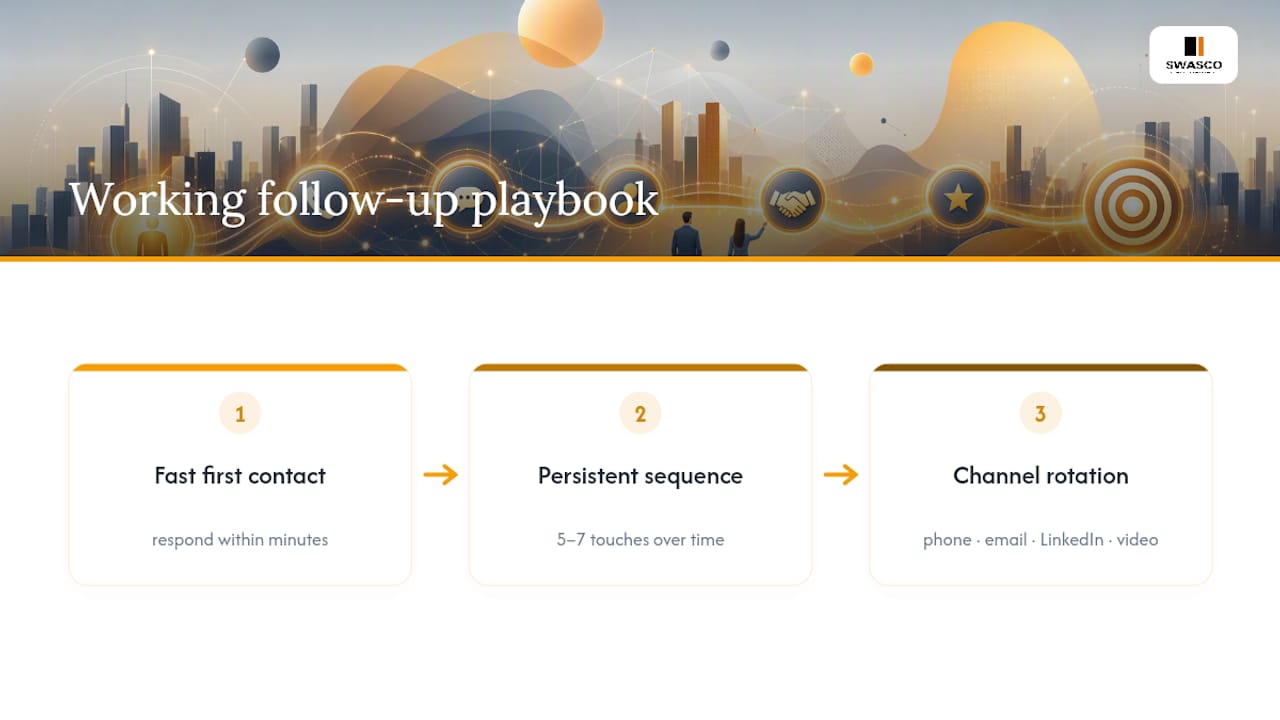
The third pattern is channel discipline. Playbooks that rotate through phone, email, LinkedIn and video, rather than hammering the same channel repeatedly, report higher contact rates because each medium reaches the prospect in a different mental state, distracted on the phone, scanning email between meetings, more receptive to LinkedIn during downtime.
None of these patterns depend on exceptional selling skill. They depend on consistency that most brokers, working leads manually alongside everything else on their desk, simply can't sustain without support.
Which tools actually support this beyond your CRM?
A CRM alone won't run a 7-touch, multi-channel cadence reliably. It stores data well but rarely automates the cross-channel sequencing this playbook depends on, which is why most firms layer additional tools on top.
Conversational AI platforms, including Talk2Aiva, handle the instant-response layer: answering calls, texts and web chat around the clock, then qualifying and booking straight into your calendar. This is the piece that closes the five-minute response gap without requiring a rep to be permanently on call.
Marketing and content automation partners can support the value-add touches in the cadence, the case studies, guides and sector-specific assets that fill out the 3:1 ratio. Agencies such as HarbourSide Digital build the SEO, content and automation assets that feed those middle-sequence emails, so brokers aren't writing fresh material for every touch.
Video messaging tools add the personal element to later touches without demanding a phone call, useful for touch six when a prospect has gone quiet but hasn't said no.
Together, these categories, instant response, content support, and video, fill the gaps a CRM leaves open, and they're what turn a documented cadence into one that actually runs itself.
The one habit worth changing this week
Stop treating the first missed call as a loss and start treating it as touch one. The habit that moves the needle isn't a smarter script, it's refusing to let more than five minutes pass before something, human or automated, reaches out. Brokers who build that habit convert leads their competitors never even call back.
— James Paul
Try a guided route to faster lead follow up
Building the cadence above by hand, manually, at 11pm, after a missed call, is exactly the gap Talk2Aiva closes. It answers calls, texts, web chat and social enquiries the moment they arrive, qualifies against your criteria, books straight into your calendar, and hands warm leads to your team once they're ready, covering touches one through three automatically so your reps only pick up leads worth their time.
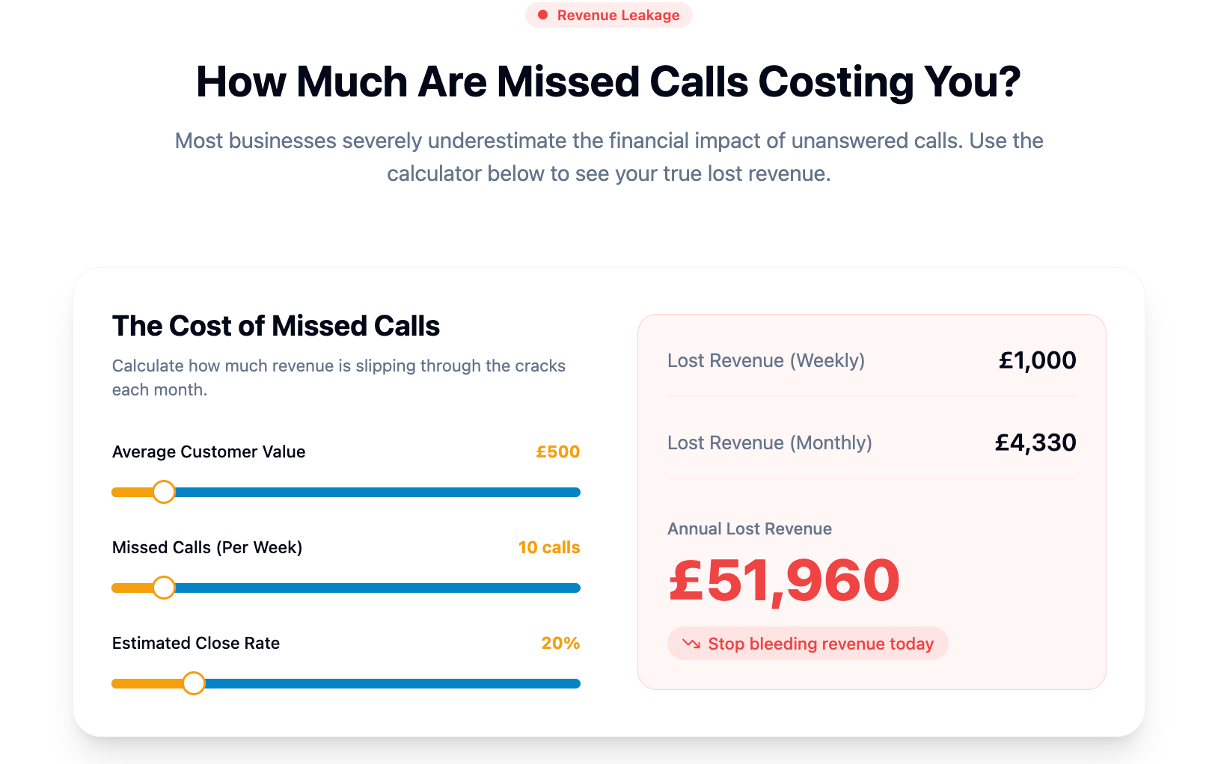
Onboarding includes setup, AI training on your qualification criteria, workflow building for your specific routing rules, a live launch, and ongoing optimisation with technical support throughout, so there's no lengthy build phase before it starts catching leads. If missed calls and slow first responses are costing settled deals, see how Talk2Aiva works and book a walkthrough.
Sources
- Lead follow-up best practices (Resources Rework)
- Lead Follow-Up: Timing, Cadence & Message Templates (Storylane)
- Best practices for lead follow-up to close deals (Forbes Business Council)