
Most service businesses get more value from a hybrid model: chatbot first, human on escalation, than from either channel alone. Pure chatbots work well for high-volume, low-complexity enquiries like booking or order status. Pure live chat still wins for high-value sales conversations or regulated advice. Below, you'll find the exact criteria and steps to build the right mix for your business.
TL;DR:
- Hybrid models of chatbot first with human escalation outperform single-channel setups in CSAT and resolution rates, especially when designed with clear handover protocols.
- Response speed and availability heavily favor chatbots, which reply in seconds and operate 24/7, while live chat offers better judgment and emotional support for complex issues.
- Cost scales linearly for live chat with volume, but fixed for chatbots, making hybrids particularly advantageous for scaling service without proportional staffing increases.
- Successful implementation relies on setting clear containment targets, escalation SLAs, thorough integration, and ongoing monitoring of KPIs like containment rate and repeat contact; poor governance leads to failure.
- Using managed solutions like Talk2Aiva simplifies deployment by providing pre-trained AI receptionists, reducing setup complexity, and enabling quicker pilots with measurable success metrics.
Table of Contents
- Chatbot vs live chat: what each one actually is
- Where live chat still beats the bot
- Chatbot vs live chat: comparing the metrics that matter
- Chatbot advantages and live chat pros and cons for your business
- How to choose: a decision framework for your business
- Why hybrid usually wins and how to design one
- Implementation checklist: from pilot to measurement
- How Talk2Aiva builds the hybrid model for you
- What actually determines success
- Get your hybrid model running with Talk2Aiva
- Sources
Chatbot vs live chat: what each one actually is
A chatbot is software that answers customer messages automatically, without a human typing the reply. There are three tiers worth knowing. Rule-based bots follow decision trees and only work within scripted paths. AI chatbots use natural language processing to interpret varied phrasing and pull answers from a knowledge base. Agentic AI goes further still, taking actions like updating a booking or checking stock through direct system integration.
Chatbots genuinely earn their place on strengths such as continuous availability, handling many conversations simultaneously, and providing consistent answers. That consistency matters more than people assume. A tired agent on their eighth call of the evening might shortcut an explanation; a well-trained bot won't.
The weaknesses are just as real. Bots lose context when a conversation shifts topic mid-thread, they can generate plausible-sounding but wrong answers (hallucination), and many escalate badly, dumping a frustrated customer into a queue with none of the conversation history intact.
For service businesses, chatbots earn their keep on:
- Appointment booking and calendar checks
- Order or job status updates
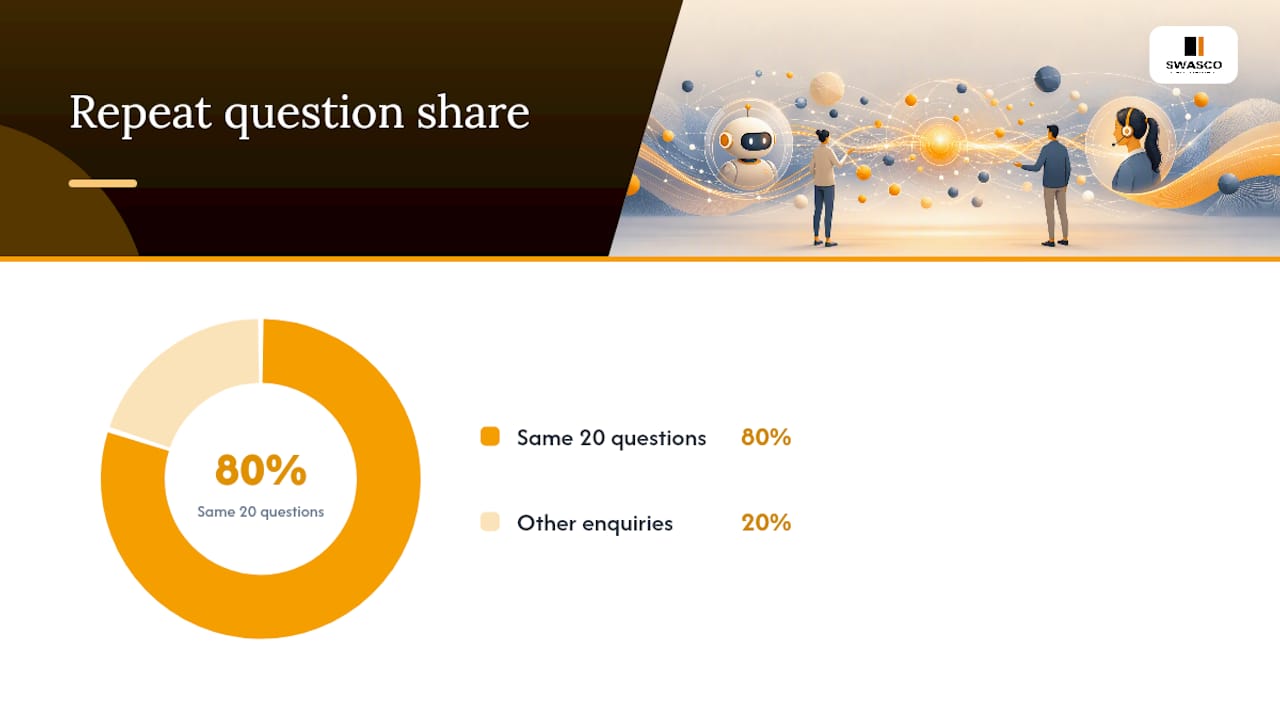
- Answering the same 20 questions that make up 80% of enquiries
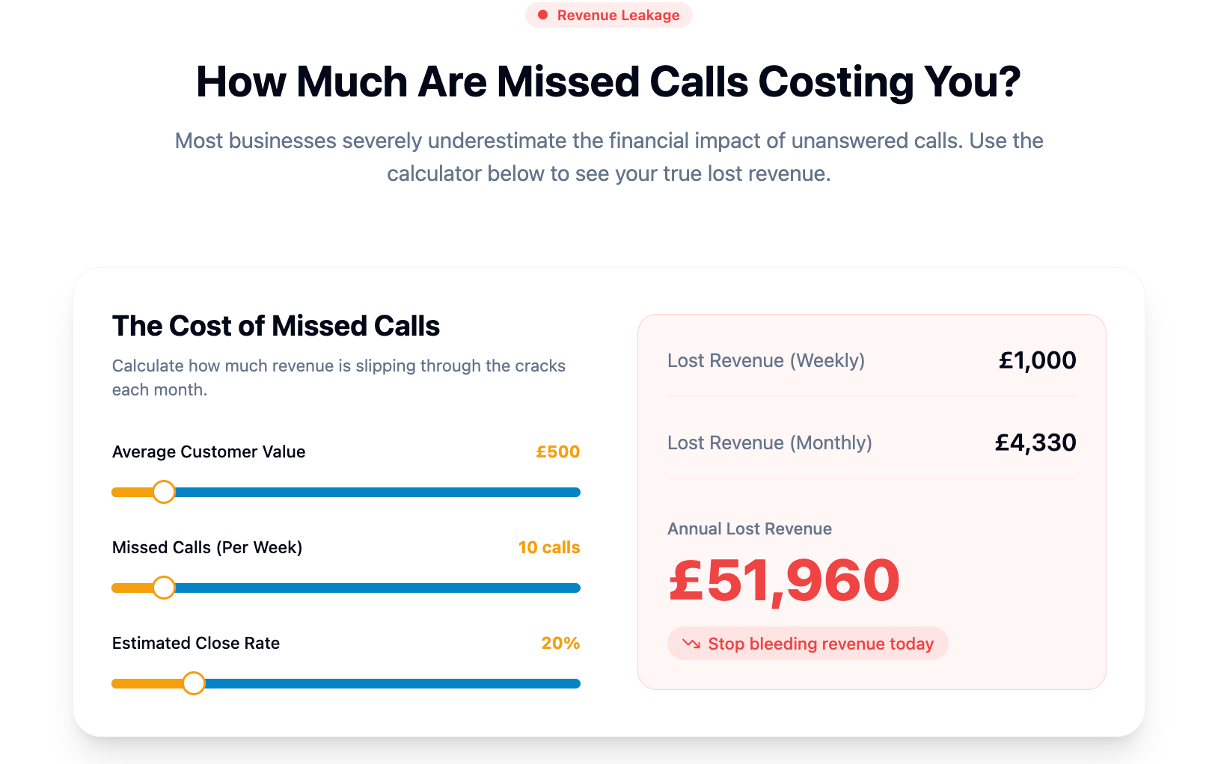
- Capturing after-hours leads before a competitor answers first
Pro Tip: Audit your last 200 support tickets before building a bot. If more than half fall into five or six repeatable categories, you have an obvious automation target.
Where live chat still beats the bot
Live chat is a human-led channel, though modern agents rarely work unassisted. Suggested replies, knowledge-base surfacing and sentiment alerts now sit alongside most live chat tools, narrowing the gap without closing it.
Humans still win where judgement matters. A cancellation request tangled up with a complaint, a high-value quote that needs negotiating, a nervous customer who needs reassurance before booking a procedure: these need empathy that scripted logic can't fake. Live chat's benefit for complex, high-judgement interactions is well documented, and it's the reason no serious operator has fully automated their retention or complaints desk.
The trade-off is operational cost. Human agents need hiring, training, and rostering, and unlike a bot, their capacity doesn't scale past headcount. Small or solo-run businesses often cannot staff live chat around the clock without outsourcing.
Live chat suits you when:
- The average enquiry value is high enough to justify agent time
- Conversations involve emotion, complaint handling, or trust-building
- Your volume is low enough that a small team can cover peak hours
- Regulatory or safeguarding rules require a documented human decision
Chatbot vs live chat: comparing the metrics that matter
Response speed is the clearest gap. Modern AI chatbots reply in under two seconds in measured studies, where a human agent, even a good one, typically takes minutes once queue time is factored in. That gap only widens at peak hours, when a live team hits its concurrency ceiling and a bot simply doesn't.
Availability follows the same pattern. A chatbot runs at 3am on a Sunday exactly as it runs at 11am on a Tuesday. Covering those same hours with humans means night shifts, weekend rotas, or an outsourced contact centre, all of which carry a real staffing cost. Portugal-based multilingual contact centres are one route businesses take to extend live coverage without building an in-house night shift, though it adds a vendor relationship to manage.
Cost structure diverges sharply too. A chatbot's cost is largely fixed: build it once, and the marginal cost per extra conversation is close to zero. Live chat cost scales roughly linearly with volume, since more conversations eventually mean more agents. This is precisely why limited human agent availability is the primary constraint for service-based SMEs: the arithmetic simply doesn't favour humans-only at scale.
The data point that changes the calculus: hybrid deployments, chatbot first with human escalation, achieve higher combined CSAT and resolution rates than either pure chatbot or pure human-only setups. The improvement doesn't come from the bot doing more work. It comes from freeing agents to spend their time only on the conversations that need a human, rather than splitting their attention across everything.
Customer experience is where the picture gets nuanced rather than one-sided. Bots win on speed and consistency but lose on nuance; live chat wins on nuance but loses on wait time during busy periods. Neither channel dominates outright, which is exactly why treating this as a binary choice misses the point. The debate itself is increasingly framed as a maturity curve rather than a fight between two competing technologies.
Integration and personalisation depend on the setup behind the channel, not the channel itself. Enterprise-grade chatbots integrate with CRM, ticketing systems, and knowledge bases through retrieval-augmented generation, letting a bot pull a customer's booking history or trigger a real workflow action instead of just chatting. Live chat agents typically already have that CRM access baked into their desktop, but their personalisation depends on training and workload, not software.
Here's how the two stack up when you line them up side by side:
| Dimension | Chatbot | Live chat |
|---|---|---|
| Response time | Seconds, constant | Minutes, variable with queue |
| Concurrency | Unlimited | Capped by headcount |
| Availability | 24/7 by default | Needs shifts or outsourcing |
| Cost scaling | Largely fixed | Roughly linear with volume |
| Complex resolution | Weaker, prone to hallucination | Stronger, judgement-based |
| Personalisation | Depends on CRM/RAG integration | Depends on agent training |
Repeat contacts and churn are where a badly deployed bot does real damage. An unmonitored chatbot that gives confident wrong answers, or fails to escalate cleanly, generates more repeat contacts than it prevents, and Zendesk's research warns explicitly that bots must be actively monitored to avoid that outcome undermining the containment gains they're supposed to deliver.
Chatbot advantages and live chat pros and cons for your business
Chatbot pros:
- Scales instantly to any volume spike without hiring
- Covers every hour of every day at no extra staffing cost
- Delivers the same answer to the same question every single time
Chatbot cons:
- Struggles to hand off context cleanly when a case needs a human
- Can produce a confident, wrong answer when it lacks the right data
- Frustrates customers when there's no visible route to a person
Live chat pros:
- Handles emotionally loaded or ambiguous cases with real judgement
- Converts high-value enquiries better through negotiation and reassurance
- Builds trust through a named, accountable person
Live chat cons:
- Costs scale with volume, unlike a fixed-cost bot
- Availability is capped by rota and headcount
- Hiring and training agents takes real time and budget
How to choose: a decision framework for your business
Four axes decide most of this for you: volume, complexity, regulatory sensitivity, and cost tolerance. High volume with low complexity (booking confirmations, opening hours, order tracking) points straight at automation. Low volume with high complexity or emotional weight (complaints, safeguarding, high-value sales) points at humans. Most service businesses sit somewhere in the middle, which is exactly the hybrid case.
Before you commit to either channel, or a vendor for either, run through this checklist:
- Containment target: what percentage of conversations should the bot resolve without escalation? Set a number before launch, not after.
- Escalation SLA: how fast must a human respond once a bot hands off? Minutes, not hours.
- Integration needs: does the bot need to read and write to your booking system, CRM, or payment platform?
- Reporting: can you see containment rate, CSAT, and repeat contact rate on a single dashboard?
When you're evaluating a vendor or an internal build, ask directly: how does handover preserve conversation context and sentiment? Does the bot use retrieval-augmented generation against your own knowledge base, or a generic model prone to guessing? Can every automated decision be audited after the fact?
Pro Tip: Treat integration as a gating criterion, not a nice-to-have. A bot that can't see your calendar or CRM is answering questions in isolation, and that's where repeat contacts creep back in.
Red flags to walk away from: vendors who can't explain their escalation logic in plain terms, no visible audit trail, and any promise of "full automation" with no human fallback at all for a service business handling real money or real appointments.
Why hybrid usually wins and how to design one
A hybrid model puts the bot first for triage, capture, and routine answers, then hands off to a human the moment a conversation needs judgement, a complaint, or a big-ticket decision. Some businesses run it the other way too: a human-assisted setup where agents lean on AI suggestions rather than the bot leading.
The evidence keeps pointing the same direction. Hybrid deployments consistently produce higher combined CSAT and resolution rates than single-mode setups, and the smarter framing treats automation and human support as stages on a maturity curve rather than rivals.
Getting the handover right is where most hybrid builds actually fail. Good practice means:
- Passing the full conversation history to the agent, not a summary
- Flagging sentiment (frustrated, confused, happy) at the point of handover
- Routing by priority, so a furious customer doesn't sit behind a routine query
- Giving agents suggested replies drawn from the same knowledge base the bot used
Set your automation boundaries explicitly: anything involving a refund over a set amount, a legal or safeguarding concern, or three failed bot attempts in a row should trigger an automatic human handover, no exceptions.
Implementation checklist: from pilot to measurement
Rolling out a hybrid model works best as a sequence, not a single leap:
- Map customer journeys to find where enquiries actually enter, chat, phone, social, or SMS.
- Define KPIs before building anything, so success has a number attached, not a feeling.
- Build the knowledge base the bot and agents will both draw from, using conversational lead capture principles to keep answers consistent.
- Train the bot with retrieval-augmented generation against that knowledge base, not a generic model.
- Design the handover rules and escalation triggers in detail before launch, not after the first complaint.
- Run an 8 to 12 week pilot on a defined slice of volume.
- Iterate weekly based on real conversation data, not assumptions.
Governance matters as much as the tech. Agents need coaching on how to pick up a bot handover mid-conversation, someone needs to own quality checks on bot answers, and you need a clear data-handling policy for anything the bot stores.
Your measurement suite should track containment rate, first-contact resolution, CSAT, repeat contact rate, and average handling time, all on one view. A pilot scoped to 8 to 12 weeks with a hard rule that CSAT can't drop more than five percentage points below baseline gives you a fair test without risking your existing customer relationships.
Pro Tip: Run your pilot on a single service line or location first. It's far easier to fix a broken handover rule affecting 50 conversations than one affecting 5,000.
How Talk2Aiva builds the hybrid model for you
Aiva is described as an AI receptionist that answers calls, texts, website chat, and social messages 24/7, then qualifies and books the enquiry before it ever goes cold. It maps directly onto the framework above: instant engagement covers the response-time and availability gaps, automated follow-ups reduce repeat contacts, and the unified inbox gives you the single reporting view your containment and CSAT numbers need. Setup, AI training, and ongoing technical support may be provided as part of onboarding to assist with configuring escalation rules.
What actually determines success
Most failed chatbot rollouts I've seen fail on governance, not technology. The bot itself was fine; nobody set a containment target, nobody defined when it must hand off, and nobody checked the transcripts for three months. Hybrid only works if someone owns the numbers weekly. Start a short pilot, watch CSAT and repeat contacts closely, and expand only once both hold steady.
— James Paul
Get your hybrid model running with Talk2Aiva
This kind of AI receptionist can replace the guesswork in this whole comparison with a done-for-you setup: instead of building a bot, hiring live agents, and stitching together escalation rules yourself, you get an AI receptionist that's already trained and ready to use. A short pilot with such a system typically includes a guided onboarding call, a review of your current call and enquiry volume, and setup of your booking and follow-up workflows within the first weeks, with ongoing technical support rather than a one-off install.
Three things worth doing this week: request a demo to see the AI receptionist handle a live enquiry, define which service line or location you'll pilot it on, and agree the CSAT and containment numbers you'll judge it against before you start. If you're ready to see how it fits your business, book a demo with Talk2Aiva and get your setup scoped out properly.
Sources
- AI Chatbot vs Live Chat: 2026 Data Study | LoopReply
- Chatbots vs Live Chat in 2026: Why the Question Itself Is Outdated | Intelegencia
- Chatbot vs. Live Chat: Pros and Cons for Businesses | Mailchimp
- Live chat benefits — Salesforce