
A dedicated car repair call answering service, whether human, AI or hybrid, catches the calls your bay staff can't, and turns them into booked jobs instead of missed opportunities. Talk2Aiva is one practical route to get this running fast, with guided setup so you're not fighting a config screen while a customer's exhaust is falling off. Done right, you capture the enquiry, log the vehicle details, and get the job on the calendar before the caller hangs up.
TL;DR:
- Call recording and structured data capture, including vehicle details and symptoms, are essential for accurate booking and seamless integration into shop management systems.
- Hybrid models combining AI and human agents are most adaptable for garages handling a mix of routine bookings and complex or emergency calls.
- Vendors should demonstrate real call handling and clearly show where call data ends up; vague answers indicate poor data management and integration.
- Most garages underestimate call volumes outside normal hours, where the easiest revenue gains from automated call handling often exist.
- A staged rollout minimizes disruption, with proper escalation rules and calendar sync being critical to a successful launch.
Table of Contents
- What car repair call answering actually means for your workshop
- Why call capture matters more than most garages think
- How it works: the features that actually matter
- Manual, automated or hybrid: which model suits your operation?
- Choosing a provider: the checklist that saves you from a bad decision
- Going live in 30 days without disrupting the bay
- What "fully guided" onboarding means with Talk2Aiva
- Why this matters more than most garage owners assume
- Try Talk2Aiva for your garage's call handling
- Sources
- FAQ
What car repair call answering actually means for your workshop
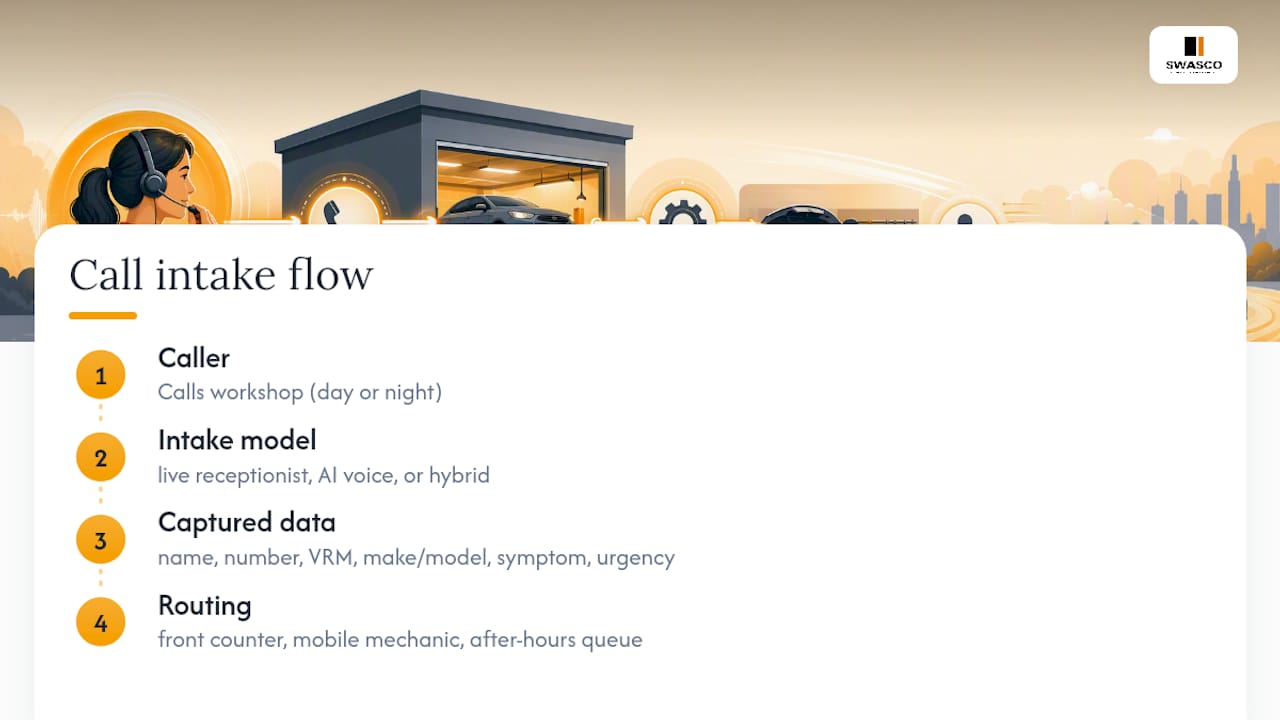
Three models cover most garages. A live receptionist service routes your calls to trained human agents who take messages, book slots and can handle a distressed customer with genuine empathy. An AI voice agent answers instantly, asks structured questions and books directly into your calendar, day or night. A hybrid setup lets AI handle routine bookings and after-hours triage, then hands trickier calls to a human.
Whichever model you pick, a decent service should capture the caller's name and number, the vehicle registration mark (VRM), make and model, the symptom in their own words, and how urgent it is. That data then needs to reach the right place, whether that's your front counter, a mobile mechanic's next stop, or an after-hours queue waiting for the morning shift. Automated intake systems can transcribe the call and post a structured record straight into your shop system as it happens.
Why call capture matters more than most garages think
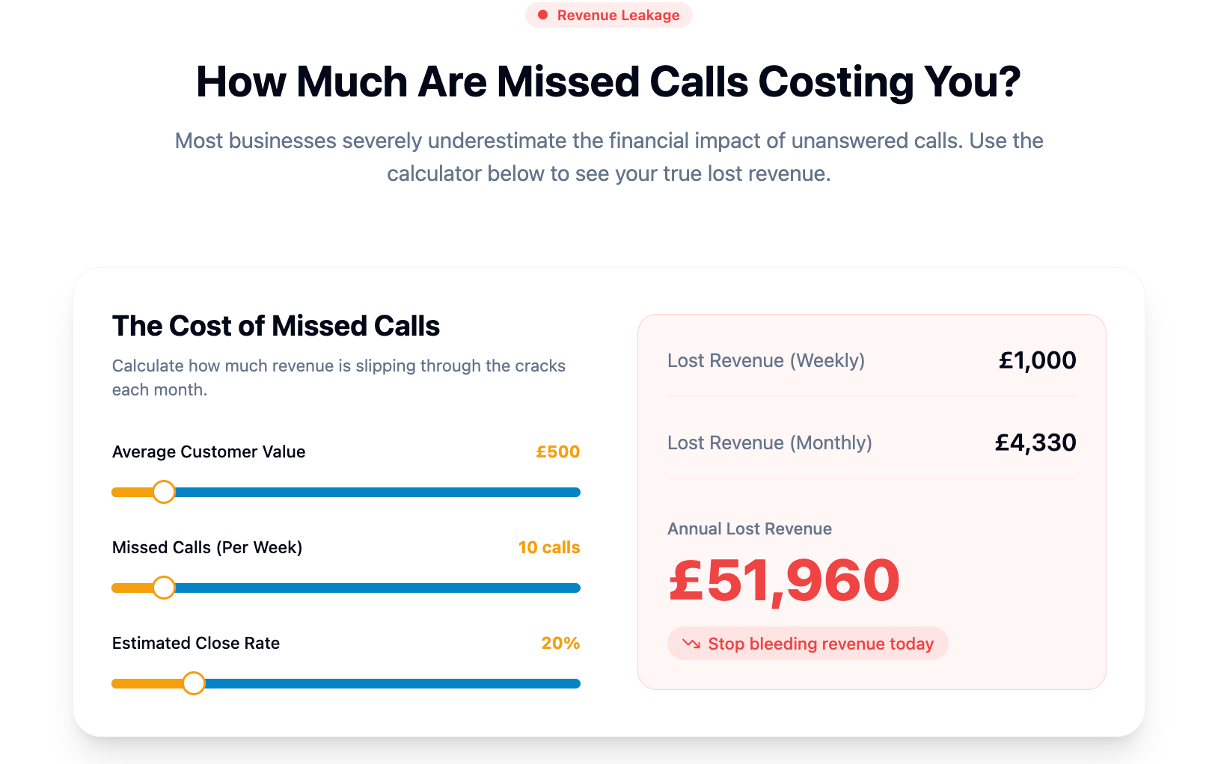
Every unanswered call is a job that might book with the garage down the road instead. Capturing every enquiry protects revenue you're currently losing without realising it, because a missed call rarely shows up as a line item, it just quietly doesn't become a booking.
The knock-on benefits stack up fast:
- Technicians and advisors stop dropping tools to answer the phone mid-job
- Fewer interruptions in the bay means fewer mistakes and faster turnaround
- Better first-call data (VRM, mileage, symptom) speeds up triage and cuts admin at check-in
- Automated confirmations and reminders reduce no-shows, which matters when a missed slot is dead time you can't recover
Vendor demos for AI voice agents built for auto shops show the agent checking live calendar availability and booking directly while the caller is still on the line, no callback needed, no game of phone tag.
Pro Tip: Track how many calls come in outside your opening hours for one week. Most garages underestimate this by a wide margin, and it's usually where the easiest wins sit.
How it works: the features that actually matter
The features worth checking on a demo aren't flashy. They're the ones that stop your data falling through the cracks.
- Vehicle and symptom capture — the system should record VRM, make, model and the fault described in the customer's own words, not a vague ticket
- Live booking with calendar sync — appointments should land directly in Google Calendar, Outlook, or your shop management software, with an SMS confirmation sent automatically
- After-hours and emergency triage — clear routing rules decide what waits until morning and what gets escalated immediately (a caller with a car that won't start on a motorway hard shoulder is not a "call back tomorrow" scenario)
- Call logging and posting — recordings and transcripts should feed into repair orders or a unified inbox, not sit in a separate system nobody checks
Automated Intake's capture setup demonstrates this well: vehicle year, make and model, the symptom described verbatim, and a signed webhook pushing the record into the shop system in real time. That last part matters more than it sounds, because it's the difference between a note someone might read and a service record that's already waiting when the car arrives.
Pro Tip: Ask any vendor to show you exactly where a captured call ends up. If the answer is vague, that's where your data will get lost too.
Manual, automated or hybrid: which model suits your operation?
The choice usually comes down to call volume, budget and how complex your typical enquiry is.
- Human agents bring genuine empathy and can navigate a complicated, emotional call (a written-off car, an insurance dispute) far better than a script. The trade-off is cost and limited hours; you're paying for a person's time, and that person needs to sleep.
- AI agents answer around the clock at a lower marginal cost and never miss a call because they're on lunch. The trade-off is nuance. An AI handles a routine booking well but needs clean escalation rules for anything genuinely unusual.
- Hybrid setups let AI take the routine bookings and after-hours triage, then route anything complex or distressed to a human. This tends to suit garages that get a mix of straightforward service bookings and the occasional roadside emergency.
In practice, solo mobile mechanics often do best with a lean AI or hybrid setup that handles bookings while they're under a car. Small workshops usually want hybrid, and multi-bay centres with higher call volume tend to lean further into automation simply to keep pace.
Choosing a provider: the checklist that saves you from a bad decision
Before you sign anything, run through this list on the demo call itself, not after.
- Does it capture VRM, make, model and symptom automatically, or does someone still need to type it in later?
- Does it write straight into your existing shop management system, or does it dump data somewhere you'll never check?
- What's the actual SLA for answer speed and after-hours coverage?
- Can you see reporting on answered calls, booked jobs and missed enquiries?
On the call, ask directly: "How do you handle a genuine emergency call at 2am?" and "Can I hear a sample transcript, not a script?" Vendors who can answer both without hesitation are worth a second look.
Pricing typically runs on either pay-as-you-go (you pay per call or per minute) or a monthly subscription with included minutes and coverage hours bundled in. Ansio's own pricing notes confirm both models exist in the sector, with cost driven mainly by hours covered, minutes included, and how many systems it needs to integrate with.
Pro Tip: Treat "no live demo available" as an immediate red flag. If a vendor won't show you a real call in real time, assume the finished product won't match the pitch either.
Reject anything with vague answers on data ownership, no clear integration path, or a refusal to let you test before committing.
Going live in 30 days without disrupting the bay
You don't need a big-bang launch. A staged rollout keeps the garage running normally while you test the new setup.
- Week 1: Forward your main line during quiet hours first, not straight into your busiest slot.
- Week 2: Set your scripts and escalation rules, particularly for emergencies and after-hours calls.
- Week 3: Integrate your calendar and shop management system, then run test calls with real scenarios.
- Week 4: Go fully live and start tracking answer rate, bookings from answered calls, callback time and no-show rate.
Most launch problems trace back to unclear escalation rules or a calendar that isn't syncing properly, both fixable within a day once spotted.
What "fully guided" onboarding means with Talk2Aiva
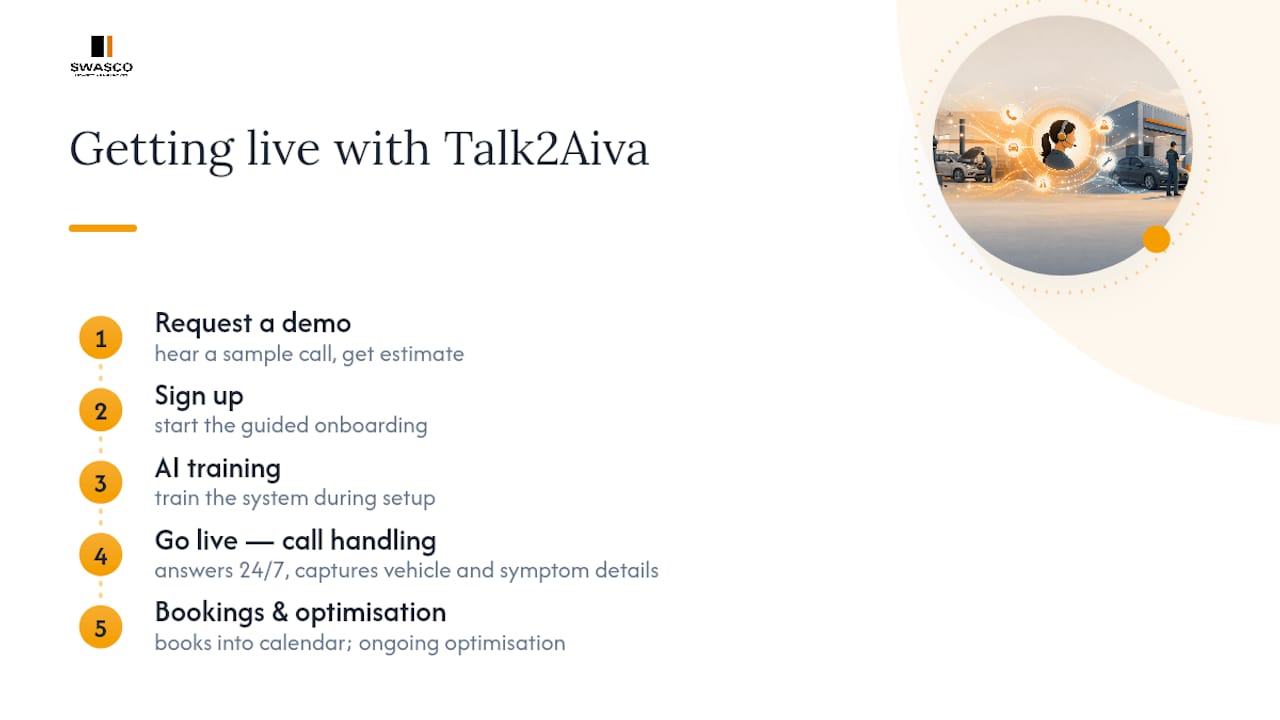
Talk2Aiva by SWASCO builds onboarding, AI training and workflow setup into the process itself, rather than leaving you to configure it alone. That includes a live launch phase and ongoing optimisation once you're running, which in practice means fewer scripts to write from scratch and less time spent tuning things after go-live. Swasco's own onboarding model is designed to shorten the gap between signing up and having real bookings handled automatically.
Why this matters more than most garage owners assume
Every missed call is a job someone else picks up. The simplest test isn't a spreadsheet exercise, it's running a call answering trial during your busiest week and watching what happens to your booking numbers. If the uplift is obvious within a fortnight, you've already found your answer.
— James Paul
Try Talk2Aiva for your garage's call handling
Talk2Aiva is the alternative to hiring extra front-desk staff or relying on voicemail: it answers every call around the clock, captures the vehicle and symptom details automatically, and books the job straight into your calendar, without you needing to be free to pick up the phone.
The setup includes guided onboarding, AI training and ongoing optimisation, so you're not left tuning scripts alone after launch. That guided approach can shorten the time from sign-up to real bookings being handled without you lifting a finger. If you want to see how follow-up messages and confirmations get automated alongside call handling, AI tools for small business workflows cover the wider picture well. For a deeper look at how the receptionist itself works day to day, the Talk2Aiva product breakdown walks through it in full.
The next step is simple: request a demo, hear a sample call handled live, and get a practical estimate of how quickly your garage could be live.
Sources
For deeper vendor detail, Automated Intake and ServiceGeni both offer live demos worth hearing before you decide.
FAQ
What Does a Car Repair Call Answering Service Typically Cost?
Pricing usually runs on either pay-as-you-go per-call rates or a monthly subscription with included minutes, and cost depends mainly on coverage hours and integrations rather than a flat industry rate.
What Is a Pay-As-You-Go Call Answering Service?
It's a pricing model where you pay per call or per minute handled rather than a fixed monthly fee, which can suit garages with lower or seasonal call volumes.
Is There a Free AI Phone Answering Option?
Most genuinely capable AI voice agents for auto shops are paid services, though several vendors offer a short trial period or a sample call so you can test the setup before committing.
How Do I Choose Between Human, AI and Hybrid Call Handling?
Match the model to your call volume and complexity: human agents suit emotionally complex calls, AI suits high-volume routine bookings, and hybrid setups like Talk2Aiva cover both by escalating unusual calls to a person while automating the rest.
What Happens to After-Hours Emergency Calls?
A properly configured service applies routing rules that immediately escalate genuine emergencies, such as a breakdown, while routine after-hours enquiries wait for a callback the next morning.