
When calls exceed what your live team can answer right now, the fix is a layered playbook: capture the caller's outcome first, offer a callback or safe deferral, then route to a fallback human or AI receptionist. That sequence stops the two things that actually cost you money: abandoned calls and silent re-contacts.
Here's what to change in the next 60 to 90 minutes:
- Turn on a callback offer at your busiest queue trigger point, even a basic "press 1 for a callback" IVR prompt.
- Check your average wait time trigger. If it's not set, or set above 90 seconds, that's your first fix.
- Confirm a fallback destination exists for every queue. No queue should dead-end in a busy tone.
- Pull today's abandon rate. If it's above a moderate threshold, you're already losing revenue, not just patience.
- Assign one named owner for callback follow-through. Unowned callbacks become a second, invisible queue.
Microsoft's own platform documentation on managing overflow sets out exactly this pattern: pre-queue and in-queue conditions that trigger a direct callback, a transfer to another queue, voicemail, or an external number. The rest of this guide walks through the configuration choices, the KPIs that tell you if it's working, and a 30/90-day rollout checklist, including where a managed option like Talk2Aiva fits as your permanent fallback layer.
Key Takeaways
Effective call overflow management pairs capture-first configuration (callbacks, fallback routing, voicemail with follow-up) with workforce fixes and distributional KPI monitoring, not ASA alone.
| Point | Details |
|---|---|
| Capture before connecting | Always offer a callback, voicemail, or fallback route before attempting to connect a caller during overflow. |
| Split pre-queue and in-queue triggers | Use pre-queue rules for known capacity limits and in-queue rules like average wait time for dynamic congestion. |
| Preserve callback fairness | Configure callbacks to keep the caller's original queue position, and assign a named owner to the callback list. |
| Track distributions, not averages | Monitor service level and abandon rate patterns instead of relying on ASA alone to judge caller experience. |
| Use Talk2Aiva as your fallback layer | Talk2Aiva offers 24/7 call capture, lead qualification, and calendar-synced callback booking as a managed alternative to an unattended overflow queue. |
Table of Contents
- What is call overflow management and why it differs from a spike
- How overflow damages your KPIs, your customers and your budget
- What actually causes persistent call overflow
- The layered playbook: what actually stops lost calls
- Getting queued callbacks right without creating a second backlog
- Configuring overflow triggers: pre-queue rules versus in-queue rules
- The KPIs and alerts that catch overflow before it becomes a crisis
- Your 24-hour, 30-day and 90-day rollout plan
- How Talk2Aiva prevents lost calls when your team can't keep up
- What experienced contact-centre leads get wrong about overflow
- Ready to stop overflow from costing you customers?
- Where to go for deeper configuration reference
- Sources
What is call overflow management and why it differs from a spike
Call overflow happens when demand persistently exceeds the capacity you have available right now, not just for a few minutes but for a sustained stretch of the day. That distinction matters more than most teams realise, because a short spike and true overflow need completely different responses.
A spike is a burst. Maybe a marketing email goes out at 9am and you get forty calls in fifteen minutes, then it settles. Overflow is what happens when that pattern doesn't settle. It's a queue that stays over its work-item limit for an hour, two hours, or the whole afternoon shift. Repeat callers start showing up (the same person dialling three times because their first two attempts got dropped), your abandon rate climbs steadily rather than spiking and recovering, and your re-contact volume the next day increases because unresolved issues don't disappear.
Take a platform-level example. When a queue in Microsoft's unified routing hits its configured work-item limit, the system can trigger an immediate action, such as a direct callback offer or a transfer to a fallback queue, based on a pre-set condition. A momentary surge might trip that limit for ninety seconds and clear on its own. Genuine overflow trips it repeatedly across a shift, which tells you the underlying capacity problem is structural, not a blip.
This matters for measurement too. Average speed of answer only tells the full story when it's calculated from the caller's actual queuing start, including time spent in overflow states, not just the time an agent was actively engaged. Measure it any other way and you'll systematically underestimate how bad the caller experience actually is.
How overflow damages your KPIs, your customers and your budget
Overflow doesn't just create a bad five minutes for one caller. It quietly degrades nearly every metric you report on, and it hides the damage unless you're looking at the right numbers.
The direct hits are predictable once you know where to look:
- Abandon rate climbs as wait times stretch, and callers who hang up rarely just give up. Many redial within the hour, adding load you didn't plan for.
- Average speed of answer (ASA) gets distorted because an average hides the tail. A queue with mostly fast answers and a handful of ten-minute waits can still report a "healthy" ASA.
- Service level slips below target, and once it does, the gap is hard to claw back within the same shift.
- First-call resolution (FCR) drops because agents rushed by overflow queues take shortcuts to clear the backlog.
- CSAT falls, often more from the wait itself than from anything the agent did wrong.
- Agent occupancy spikes, and sustained high occupancy is a well-documented driver of burnout and turnover.
ICMI's standard KPI framework treats service level, ASA, abandon rate, occupancy, AHT, FCR and CSAT as the core dashboard for exactly this reason: each one moves when overflow hits, and together they show the pattern an ASA figure alone will miss.
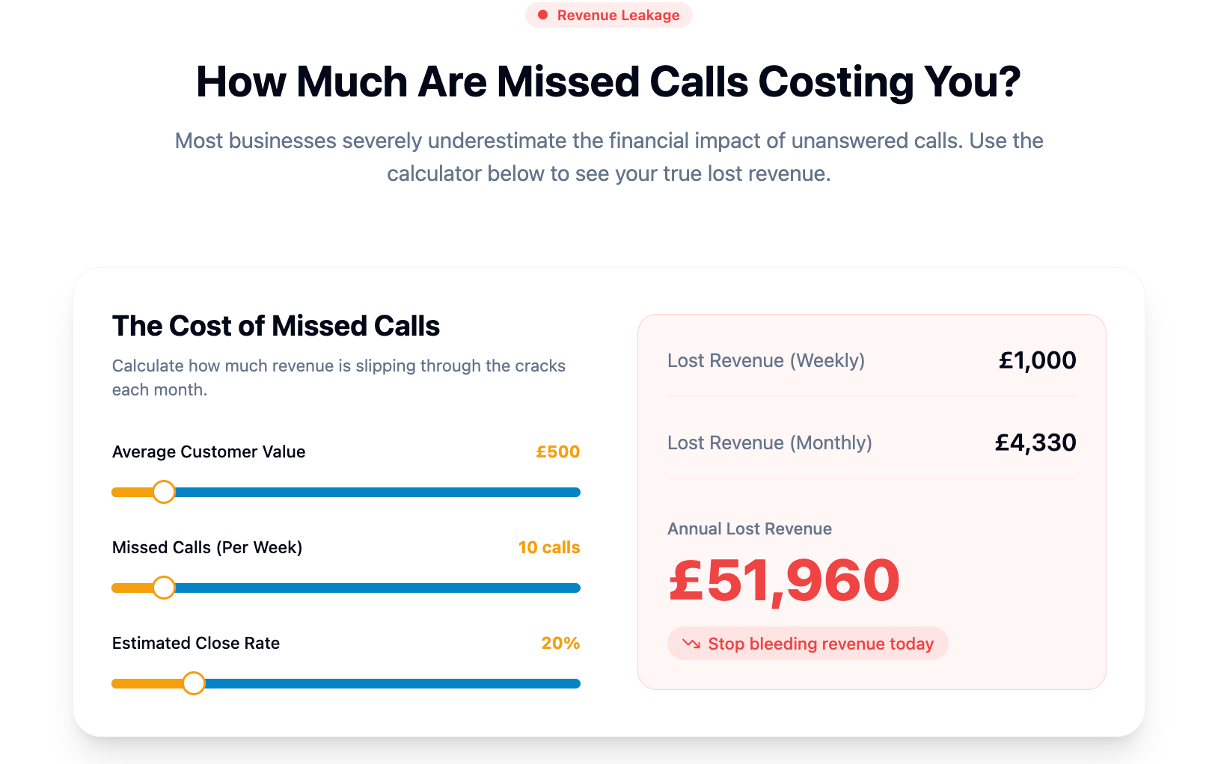
The hidden costs are the ones that don't show up on a live dashboard at all. Every abandoned call that represents a genuine sales enquiry or a customer with an unresolved problem becomes a re-contact, a lost booking, or in the worst case, a customer who simply calls your competitor instead. Abandonment rates vary meaningfully by operating model. Erlang-based modelling guidance notes that once abandonment becomes material to your queue behaviour, standard Erlang-C staffing formulas actively overstate how many agents you need, because Erlang-C assumes callers have infinite patience. They don't. Plan around Erlang-A or simulation instead once abandonment starts shaping outcomes.
What actually causes persistent call overflow
Overflow rarely comes from one thing going wrong. It's usually two or three factors compounding at once, and diagnosing which ones you have determines whether the fix is a staffing change, a routing change, or a messaging change.
Run through this checklist against your last month of reporting:
- Forecasting error. Your workforce plan assumed a call pattern that didn't match reality, whether from underestimating a seasonal lift or missing a slow structural rise in volume.
- Shrinkage. Breaks, training, coaching sessions and absence eat into planned capacity, often without adjustment to the original headcount plan.
- Single-point routing. All calls funnel through one queue or one skill group with no overflow path to a secondary pool.
- IVR misroutes. Callers select the wrong option, or the menu itself pushes too much volume into one branch, overloading a single queue while others sit quiet.
- Blended dialling conflicts. Outbound campaigns pull agents away from inbound queues at exactly the moment inbound volume rises.
- Technical failures or outages. A carrier issue, a CRM outage, or a broken integration slows every call down, which compounds queue length fast.
- Unplanned campaigns. Marketing, PR, or even a viral social post drives volume nobody forecast.
Each cause points to a different fix type. Forecasting error and shrinkage need workforce management (WFM) adjustments. IVR misroutes and single-point routing need configuration changes. Technical failures need a fallback pathway that doesn't depend on the broken system. To detect which one you're dealing with, run an intraday adherence report against actual call arrival patterns, check IVR menu selection reports for lopsided branch volumes, and look at Cisco's overflow-in and overflow-out reporting concepts to separate calls that overflowed and were recovered from calls that overflowed and were simply lost.
The layered playbook: what actually stops lost calls
Capture the outcome first, then attempt live handling. That ordering sounds backwards to teams used to prioritising "answer the phone" above everything else, but it's the single biggest shift that reduces lost revenue from overflow. A callback offer or a voicemail with a guaranteed follow-up window preserves the enquiry even when no agent is free. Silence loses it completely.
Workforce actions solve the capacity side of the equation:
- Short-term reassignment of agents from lower-priority queues during known peak windows.
- Surge staffing or split shifts that add capacity for predictable busy periods (Monday mornings, post-holiday weeks, seasonal peaks).
- Longer-term forecasting improvements using historical arrival patterns rather than static monthly averages.
Routing and IVR actions solve the distribution side:
- Pre-queue overflow rules that redirect callers before they ever enter an overloaded queue.
- Dynamic skill-based routing that opens secondary agent pools automatically once a primary queue crosses its threshold.
- Escalation paths to a backup pool or supervisor group for calls that have already waited past an acceptable threshold.
Automation actions absorb what people and routing alone can't:
- Callback offers that let the caller keep their place without staying on the line.
- Queued callbacks that preserve the caller's original position, discussed in detail below.
- Self-service options (IVR account lookups, a knowledge base link via SMS) for enquiries that don't need a live agent at all.
- An AI receptionist fallback for after-hours or fully saturated queues, so no call ever hits dead air.
Each layer carries a trade-off, including routing some calls to an AI receptionist & phone automation solution for after-hours or fully saturated queues. Surge staffing costs money and takes lead time to arrange. Skill-based routing needs upfront configuration and clean skill tagging, or it misroutes calls just as badly as no routing at all. Self-service only works for enquiry types that genuinely don't need a human. Build your playbook by matching the layer to the cause you diagnosed, not by deploying all of them everywhere at once.
Pro Tip: Prioritise callbacks by original queue start time, not by the order they were requested. A caller who waited four minutes before requesting a callback has already earned priority over someone who requested one after thirty seconds. Getting this backwards is one of the most common (and most invisible) sources of caller complaints about fairness.
Getting queued callbacks right without creating a second backlog
Configure callbacks to preserve the caller's original queue start time, or set an explicit, documented priority rule. Either works. What doesn't work is leaving the default settings unexamined, because a poorly configured callback queue simply becomes a second, less visible backlog that's easier to ignore than the live queue.
There are two broad callback modes, and the choice affects your agents' day directly:
- Agent-first callbacks dial the agent first, then connect the caller once the agent is live. This protects agent time but adds a small delay before the caller hears a human voice.
- Customer-first callbacks dial the caller first, holding the agent connection until the customer picks up. This feels more responsive to the caller but risks agent idle time if the customer doesn't answer promptly.
On retry settings, Amazon Connect's queued callback configuration documents the mechanics worth borrowing regardless of your platform: an initial delay before the first attempt, a maximum number of retries, and a minimum gap between attempts. Callbacks also count towards your overall queue limits, so a callback backlog left unmanaged can itself trigger further overflow, which is exactly the trap that catches teams who treat callbacks as a "set it and forget it" feature.
Two configuration decisions matter more than the rest. First, whether callback priority matches the original inbound priority (fairness-first) or sits deliberately lower so live calls never wait behind a backlog of callbacks (throughput-first). Amazon Connect's guidance frames this explicitly as a trade-off between preserving order and preventing callbacks from blocking live inbound work during sustained high load. Second, set a retention window. Callbacks left unhandled for too long should be flagged or removed rather than sitting silently in a queue nobody's tracking.

Pro Tip: Build a duplicate-prevention check into your callback flow. Without one, a caller who requests a callback and then rings back live ends up with two open records, which inflates your queue counts and confuses whoever owns follow-through.
Configuring overflow triggers: pre-queue rules versus in-queue rules
Use pre-queue triggers to handle predictable overload before a caller ever joins a queue, and in-queue triggers to handle congestion that builds dynamically while calls are already waiting. Getting this split right is the difference between overflow rules that feel proactive and rules that only ever react after the damage is done.
Pre-queue triggers fire based on conditions you can check the moment a call arrives: is this queue already at its work-item limit, is it currently outside business hours, has a known outage been flagged. In-queue triggers fire based on what's happening to calls already waiting: average wait time creeping past a threshold, or queue length climbing past a set number of items. Microsoft's overflow documentation for unified routing supports both types on the same channel, which means you can layer a pre-queue check with an in-queue check on top of it for the same queue.
| Trigger type | Typical threshold range | Recommended action |
|---|---|---|
| Pre-queue: work-item limit reached | Queue already at or near configured capacity | Transfer to a secondary queue or fallback pool immediately |
| Pre-queue: out-of-hours | Outside defined operating hours | Route to voicemail, AI receptionist, or scheduled callback |
| In-queue: average wait time | 60 seconds, tuned to your service level target | Offer a callback or transfer to an available skill group |
| In-queue: queue length | Above a set number of concurrent waiting items, calibrated to team size | Trigger overflow to a backup pool or external number |
| In-queue: repeated short abandons | Rising short-abandon count within a rolling window | Flag for early-warning review, tighten a downstream trigger |
Start your average wait time trigger conservatively in a sensible range, then tune it against your actual service level target rather than a generic industry number. If your target is "80% answered within 20 seconds," a 90-second in-queue trigger gives you an early-warning buffer before you reach that target, not after.
A common flow example: a queue has a pre-queue check for its work-item limit, and if it passes that, an in-queue average wait trigger set at 90 seconds. If the wait trigger fires, the caller is offered a callback that preserves their original queue position. If the work-item limit itself is breached, the call skips straight to a fallback queue or an AI receptionist, no wait threshold required. That layering means slow degradation gets a softer response (a callback offer) while hard capacity limits get an immediate redirect. Some platforms also batch-process overflowed items when many arrive in a short window, prioritising queues with the shortest wait time first, so keeping priority settings consistent across queues avoids one queue perpetually losing out to another during a mass overflow event.
The KPIs and alerts that catch overflow before it becomes a crisis
Focus on distributional service-level metrics and abandonment patterns, not on ASA in isolation. A single average number will always hide the caller who waited eight minutes behind three who waited eight seconds, and that hidden caller is exactly the one who abandons, re-contacts, and leaves a bad review.
The essential metrics to track daily:
- Service level, expressed as a percentage answered within a target number of seconds, not as an average.
- Abandon rate, ideally adjusted for short abandons (callers who hang up within the first few seconds and were never really "waiting").
- Offered versus answered volume, to spot when demand is simply outpacing every capacity lever you've pulled.
- Queued callback volume and fulfilment time, so callbacks don't quietly become the new overflow.
- Occupancy, watched for sustained highs that signal burnout risk rather than efficient utilisation.
- Forecast variance, comparing predicted versus actual call arrivals to catch forecasting drift early.
- Re-contact volume, the clearest signal that overflow from yesterday is still unresolved today.
Set alert thresholds that trigger before a shift is already lost. A workable starting rule: alert if abandon rate is elevated for two consecutive 15-minute intervals, or if average wait time crosses your in-queue trigger threshold for the same duration. Call Centre Helper's analysis of ASA versus service level makes the case plainly: relying on ASA alone masks the distribution of wait times that service level and abandon rate expose far more honestly.
Monitoring cadence matters as much as the metrics themselves. Real-time dashboards should surface abandon rate and queue length to the floor supervisor. Near-real-time reporting (every 15 to 30 minutes) should go to the shift manager, with authority to trigger surge staffing or open a fallback queue. Daily reporting, reviewed by the operations lead, should track forecast variance and re-contact volume, the two metrics that reveal whether yesterday's overflow is still costing you today.
Your 24-hour, 30-day and 90-day rollout plan
Act immediately on capture behaviours. Everything else, routing improvements, forecasting fixes, automation rollouts, comes after you've stopped the immediate bleeding of calls that simply vanish with no follow-up.
In the next 24 hours:
- Update your IVR message to acknowledge longer-than-usual wait times honestly, rather than leaving callers on silent hold.
- Turn on the callback toggle for your highest-volume queue if it isn't already active.
- Confirm a working fallback number or voicemail exists for every queue with no dead ends.
- Assign a named owner for reviewing captured callbacks and voicemails each shift.
Within 30 days:
- Document routing playbooks for each queue, including exactly which trigger fires which action.
- Adjust workforce management shift patterns based on the forecast variance you've now started tracking.
- Test your callback flow end-to-end, including retry settings and duplicate prevention.
- Review IVR menu selection data and fix any branch that's clearly overloaded relative to others.
Within 90 days:
- Move staffing models to Erlang-A or simulation-based forecasting if abandonment is materially affecting your numbers.
- Evaluate automation options for after-hours and peak-hour fallback, including a pilot of a managed AI receptionist.
- Review 90 days of overflow-in and overflow-out reporting to confirm the fixes actually reduced lost calls rather than just relocating them.
| Phase | Owner | Success metric | Expected impact |
|---|---|---|---|
| 24-hour capture fixes | Shift supervisor | Reduction in unhandled voicemails and silent abandons | Immediate drop in fully lost enquiries |
| 30-day routing and WFM tuning | Operations manager | Abandon rate and forecast variance trending down | Improved service level within two to three weeks |
| 90-day modelling and automation pilot | Contact centre lead | Callback fulfilment time and answered-rate increase | Sustained reduction in re-contact volume |
Test every threshold change on a single queue before rolling it out centre-wide, and validate against a full week of data (including your worst day) before calling any fix final.
How Talk2Aiva prevents lost calls when your team can't keep up
Talk2Aiva acts as a managed fallback layer that captures the outcome, qualifies the lead, and books a follow-up, 24 hours a day, exactly at the point where your overflow triggers would otherwise send a caller to a dead voicemail or a busy tone. It's the automation layer described in the playbook above, built specifically for service businesses that can't staff every peak and every after-hours call with live agents.
The features that map directly onto overflow scenarios:
- 24/7 answering across calls, SMS, website chat and social media, so overflow outside business hours doesn't just become tomorrow's backlog.
- Instant call capture and lead qualification, so an overflowed enquiry doesn't sit unattended waiting for a callback slot.
- Callback scheduling with calendar sync, keeping the caller's booking intent alive rather than losing it to a missed connection.
- Automated follow-ups, including review requests, so a captured lead doesn't go cold after the first contact.
- A unified inbox, pulling every channel into one place so nothing captured during overflow gets missed by whoever picks it up next.
In practice, this shows up in three common overflow scenarios: a dental practice whose phones overflow during lunch-hour bookings, an estate agent whose evening enquiries currently go to voicemail and sit unanswered until morning, and a home services business whose call volume spikes after a local storm and swamps a two-person office. In each case, the pattern from earlier in this guide (capture first, defer safely, route to fallback) is exactly what Talk2Aiva's AI receptionist is built to execute automatically. Onboarding covers setup, AI training on your specific services and tone, workflow building for your booking and follow-up process, a live launch, and ongoing technical support, so the system doesn't sit as an unconfigured tool nobody trusts.
What experienced contact-centre leads get wrong about overflow
Two patterns show up again and again in overflow post-mortems, and neither is a technology gap. The first is treating overflow as a routing problem when it's actually a fairness and ownership problem. Teams build elaborate skill-based routing trees, then let callback queues sit unowned, and the callback queue becomes the place where enquiries genuinely die. The second is trusting ASA as a health check when it's actively hiding the problem you most need to see. A queue can report a respectable average speed of answer while a meaningful share of callers waited well past your service level target and simply aren't in that average because they abandoned before being counted.
The fix for both isn't more technology. It's discipline in how you configure and audit what you already have. Every overflowed contact needs a recorded trigger, a recorded action, a named owner, and a final disposition. Skip any one of those four and you've built a system that looks resilient on a dashboard and quietly loses enquiries in practice.
Pro Tip: Reserve a small backup agent pool that only activates once your primary queue's in-queue trigger fires, rather than distributing all agents evenly across every queue by default. A dedicated backup pool prevents the cascading failure where one overloaded queue starves every other queue of the agents needed to absorb its own overflow.
The most common implementation mistake worth naming directly: teams launch callback functionality, celebrate the configuration as "done," and never assign anyone to own the callback list day-to-day. A callback with no owner is functionally the same as no callback at all. It just delays the moment the caller realises nobody's coming back to them, and by then, the damage to trust is worse than an honest busy signal would have been.
Ready to stop overflow from costing you customers?
Everything in this guide, pre-queue triggers, callback logic, backup agent pools, gets you closer to zero lost calls, but each layer still depends on someone configuring it correctly and keeping it maintained. Talk2Aiva removes that maintenance burden by acting as a fully managed fallback that's already trained, already integrated, and already answering the moment your queues hit capacity.
Before trialling any AI receptionist or answering service, ask a few pointed questions: does it preserve queue fairness for callbacks, does it qualify leads rather than just take a message, does it sync with your existing calendar and CRM, and what happens to a captured enquiry after hours when nobody's watching the inbox. Talk2Aiva is built to answer yes to all four, with onboarding, AI training on your specific business, workflow building, a live launch, and ongoing optimisation and support included rather than left to you to figure out. If you're losing enquiries to overflow right now, the fastest way to find out what a managed fallback recovers is to see it configured against your own call patterns. Visit Swasco to start that conversation.
Where to go for deeper configuration reference
The technical detail behind this guide comes from vendor documentation and industry KPI standards, each useful for a different part of implementation:
- Microsoft's overflow management documentation for exact pre-queue and in-queue configuration steps.
- Amazon Connect's queued callback setup guide for retry, delay and priority settings.
- ICMI's KPI reference for standard metric definitions, including how ASA should be measured.
- WFM Labs on abandonment for staffing model guidance once abandonment materially affects your queues.
- Cisco's reporting concepts for overflow and abandoned calls for distinguishing recovered overflow from permanently lost calls.
Use the vendor documentation for exact configuration syntax, the KPI reference for how to define and report your metrics consistently, and the abandonment and reporting sources for the modelling and diagnostic side of the work.
Sources
- Manage overflow of work items in queues
- # Set up queued callback by creating flows, queues, and routing profiles in Connect Customer
- CCMetricsKPIs.pdf
- Abandonment_Rate
- Reporting concepts for Cisco Unified ICM — short calls, abandoned and overflow calls