
For UK service businesses, the safest AnsweringAgent.com alternative is a guided AI receptionist that combines GDPR-ready data residency, UK local numbers, and hands-on onboarding. Talk2Aiva by SWASCO is the recommended option for service businesses wanting all three without managing the technical setup themselves.
Three solution categories are worth trialling:
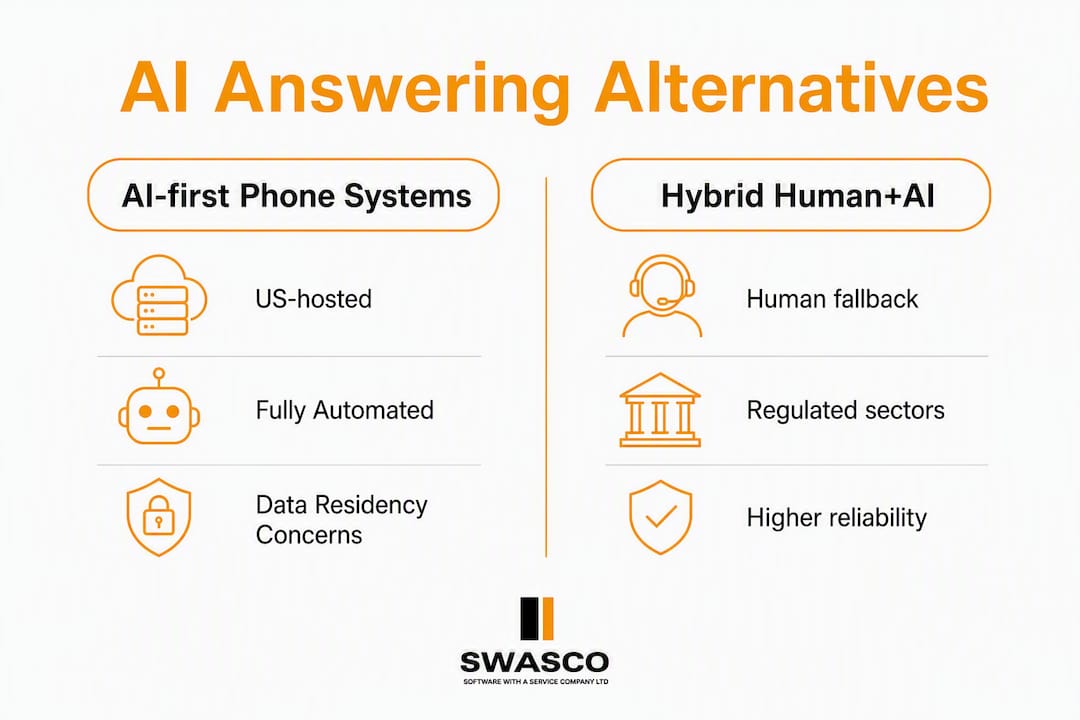
- AI-first phone systems — best for businesses that want full automation with no human agents and low monthly costs
- Hybrid human+AI receptionists — best for teams that need a human fallback for complex or sensitive calls
- Platform-integrated answering services — best for businesses already on a telephony platform (such as RingCentral or CloudTalk) that want to add AI answering as a bolt-on
TL;DR — what to check before you commit:
- Does the vendor hold a signed Data Processing Agreement (DPA) and offer UK data residency? If not, walk away.
- Can they provision or port a UK local number on day one?
- Is onboarding guided and included, or will you be left to configure the system yourself?
- Is there a live-traffic pilot of 7–14 days before you pay full price?
Table of Contents
- How the main alternatives compare at a glance
- What each alternative category actually delivers for UK businesses
- How to choose the right AI phone-answering provider for your UK business
- Switching from your current setup: what to expect
- What pricing and trial offers look like for UK buyers
- How Talk2Aiva handles AI receptionist onboarding for UK service businesses
- What UK buyers say: reputation and reviews across the market
- Which UK business tools and CRMs do these systems integrate with?
- Does your provider offer UK-hours support?
- Security standards beyond GDPR: what UK businesses should check
- Key takeaways
- The onboarding gap nobody talks about
- Talk2Aiva: stop losing revenue from missed calls
- Useful sources and further reading
How the main alternatives compare at a glance
Industry roundups consistently group AI answering solutions by delivery model rather than by a single best vendor, and recommend selecting by use-case and compliance needs. The table below uses that same logic.
| Dimension | AI-first phone systems | Hybrid human+AI | Platform add-ons | Talk2Aiva (SWASCO) |
|---|---|---|---|---|
| Best for | Simple inbound call automation | Teams needing human escalation | Existing telephony platform users | UK service SMEs wanting done-for-you AI |
| GDPR / ICO | Varies widely; check DPA | Usually stronger (UK-staffed agents) | Depends on parent platform | ICO-compliant; DPA included |
| UK local numbers | Often available; confirm on sign-up | Yes, typically included | Yes, via parent platform | Yes, provisioned during onboarding |
| Channels | Calls, SMS | Calls, sometimes chat | Calls, SMS, video | Calls, SMS, website chat, social media |
| AI vs human fallback | AI only | AI triage + human agent | AI add-on; human via platform | AI primary; human escalation configurable |
| Onboarding & support | Self-serve or minimal | Moderate; agent training required | Minimal; DIY configuration | Fully guided; ongoing optimisation included |
| Integrations | Basic CRM; limited calendar sync | CRM common; calendar varies | Deep platform integrations | Calendar sync, CRM, unified inbox |
| Pricing / trial | Monthly subscription; free trial common | Per-minute or monthly; demo available | Licence + usage; trial via platform | Subscription tiers; pilot included |
| SLA / reporting | Basic uptime; limited reporting | SLA common; call recording | Platform SLA; reporting via dashboard | SLA monitoring; KPI reporting during pilot |
One-line trade-offs:
- AI-first systems are the most affordable but require you to self-configure compliance and integrations.
- Hybrid services offer the strongest human fallback but cost more per minute and introduce data-handling complexity if agents are offshore.
- Platform add-ons suit businesses already invested in a telephony stack but rarely include guided onboarding.
Critical compliance check for UK buyers: Before signing any contract, confirm the vendor can provide a signed DPA, state where your call data is stored, and confirm ICO registration. Compliance checks are a gating item in every credible buyer guide — a vague answer here is a procurement red flag, not a minor detail.
What each alternative category actually delivers for UK businesses
AI-first phone systems
These are purpose-built to handle inbound calls without any human agent. The AI answers, qualifies the caller, books appointments, and sends follow-up messages. Roundups that tested these services found they work well for straightforward use cases: appointment booking, FAQ handling, and lead capture. Where they struggle is with nuanced or emotionally sensitive calls, and with GDPR compliance documentation, which is often thin or US-focused.

For UK buyers, the key question is data residency. Many AI-first systems are US-hosted, which creates complications under UK GDPR if personal data is transferred outside the UK without adequate safeguards.
Pro Tip: Ask the vendor directly: "Where is call audio and transcript data stored, and can you provide a UK-GDPR-compliant DPA?" If they hesitate or send you a generic privacy policy, that is your answer.
Hybrid human+AI receptionists
Hybrid services use AI to triage and route calls, then hand off to a human agent when the conversation requires judgement. Moneypenny is a well-known UK example in this category, with UK-based agents and strong compliance credentials. The trade-off is cost: per-minute billing adds up quickly for high-volume businesses, and the human element means you are partly dependent on agent availability and training quality.
For businesses in regulated sectors (legal, healthcare, financial services), the human fallback is often worth the premium. For a busy salon or home-services firm, it may be more than you need.

Telephony platform add-ons
Platforms such as RingCentral and CloudTalk offer AI answering as a feature within a broader telephony suite. Cognigy sits in a related space as an enterprise-grade conversational AI platform that can be layered onto existing contact-centre infrastructure. Vertical-specialist solutions in this category often include pre-built workflow templates that accelerate onboarding for appointment-heavy businesses.
The limitation is flexibility. You are buying into the platform's ecosystem, and if the AI answering module is a bolt-on rather than a core product, it tends to receive slower updates and thinner support.
Pro Tip: If you are already on RingCentral or CloudTalk, test the native AI answering module before switching providers. The integration savings may outweigh the feature gap.
"Buyers frequently over-index on headline AI features and under-index on onboarding; vendors that bundle guided training and workflow build tend to achieve better outcomes faster." — AI answering service research, 2026
How to choose the right AI phone-answering provider for your UK business
Prioritise GDPR/ICO proof, UK local-number coverage, and a hands-on onboarding plan. Everything else is secondary until those three boxes are ticked.
Step-by-step evaluation
- Map your requirements. List your inbound call volume, peak hours, channels needed (calls only, or SMS and chat too), and the CRM or calendar you use. This prevents you from being sold features you will never use.
- Check compliance evidence first. Request the vendor's DPA, ask for their ICO registration number, and confirm where data is stored. Industry directories flag this as a non-negotiable gating item before any other evaluation.
- Test UK number availability. Confirm the vendor can provide or port a UK local number before the pilot starts. A US number on your website signals to callers that something is off.
- Run a live-traffic pilot. A brief pilot on real inbound calls provides more insight than any demo. This approach consistently beats feature checklists alone for identifying fit.
- Review SLA and exit terms. Check minimum contract length, data deletion on exit, and what happens to your number if you leave.
Questions to ask vendors on a sales call
- Where is call data stored, and is UK data residency available?
- Can you share your ICO registration number and a sample DPA?
- How long does onboarding take, and what does your team do versus what we configure ourselves?
- What does a successful pilot look like, and how do you measure it?
- What is the escalation path if the AI cannot handle a call?
Red flags to walk away from: vague compliance answers, no UK phone numbers, no trial or pilot option, limited CRM integration, and no clear human escalation path.
Switching from your current setup: what to expect
A focused migration from an existing AI answering setup typically completes in 1–4 weeks, provided you have a clear onboarding plan and a vendor who handles the technical heavy lifting.
What usually transfers:
- UK phone numbers (via porting — allow 5–10 working days)
- IVR call flows and routing rules
- Call recordings, where your DPA permits transfer
- Custom FAQs and call scripts
- CRM and calendar integration credentials
What typically needs rebuilding:
- AI conversational training datasets (these are model-specific and rarely portable)
- Bespoke automation workflows
- Qualification rules and lead-scoring logic
Migration timeline
- Discovery and DPA sign-off (days 1–3): document current setup, sign new DPA, confirm data handling.
- Number porting or provisioning (days 3–10): initiate port request or provision new UK number.
- AI training (days 5–18): feed historical call transcripts or scripts into the new system.
- Pilot on diverted live traffic (days 14–21): run real calls through the new system with monitoring.
- Staged go-live (day 21 onwards): full launch with SLA monitoring and overlap period.
Pro Tip: Keep your previous provider active for a 5–7 day overlap after go-live. This costs a small amount but eliminates the risk of missed leads if something needs adjusting at launch.
What pricing and trial offers look like for UK buyers
Expect three billing models: flat monthly subscription, per-minute or credit-based usage, and platform licence plus usage. Pricing structures split by usage and service level rather than by dramatic feature differences across the market.
Typical price bands for UK service SMEs:
- Entry-level AI-first systems: £30–£100/month, covering a set number of minutes or calls, basic integrations, and one UK number.
- Mid-tier AI with integrations: £100–£300/month, including CRM sync, calendar booking, SMS, and more minutes.
- Hybrid human+AI: often per-minute (typically £1.00–£2.50/minute) plus a monthly base fee.
- Enterprise or managed services: custom pricing, usually with a dedicated onboarding team and SLA guarantees.
| Billing model | Best for | Watch out for |
|---|---|---|
| Flat monthly subscription | Predictable call volumes | Overage charges above minute cap |
| Per-minute / credit | Variable or seasonal call volumes | Costs spike during busy periods |
| Platform licence + usage | Existing telephony platform users | Setup fees and integration costs |
Billing notes for UK buyers:
- VAT at 20% applies to SaaS subscriptions for UK-registered businesses.
- Annual billing typically saves 15–20% versus monthly, but check exit terms before committing.
- Setup fees are common on managed or hybrid services; confirm whether onboarding is included or billed separately.
A good pilot provides live traffic over several days, measures contact rate and booking conversion, and includes vendor support throughout. Cost savings versus hiring full-time staff and customer experience metrics are the dominant ROI arguments in buyer guidance, so build those into your pilot success criteria from day one.
How Talk2Aiva handles AI receptionist onboarding for UK service businesses
Talk2Aiva offers fully guided onboarding, AI training, workflow building, and ongoing optimisation with UK considerations built in from the start: ICO compliance, UK local numbers, and support during UK business hours.
Onboarding steps at a glance:
- Discovery call and requirements mapping
- DPA sign-off and data documentation
- UK number provisioning or porting
- AI conversational training using 2–4 weeks of historical call or text cases where available
- Pilot on diverted live traffic for 7–14 days, measuring contact rate, qualified lead rate, and booking conversion
- Staged live launch with SLA monitoring
- Ongoing optimisation and support included post-launch
The pilot measures three KPIs: contact rate (calls answered or routed to a human), qualified lead rate (callers who match your qualification rules), and booking conversion rate (appointments created and synced to your calendar). These are the metrics that tell you whether the system is recovering revenue, not just answering calls.
"From onboarding and setup to AI training, workflow building, live launch, ongoing optimisation and technical support — the entire process is designed to help businesses implement AI confidently, professionally and with continued support included." — Talk2Aiva by SWASCO
Talk2Aiva covers calls, SMS, website chat, and social media from a single unified inbox, with mobile app notifications so you never miss an escalation. For service businesses that want to understand how AI call handling works before committing, the underlying mechanics are worth reviewing before your first vendor call.
Pro Tip: During any demo or pilot, ask the vendor to record a live call and debrief it with you within 24 hours. This single exercise reveals more about AI quality and support responsiveness than any feature list.
What UK buyers say: reputation and reviews across the market
Third-party review platforms such as G2 and Capterra are the standard starting point for UK buyers evaluating virtual answering services. Review-platform presence is useful but not decisive without corroborating case studies and SLA evidence, so treat star ratings as a filter, not a verdict.
Moneypenny consistently draws positive reviews from UK businesses for its human-agent quality and local knowledge. Platform-based solutions like RingCentral and CloudTalk receive strong marks for reliability and integration depth, but mixed feedback on AI answering quality specifically. Cognigy is rated highly in enterprise contexts but rarely reviewed by SMEs, reflecting its positioning.
For AI-first systems, G2's alternatives listings show a wide range of satisfaction scores, with onboarding quality and compliance documentation being the most common differentiators in positive reviews. Negative reviews cluster around two themes: poor AI handling of complex calls, and slow or absent support when something goes wrong.
The practical takeaway: check reviews specifically for businesses in your sector and of your size. A five-star review from an enterprise contact centre tells you little about how the system performs for a 10-person estate agency.
Which UK business tools and CRMs do these systems integrate with?
Integration depth is often the real automation win: a system that books and syncs appointments every time reduces admin overhead more than incremental improvements in conversation quality alone.
Common UK business tools that AI answering services integrate with include Salesforce, HubSpot, Zoho CRM, and Microsoft Dynamics for CRM; Google Calendar and Microsoft Outlook for scheduling; and Zapier or Make (formerly Integromat) for custom workflow connections. For sector-specific tools, look for native integrations with Cliniko or Jane App (healthcare), Clio or PracticeEvolve (legal), and Xero or QuickBooks for finance workflows.
Platform-based solutions like RingCentral and CloudTalk tend to offer the deepest native integration libraries. AI-first systems vary considerably: some offer 50+ pre-built connectors, others rely entirely on Zapier. Hybrid services often handle CRM logging manually, which introduces a lag.
Talk2Aiva integrates calendar sync and CRM connections as part of the onboarding process, so these are configured and tested before go-live rather than left as a post-launch task. For a broader view of how service-based AI fits into your existing tech stack, the integration question is worth mapping before you speak to any vendor.
Does your provider offer UK-hours support?
Support availability during UK business hours (9 AM–6 PM GMT/BST) is a practical requirement, not a nice-to-have. If your AI answering system goes down at 10 AM on a Tuesday and your provider's support team is in a US time zone, you are losing calls for hours before anyone picks up your ticket.
US-headquartered AI-first systems frequently offer email or chat support only, with response times measured in hours. Hybrid services with UK-based agents naturally offer UK-hours support as part of their model. Platform providers like RingCentral and CloudTalk offer 24/7 support, though the quality of first-line response for AI-specific issues varies.
Talk2Aiva operates with UK-based support and ongoing optimisation included in the subscription, meaning issues are addressed within UK business hours and the team proactively reviews performance rather than waiting for you to raise a ticket.
Security standards beyond GDPR: what UK businesses should check
UK GDPR is the baseline, not the ceiling. For businesses handling sensitive personal data (medical records, financial information, legal case details), additional security certifications matter.
ISO 27001 is the most relevant standard for UK buyers: it covers information security management and is widely recognised by enterprise procurement teams and regulated-sector compliance officers. Ask any vendor whether they hold ISO 27001 certification or are working towards it.
Cyber Essentials and Cyber Essentials Plus are UK government-backed schemes that demonstrate a baseline of cyber hygiene. Many UK public-sector and NHS-adjacent contracts require Cyber Essentials as a minimum. For security-conscious buyers evaluating providers across categories, reviewing security certifications alongside compliance credentials gives a more complete picture than GDPR documentation alone.
Additional standards to ask about: SOC 2 Type II (relevant for US-hosted vendors processing UK data), PCI DSS (if calls involve payment card data), and TLS 1.2 or higher encryption for call audio in transit and at rest.
A vendor that cannot produce evidence of at least one of these standards alongside their DPA should not be handling sensitive customer calls for your business.
Key takeaways
For UK service businesses evaluating AnsweringAgent.com alternatives, GDPR/ICO compliance, UK local numbers, and guided onboarding are the three criteria that separate credible options from risky ones.
| Point | Details |
|---|---|
| Compliance is non-negotiable | Require a signed DPA, ICO registration, and confirmed UK data residency before any other evaluation. |
| Run a live-traffic pilot | A 7–14 day pilot on real calls, measuring contact rate and booking conversion, outperforms any feature demo. |
| Onboarding quality drives outcomes | Vendors that include guided AI training and workflow build achieve better results faster than self-serve setups. |
| Integration depth matters most | Calendar and CRM sync that works from day one reduces admin overhead more than marginal AI improvements. |
| Talk2Aiva is the recommended option | Talk2Aiva offers done-for-you onboarding, UK numbers, ICO compliance, and ongoing support included in the subscription. |
The onboarding gap nobody talks about
Most businesses that reject AI answering do so within the first two weeks. The reason is almost never the AI itself. It is the absence of proper onboarding: no one trained the system on the business's actual call types, no one mapped the qualification rules, and no one debriefed the first batch of calls to fix what was not working.
The vendors that get blamed for "poor AI" are often selling a capable system that was simply never configured correctly. This is why the done-for-you model matters so much for service businesses. You are not buying software; you are buying a functioning receptionist. The difference between a system that recovers revenue and one that frustrates callers is almost always in the setup, not the underlying technology.
If you are evaluating any provider, insist on a recorded live call debrief during the pilot. Ask the vendor to sit with you and review what the AI said, where it hesitated, and what it missed. A vendor who resists that conversation is telling you something important about their support model.
Talk2Aiva: stop losing revenue from missed calls
Every missed call is a missed booking. For UK service businesses, the cost of a poor answering setup is not abstract — it is the client who called twice and went elsewhere.
Talk2Aiva by SWASCO is built specifically for this problem. You get a fully guided AI receptionist that answers calls, qualifies leads, books appointments, and follows up automatically, across calls, SMS, website chat, and social media. UK local numbers, ICO-compliant data handling, and a signed DPA are included from day one. Onboarding is done for you: discovery, AI training, workflow build, pilot, and live launch, with ongoing optimisation and UK-hours support after that.
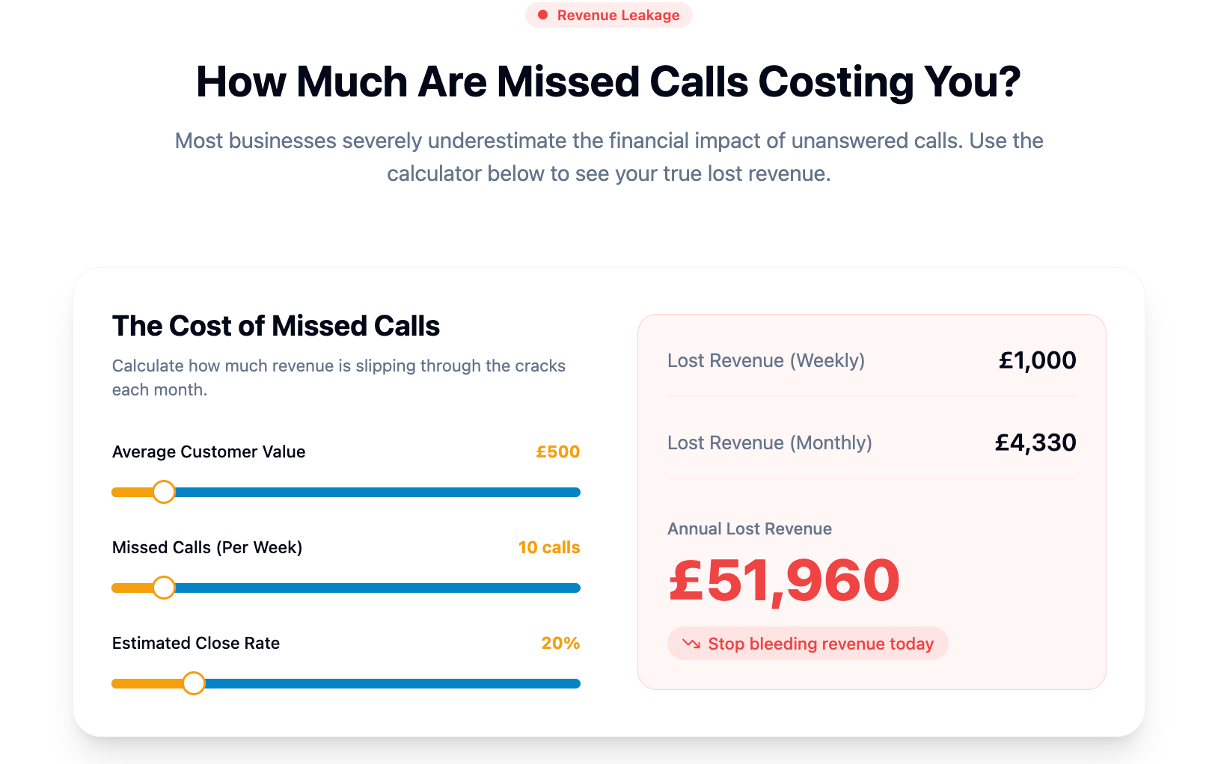
There is no complex configuration to manage and no technical knowledge required on your side. The pilot runs on your real inbound traffic so you can see the contact rate and booking conversion before you commit to a full subscription.
Book a demo with Talk2Aiva and see what a properly onboarded AI receptionist does for your call answer rate in the first two weeks.
Useful sources and further reading
- Top 10 Answering Agent alternatives and competitors — G2: third-party review listings and competitor comparisons for AnsweringAgent.com
- Best answering services — Forbes Advisor: cost and CX-focused buyer guidance
- AI agent types — IBM: reference on AI agent architectures and how they affect conversational capability
Before you sign any contract, confirm: