
AI-powered call handling is defined as the use of conversational AI, speech recognition, and natural language processing (NLP) to automatically answer, route, and resolve incoming customer calls without requiring a human agent for every interaction. The industry term for this technology is "intelligent call automation," though AI-powered call handling is now the widely accepted shorthand among business owners and contact centre professionals alike. Gartner projects that conversational AI will reduce contact centre agent labour costs by $80 billion by the end of 2026. That figure reflects how fundamentally this technology is reshaping the economics of customer service. For service businesses fielding dozens or hundreds of calls daily, understanding what AI-powered call handling actually does, and how to use it well, is no longer optional.
What is AI-powered call handling and how does it work?
AI-powered call handling works through a chain of three core technologies working in sequence. First, speech recognition converts a caller's voice into text in real time. Second, NLP analyses that text to identify the caller's intent. Third, conversational AI generates a natural, contextually relevant response and manages the back-and-forth dialogue across multiple turns.
The practical workflow looks like this:
- Call received. The AI answers immediately, with no hold time or queue.
- Intent identified. NLP reads the caller's words and classifies their request, such as booking an appointment, checking an order, or asking a billing question.
- CRM lookup. The system queries your customer relationship management database to personalise the response using the caller's history.
- Resolution or routing. Routine queries are resolved autonomously. Complex or sensitive calls are transferred to a human agent, along with a full context summary so the agent does not need to ask the caller to repeat themselves.
- Post-call processing. AI automatically writes after-call summaries, transcribes the conversation, and flags any at-risk customers for follow-up.
AI phone assistants handle complex conversational needs in real time, including multi-turn dialogue where the caller changes topic or asks follow-up questions mid-call. That capability is what separates modern AI call management from the rigid, menu-driven interactive voice response (IVR) systems many businesses still rely on. IVR forces callers down a fixed path. Conversational AI adapts to what the caller actually says.
Pro Tip: Before deploying any AI call handling system, map your three highest-volume call types. These are your best automation candidates and will deliver the fastest return on investment.

What are the main benefits of AI call handling for service businesses?
The financial case for AI call handling is direct. Organisations adopting AI for call handling report operational cost savings of up to 50% per call, driven by improved routing efficiency and the automation of repetitive enquiries. That is not a marginal efficiency gain. It is a structural reduction in the cost of serving each customer.
Beyond cost, the operational benefits include:
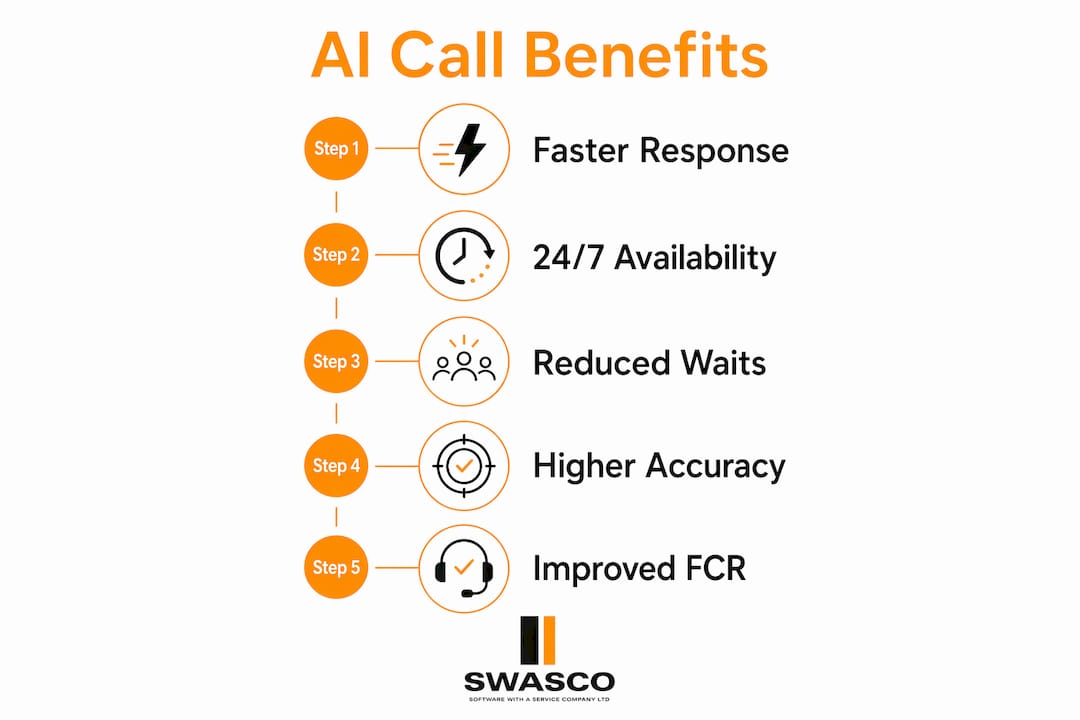
- 24/7 availability. AI answering services operate as virtual receptionists around the clock, handling calls simultaneously with no hold times. A plumbing firm, a legal practice, or a property management company can capture every enquiry, even at 11pm on a Sunday.
- Higher First Contact Resolution (FCR). FCR is the primary success metric for AI call handling. AI boosts FCR by resolving routine queries autonomously and routing complex ones with full context attached. Higher FCR directly correlates with improved customer satisfaction and fewer repeat calls.
- Reduced agent workload. AI automates FAQ handling, appointment scheduling, and transaction processing. Your human staff spend less time on repetitive questions and more time on conversations that genuinely require their judgement.
- Accurate call routing. Intelligent routing uses customer context and call urgency to direct calls correctly on the first attempt. Fewer unnecessary transfers means less frustration for callers and less wasted time for agents.
- Simultaneous call handling. A single AI system handles unlimited concurrent calls. No more engaged tones during peak periods.
The cumulative effect on customer experience is significant. Callers get faster answers. Agents get fewer low-value interruptions. And your business stops losing revenue to missed or mishandled calls.
What challenges should businesses consider before adopting AI call handling?
AI call handling is not a universal fix. Knowing where it falls short is as important as knowing what it does well.
- Complex and emotional calls still need humans. A caller disputing a large invoice, reporting a serious complaint, or dealing with a bereavement needs a human voice. AI lacks the emotional intelligence to handle these situations appropriately.
- Poor implementation damages trust. An AI that misunderstands callers, loops them in circles, or fails to escalate correctly will frustrate customers more than a slow human agent would. The technology is only as good as its configuration.
- Escalation protocols must be deliberate. Every AI call handling deployment needs clearly defined rules for when and how calls transfer to a human. Without these, complex calls fall through the gaps.
- Integration takes planning. Connecting AI to your CRM, booking system, or billing platform requires technical work upfront. Businesses that skip this step end up with an AI that cannot personalise responses or access relevant customer data.
- Data privacy and compliance apply. Call recordings and transcripts contain personal data. Your AI call handling system must comply with UK GDPR and any sector-specific regulations relevant to your industry.
- AI supports agents. It does not replace them. AI is designed to assist rather than replace human agents. Businesses that treat it as a full replacement for their customer service team tend to see satisfaction scores fall.
Pro Tip: Run a pilot on one call type before full deployment. Measure FCR and customer satisfaction scores for four weeks, then use that data to refine the system before scaling.
How can businesses successfully implement AI call handling solutions?
A successful deployment follows a clear sequence. Rushing any step creates problems that are harder to fix once the system is live.
- Audit your call volume. Identify which enquiry types account for the most calls. Appointment bookings, opening hours, pricing questions, and order status checks are typically the highest-volume and easiest to automate.
- Choose a system with genuine NLP capability. Not all AI call handling tools are equal. Prioritise systems that handle multi-turn dialogue, integrate with your existing CRM, and support UK English accents accurately.
- Start narrow, then expand. Automate one or two call types first. Prove the results, then add more. This approach reduces risk and builds internal confidence in the technology.
- Train your team. Staff need to understand what the AI handles, when it escalates, and how to pick up transferred calls with the context already provided. AI engagement for service businesses works best when human and AI roles are clearly defined.
- Monitor FCR and customer satisfaction weekly. These two metrics tell you whether the AI is resolving calls correctly or creating friction. Review call transcripts regularly to catch misunderstandings early.
- Update the AI continuously. Customer language evolves. New products and services create new enquiry types. Feed updated information and real call data back into the system on a regular schedule.
The businesses that get the most from AI call management are those that treat it as an ongoing process rather than a one-time installation.
| Implementation stage | Key action |
|---|---|
| Pre-deployment | Map top call types and define escalation rules |
| Integration | Connect AI to CRM and booking systems |
| Pilot phase | Automate one call type and measure FCR |
| Scale | Add call types based on pilot performance data |
| Ongoing | Review transcripts and update AI monthly |
Which AI call handling features matter most in 2026?
The gap between basic and advanced AI call handling systems is wide. These are the capabilities that separate tools worth investing in from those that will frustrate your customers.
Speech recognition accuracy is the foundation. If the system mishears callers, every subsequent step fails. Accuracy across regional UK accents and varying call quality is non-negotiable.
NLP sophistication determines whether the AI understands intent correctly. A caller who says "I need to move my appointment" and one who says "can we reschedule for Thursday?" are expressing the same intent. Strong NLP recognises both.
Real-time transcription and post-call summarisation remove the administrative burden from agents. Automated transcription and AI quality scoring also highlight at-risk customers for churn prevention, turning call data into a retention tool.
Multi-channel integration extends the benefits of AI beyond voice. The best systems connect calls, SMS, email, and web chat into a single customer view. A caller who previously contacted you via web chat should not have to repeat their history when they phone.
Cloud-based architecture means the system scales without hardware investment. During peak periods, such as a promotional campaign or a service outage, the AI handles the surge without degrading performance.
Talk2Aiva combines all of these capabilities in a fully guided deployment designed specifically for service businesses. The AI receptionist handles calls, qualifies leads, books appointments, and follows up across multiple channels, with setup and ongoing support included.
Key takeaways
AI-powered call handling delivers measurable cost savings, higher First Contact Resolution, and 24/7 availability, but only when implemented with clear escalation rules, CRM integration, and continuous monitoring.
| Point | Details |
|---|---|
| Core technology | Speech recognition, NLP, and conversational AI work together to handle calls automatically. |
| Cost impact | Organisations report up to 50% cost savings per call through AI-driven automation and routing. |
| FCR is the key metric | First Contact Resolution directly measures whether AI is resolving calls or creating repeat contacts. |
| Human agents remain essential | AI handles routine tasks; complex, emotional, or sensitive calls require a human agent. |
| Phased deployment works best | Start with one or two call types, measure results, then scale based on real performance data. |
AI in call handling: what I have actually seen work
The businesses that struggle most with AI call handling share one trait. They deploy it hoping it will solve a disorganised customer service operation. It does not. AI amplifies whatever process it sits on top of. If your call handling is chaotic before AI, it will be chaotic after.
The businesses that succeed treat AI as a precision tool. They identify the three or four call types that consume the most agent time, automate those specifically, and leave everything else to humans until the data justifies expanding. That discipline is less exciting than a full rollout, but it produces results that hold up over time.
The other thing I have seen consistently underestimated is the cultural shift required. Agents who have spent years answering the same questions every day sometimes resist AI, not because they fear redundancy, but because they have not been shown what they will do instead. The businesses that handle this well reframe the agent's role explicitly. AI takes the repetitive calls. Agents handle the conversations that actually require their skills. That reframing changes the reception entirely.
The end of human customer service is not coming. What is coming is a clearer division of labour between machines and people, and the businesses that define that division deliberately will outperform those that leave it to chance.
— James Paul
How Talk2Aiva helps service businesses handle calls without missing revenue
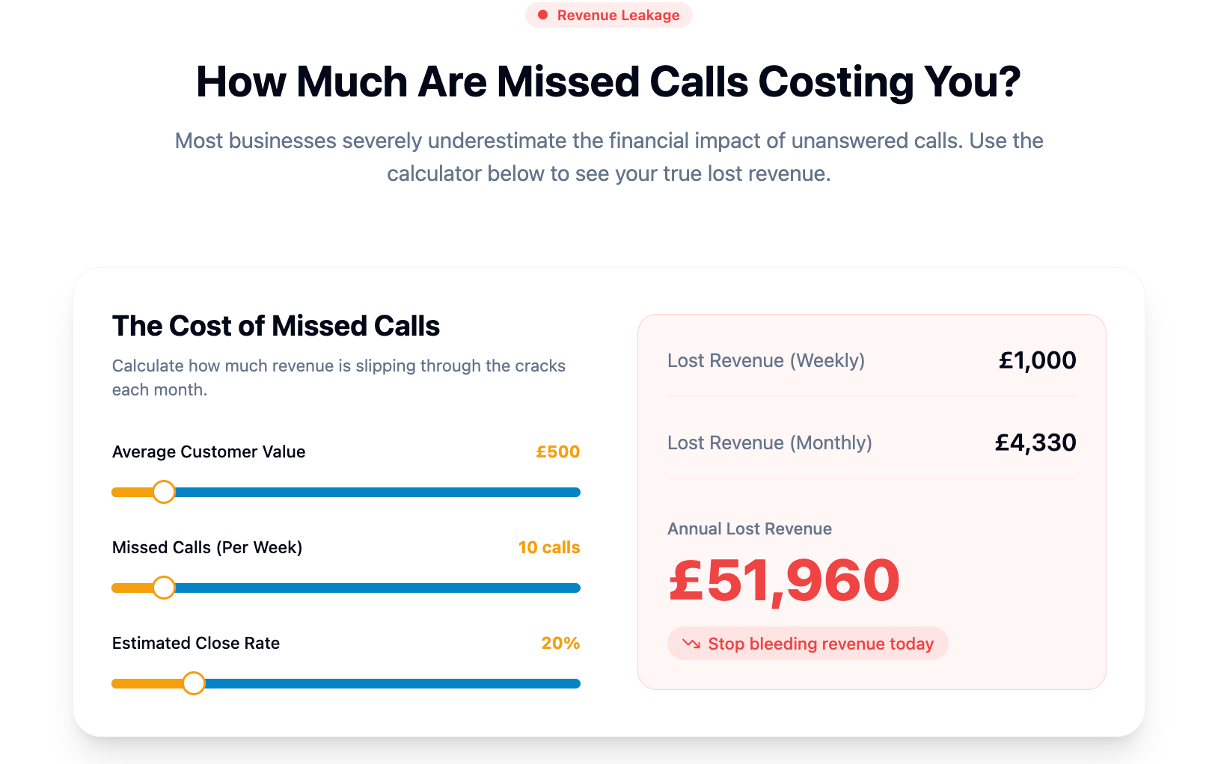
Service businesses lose revenue every time a call goes unanswered, a lead is not followed up, or a booking is missed because no one was available.
Talk2Aiva by SWASCO is a fully guided AI receptionist and revenue recovery system built for service businesses. It answers calls, qualifies leads, books appointments, and follows up across calls, SMS, and web chat, around the clock. Every deployment includes setup, AI training, workflow building, and ongoing support. You do not need technical expertise to get started. If you want to see exactly how it works, the Talk2Aiva voice AI page covers the full capability set, and the how it works page walks through the deployment process step by step.
FAQ
What is AI-powered call handling?
AI-powered call handling is the use of conversational AI, speech recognition, and NLP to automatically answer, route, and resolve customer calls. It handles routine enquiries autonomously and transfers complex calls to human agents with full context attached.
How does AI call handling differ from traditional IVR?
Traditional IVR forces callers through fixed menus. AI call handling uses natural language understanding to respond to what callers actually say, enabling flexible, multi-turn conversations rather than rigid button-press navigation.
What types of calls can AI handle automatically?
AI handles appointment bookings, FAQ responses, order status checks, opening hours queries, and basic account enquiries. Calls involving complaints, legal matters, or strong emotional distress are best escalated to a human agent.
How does AI call handling improve First Contact Resolution?
AI boosts FCR by resolving routine queries on the first call and routing complex ones with customer context already attached. Higher FCR reduces repeat calls and improves customer satisfaction scores directly.
Is AI call handling suitable for small service businesses?
AI call handling is well suited to small service businesses with high call volumes and limited staff. Cloud-based systems require no hardware investment, and phased deployment means you can start with a single call type and expand as results confirm the value.