
AI engagement is defined as the use of artificial intelligence to create personalised, responsive, and revenue-generating customer interactions across every touchpoint in a service business. For service business owners asking what does AI engagement mean for their business, the answer goes well beyond automated replies. It covers the full arc of a customer relationship: first contact, qualification, booking, follow-up, and retention. Technologies including natural language processing (NLP), machine learning, and predictive analytics work together to make these interactions feel personal and immediate. Companies using AI conversations across the customer lifecycle report 30% lower churn compared to businesses relying on reactive support alone. That figure signals a shift from AI as a cost-saving tool to AI as a direct revenue driver.
What does AI engagement mean for a service business?
AI engagement in a service business context splits into two distinct architectural types: AI-enabled and AI-native. Understanding the difference shapes every decision you make about technology, budget, and customer experience.
AI-enabled engagement layers AI capabilities behind your existing systems. Think of a contact form that uses AI to summarise submissions before routing them to your team, or a helpdesk that auto-tags tickets. The front-end interaction stays the same. The customer still fills in a form or sends an email. Removing AI from an AI-enabled system leaves a working product. That is the practical test.

AI-native engagement rebuilds the interaction so that the AI conversation is the primary interface. There is no form behind it. The customer talks to the AI directly, and the AI qualifies, books, or escalates in real time. Remove the AI and the product stops working entirely. This is a fundamental architectural shift that affects what data you collect, how your team operates, and how customers experience your brand.
For most service businesses, the distinction matters because it determines your starting point and your risk level.
- AI-enabled suits businesses that want fast deployment with low disruption to existing workflows.
- AI-native suits businesses ready to redesign their intake and customer communication from the ground up.
- Neither approach is universally better. The right choice depends on where your biggest revenue leaks are right now.
Pro Tip: Run the removal test on any AI tool you are evaluating. Ask the vendor: if we switch off the AI component, does the customer-facing product still function? The answer tells you immediately which category you are in.
How is AI engagement measured in service businesses?
Measurement is where most service businesses go wrong. High engagement rates alone do not guarantee business success. A busy chatbot that never books a single appointment is a cost, not an asset.
The correct model tracks engagement in stages, connecting each stage to a concrete business outcome.
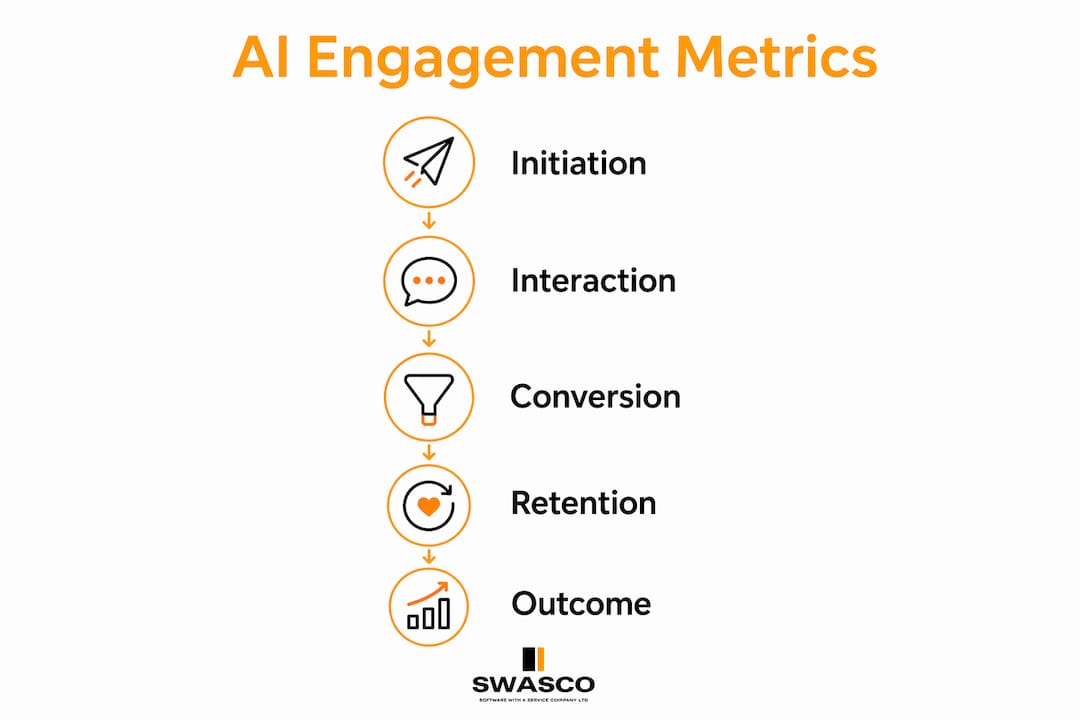
| Stage | Metric | Business Outcome |
|---|---|---|
| Conversation initiation | Number of chats or calls started | Reach and visibility |
| Conversation completion | Percentage of conversations finished | Flow quality and relevance |
| Goal attainment | Qualified leads, bookings, resolved queries | Direct revenue impact |
| Drop-off point | Where customers leave the conversation | Identifies friction to fix |
| Conversion | Sales closed, appointments kept | Final revenue result |
Engagement measures interaction depth; conversion measures concrete results. Tracking both together shows you whether your AI is genuinely moving customers forward or simply keeping them busy.
Drop-off analysis is particularly valuable. If 70% of conversations end at the pricing question, that is not an AI problem. That is a pricing communication problem. The data surfaces the issue so you can fix it.
Pro Tip: Set your primary success metric before you launch any AI engagement tool. For most service businesses, that metric should be qualified leads generated or bookings confirmed, not conversations started.
What technologies power effective AI engagement?
Four core technologies combine to make AI engagement work at scale for service businesses. Each one contributes a specific capability.
- Natural language processing (NLP) allows the AI to understand what a customer actually means, not just the words they type or say. A customer asking "do you have anything free on Thursday afternoon?" is understood as a booking request, not a general availability question.
- Machine learning allows the AI to improve over time by recognising patterns in customer behaviour. If customers from a particular postcode consistently ask about a specific service, the AI learns to surface that service earlier in the conversation.
- Predictive analytics allows the AI to anticipate customer needs before they are expressed. A customer who visited your pricing page three times in one week is likely ready to book. Predictive analytics flags that signal so the AI can respond proactively.
- Sentiment analysis reads emotional context in real time. If a customer's language shifts to frustration, the AI can escalate to a human agent before the situation deteriorates.
Together, machine learning, NLP, and predictive analytics create tailored, scalable 24/7 responses that reduce human workload without reducing the quality of the customer experience. The operational benefit is real: your team handles fewer repetitive enquiries and spends more time on work that requires human judgement. For local service businesses competing on responsiveness, this combination is a direct competitive advantage.
How should service businesses implement AI engagement?
A phased approach reduces risk and builds internal confidence before committing to a full AI-native redesign. The roadmap below reflects how successful service businesses structure their rollout.
-
Months 1–3: AI-enabled overlay. Add AI capabilities to your existing intake channels. This means connecting an AI layer to your website contact form, your phone line, or your social media inbox. The goal is speed of response and basic qualification without disrupting your current workflow. Your team still handles the same processes; the AI just handles the first touch faster.
-
Months 4–6: Identify high-friction moments. Use the data from phase one to find where customers drop off or where your team spends the most time on repetitive tasks. These are your candidates for AI-native redesign. Common examples include the initial enquiry call, the booking confirmation process, and the follow-up sequence after a quote is sent.
-
Months 7–9: AI-native migration for bottleneck moments. Rebuild the highest-friction interactions as AI-native conversations. The AI becomes the primary interface for these specific touchpoints. A typical roadmap moves from AI-enabled in months 1–3 to AI-native for bottleneck moments in months 4–9, giving businesses time to adapt operationally.
-
Ongoing: Contextual handoff to humans. When the AI escalates a conversation to a human agent, that agent must receive full context. Service type, location, timing, urgency, and any information the customer already provided should transfer automatically. Gathering only relevant context avoids the single most frustrating customer experience: being asked to repeat yourself.
The new client onboarding automation process is one of the first areas where this phased approach pays off visibly. Automating the intake and qualification steps frees your team to focus on delivering the service rather than managing the admin around it.
Pro Tip: Do not attempt to automate everything at once. Pick the one interaction that costs your team the most time or loses you the most leads, and start there. One well-built AI conversation that converts reliably is worth more than five mediocre ones.
Key takeaways
AI engagement in service businesses works when it is built as a conversion and handoff system, not simply an automated answering service.
| Point | Details |
|---|---|
| AI-enabled vs AI-native | AI-enabled overlays existing systems; AI-native rebuilds the interaction with AI as the primary interface. |
| Measure conversion, not just volume | Track goal attainment and bookings, not just conversation starts, to connect AI to revenue. |
| Four core technologies | NLP, machine learning, predictive analytics, and sentiment analysis combine to deliver personalised, scalable engagement. |
| Phased implementation reduces risk | Start with AI-enabled overlays in months 1–3, then migrate high-friction points to AI-native in months 4–9. |
| Context-rich handoffs protect revenue | Passing full customer context to human agents prevents repetition and protects the customer relationship. |
Why most service businesses are measuring AI engagement backwards
I have worked with enough service businesses to spot the pattern immediately. The owner installs a chatbot, watches the conversation volume climb, and declares it a success. Three months later, revenue has not moved. The conversations were happening; the conversions were not.
The uncomfortable truth is that high chatbot engagement without conversion almost always signals a problem in conversation flow or in the offer itself. It is not evidence of a working system. It is evidence of a busy one.
What I have found actually works is treating AI engagement as a qualification and handoff system first, and an answering system second. The AI's job is not to resolve every query. Its job is to gather the right context, qualify the lead, and pass it to a human or a booking system with everything that human needs to close. When you build it that way, the data compounds over time. Every conversation adds to your understanding of what customers actually want, when they want it, and where they hesitate.
The businesses that get the most from AI engagement are the ones that treat conversational AI as a product that iterates with user feedback, not a tool to be installed and forgotten. They review drop-off points monthly. They update conversation flows when new objections appear. They treat the AI as a member of the sales team that needs coaching, not a piece of software that runs itself.
One more thing: do not let the automation remove the human feel entirely. Customers in service businesses are often making decisions that involve trust. A plumber coming into their home. A consultant handling their finances. A therapist supporting their wellbeing. The AI earns the right to that booking by being fast, clear, and genuinely helpful. The human closes it by being exactly that: human.
— James Paul
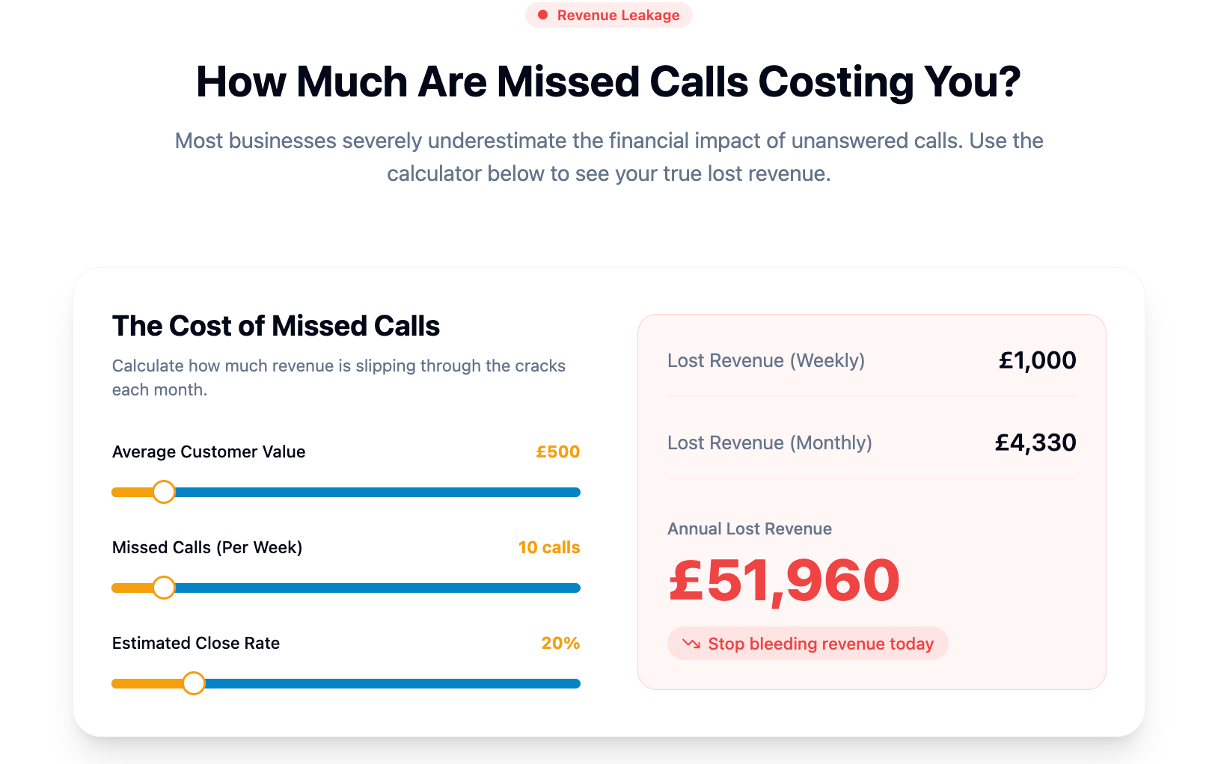
Stop losing revenue from missed enquiries
If you are a service business owner who has read this far, you already know the cost of a missed call or a slow response. Every unanswered enquiry is a lead that went to a competitor.
Talk2Aiva by SWASCO is built specifically for service businesses that want to stop that revenue loss. It handles calls, texts, website chat, and social media enquiries 24/7, qualifying leads and booking appointments automatically. The entire setup, AI training, and ongoing support is done for you. You do not need technical knowledge. You need a system that works while you are busy doing the work. Explore Talk2Aiva's AI automation platform to see how it fits your business.
FAQ
What is the AI engagement definition for service businesses?
AI engagement is the use of artificial intelligence to manage, personalise, and convert customer interactions across calls, chat, and social media. For service businesses, it specifically means using AI to qualify leads, book appointments, and follow up automatically.
What does AI chat engagement mean in practice?
AI chat engagement refers to conversations initiated and managed by an AI system, typically through a website widget, SMS, or social media message. Effective AI chat engagement moves customers from enquiry to qualified lead without requiring human intervention at every step.
How does AI engagement differ from a basic chatbot?
A basic chatbot follows a fixed script and cannot adapt to unexpected inputs. AI engagement uses NLP and machine learning to understand intent, personalise responses, and improve over time based on real conversation data.
How do i know if my AI engagement is actually working?
Track goal attainment metrics such as qualified leads generated, appointments booked, and queries resolved, rather than conversation volume alone. If engagement is high but bookings are flat, the conversation flow needs reviewing.
Is ai-native engagement right for a small service business?
Not necessarily as a starting point. Most small service businesses benefit from beginning with an AI-enabled overlay on existing channels, then migrating to AI-native interactions for their highest-friction touchpoints once they have data to guide the redesign.